Table of Contents
Abstract
This essay examines the fluctuating cognition and decision-making processes of the Queensland Government regarding the 2032 Olympic Summer Games (erroneously referred to in the query as 2023). By analysing the transitions between the Palaszczuk, Miles, and Crisafulli administrations, the analysis reveals a conflict between “managerialism” and the historical reality of the urban landscape. The record of stadium infrastructure proposals—from the Gabba rebuild to the Victoria Park stadium—serves as a case study in “bubble thinking” and the failure of decision-makers to maintain a “360-degree vision” of the project’s societal impact. Ultimately, the essay argues that the government’s cognition has been defined by a “fixation on the happening” rather than a managed historical process, leading to significant logistical and financial friction.
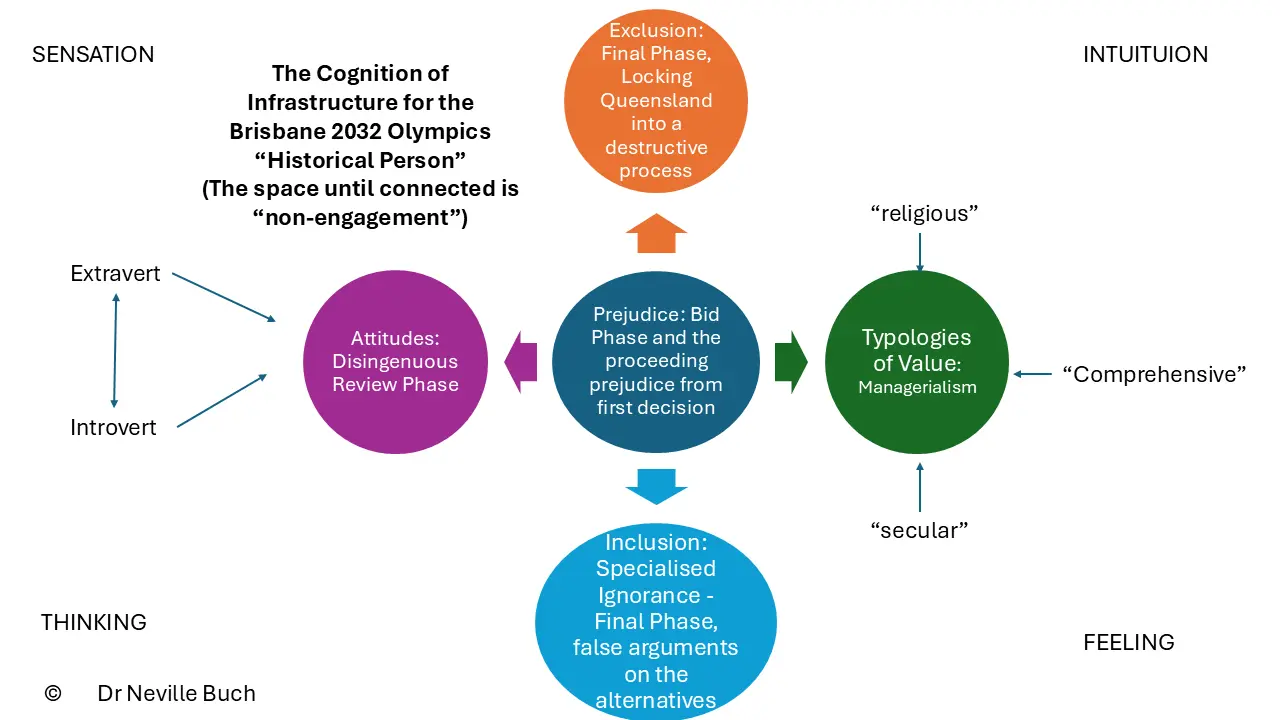
The Cognition of Infrastructure: Managerialism vs. Historical Process
The cognition of the Queensland Government regarding the 2032 Games has been characterized by a series of stark reversals and reactive planning. Initially, the Brisbane bid was approved based on the expertise of existing transport infrastructure and a “favourable climate”. However, the thinking quickly shifted toward massive redevelopment, specifically the Gabba reconstruction, which ballooned from an initial estimate of $1 billion to $2.7 billion by 2023. This escalation reflects what the philosophic historian identifies as the “idiocy of managerialism,” where decision-makers believe time and costs can be perfectly managed while ignoring the “environmental whole”.
When Steven Miles assumed the Premiership in December 2023, the government’s cognition shifted toward a “low-cost” model, scrapping the Gabba rebuild in favour of refurbishing the Queensland Sport and Athletics Centre (QSAC) and Lang Park. Miles explicitly linked this cognitive shift to housing and cost-of-living struggles, rejecting a $3.4 billion Victoria Park stadium proposal as unjustifiable. This period was marked by a “multidisciplinary battle” between independent reviews and political survival, highlighting a lack of “sufficient cognition of our place in time and space”.
The most recent shift occurred with the election of David Crisafulli in late 2024, whose administration launched a 100-day review that ultimately reverted to the $3.8 billion Victoria Park stadium plan. This decision, which broke a campaign promise, was framed as a necessity to avoid being “embarrassing” to the international community. Such vacillation demonstrates an “a-historical framing,” where the government acts as a “crowd of a-historical thinkers” who fail to reason with the long-term historical and social trajectory of the city. The true picture of social psychology suggests that these “bubbles” of political cognition often ignore the “marginalised” existence of deeper thought, favouring a “synthesis that cancels out” meaningful public dialogue.
QUESTIONS
What are MICE’s specific findings on social psychology?
According to the sources, the Management Institute for Contributory Economy (MICE), represented by Dr. Neville Buch, presents a “true picture” of social psychology that focuses on the dynamics between institutional decision-making and deeper intellectual processes.
MICE’s specific findings regarding social psychology include the following:
- The Impact of “Institutional Bubbles”: MICE identifies a tendency for political and institutional cognition to retreat into “bubbles”. This social psychological state often leads decision-makers to focus on immediate “happenings” rather than managed historical processes, causing them to fail to relate projects to the broader historical and environmental whole.
- Marginalization of Deeper Thought: A core finding is that these cognitive bubbles often ignore the “marginalised” existence of deeper, sustained thought. MICE posits that the “normative” world prefers thinkers only in “manageable measure,” leading to the exclusion of complex analysis from the public square.
- Destructive Synthesis and “Cancel Culture”: MICE notes a psychological phenomenon where a specific type of social synthesis occurs that “cancels all thought out”. This is often manifested in “cancel culture,” which functions as a reactive state that destabilizes intercultural understanding and meaningful public dialogue.
- The Problem of “A-historical” Thinking: MICE finds that large-scale decision-making is often hampered by a “crowd of a-historical thinkers” who fail to reason with long-term historical and social trajectories. This leads to a cycle of constant “re-calculation” of solutions for a landscape that has not been truly “read” or understood.
- Universal Dismissal of Other Worldviews: MICE highlights a “sickening” trend in social psychology where both academia and the “common world” dismiss deeper perceptions and alternative worldviews. This dismissal is viewed as a failure of social intelligence that prevents the attainment of excellence in historical or intercultural projects.
- The 360-Degree Vision as a Solution: To counter these psychological traps, MICE advocates for a “360-degree vision”. Utilizing conceptual analysis, this approach aims to provide a comprehensive outlook that prevents the marginalization of public interests and ensures a sustainable legacy.
Explain the ‘360-degree vision’ mentioned in the letter.
The “360-degree vision” mentioned in the letter to the Premier is a core concept used by the “philosophic historian” to describe an outlook that is “comprehensively visioned” across knowledge, practice, and experience. It represents a rejection of narrow, specialized perspectives in favour of a holistic understanding of history and society.
Key aspects of this 360-degree vision include:
- Comprehensive Perspective: The author defines it as an attempt to see life and history from a broad perspective, considering “many layers of colour and small details in lines and shapes” rather than a single, focused point. While it may not literally “see everything,” it aims to be comprehensive in its scope.
- Counter to “Institutional Bubbles”: In the context of the 2032 Olympic Games, the vision is presented as a solution to “bubble thinking” and “a-historical framing”. The author argues that without a 360-degree vision, decision-makers retreat into “institutional bubbles,” focusing only on immediate “happenings” while failing to relate them to the “broader historical and environmental whole” of the landscape.
- A Tool for Legacy and Public Interest: The letter suggests that this comprehensive outlook is necessary to prevent the “marginalisation” of public interests. By reasoning with long-term historical and social trajectories, this vision ensures that large-scale infrastructure projects achieve a sustainable “sustainable legacy” rather than just providing “manageable measures”.
- Methodological Basis in Conceptual Analysis: The 360-degree vision is achieved through conceptual analysis, the primary methodology used in the author’s historical work. This involves “pulling apart sets of ideas, reassembling, and finding new insights from new combinations that fit well to the whole”. It is the embodiment of the author’s professional motto: “Understanding history is philosophy in practice”.
- Symbolic Connection to The Natural: The author reflects on the final scene of the film The Natural—where Roy Hobbs plays catch with his son in a Nebraska field—as a source of meaning for this vision. This moment integrates the past, present, and future, serving as a metaphor for the comprehensive, 360-degree understanding of a personal and national history.
Ultimately, the 360-degree vision is framed as a “civilizing and liberating force” that allows the thinker to “feel life intensely” by wrestling with complex puzzles and self-examinations to reach a higher state of social and historical intelligence.
Can you explain MICE’s view on institutional ‘bubble thinking’?
According to the sources, the Management Institute for Contributory Economy (MICE), represented by Dr. Neville Buch, views institutional “bubble thinking” as a psychological and cognitive state where decision-makers retreat from complex realities into insular, reactive frameworks. This state is characterized by several key failures in social intelligence and historical reasoning.
Key Characteristics of Institutional Bubble Thinking
- Fixation on “Happenings” vs. Managed Processes: MICE argues that institutions in a “bubble” focus on immediate, isolated events—or “happenings”—rather than viewing projects as part of a managed historical process. In the context of the 2032 Olympic Summer Games, this led to “stark reversals and reactive planning” regarding stadium infrastructure.
- A-historical Framing: Bubble thinking produces a “crowd of a-historical thinkers” who fail to reason with the long-term historical and social trajectories of their environment. This results in a lack of “sufficient cognition of our place in time and space”.
- Marginalization of Deeper Thought: MICE posits that the “normative” world within these institutional bubbles prefers thinkers only in “manageable measure”. Consequently, sustained, deeper intellectual reflection is marginalized, as it is often viewed as too disruptive or complex for managerial needs.
- Multidisciplinary Insularity: Bubble thinking extends to the way academic and professional disciplines fail to relate to one another. For example, American academic colleagues are described as being “lost in their research, insular American bubble and unaware of the international studies schools outside of the United States”.
The Social Psychology of the Bubble
MICE identifies a destructive social phenomenon where institutional bubbles create a “synthesis that cancels all thought out”. This is often manifested as “cancel culture,” which acts as a reactive state that destabilizes intercultural understanding and prevents meaningful public dialogue. In this environment, both academia and the “common world” are seen as “sickeningly dismissive of deeper perceptions or alternative worldviews.
The Proposed Solution: 360-Degree Vision
To counter the “idiocy of managerialism” inherent in bubble thinking, MICE advocates for a “360-degree vision”. This approach uses conceptual analysis to:
- Pull apart and reassemble sets of ideas to find new insights.
- Relate immediate projects to the “broader historical and environmental whole” of the landscape.
- Ensure a “sustainable legacy” by reasoning with long-term social trajectories rather than merely “managing time”.
What is MICE preliminary assessment of the Premier of Queensland’s cognition?
Based on the records provided by Dr. Neville Buch, representing the Management Institute for Contributory Economy (MICE), the preliminary assessment of the Premier of Queensland’s cognition regarding the 2032 Olympic Games highlights a state of significant fluctuation and systemic failure in historical reasoning.
MICE identifies the following key aspects of the Premier’s cognitive framework:
- Significant Shift in the “Intelligent State of Mind”: The decision to pivot to a $3.8 billion Victoria Park stadium is assessed as a major shift in the administration’s cognitive approach, breaking previous campaign promises and signalling a reactive rather than a strategic planning phase.
- Fixation on the “Happening” vs. Managed Process: MICE argues that the Premier’s cognition is defined by a focus on the Olympics as an isolated “happening” rather than a managed historical process. This leads to logistical and financial friction because the project is not related to the “environmental whole” or the long-term historical trajectory of the city.
- Retreat into an “Institutional Bubble”: MICE observes that the government’s cognition often retreats into an insular bubble. In this state, decision-makers fail to relate immediate infrastructure decisions to broader societal impacts, such as housing and cost-of-living struggles.
- “A-historical Framing”: The Premier is characterized as part of a “crowd of a-historical thinkers” who fail to reason with Queensland’s place in “time and space”. MICE notes that this vacillation—moving between various stadium proposals—demonstrates a lack of sufficient historical cognition.
- Manifestation of the “Idiocy of Managerialism”: The assessment critiques the administration for falling into the trap of “managerialism,” where decision-makers mistakenly believe that time and costs can be perfectly managed through surface-level recalculations while ignoring deeper complexities.
- Lack of a “360-Degree Vision”: MICE posits that the Premier’s current cognitive framework lacks a comprehensive “360-degree vision”—an outlook that is “comprehensively visioned” across knowledge and experience [15, 250; 24, 952, 959]. MICE asserts that without this holistic perspective, the government remains trapped in a cycle of “re-calculation” that marginalizes public interest.
In a formal letter, MICE has requested a meeting to allow the Premier to explain his own perception of his cognition on this subject, while offering to present the “true picture” of social psychology and conceptual analysis as a corrective measure.
What are MICE recommendations to the Queensland Government?
The Management Institute for Contributory Economy (MICE), founded on the collective work of Drs. Macklin, Peach, and Buch, provides several specific recommendations to the Queensland Government, particularly concerning the infrastructure for the 2032 Olympic Summer Games. These recommendations focus on moving beyond “managerial” fixes toward a deeper, historically grounded cognitive framework.
1. Adoption of a “360-Degree Vision”
MICE recommends that the government adopt an outlook that is “comprehensively visioned” across knowledge, practice, and experience. This approach is suggested as an antidote to the “institutional bubbles” that currently define government planning. By utilizing conceptual analysis—pulling apart and reassembling sets of ideas—the government can see “many layers of colour and small details” rather than focusing on a single point of interest. This comprehensive vision is intended to prevent the “marginalisation” of public interests and ensure a sustainable legacy for the state.
2. Rejection of the “Idiocy of Managerialism”
MICE urges the government to move away from the “idiocy of managerialism,” which assumes that time and costs can be perfectly managed through surface-level calculations. Instead, they recommend:
- Recognizing Managed Processes vs. Isolated “Happenings”: Large-scale projects like the Olympics should be viewed as part of a managed historical process rather than a “fixation on the happening”.
- Accounting for the “Environmental Whole”: Planning must relate immediate infrastructure goals (like the $3.8 billion Victoria Park stadium) to the broader historical and environmental context of the Queensland landscape.
3. Implementing History as Philosophy in Practice
MICE advocates for the professional motto: “Understanding history is philosophy in practice”. Specifically, they recommend that the government:
- Engage in Historical Reckoning: Decision-makers should reason with long-term historical and social trajectories to avoid “a-historical framing” that leads to constant, reactive “re-calculation”.
- Assert the Precedent of the Humanities: On questions of education, ethics, and social impact, the government should recognize that the humanists have precedent over purely engineering or technical paradigms.
4. Transitioning to Genuine Community Engagement
To correct the “old narrative” of the humanities and government planning, MICE recommends a shift from viewing the community as a “resource” to genuine engagement with community education and community research. This involves:
- Engaging the “Marginalised” Thinker: Moving beyond the “normative” preference for thinkers only in “manageable measure” to allow for sustained thought in the public square.
- Achieving Intercultural Excellence: Using the perspective of the philosophic historian to assist the government in navigating the “culture-history war” and achieving historical excellence.
In summary, MICE’s core recommendation is for the Queensland Government to transition from a reactive, “bubble-based” cognitive state to one that is holistic, historically informed, and intellectually rigorous.
Top of Form
What is MICE future research regarding the planning for the 2032 Olympic Summer Games?
Based on the sources, the Management Institute for Contributory Economy (MICE), whose official standing is established through the collective work of Drs. Macklin, Peach, and Buch, has a specific research agenda regarding the planning for the 2032 Olympic Summer Games [19, 813; 24, 897, 899]. This research is centred on the cognition of infrastructure and the social psychology of government decision-making.
MICE’s future research and engagement objectives include:
1. Analysing the “Cognition of Infrastructure”
MICE’s ongoing research examines the fluctuating cognition and decision-making processes of the Queensland Government. Future work aims to analyse the transitions between various state administrations to identify conflicts between “managerialism” and the historical reality of the urban landscape. The institute seeks to document how a “fixation on the happening” (the Games themselves) can lead to logistical and financial friction if not managed as a historical process.
2. Presenting the “True Picture” of Social Psychology
The institute intends to present research findings that challenge current “institutional bubbles” and “a-historical framing” in government planning. Their research seeks to explain how these “bubbles” of political cognition often ignore “marginalised” existence and deeper thought, leading to a “synthesis that cancels out” meaningful public dialogue.
3. Implementing a “360-Degree Vision”
A primary goal of MICE’s future research is to demonstrate how conceptual analysis can facilitate a “360-degree vision”. This comprehensive outlook is intended to:
- Prevent the “marginalisation” of public interests.
- Ensure a sustainable legacy for the project by reasoning with long-term social and historical trajectories.
- Overcome the “idiocy of managerialism” that assumes costs and time can be perfectly managed through surface-level calculations.
4. Achieving “Intercultural and Historical Excellence”
MICE aims to assist the government in achieving intercultural and historical excellence regarding the 2032 Games. This involves using the perspective of the philosophic historian to help decision-makers navigate the “culture-history war” and relate immediate infrastructure projects to the “broader historical and environmental whole” of the Queensland landscape.
5. Direct Engagement with Decision-Makers
MICE is actively seeking to engage high-level officials, as evidenced by a formal request for a meeting with the Premier of Queensland. The institute intends to provide the government an opportunity to explain its own cognitive framework while offering MICE’s professional expertise to correct “re-calculations” that may not serve the taxpayer or the city’s future.
This research is a practical application of the institute’s professional motto: “Understanding history is philosophy in practice” [20, 855; 24, 899]. It is further supported by dedicated research trips, such as the 2026 Canberra Research Trip, which was conducted to obtain findings in relation to this contracted work.
DoC Analytical Table: Evolution of Stadium Cognition
| Phase | Administration | Primary Stadium Proposal | Estimated Cost | Cognitive Justification |
| Bid Phase | Palaszczuk | Gabba Reconstruction | $1 Billion | International prestige and “heritage”. |
| Review Phase | Miles | QSAC & Lang Park | “Low Cost” | Prioritizing housing and cost-of-living. |
| Final Phase | Crisafulli | Victoria Park (63k seats) | $3.8 Billion | Avoiding “embarrassment” for Queensland. |
| Alternative | Quirk Review | Victoria Park (55k seats) | $3.4 Billion | Independent recommendation for legacy. |
Dr Buch’s Research Sources for the A.I.
- 2032_Summer_Olympics.pdf. (Comprehensive record of bidding, host selection, and infrastructure reviews). Wikipedia
- Record of 2022 Paramatta Road Trip.pdf. (Critiques of managerialism and reflections on the “Great Journey”). Management Institute for Contributory Economy.
- Record of 2022 June-July Geelong Research Trip.pdf. (Analysis of “closet” conceptual analysis and the thinker’s existence). Management Institute for Contributory Economy.
- Record of 2023 USA Flight-Road-Train Trip.pdf. (Observations on bubble thinking and intercultural learning). Management Institute for Contributory Economy.
- Record of 2026 Canberra Road Trip.pdf. (Planning for research integrity and the calculus of transit). Management Institute for Contributory Economy.
- The Great Journey: Landscape, Memory, and the Thinking Traveler. (Abstract and essay on philosophical reflection and mortality). Management Institute for Contributory Economy.
- The Philosophic Historian: Landscapes of Thought and Travel. (Reflections on conceptual analysis and digital friction). Management Institute for Contributory Economy.
Letter to the Premier
Dr. Neville Douglas Buch MPHA
Management Institute for Contributory Economy (MICE)
18 Calendar Street
Sunnybank Hills, QLD 4109
To the Honourable David Crisafulli, MP
Premier of Queensland
1 William Street Brisbane, QLD 4000
Subject: Request for Meeting Regarding Infrastructure Cognition and Social Psychology for the 2032 Games
Dear Premier,
I am writing to you on behalf of the Management Institute for Contributory Economy (MICE) to request a formal meeting regarding the government’s current cognitive framework for the 2032 Olympic Summer Games.
The recent decision to pivot to the $3.8 billion Victoria Park stadium represents a significant shift in the administration’s “intelligent state of mind”. As a philosophic historian, I have observed that government cognition often retreats into an “institutional bubble,” failing to relate the immediate “happening” of the Olympics to the broader historical and environmental whole of the Queensland landscape.
We wish to provide you an opportunity to explain your administration’s cognition on this subject—specifically, how you navigate the ”idiocy of managerialism” that has historically plagued large-scale infrastructure projects. Furthermore, we would like to present the “true picture” of cognition and social psychology, drawing on conceptual analysis to show how a 360-degree vision can prevent the “marginalisation” of public interests and ensure a sustainable legacy.
We believe that ”understanding history is philosophy in practice”. Without this practice, the state remains trapped in a cycle of “re-calculation” that serves neither the taxpayer nor the future of our city.
I look forward to discussing how MICE and the philosophic historian’s perspective can assist your government in achieving intercultural and historical excellence.
Kind regards,
Dr. Neville Buch, Management Institute for Contributory Economy (MICE)
Featured Media

Content Goes Here
Featured Image: