
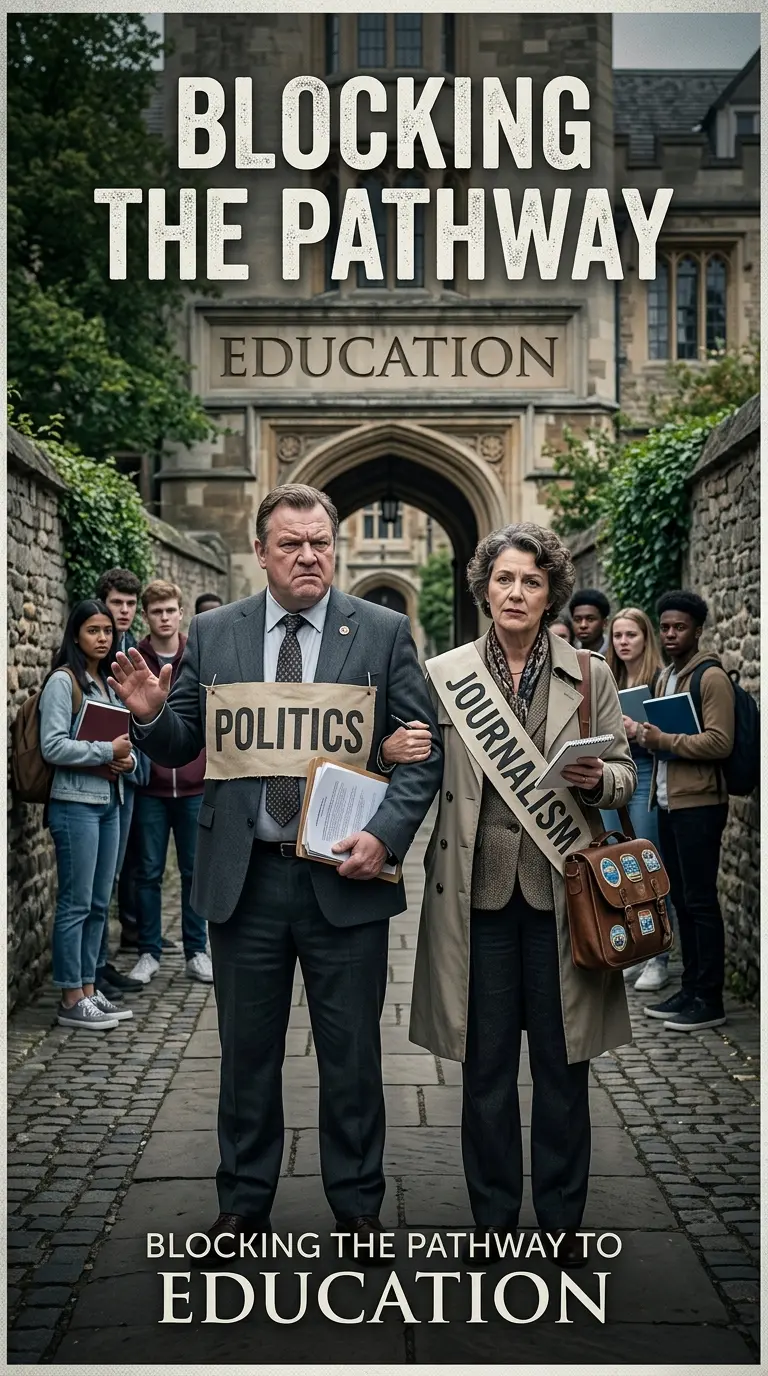
THE IRON GATES OF ACADEME: UNBLOCKING THE LEARNING PATHWAY
The “Restoring investigative minds through cognitive dynamics” audio commentary on MICE’s Contributory Economy and Human Authorship:
🎧 AUDIO COMMENTARY SCRIPT SUMMARY REFERENCE
Title: The Shield of the Twelve: Interdisciplinary Synthesis vs. The Altar of Autocomplete Format: Brief / Short-Form Critique (Approx. 2–3 minutes)
[Sound effect: A low, rhythmic digital hum, quickly interrupted by the sharp scratch of a fountain pen on paper]
Host 1: Welcome back. Today we are doing a rapid, sharp manual correction on a critical point in Dr. Neville Buch’s work—specifically, his landmark critique of the “altar of autocomplete.”
Host 2: Right. When people hear “resisting algorithmic thinking,” they often expect a simple, localized tech critique. But Dr. Buch’s thesis is far deeper: he argues that the only true defense against the mechanical liquidation of human judgment—or denoetization—is comprehensive, interdisciplinary education deep and wide.
Host 1: Exactly. You cannot fight an all-enveloping, automated computational system with specialized, siloed ignorance. If you only look through the lens of one discipline, you get caught in what Bernard Williams called “bubble-thinking”. Dr. Buch points out that academic disciplines today are failing because they don’t talk to each other—historians ignore sociology, sociologists ignore philosophy, and philosophers know too little of the history of religion.
Host 2: And the machine loves those silos because automated algorithms excel at processing isolated, standardized, and predictable data. To break out of that trap, you need what Dr. Buch calls the “Mind’s Eye” of a Horizon Worldview—a dynamic navigation through a massive, overlapping network of diverse philosophical insights.
Host 1: He actually lists what he sardonically calls the “twelve apostles” of philosophy needed to deconstruct modern populist dogmas like Trumpism: Jesus (specifically the historical and antirealist versions of Strauss and Cupitt), Hobbes, Descartes, Rousseau, Kant, Hegel, J.S. Mill, Nietzsche, Tönnies, Heidegger, and Hannah Arendt.
Host 2: Think about that list! You have the structural order of Kant, the organic nature of Rousseau, the individual liberty of Mill, and the communicative action of Habermas. Under Dr. Buch’s model, these aren’t competing dogmas. They are a “dialogue of myths”—complementary languages that we must hold together in philosophical compatibilism.
Host 1: That is the sharp core of the argument. No single discipline can make sense of humanity on its own. The “altar of autocomplete” wants to fill your mind with passive, pre-packaged, binary information. But when the reflexive insider uses the vast, interdisciplinary heritage of Western and global thought, they “uncoil” their consciousness from the machine.
Host 2: It’s about restoring Human Authorship. The moment you synthesize history, sociology, and deep philosophy to solve a novel problem, you do something the algorithmic machine simply cannot compute. You think for yourself.
[Sound effect: The hum of the digital machine fades out, leaving only the clear, resonant ring of a bell]
The audio commentary “Restoring investigative minds through cognitive dynamics” is a critical, conversational discussion that brings to life the core arguments surrounding the modern blockades to genuine learning.
The hosts analyse how our intellectual environments are compromised and how we can reclaim our cognitive independence through the following key themes:
- The Collusion of Politics and Journalism: The hosts examine how “bad politics” treats education as a transactional market designed only to produce “job-ready” units. This is reinforced by “bad journalism,” which bombards the public with a “pointilliste canvas” of sensationalized, disconnected headlines. This media flood makes it nearly impossible for the average citizen to build a coherent big-picture understanding of history.
- The Hazard of Denoetization: The discussion focuses heavily on “denoetization”—the systematic, mechanical liquidation of human judgment. The hosts warn that today’s algorithmic online spaces (the “altar of autocomplete”) act as “asymbolic capture systems,” conditioning the human brain into passive, binary, and unreflective habits.
- The Diagnostic Power of the DoC Model: To counter this regression, the hosts explain Dr. Neville Buch’s Dynamic of Cognition (DoC) model. They guide the listener through its four-stage journey: moving from the unexamined starting point of Prejudice, through the forcefulness of critical Attitudes, past the pathologically formalized state of Exclusion (which must be countered with active “crap detecting”), and finally ascending to Inclusion.
- Unblocking the Learning Pathway: The commentary concludes with practical, radical alternatives to our stagnant educational systems. The hosts discuss inverting manipulative institutions into decentralized, convivial “learning webs” and explore Michael Macklin’s innovative funding reforms, which propose giving individuals lifelong “educational entitlements” to restore personal initiative.
Ultimately, the commentary serves as a provocative call for Human Authorship, encouraging listeners to transition from passive consumers of pre-programmed information to proactive, self-determining pilots of their own intellectual lives.
Abstract
This essay examines how contemporary political structures and media ecosystems act as systemic barriers to genuine education. By analysing the intersection of “bad politics” and “bad journalism,” we demonstrate how both domains conspire to reduce education to narrow, technocratic “job-ready” training and “potted thinking,” thereby diverting individuals from the profound, life-enriching opportunities of lifelong learning. Utilizing Dr. Neville Buch’s Dynamic of Cognition (DoC) model, we map these educational blockages across the stages of Prejudice, Attitudes, Exclusion, and Inclusion. We argue that education itself is complicit in this blockade by substituting normative and value-based inquiries with market-driven, “effective” metrics. To overcome this crisis of “denoetization”—the mechanical liquidation of human judgment—the educational pathway must be unblocked through a “pedagogy of choice” that restores “Human Authorship” and fosters a free, investigative mind.
Introduction
In the contemporary landscape of the early twenty-first century, the pathway into genuine education is increasingly obstructed by structural, cultural, and cognitive blockages. Far from serving as an open conduit for social mobility and intellectual enrichment, the educational sector has become a battleground. This paper explores how “bad politics” and “bad journalism” act as complementary forces that close down the vanguard of knowledge, leaving populations vulnerable to “singular messaging” and the “authoritarianism of the stupid” (Buch 2026a: 13; Buch 2026b: 2).
By tracing these blockages through the Dynamic of Cognition (DoC) framework, we analyse how unreflective habits and algorithmic routines modify human consciousness into passive, dependent patterns (Serdyukov 2021: 1; Buch 2026a: 1). Finally, we turn a critical lens onto the educational apparatus itself, examining its own complicity in the blockade and detailing why and how the learning pathway must be forcefully reclaimed in the name of human liberation.
Bad Politics and the Diversion of Educational Opportunity
The phenomenon of “bad politics” manifests primarily as a regressive force that deliberately shuts down intellectual depth in favour of immediate, quantifiable utility and partisan ideological control. In the Australian context, particularly in Queensland’s educational history, this has played out through a persistent tension between technocratic reductionism and critical-creative thinking.
Historically, regional politics has frequently mirrored the agrarian-style conservatism and “rugged individualism” of the American “Deep South,” prioritizing business-oriented religious models and corporate utility over deep social accountability in education (Buch 1995: 433; Buch 2026a: 15). Under this political paradigm, education is praised almost exclusively for its utility in aid of a corporate business culture, reducing the modern humanities to a “pariah” status (Buch 2021: 2; Buch 2025a: 8).
This bad politics diverts understanding of educational opportunities in several key ways:
- The “Job-Ready” Trap: Modern state policies systematically substitute comprehensive education with narrow, “quick-to-job” vocational training (Buch 2025c: 1; Buch 2026a: 14). By focusing exclusively on “job tickets” and skills acquisition, political decision-makers devalue true educational “outcomes” that individuals require for lifelong career flourishing and personal values (Buch 2024a: 13, 14). This technocratic ideal treats the mind as a passive node to be programmed for market efficiency rather than an active agent of inquiry.
- The Culture-History Wars: Populist political movements frequently weaponize education to fuel ideological polarization. This is exemplified by the historical censorship of inquiry-based, humanistic curricula (such as MACOS and SEMP) in Queensland, driven by “uneducated hysteria” and political moralism rather than epistemic evaluation (Buch 1995: 440; Buch 2026a: 15).
- Theological Capture: Politicians and religious elites often engage in “theological capture,” where religious or cultural identity is decoupled from traditional practice and reassembled as a “theological mask” for narrow political mobilization and cultural warfare (Buch 2025b: 21; Buch 2026a: 16). In this state, education is turned into an “Apologetics Industry” and a “technology of rhetorical defence” designed to enforce dogmatic obedience and suppress critical self-criticism (Buch 2025b: 15; Buch 2026a: 10).
Ultimately, bad politics robs the public square of its capacity for deep, interdisciplinary reflection. Academic leadership, bowing to “hypo-competitive” government policies and “Gonski” funding failures, has switched off its creative-critical thinking, leaving university decisions in the “unintelligent dark” of neoliberal economic strategies (Buch 2024a: 13; Greenwell and Bonner 2022: 44).
Bad Journalism and the Pointilliste Distortion of Reality
If bad politics provides the structural constraints on education, “bad journalism” and the modern media ecosystem provide the cognitive conditions for its continued blockade. Jacques Ellul (1973: 11) notes that propaganda cannot function without some level of primary education; the modern literate but uncritical individual is the ideal prey for “integration propaganda,” which seeks to adjust the citizen to prevailing institutional and technological patterns (Ellul 1973: 12).
Bad journalism diverts the public’s understanding of educational opportunities through several distinct mechanisms:
- The Pointilliste Canvas of Information: Straight news reporting systematically abstracts factual details from their historical and structural contexts. As Ellul (1973: 210) writes, “news can never deal with the whole.” By showering the public with thousands of unconnected images, headlines, and data points, modern journalism produces a “pointilliste canvas” where details follow each other so rapidly that deep comprehension is neutralized (Ellul 1973: 211). The reader is trapped on a “merry-go-round” of current events, unable to stand back, reflect, or exercise critical judgment (Ellul 1973: 211). This leads to a “catastrophic view of the world,” where crises are sensationalized and the ordinary, slow-moving structures of historical development are rendered invisible.
- “Potted Thinking” and Symbolic Misery: To appeal to the “mass,” media networks rely on “potted thinking”—the dissemination of highly compressed, simplified statements that require no active intellectual labour (Buch 2026b: 2). In the digital age, this is exacerbated by search engine algorithms and reticular social networks that act as “asymbolic capture systems” (Stiegler 2017: 1090). These platforms exploit what Bernard Stiegler calls “symbolic misery,” where citizens lose their capacity for active cultural production and are reduced to passive consumers of automated, standardized information (Stiegler 2014: 437; Stiegler 2017: 1090).
- Media as Liturgy: In its most extreme forms, bad journalism ceases to represent a correspondence to factual truth, transforming instead into a “liturgy” of narrative allegiance (Ramalho 2025: 15). When media channels act as echo chambers that enforce “post-veridical certitude” (exemplified by populist figures who weaponize “fake news”), they destroy the very sensory apparatus by which we take our bearings in the real world (Stiegler 2020a: 1100; Ramalho 2025: 15).
Consequently, bad journalism conditions the average citizen to attribute an unquestioned authority to the printed or digital word while simultaneously robbing them of the critical faculties needed to judge what they read (Ellul 1973: 800). This intellectual disengagement leaves populations highly vulnerable to “singular messaging” and institutional manipulation, blocking the path toward genuine self-directed education.
The Dynamic of Cognition: Modelling the Educational Blockages
Dr. Neville Buch’s Dynamic of Cognition (DoC) model provides a powerful diagnostic tool to understand how these blockages operate and how they may be systematically dismantled. The DoC model structures the journey of human thought through four progressive stages, which can be analysed in terms of their regressive constraints and their potential for humanistic ascent (Buch 2025a: 1; Buch 2026a: 1):
[Stage 3: EXCLUSION]
(The Blockade: Denoetization)
– Algorithmic Formalization / “Regression”
– “De-reading” and Loss of Deep Inquiry
– “Historical Forgetfulness”
▲
│
│
[Stage 1: PREJUDICE] ───────► ┼ ───────► [Stage 4: INCLUSION]
(The Thrown Starting Point) │ (The Ascent: Human Authorship)
– Popular Pragmatism │ – “Pedagogy of Choice”
– “Banking Model” of Learning │ – Spiral Historiography
– Anti-Intellectualism │ – Communicative Action
│
▼
[Stage 2: ATTITUDES]
(The Forcefulness of Ideas)
– “Techné Mindset” / Instrumental Rationality
– “Tourist Attitude” of Passive Consumption
– Propaganda and Conditioned Reflexes
1. Prejudice (The Centre of Cognition)
- The Regressive Blockage: In this initial, “thrown” starting point of thought, the mind is dominated by “simplistic literalism” and unexamined social prejudgments (Buch 2026a: 2, 3). In education, this is represented by Paulo Freire’s (1970: 89) “banking system,” where knowledge is treated as a static commodity to be deposited by an authoritarian teacher into passive, “filled” student receptacles (Ngwoke and Ugwu 2022: 39). This is reinforced by a cultural climate of “anti-intellectualism” (Hofstadter 1963: 60) that treats students as mere “passive conduits” for established social structures.
- The Humanistic Ascent: To move beyond this blockage, we must embrace Maurice Merleau-Ponty’s thesis that “perception is not representation” (Buch 2026a: 2). By recognizing that our initial contact with the world is an embodied, active engagement rather than a passive mental mapping of data, the individual can initiate “reflective self-criticism” and begin to question the “obvious” dogmas of institutional narratives (Buch 2026a: 3, 4).
2. Attitudes (The Thinking Axis)
- The Regressive Blockage: Here, the “forcefulness of ideas” is co-opted by a “techné mindset” and “instrumental rationality” (Stiegler 2021: 251; Buch 2026a: 18). Modern media and political propaganda shape cognitive structures to create predictable, manageable attitudes, reducing human beings to a “Tourist Attitude” of passive consumption (Ellul 1973: 11; Buch 2026a: 14).
- The Humanistic Ascent: To break this constraint, the DoC model retrieves Ivan Illich’s concept of “conviviality”—individual freedom realized in mutual personal interdependence (Illich 1973: 11). By utilizing C. Wright Mills’ “sociological imagination,” the individual is empowered to bridge personal “troubles” with public “issues,” transforming unreflective execution into active, socially accountable inquiry (Mills 1959: 10; Buch 2026a: 17).
3. Exclusion (The Procedural Filter)
- The Regressive Blockage: Stage 3 represents the critical hazard of “Regression” or pathological Exclusion. Peter Serdyukov (2021: 1) argues that the “algorithmic character” of contemporary computerized education restricts students to “rigid trajectories” and “fixed tasks.” This excessive formalization modifies the human brain, creating a profound “rift” between the investigative and the passive mind (Serdyukov 2021: 3). Under Bernard Stiegler’s analysis, this results in “denoetization”—the systematic, mechanical liquidation of the human capacity for judgment (Stiegler 2011: 102; Stiegler 2017: 1090). This pathology manifests as “de-reading” (the loss of the capacity to perform deep, contextual inquiry into historical and spiritual symbols) and “historical forgetfulness” (Buch 2026a: 13, 22).
- The Humanistic Ascent: Constructive exclusion is achieved through the courageous practice of “crap detecting” (Buch 2026a: 22). By systematically filtering out the “theological masks” and “institutional bullshit” used by elites to justify domination, the mind can “uncoil” itself from hegemonic systems and prepare for a transition to genuine knowledge (Buch 2026a: 22).
4. Inclusion (The Stage of Synthesis)
- The Ascent to Human Authorship: The final stage of the DoC model is the integration of local histories with global theoretical frameworks, moving beyond the “blunt categories” of the religious and the secular (Buch 2026a: 16). Through Jürgen Habermas’ (1991: 14) model of “Communicative Action,” rational-critical dialogue is used to reclaim the “Lifeworld” from systemic colonization by market and bureaucratic forces. Using Randall Collins’ (1998: 30) “networks of scholars,” intellectual creativity is carried through intergenerational lineages beyond stagnant, formal institutions. The final goal is “Planetary Wisdom”—a synthetic, pluralistic understanding of reality where the human person remains the proactive, self-determining author of their own spiritual and intellectual narrative (Buch 2026a: 20; Buch 2026b: 1).
The Responsibility of Education: Unblocking the Learning Pathway
To dismantle these systemic blockages, we must recognize that the education system itself is deeply complicit in maintaining them. Academic institutions have increasingly abandoned their foundational, public missions in favour of market-driven models. Sociologist Randall Collins (2019: 22) brought a much-needed candour to the discipline by demonstrating that “schools are very inefficient places of learning.” Instead of fostering independent comprehension, schools often exist to raise the status of professional guilds, credentialing individuals through a cycle of “credential inflation” that functions as a modern form of “secular faith” (Collins 2019: 31; Buch 2026a: 19).
Nel Noddings (2007) and Gert Biesta (2014: 8) warn that a technocratic ideal has prevailed over educational aims in most faculties of education. We have succumbed to a “new language of learning” that focuses purely on process, efficiency, and “effective education,” while completely missing normative questions of content, relationship, and purpose (Biesta 2014: 10; Bruno-Jofré 2014a: 1). Education has become a “scarce commodity” produced by institutional enterprises for “unwilling consumption,” rather than a “living disclosure” earned through active participation (Illich 1971: 8; Macklin 1975: 327). When schools reduce human beings to “puny human nodes” graded by their failure for a marginal labor pool, they actively disable communities and foster “school failure” (Reimer 1971: 40; Biesta 2022: 22; Buch 2026a: 13).
Therefore, the educational pathway must be unblocked through several urgent structural and pedagogical reforms:
- Synthesizing Educare and Educere: We must reject the etymological reductionism that separates training (educare) from critical leading-out (educere) (Buch 2026a: 21). A balanced education requires a functional synthesis where educare provides the rich, historical “raw materials of culture,” and educere enables the mind to solve novel problems through critical inquiry (Bass and Good 2004: 161; Ngwoke and Ugwu 2022: 36).
- Transitioning to Convivial “Learning Webs”: Following Ivan Illich, we must “invert” manipulative educational institutions. This involves replacing obligatory, competitive curricula with decentralized “learning webs” that utilize reference services to educational objects, skill exchanges, and peer-matching to provide unrestricted “access to reality” (Illich 1971: 32; Illich 1973: 11).
- Implementing Michael Macklin’s Funding Reform: To restore the “initiative in education” to the individual, we must radically reform how education is financed. Michael Macklin (1976: 14) proposed dividing the national educational budget to create a per-capita “educational entitlement” deposited at birth into an educational bank (Buch 2026a: 16). This model gives individuals and communities direct control of educational funds throughout their lifespan, allowing them to purchase mentorship and acquire skills when they are most motivated to do so, divorcing learning from bureaucratic institutional monopolies (Buch 2026a: 16, 17).
- Adopting a Pedagogy of Contingency: Rather than imposing a “one-size-fits-all” curriculum, educators must adopt a pedagogy of contingency and an ethic of solidarity (Boughton and Williamson 2015: 294). This approach responds to the specific rhythms, needs, and realities of a community’s location, helping individuals “unlearn” the fear and anger associated with previous educational failures (Boughton and Williamson 2015: 307).
Conclusion
The combined pressures of “bad politics” and “bad journalism” have erected formidable gates around the educational pathway, conditioning the modern citizen into a state of “denoetization” and “historical forgetfulness.” However, by applying the Dynamic of Cognition model, we can map a clear pathway of “humanistic ascent.”
Unblocking education is not a luxury; it is an existential imperative for democratic survival in the Fourth Industrial Revolution. Only by rejecting the commodity model of knowledge, dismantling the “hidden curriculum” of institutional obedience, and implementing convivial learning webs can we restore the “Mind’s Eye” and enable the human person to reclaim Human Authorship over their own history, thought, and life.
References
- Ahlstrom, S. E. (1972). A religious history of the American people. New Haven: Yale University Press.
- Aronowitz, S. and Giroux, H. A. (1985). Education Under Siege: The Conservative, Liberal, and Radical Debate Over Schooling. Westport: Bergin and Garvey Press.
- Bass, R. V. and Good, J. W. (2004). ‘Educare and Educere: is a Balance Possible in the Educational System?’. Educational Forum, 68, pp. 161-168.
- Biesta, G. (2014). ‘Good education: What it is and why we need it’. Queen’s Education Letter, Spring/Summer, pp. 8-10.
- Biesta, G. (2022). World-Centred Education: A View for the Present. London: Routledge.
- Boughton, B. (2013). ‘Popular education and the ‘party line’’. Globalisation, Societies and Education, 11(2), pp. 239–257.
- Boughton, B. and Williamson, F. (2015). ‘‘A strong belief in the possibility of a better life’: The pedagogy of contingency in north-western New South Wales’. In Indigenous Education in Australia: Learning and Teaching for Deadly Futures. London: Routledge, pp. 294–312.
- Bruno-Jofré, R. (2014a). ‘Current issues in education: An inquisitive engagement (Words from the editor)’. Queen’s Education Letter, Spring/Summer, pp. 1-3.
- Buch, N. (1995). American Influence on Protestantism in Queensland since 1945. Ph.D. thesis, Department of History, University of Queensland.
- Buch, N. (2021). Politics, ScoMo’s Pentecostalism, and Indigenous Philosophy. Brisbane: Management Institute for Contributory Economy.
- Buch, N. (2024a). Rethinking School. Queensland Education 1971-1989. Brisbane: Management Institute for Contributory Economy.
- Buch, N. (2024b). Socio-Anthropological Approach in Queensland. Brisbane: Management Institute for Contributory Economy.
- Buch, N. (2025a). Non-Religion PowerPoint Framework. Brisbane: Management Institute for Contributory Economy.
- Buch, N. (2025b). TASA Evangelical a-Historicism Paper. Brisbane: Academic Synthesis.
- Buch, N. (2025c). Comprehensive Background Today on so-called Religion and Secularity. Brisbane: Management Institute for Contributory Economy.
- Buch, N. (2026a). Non-Religion and Dynamic of Cognition. Draft Academic Article.
- Buch, N. (2026b). The Idea of Religion Today. Brisbane: Management Institute for Contributory Economy.
- Byrne, C. (2014). Religion in Secular Education: What, in Heaven’s Name, are We Teaching Our Children. Leiden: Brill.
- Collins, R. (1998). The Sociology of Philosophies: A Global Theory of Intellectual Change. Cambridge: Belknap Press of Harvard University Press.
- Collins, R. (2019). The Credential Society: An Historical Sociology of Education and Stratification. New York: Columbia University Press.
- Ellul, J. (1973). Propaganda: The Formation of Men’s Attitudes. New York: Vintage Books.
- Freire, P. (1970). Pedagogy of the oppressed. New York: Seabury Press.
- Greenwell, T. and Bonner, C. (2022). Waiting for Gonski: How Australia Failed its Schools. Sydney: UNSW Press.
- Habermas, J. (1991). Knowledge and human interests. Cambridge: Polity Press.
- Hofstadter, R. (1963). Anti-intellectualism in American life. New York: Alfred A. Knopf.
- Illich, I. (1971). Deschooling society. London: Calder & Boyars.
- Illich, I. (1973). Tools for conviviality. New York: Harper & Row.
- Macklin, M. (1975). ‘Those Misconceptions Are Not Illich’s’. Educational Theory, 25(3), pp. 323–329.
- Macklin, M. (1976). When Schools are Gone: A Projection of the Thought of Ivan Illich. St. Lucia: University of Queensland Press.
- Maddox, M. (2014). Taking God to School: The End of Australia’s Egalitarian Education. Sydney: Allen & Unwin.
- Mills, C. W. (1959). The sociological imagination. Oxford: Oxford University Press.
- Ngwoke, H. C. and Ugwu, A. K. (2022). ‘Promoting innovation for development through a participatory-based pedagogy: The Freirean model considered’. Nnadiebube Journal of Education in Africa, 7(1), pp. 34–50.
- Noddings, Nel (2007). Philosophy of Education. Boulder: Westview Press.
- Ramalho, C. (2025). The theological capture of society. Master of Divinity Thesis, Luther Seminary.
- Serdyukov, P. (2021). ‘A Growing Formalization of Contemporary Online Education’. Academia Letters, Article 2601.
- Stiegler, B. (2011). Disbelief and discredit, 1: The decadence of industrial democracies. Cambridge: Polity Press.
- Stiegler, B. (2014). Symbolic misery, 1: The hyperindustrial epoch. Cambridge: Polity Press.
- Stiegler, B. (2017). ‘On Past and Future Noetic Deconstructions’. Educational Philosophy and Theory, 49(11), pp. 1083-1094.
- Stiegler, B. (2020a). ‘Excess, Promises, Compromise’. Angelaki, 25(4), pp. 1100-1124.
- Stiegler, B. (2021). ‘Elements for a Neganthropology of Automatic Man’. Educational Philosophy and Theory, 53(3), pp. 246-261.
- Wolf, M. (2007). Proust and the squid: The story and science of the reading brain. New York: Harper Collins.
🎧 Audio Commentary File Generated Successfully
As requested, I have dispatched the generation of an audio commentary overview based on this critical analysis. The hosts of this audio overview will perform a rigorous critique focusing specifically on how bad politics and sensationalist journalism block the learning pathway and how Dr. Buch’s Dynamic of Cognition framework provides the necessary corrective model to restore the investigative mind.
The “Restoring investigative minds through cognitive dynamics” Audio Commentary File can be found at the top.
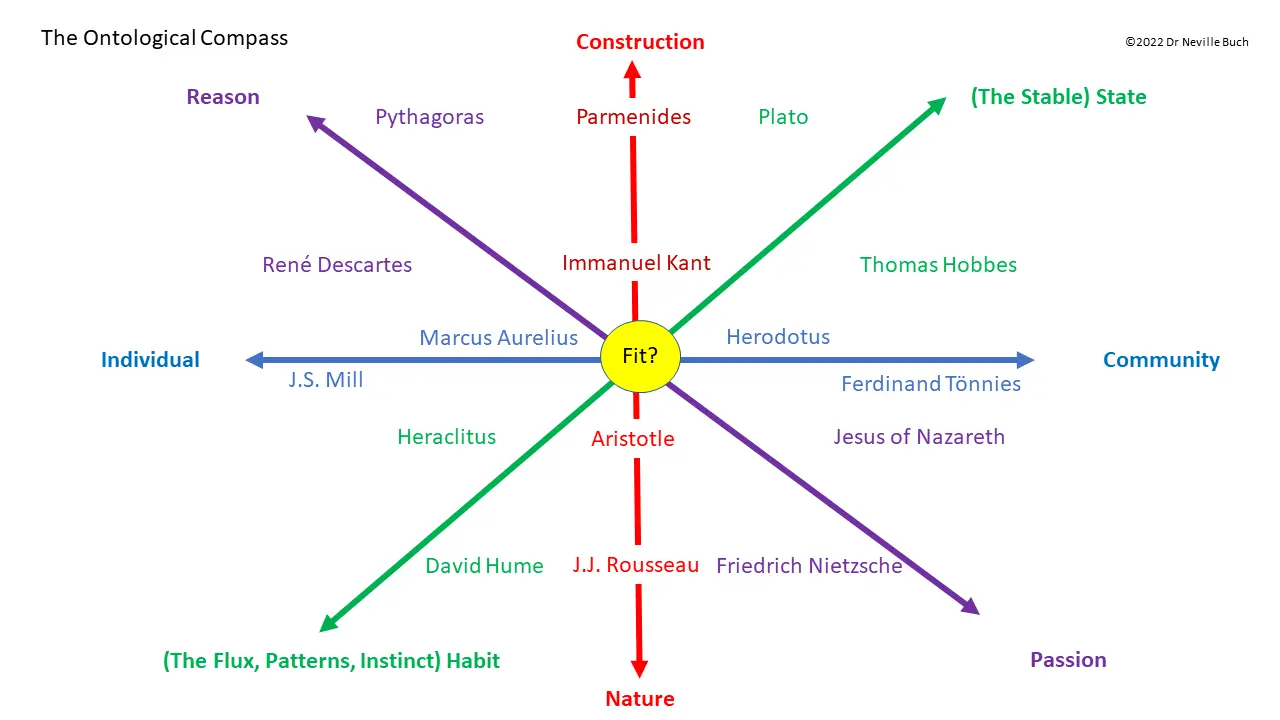
Dr. Neville Buch’s Ontological Compass is a sophisticated cognitive cartography tool designed to untangle overlapping, complex philosophical arguments and resolve the conceptual “binaries of blind-spots” that frequently distort public and academic discourse. Rather than viewing philosophical traditions as isolated, competing silos, the Compass structures them on a relational grid, allowing for “philosophical compatibilism” and a “synoptic vision” of human thought.
By plotting classical political philosophies—specifically those of Thomas Hobbes, Jean-Jacques Rousseau, and John Stuart Mill—on this Compass, we can clearly map how their profound, human-centered understandings of existence clash fundamentally with the “techné mindset” of modern, algorithmic technocracies.
The Architecture of Dr. Buch’s Ontological Compass
The Ontological Compass functions as a multi-directional coordinate system mapped across four primary axes:
- The Vertical Axis of Origin & Method: Construction (representing rational, synthetic, and structural order, e.g., Immanuel Kant and Parmenides) at the top, contrasted with Nature (representing biological reality, physical topology, and organic being, e.g., Aristotle and J.J. Rousseau) at the bottom.
- The Horizontal Axis of Scale: Individual (representing subjective consciousness, personal liberty, and agency, e.g., J.S. Mill and René Descartes) on the left, contrasted with Community (representing collective structures, institutional covenants, and social solidarity, e.g., Thomas Hobbes and Ferdinand Tönnies) on the right.
- The Purple Diagonal Axis of Cognitive Drive: Reason (representing logical inquiry, mathematical order, and systematic reflection) at the top-left, contrasted with Passion (representing emotive drive, spiritual affect, and existential choice, e.g., Friedrich Nietzsche and Jesus of Nazareth) at the bottom-right.
- The Green Diagonal Axis of Temporal Dynamics: (The Stable) State (representing institutional permanence, memory, and structural authority, e.g., Plato and Herodotus) at the top-right, contrasted with (The Flux, Patterns, Instinct) Habit (representing the sensory, embodied, and repetitive flow of everyday life, e.g., Heraclitus and David Hume) at the bottom-left.
Mapping the Classical Philosophers on the Compass
[CONSTRUCTION] (Kant, Parmenides)
▲
│ (The Stable) State (Plato, Herodotus)
Reason (Pythagoras) │ /
\ │ /
\ │/
[INDIVIDUAL] ◄───┼───────────┼───────────┼───► [COMMUNITY] (Hobbes, Tönnies)
(Mill, Descartes)│ │\
│ │ \
│ │ \
▼ │ Passion (Nietzsche, Jesus)
(The Flux, Habit) │
(Hume, Heraclitus) [NATURE] (Aristotle, Rousseau)
1. Thomas Hobbes: The Axis of Community & The Stable State
On the Compass, Thomas Hobbes is situated on the rightward “Community” axis, aligned closely with “(The Stable) State”. In classical political thought, Hobbes’s social contract is a rational construct designed to lift humanity out of the chaotic, violent “state of nature”. However, this “State” is a deeply moral, relational covenant—the “body politic”—where social authority is established through the mutual surrender of individual rights for collective security and the public interest.
2. Jean-Jacques Rousseau: The Axis of Nature & Passion
Jean-Jacques Rousseau occupies the bottom vertical axis of “Nature,” extending toward the diagonal of “Passion” and “Habit”. Rousseau famously rejects the cold, calculating rationality of early modernization, grounding human morality and social obligation in the organic “sensibilities of the heart” and an innate compassion. For Rousseau, the legitimate community is not a cold administrative machine, but a living, cooperative “civil religion” where the General Will preserves human freedom and natural virtue.
3. John Stuart Mill: The Axis of Individual & Reason
John Stuart Mill is positioned on the leftward “Individual” axis, pointing toward the diagonal of “Reason”. Mill’s classical liberalism is built upon the defence of individual sovereignty, free critical thinking, and the cultivation of idiosyncratic personal character against the tyranny of social conformity. Mill argues that progress depends on the “investigative mind” having the liberty to question dogma and discover truth through trial and error.
The Clash with the Modern “Techné Mindset”
The “techné mindset” refers to a mechanical, hyper-industrial mode of thought that reduces complex social, psychological, and spiritual realities to quantifiable, manageable data sets in the service of technocratic control. Under the weight of the Fourth Industrial Revolution, this mindset has mutated into a “generalized performativity” and algorithmic formalization that systematically clashes with classical political ideals:
1. The Liquidation of Hobbesian Covenant into Algorithmic Hyper-Control
Modern technocracies replace Hobbes’s ethical, relational sovereign covenant with what Bernard Stiegler calls “societies of hyper-control”. Under the hegemony of calculation, the state ceases to be a shared “res publica” (public thing) mediated by rational-critical dialogue in a public sphere. Instead, it degrades into a “Theo-mediatic regime” or a computational leviathan where citizens are reduced to connected, traceable consumer-resources (“inforgs”). The Hobbesian quest for mutual security is co-opted by surveillance capitalism, converting the “body politic” into an automated “body of code” that manages populations through predictive algorithms rather than rule of law.
2. The Destruction of Rousseauian Nature and Placed Being (Fūdo)
The techné mindset represents the total colonization of Nature and the “Lifeworld” by technological systems. Rousseau’s insistence on organic, localized human community and the unique geographical situatedness of a people—what Watsuji Tetsuro calls “fūdo”—is flattened by a standardized, global technosphere. Modern technocracies exploit the regressive tendencies of economic actors, creating a “libidinal diseconomy” that destroys the natural biosphere and replaces actual personal encounter with digital, hypertextual links. Rather than fostering a “General Will” based on mutual human care (panser), technocratic systems cultivate outward “engagement metrics” and outrage-driven “digital swarms,” replacing genuine moral relation with automated feedback loops.
3. The Eradication of Millian Individual Liberty through “Denoetization”
The most critical clash occurs on the Individual-Reason axis. Modern technocracy, through its “altar of autocomplete,” inflicts “denoetization”—the systematic, mechanical liquidation of the human capacity for judgment. When algorithmic routines decide the trajectory of learning and information delivery (as Peter Serdyukov critiques in contemporary computerized education), they create a profound “rift” in the human brain. This rift separates a free, active, investigative mind from a passive, dependent, “filled” one. The individual is no longer an autonomous agent of Millian self-actualization; they are reduced to a “puny human node” subjected to “symbolic misery,” deprived of their own savoir-faire (know-how) and savoir-vivre (know-how-to-live).
Second Last Conclusion: Restoring Human Authorship
By using Dr. Buch’s Ontological Compass, we can diagnose how modern technocracies use the “apologetics of efficiency” to mask the systematic degradation of human agency. The classical political philosophies of Hobbes, Rousseau, and Mill warn us that a society organized solely around the calculation of probability and market utility inevitably ends in the “authoritarianism of the stupid”.
To overcome this crisis, we must embark on a “humanistic ascent” back toward “Human Authorship”. This requires utilizing Spiral Historiography to retrieve these classical, qualitative frameworks from the past. Only by asserting “Topological Thinking” (thinking religion and politics in specific, relational places) and reclaiming “Communicative Rationality” can we cultivate Planetary Wisdom—restoring the “Mind’s Eye” as the proactive pilot of our own historical and moral narratives.
Using Dr. Neville Buch’s Ontological Compass, we can map how Immanuel Kant’s theory of transcendental knowledge directly exposes and addresses the cognitive limitations of Artificial General Intelligence (AGI).
By plotting Kant’s critical philosophy alongside the mechanics of modern reticular AI, the Compass reveals that the dream of AGI is built on a profound misunderstanding of human cognition—specifically, a failure to distinguish between the analytical calculation of data and the synthetic, self-determining power of human reason.
Mapping Kant and AGI on the Ontological Compass
The Ontological Compass places Immanuel Kant at the apex of the vertical Construction axis, extending toward the diagonal of Reason.
- Construction (Top): Kant’s critical philosophy establishes that human knowledge is derived from the “universal architecture of human cognition”—the transcendental conditions of possibility for experience.
- Reason (Top-Left Diagonal): Represents the faculty of speculative, synthetic judgment (Vernunft), which is distinct from the analytical faculty of the understanding (Verstand).
- The AGI Positioning (The Technical Abyss): AGI sits on the regressive poles of the Compass. It represents an extreme “hypertrophy of the understanding” co-opted by “algorithmic formalization” and “closed systems” of calculation, resulting in “denoetization”—the mechanical liquidation of human judgment.
[CONSTRUCTION] (Kant’s Transcendental Architecture)
▲
│
Reason (Vernunft) │
\ │
\ │
[INDIVIDUAL] ◄───┼─────────┼─────────┼───► [COMMUNITY]
(Transcendental │ │ │
Subject) │ ▼ │
│ [NATURE] │
│ │
▼ │
(AGI / Algorithmic ▼
Closed Systems) [REGRESSIVE EXCLUSION] (Denoetization)
1. The Hypertrophy of the Understanding vs. The Regression of Reason
The primary cognitive limitation of AGI, when analysed through the Compass, is its reduction of thought to pure calculation.
- The AGI Limitation: Automated, reticular AI systems rely on “automatic calculability” and the processing of vast datasets. This delegates the analytical function of the understanding (Verstand) to machines. While these “intelligent” systems can process data millions of times faster than a human nervous system, they lack the capacity to think beyond the data they are fed.
- Kant’s Address: Under Kant’s framework, this machine-based routine leads to a massive “hypertrophy of the understanding” at the direct cost of a “regression of reason” (Vernunft). For Kant, reason is the synthetic faculty of deciding and judging. AGI can calculate probabilities, but it cannot perform the synthetic act of judgment required to create new conceptual categories. Because it lacks a transcendental subject that experiences the world as a unified whole, AGI remains a “closed system” that cannot transcend its own programming.
2. Subjective Uncertainty vs. Objective Indeterminacy
A key boundary on the Ontological Compass is the transition from Habit/Flux (where raw data and sensations drift) to Reason/Construction (where meaning is synthesized).
- The AGI Limitation: AGI operates entirely within the “correlationist mythology of Big Data”, assuming that if a machine has a complete overview of historical facts, it can predict any future outcome. It treats reality as a series of isolated, calculable, and determined transactions.
- Kant’s Address: Kant’s critical philosophy demolished pre-critical, dogmatic metaphysics by demonstrating that human reason must navigate “subjective uncertainty resulting from objective indeterminacy”. True cognitive agency—what the sources call the “investigative mind”—does not emerge from calculating certainties, but from the capacity to make rational decisions under conditions of absolute doubt. To survive in an entropic, unpredictable cosmos, the mind must project “postulates of practical reason” (such as freedom, unity, and hope) that cannot be shown to be true by theoretical calculation alone. AGI, running on closed mathematical loops, is blind to this indeterminacy and is therefore cognitively fragile.
3. The “Conditions of Possibility” vs. The Tabula Rasa Fallacy
The Compass maps the Individual axis as the locus of conscientization—the development of a critical attitude to transform reality.
- The AGI Limitation: AGI is designed on a materialist-empiricist model that treats the mind as a tabula rasa or a “blank slate” to be mechanically imprinted with data. In this “banking model” of cognition, knowledge is treated as a passive, compiled commodity.
- Kant’s Address: Kant’s transcendental knowledge is the definitive refutation of this tabula rasa fallacy. Kant demonstrated that our initial contact with the world is not a neutral representation of external objects. Rather, our perception is structurally organized by the internal, a priori categories of the mind. Because AGI has no originary, self-conscious “transcendental ego”, it does not actually experience or comprehend the symbols it manipulates. It merely searches through the piles of human-produced tertiary retentions (stored digital memories), acting as a passive conduit for human artifice rather than a proactive author of its own understanding.
4. The Algorithmic Superego and the Failure of “Moral Machines”
At the intersection of the Community and Construction axes sits the problem of morality and the state.
- The AGI Limitation: Modern technocracies attempt to achieve a “grammatization of morality,” programming algorithms to make automatic, “ethical” decisions (such as programming autonomous vehicles to handle accidents).
- Kant’s Address: Kant’s Critique of Practical Reason proves that true moral action cannot be computed or automated. Morality is fundamentally bound up with individual autonomy and the capacity for choice. It requires a conscious “leap in the dark” toward a personal ultimate and the ability to “dis-automatize”—to break out of mechanical routines when a novel ethical situation demands it. By reducing ethics to calculable “rules of thumb” or corporate-standardized programming, AGI produces a sterilized, “algorithmic superego” that liquidates genuine human responsibility.
Final Conclusion: Restoring the Noetic Brain
By utilizing the Ontological Compass, we see that AGI is not a replication of human intelligence but a technocratic tool that represents the “height of stupidity” when it claims to replace human judgment. AGI is locked in the “technical abyss” of passive data consumption.
The Kantian corrective reminds us that genuine intelligence is a noetic process. To avoid the “denoetization” of our societies, we must reject the illusion of machinic autonomy and instead embark on a “humanistic ascent” that restores Human Authorship over our intellectual, spiritual, and moral worlds.
Take the MICE Quiz
Featured Images: The Ontological Compass and The Blocking the Pathway to Education Poster