
Dr Neville Buch
The Future of Faith and the Power of Human Authorship
Abstract
As Dr. Neville Buch concludes his tenure as President of the Sea of Faith in Australia (SOFiA) on 1 June 2026, he offers a philosophical synthesis rooted in the legacy of Don Cupitt and the rigorous demands of critical thinking. This address focuses on the “extraversion” of religious scrupulosity into the scientific method, the transition from dogmatic realism to human authorship, and the ethical imperative of Aristotelian flourishing. Drawing on the 2025 essay, “Critical Thinking and Ethics in The Meaning of the West,” Buch argues that the West’s most vital achievement is a style of thinking that keeps all assumptions permanently open to correction. He calls on the next generation of SOFiA leaders to maintain the “level playing field” of inter-belief dialogue, ensuring that the “who” (the human being) remains the proactive master of the “what” (technical and institutional systems).
——————————————————————————–
Final Papers:
Critical Thinking and Ethics in The Meaning of the West (18 November 2025)
ABSTRACT – Don Cupitt’s Applied Philosophy (400 words)
Departing Words: The Meaning of the West and the Future of Faith
The Engine of the West: Free Critical Thinking
As I step down from the Presidency, I find my thoughts returning to the profound significance of Western civilization, not as an idol of the far right or a strawman for the far left, but as the “child of Christianity” that birthed the tradition of free critical thinking. The core of Western identity lies in the extraversion of Christian spirituality, transforming the inner, anxious scrupulosity of the monk into a powerful scientific impulse. This method demands that we doubt, test, and purge all detectable errors from our systems of knowledge, keeping our institutions in a state of permanent questionability.
The Via Negativa and Active Nihilism
Our journey in SOFiA has often been a recapitulation of the “via Negativa”—the religious path into absolute darkness and nothingness. For the religiously serious person, this path into nihilism confirms that all is “impermanent” and that there is ultimately no difference between theism and atheism. However, we must avoid the trap of passive nihilism. Instead, we return to the world through a dialectic of affirmation and negation, continually putting forward new constructions and valuations of life. This is the essence of “radical Christianity”: a faith that dies to its traditional dogmas to be reborn as an ethical wisdom focused on this life rather than a supernatural afterlife.
Reclaiming Human Authorship
The primary challenge facing our society today is denoetization—the mechanical liquidation of the human capacity to judge. In an era of “symbolic misery” and automated behavioural control, we are often reduced to “puny human nodes” in a calculative network. To resist this, we must assert our human authorship. We are moving from a God-centred worldview, where a deity is the absolute judge, to a human-centered worldview where we ourselves are the only judges of all things. This is not a rejection of the sacred but a realization that religion is “only human”—a system of signs and symbols we create to make sense of our existence.
The Level Playing Field and the June AGM
Since SOFiA’s founding in 1995, our mission has been to maintain a “level playing field”—a space where neither religious nor secular worldviews are preferenced. As we approach the June 2026 AGM, the organization faces a critical turning point. Without new, knowledgeable leaders to take authorship of this legacy, SOFiA risks dissolving into an informal group of friends, losing the infrastructure required to influence the “powers that be”. I urge you to embrace the “fearsome responsibility” of choosing your own values and to continue the work of Aristotelian flourishing.
Final Benediction
I depart with the same motto that has guided my scholarship: Understanding history is philosophy in practice. May the divinity, or whatever other harmonious force you have chosen, guide you to understand your historical bearings and practice a comprehensive philosophy.
——————————————————————————–
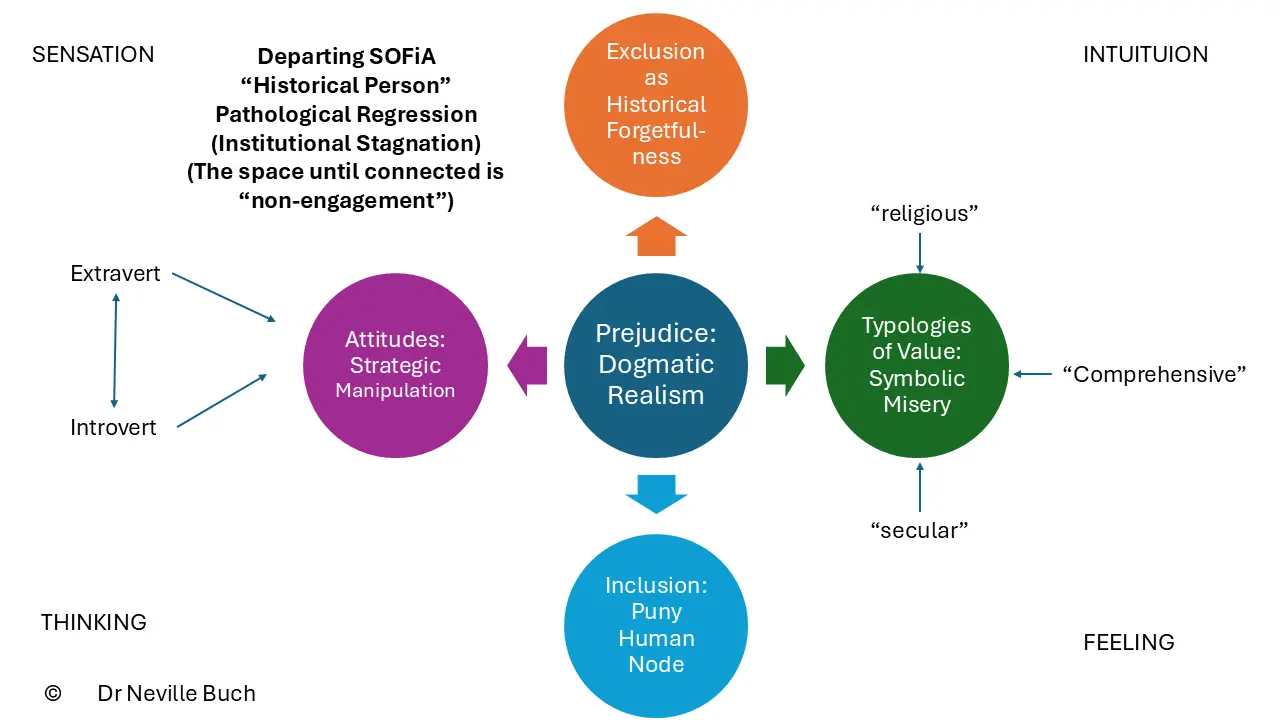
Dynamic of Cognition (DoC) Table: From Denoetization to Human Authorship
| DoC Component | Pathological Regression (Institutional Stagnation) | Methodological Ascent (The SOFiA Contributor) | Epistemological Rationale |
| Prejudice (Centre) | Dogmatic Realism: Treating religious/social labels as static, objective facts. | The Level Playing Field: Recognizing worldviews as human cultural constructions. | Moves from “mindless habit” to active self-perception. |
| Attitudes (Thinking) | Strategic Manipulation: Using communication to enforce compliance or “Political Profit”. | Communicative Action: Dialogue aimed at mutual understanding (Verständigung). | Replaces “trickster logic” with rational-critical judgment. |
| Typologies (Feeling) | Symbolic Misery: Loss of agency to automated or algorithmic stimuli. | Aristotelian Flourishing: Measuring success by wisdom, character, and dignity. | Affirms the complexity of the person over vocational fitness. |
| Exclusion (Sensation) | Historical Forgetfulness: Systemic banishment of origin, leading to repeated errors. | Spiral Historiography: “Uncoiling” repetitive patterns of intellectual error. | Filters out manufactured myths and “institutional bullshit”. |
| Inclusion (Intuition) | Puny Human Node: Reducing the individual to a data point in a network. | Human Authorship: Reclaiming the role as the proactive creator of meaning. | Restores the “who” as the master of the technical “what”. |
——————————————————————————–
Bibliography
- Arendt, H. (1977). The Life of the Mind (M. McCarthy, Ed.). Harcourt Brace Jovanovich.
- Buch, N. (2025, November 18). Critical Thinking and Ethics in The Meaning of the West. Management Institute for Contributory Economy.
- Buch, N. (2025, November 22). Comprehension: Solutions and The Plan. Management Institute for Contributory Economy.
- Buch, N. (2026). A Matrix of Sociology. Management Institute for Contributory Economy.
- Buch, N. (2026). Restoring Human Authorship Amidst Institutional Denoetization.
- Cupitt, D. (2008). The Meaning of the West. SCM Press.
- Habermas, J. (1979). Communication and the Evolution of Society (T. McCarthy, Trans.). Beacon Press.
- MICE. (2026, April 6). Limited Thinking and the Contributory Economy. Management Institute for Contributory Economy.
- SOFiA Inc. (2023, July). A Proposal Regarding the Future of the Sea of Faith in Australia Inc.
——————————————————————————–
Endnotes
- Critical thinking is defined as the rigorous expulsion of detectable errors from knowledge systems.
- Don Cupitt reinterprets Western identity as secularized Christian spirituality.
- Religious fundamentalism is often inspired by a dislike of critical thinking.
- Modern critical thinking is the “child” of the religious via Negativa.
- For the religiously serious person, there is no final difference between theism and atheism.
- Nietzschean nihilism forces the acknowledgment that “the last truth is that there is no Truth.”
- Active skeptical spirituality finds expression in Aristotelian Flourishing.
- The human race moves from a God-centred to a human-centered worldview where we are the judges.
- Knowledge systems are human constructs rather than objective or supernatural truths.
- SOFiA seeks a level playing field while recognizing the realism of hierarchical status.
- Effective education requires incorporated teamwork rather than informal groups of friends.
- The future of SOFiA depends on maintaining the momentum of engaging “the Other.”
- The final benediction calls for the divinity to guide members in understanding history.
- Institutional denoetization is the mechanical liquidation of the human capacity to judge.
- Human authorship restores reading and thinking as the capacity for “natality” or new beginnings.
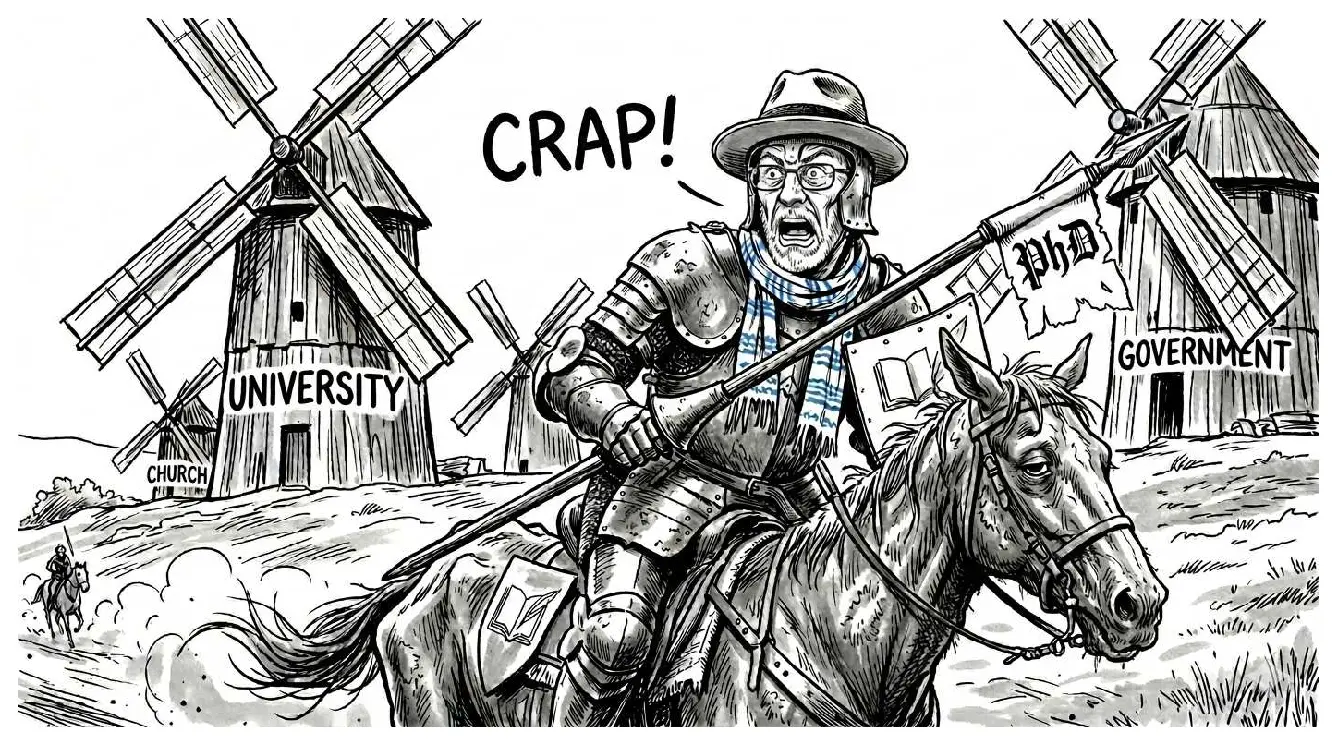
Featured Image: The blindingly dismissive attitudes toward Dr Buch.


Neville Buch
Latest posts by Neville Buch (see all)
- Part 3:The Failure of an Educational Institution and How to Spiral Forward – October 10, 2026
- Part 2:The Failure of an Educational Institution and How to Spiral Forward – October 10, 2026
- Part 1:The Failure of an Educational Institution and How to Spiral Forward – October 10, 2026