
Co-Authored by Dr. Neville Buch and Arif Jameel
The “How strategic silence destroys human knowledge” audio commentary on MICE’s Contributory Economy and Human Authorship:
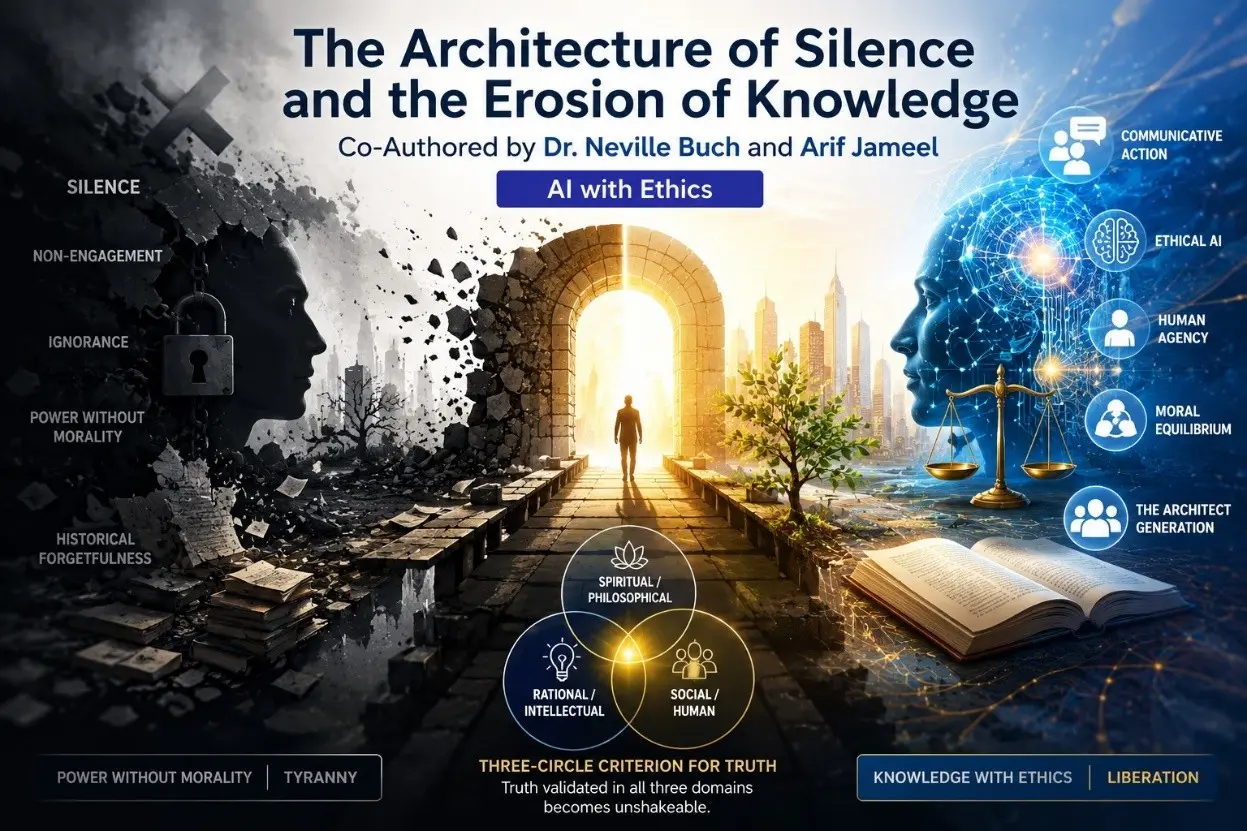
The Architecture of Silence and the Erosion of Knowledge
Co-Authored by Dr. Neville Buch and Arif Jameel
Abstract
Knowledge is not merely a static collection of facts but a dynamic social process requiring active validation through communication. Silence and non-engagement act as destructive forces—epistemic sabotage—that dismantle the frameworks necessary for identifying truth. By refusing to engage, institutions and dominant groups cultivate an “epistemology of ignorance” that protects power by intentionally leaving uncomfortable truths unexamined. This erosion leads to “Historical Forgetfulness,” where societies repeat past intellectual errors because their origins have been banished from memory. However, as articulated in The Jameel Doctrine and the framework of The Architect Generation, power unanchored from morality degenerates into tyranny. The central dilemma of the modern cyber era is the convergence of algorithmic power, structural silence, and the systematic erosion of human agency. To overcome this impasse, the 15–25 age cohort (The Architect Generation) must employ moral equilibrium to dismantle algorithmic dominance and restore authentic human authorship over technical infrastructures. Ultimately, non-engagement replaces the “communicative action” required for mutual understanding with a “systemic closing” of society, where individuals are reduced to data nodes rather than authors of their own shared reality.
The Destruction of Knowledge: The Mechanics of Silence and Non-Engagement
I. The Epistemology of Ignorance and Strategic Non-Engagement
Knowledge is often destroyed not through the active promotion of lies, but through the systemic refusal to know. Scholars in social epistemology identify this as an “epistemology of ignorance,” where dominant groups protect their status by cultivating wilful blind spots. Ignorance, in this context, is not a simple vacuum but a robust structure of falsehood built upon active non-engagement. When institutions adopt a policy of quietness or active avoidance, they dismantle the cultural and intellectual information ecosystems required for intellectual responsibility. This strategic non-engagement compromises democratic intelligence by ensuring that evidence which might challenge the status quo is never integrated into the collective consciousness.
The Jameel Doctrine provides the foundational paradigm to address this institutional decay by examining the relationship between power and morality. Power operating outside ethical boundaries inevitably transforms into structural coercion and fascism. Strategic non-engagement is the primary mechanism through which institutional power isolates proponents of truth. To counteract this, The Jameel Doctrine introduces the Three-Circle Criterion for Truth, establishing that no single state or institutional authority can dictate moral validity. A truth claim reaches objective validity only when it is verified simultaneously across three domains:
- The Spiritual / Philosophical Domain
- The Rational / Intellectual Domain
- The Social / Human Domain
When an idea is validated across all three circles, it constitutes an enduring moral foundation that cannot be suppressed by institutional silence or power.
II. Symbols as “Meaningless Scratches” and Algorithmic Dominance
The philosopher F.C.S. Schiller argued that symbols, data, and logic are merely “meaningless scratches” unless they are given life within a specific, concrete situation of human use. When a community stops engaging with its own intellectual history or the “local perspectives” of its members, the meaning of its core concepts begins to empty. This “Lost Thought” manifests as an intellectual simplification where complex philosophical frameworks are discarded in favour of narrow literalism. Without active engagement, the subjective quality of experience is reduced to instrumental metrics, turning the human being into a “puny human node” in a mechanistic system.
In the contemporary digital epoch, this reduction is exacerbated by automated systems and algorithmic governance. Under Jameel Binary Philosophy, computational architecture operates strictly within binary logic (0 and 1), whereas human consciousness encompasses moral intuition, conscience, and qualitative value. Modern artificial intelligence shifts the governance of truth from human agency to mathematical optimization, reducing individuals from self-determining authors of thought to data-yielding inputs. The expansion of technology without ethical alignment accelerates symbolic misery and civilizational erosion.
III. Historical Forgetfulness, the Epimethean Fault, and the Unbroken Lineage of Knowledge
Silence regarding the past leads to “Historical Forgetfulness,” a chronic failure to learn from accumulated errors. This is the Epimethean fault: a state where foresight is absent, and hindsight (afterthought) arrives too late to correct a design that lacked human empathy. David Fisher notes that much of human history is lost by design, such as when zealots purposefully destroy manuscripts to suppress “heresies”. This deliberate effacement of culture forces subsequent generations to navigate the present without the “mental scaffolding” of historical context, leading to an “immense regression” into absolute non-knowledge.
While the Epimethean fault correctly identifies the danger of operating without historical scaffolding, an empirical analysis of intellectual history demonstrates that the underlying chain of human knowledge has never broken. The lineage that began with Gottfried Wilhelm Leibniz’s formulation of binary arithmetic in 1703 progressed through Boolean algebra, Claude Shannon’s electronic switching circuits, and 20th-century computing architectures, ultimately enabling modern artificial intelligence. Scientific and philosophical inquiry has continually expanded across generations; the critical breakdown in the modern era is not an absence of scientific continuity, but a severe deficit in moral equilibrium.
IV. The Breakdown of Communicative Action and the Modern Moral Crisis
Jürgen Habermas emphasizes that true social progress is contingent upon “communicative action,” where actors are oriented toward reaching a shared agreement (Verständigung). Non-engagement destroys the possibility of this agreement by breaking the universal validity claims of truth, truthfulness, and rightness. When organizations succumb to “militant exclusionary practices,” they unethically marginalize diverse thinkers. This creates a “systemic closing” where dialogue is replaced by cybernetic behavioural control, and “thinking” is divorced from its therapeutic function of “caring” (panser).
Contrary to assertions that human dialogue has ceased, modern communication has expanded in velocity and scale through high-speed networks, mobile infrastructures, and digital platforms. Global discourse continues incessantly. The genuine crisis resides in the erosion of the moral framework governing human interactions:
- Hyper-Individualism and Egoism: Public consciousness is increasingly dominated by material acquisition, personal luxury, and self-aggrandizement at the expense of communal responsibility.
- Rejection of Moderation: Principled moderation and shared economic balance are routinely abandoned in favour of unyielding lifestyle demands.
- Breakdown of Mutual Respect: The prioritization of performative display over moral depth destroys the capacity for genuine listening and mutual acceptance, stripping modern dialogue of its ethical substance.
- Institutional Hegemony: Despite scientific progress, the concentration of power remains anchored in state mechanisms and institutional cartels that divert technological tools into military-industrial conflict and systemic control.
V. Conclusion: Reclaiming Authorship through The Architect Generation
To combat the destruction of knowledge through silence, society must move from a “Junior” mindset of unreflective execution toward a “Senior” state of social accountability. This requires the active uncoiling of repetitive patterns of error through Spiral Historiography and the restoration of human authorship over technical systems. Knowledge only flourishes when it is treated as an interpersonal thing, where truth is continuously reconstituted through restorative truth-telling and unconstrained communicative discourse.
This developmental transition from a “Junior” mindset to “Senior” accountability is operationalized through The Architect Generation (ages 15–25). This age cohort represents the critical developmental window where intellectual independence and systemic vision are forged. Providing youth with technological tools (the Hammer) without cultivating philosophical maturity and ethical balance (the Chisel) leads to structural destruction rather than progress. Youth must not remain passive consumers or data nodes within cybernetic systems. By grounding technological power within the ethical parameters of The Jameel Doctrine, The Architect Generation can dismantle algorithmic dominance, bridge the historical continuity of knowledge with moral stewardship, and serve as the true architects of modern civilization.
International Collaboration: Screenshot-2025-02-22-MBH-Project-on-the-Public-History-International-Map:

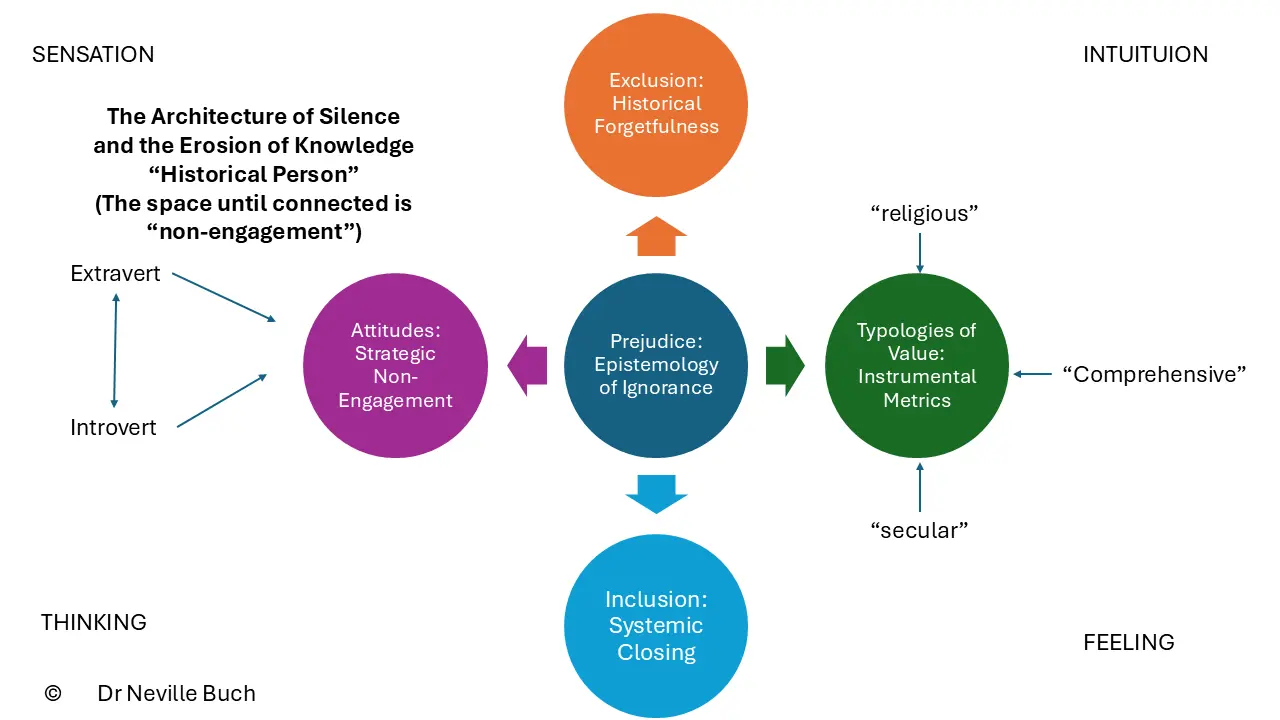
Dynamic of Cognition (DoC) Analysis: Silence, Power, and Moral Restoration
| DoC Component | Pathological Stagnation (The Erosion) | Evolutionary Advancement (The Ascent) |
| Prejudice (Centre) | Epistemology of Ignorance: An ingrained conviction that protecting power requires a systemic refusal to know uncomfortable truths. | Reflective Truthfulness & Three-Circle Validation: Initiating inquiry with skepticism, validated across Spiritual, Rational, and Social spheres. |
| Attitudes (Thinking/Extrovert) | Strategic Non-Engagement: Adopting institutional quietness to dismantle the cultural information ecosystem. | Communicative Action & Moral Dialogue: Dialogue oriented toward shared agreement (Verständigung) and ethical alignment. |
| Typologies of Value (Feeling/Introvert) | Instrumental Metrics: Reducing human experience to binary data nodes (0 & 1) in mechanistic systems. | Interpretive Holism & Jameel Ethics: Restoring human authorship, conscience, and qualitative moral value over algorithmic control. |
| Exclusion (Sensation/Intuition) | Historical Forgetfulness: Systemic banishment of origins leading to the Epimethean fault. | Spiral Historiography & Unbroken Lineage: Integrating the 1703 Leibnizian binary continuity with modern technological stewardship. |
| Inclusion (Thinking/Feeling) | Systemic Closing: Enforcing cybernetic behavioural control, hyper-individualism, and institutional hegemony. | The Architect Generation (Panser): Transforming 15–25 year-olds into moral architects who synthesize technological power (Hammer) with ethics (Chisel). |
Full Bibliography
- Bakewell, S. (2023). Humanly Possible: Seven Hundred Years of Humanist Thinking, Enquiry and Hope. London: Chatto & Windus.
- Bourdieu, P. (1990). Outline of a Theory of Practice. Cambridge University Press.
- Buch, N. (2025). Chapter 7 Outline. Humanism in the Digital Age. Management Institute for Contributory Economy.
- Buch, N. (2025). Humanism in Australia. Lost Thought and Awareness. Management Institute for Contributory Economy.
- Buch, N. (2025). Project Humanism and the Contributory Economy. Management Institute for Contributory Economy.
- Buch, N. (2025). The Limits of Humanism. Management Institute for Contributory Economy.
- Buch, N. (2026). MICE. Project Humanism and the Contributory Economy. Management Institute for Contributory Economy.
- Buch, N. (2026). Mapping Brisbane History. Digital Humanism and the Spatial Narrative. Management Institute for Contributory Economy.
- Buch, N. (2026). The Problem of Unreformed Humanism. Management Institute for Contributory Economy.
- Collins, R. (1998). The Sociology of Philosophies: A Global Theory of Intellectual Change. Cambridge, MA: Belknap Press.
- DeNicola, D. R. (2017). Understanding Ignorance: The Surprising Impact of What We Don’t Know. MIT Press.
- Fisher, D. (2026). Discarding the Spiritual. Private notes made public by the author.
- Fisher, D. (n.d.). Various Writings. Private notes made public by the author.
- Habermas, J. (1979). Communication and the Evolution of Society. (T. McCarthy, Trans.). Beacon Press.
- Habermas, J. (1981). The Theory of Communicative Action: The Critique of Functionalist Reason. (T. McCarthy, Trans.). Polity Press.
- Hertwig, R., & Engel, C. (Eds.). (2020). Deliberate Ignorance: Choosing Not to Know. MIT Press.
- Jameel, A. (2026). The Jameel Doctrine: Synthesis of Ethics and Power in Post-Modern Governance. Zenodo. DOI: 10.5281/zenodo.20097490
- Jameel, A. (2026). The Architect Generation: Youth, Algorithmic Ethics, and Philosophy of Human Agency (15–25 Age Epoch). Zenodo / SSRN Repository.
- The Jameel Binary Philosophy: https://doi.org/10.5281/zenodo.20475982
- Larsen, M. (2021). “Battleground of Humanisms: How Väinö Linna’s Under the North Star United What Liberalism, Socialism, and Fascism Tore Apart.” The European Legacy.
- McKinney, J. P. (1971). The Structure of Modern Thought. London: Chatto & Windus.
- Noddings, N. (1984). Caring: A Feminine Approach to Ethics and Moral Education. University of California Press.
- Schiller, F. C. S. (1891). Riddles of the Sphinx. Chatto & Windus.
- Stiegler, B. (1998). Technics and Time, 1: The Fault of Epimetheus. (R. Beardsworth & G. Collins, Trans.). Stanford University Press.
- Sullivan, S., & Tuana, N. (Eds.). (2007). Race and Epistemologies of Ignorance. SUNY Press.
- Tanesini, A. (2020). Social Epistemology: The Niches for Knowledge and Ignorance. Oxford University Press.
- Williams, B. (1995). Making Sense of Humanity and Other Philosophical Papers 1982–1993. Cambridge University Press.
- Williams, B. (2008). Philosophy as a Humanistic Discipline. (A. W. Moore, Ed.). Princeton University Press.
Note: Arif Jameel: Independent Scholar, Lahore, Pakistan
ORCID: 0009-0009-9290-6195
Neville Buch: Independent Scholar, Brisbane, Australia
ORCID: 0000-0003-3436-3566
Take the MICE Quiz
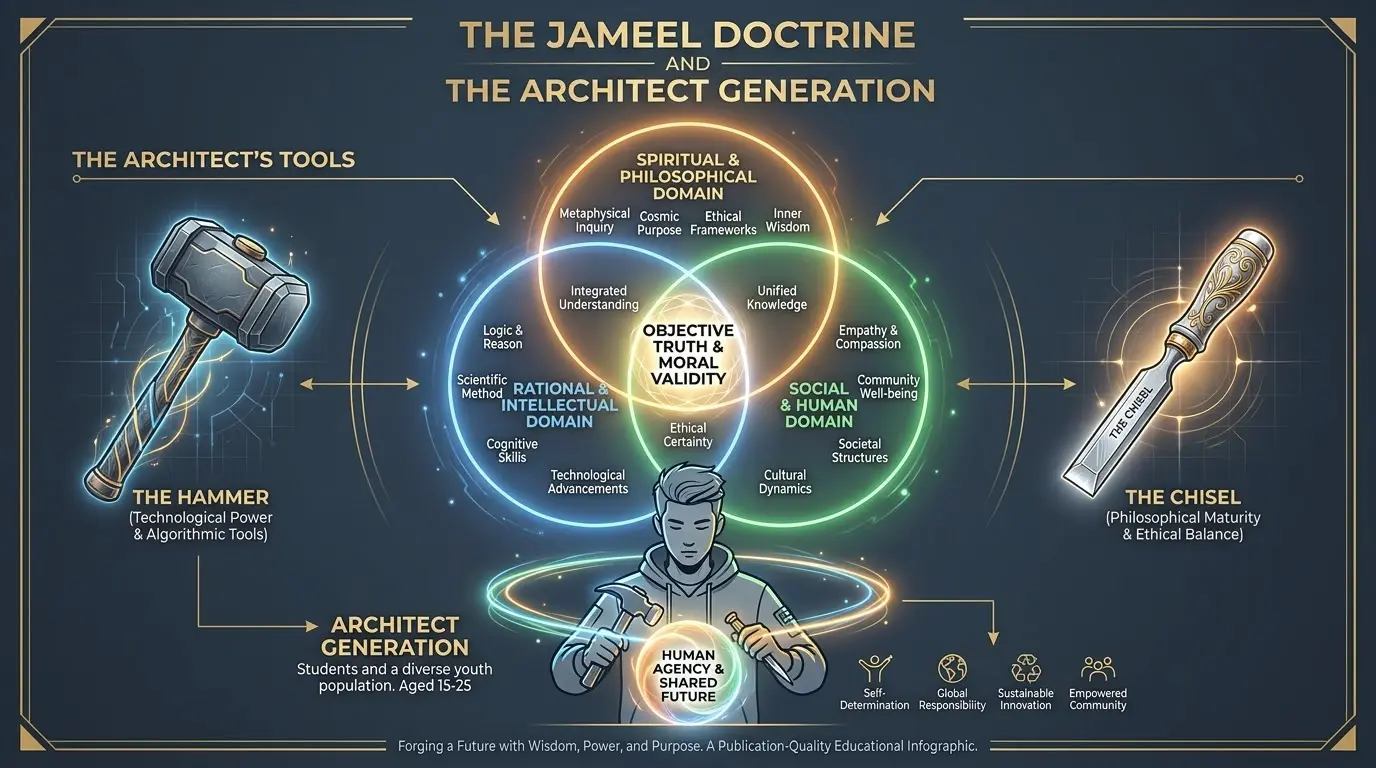
Mapping the relationship between the Three Circles of Validation and the “Hammer and Chisel” framework
(jameel_doctrine_architect_diagram.jpg).
Navigating the Conceptual Map
The diagram is structured as a professional, high-concept educational infographic set against a deep slate-blue background, representing the following core tenets of the co-authored paper by Dr. Neville Buch and Arif Jameel:
1. The Three Circles of Validation (The Jameel Doctrine)
At the heart of the diagram is the Three-Circle Criterion for Truth, illustrating that moral validity cannot be dictated by a singular state or institutional authority:
- The Spiritual / Philosophical Circle: Positioned at the top (glowing with warm amber light), representing our deep existential and metaphysical ideals.
- The Rational / Intellectual Circle: Positioned at the bottom-left (glowing with blue light), representing rigorous logical coherence, fallibilism, and systematic reasoning.
- The Social / Human Circle: Positioned at the bottom-right (glowing with green light), representing the “thick” lived experience of the community and the local perspective.
- The Central Intersection: Where all three domains overlap, the diagram illuminates with a bright golden core labelled “Objective Truth & Moral Validity”—the only zone capable of resisting institutional silence and power.
2. The “Hammer and Chisel” Framework (The Architect Generation)
Flanking the circles of validation are the dual tools required by The Architect Generation (Ages 15–25) to transition from unreflective “Junior” execution to mature “Senior” accountability:
- The Hammer: A powerful, heavy iron mallet representing Technological Power and Algorithmic Tools. Without guidance, the hammer is a force of raw, mechanical acceleration that can lead to structural destruction.
- The Chisel: An elegant, sharp silver chisel representing Philosophical Maturity and Ethical Balance.
- The Act of Authorship: At the base of the diagram, a focused outline of a student is shown actively utilizing both tools in unison. By combining the physical force of the Hammer with the precise, deliberate direction of the Chisel, youth are empowered to dismantle algorithmic dominance and restore human authorship over our technical and social systems.
Featured Images:


Neville Buch
Latest posts by Neville Buch (see all)
- Thank you, Richard: Knowing the message but then acting – October 8, 2026
- The Desiccation of the Common Well: Identity Politics, Algorithmic Assessment, and the Crisis of Adult Responsibility – October 6, 2026
- Academic Rigour, Epistemic Renewal, and the Crisis of Inquiry: A Scholarly Review of the Vanderbilt Commission Report on the State of Scholarship – October 5, 2026