
Dr Neville Buch and Coopers Plains History Group and MICE[1]
Abstract
This essay examines the multi-generational infrastructure failure known as the Coopers Plains railway crossings problem in southern Brisbane, Queensland. Originating nearly a century ago, the level crossing conflict represents a textbook case of urban planning inertia, institutional neglect, and ideologically driven governance. By synthesizing primary archival newspaper reporting from The Courier Mail and Sunday Mail with local historical studies and contemporary socio-philosophical analyses by Dr. Neville Buch and the Management Institute of Contributory Economy (MICE), this paper traces the historical trajectory of the crossing from its earliest recorded accidents in 1934. It details the spatial evolution of the Coopers Plains township—including the transition of Orange Grove Road Primary School to Coopers Plains State School and the settlement of the Buch family on Orange Grove Road—alongside the persistent political refusal of successive Queensland State Governments to fund grade separation. It is argued that ultra-conservative economic policies and fiscal austerity have historically prioritized developer interests and political favouritism over local population requirements. Ultimately, utilizing MICE’s diagnostic frameworks, the essay demonstrates how pitting suburbs against each other for scarce capital allocation exemplifies active institutional “stupidity” and historical forgetfulness, demanding a shift toward substantial fairness and genuine human-centered infrastructure planning.
1. Introduction: The Coopers Plains Level Crossing Bottleneck
The suburb of Coopers Plains, situated approximately eleven kilometres south of the Brisbane central business district, occupies a vital geographic position within the southern Brisbane urban corridor[1][2]. Historically defined by the convergence of major road pathways—such as Beaudesert Road, Boundary Road, and Orange Grove Road—and heavy rail infrastructure, including the Beenleigh passenger line and the interstate standard-gauge freight line, the area functions as a heavy transit thoroughfare[1]. However, this dual role as a high-density residential community and a regional freight hub has generated severe spatial and logistical friction, centred predominantly on its railway level crossings[2][4].
For decades, the Boundary Road level crossing at Coopers Plains has stood as one of the most hazardous and congested traffic bottlenecks in South East Queensland[4][5]. Long delays caused by frequent passenger and freight train movements regularly sever local road connectivity, severely impacting daily commuting, freight logistics, and emergency service responses[2]. Rather than being a recent byproduct of rapid 21st-century urban sprawl, historical documentation demonstrates that this infrastructure crisis has persisted for over ninety years[4][6].
2. Historical Genesis: The 1934 Record and Early Suburban Growth
The structural dangers of the Coopers Plains railway crossing were formally documented as early as 1934 in Queensland’s primary daily newspaper, The Courier Mail[6][7]. On November 6, 1934, a heavy motor lorry carrying metal crashed into a passenger rail motor trailer at the Boundary Street level crossing near Coopers Plains station[6]. Driven toward the Archerfield Aerodrome, the truck struck the rail motor with immense force, shattering passenger trailer windows, inflicting injuries, and destroying cattle grids and posts (The Courier Mail 1934b: 20)[6]. Earlier that same year, local civic groups such as the Sunnybank Progress Association had already begun lobbying municipal authorities and the Main Roads Commission to complete and upgrade crucial road links connecting Coopers Plains to major arterial roads (The Courier Mail 1934a: 21)[7].
1934: First major level crossing crash recorded in The Courier Mail (Boundary St) [6]
└── 1942: Orange Grove Road State School renamed Coopers Plains State School [8]
└── 1947–1953: Imposition of 12 mph speed limits and repeated collisions [5, 9]
└──1950s–Present: Post-war suburban growth; state delays grade separation [4, 10, 11]
Throughout the post-war era, traffic density across the Beaudesert and Boundary Road crossings escalated rapidly, turning the intersection into what contemporary journalists termed “death traps for traffic” (Sunday Mail 1951: 3)[4]. Almost daily near-misses and collisions prompted the Railway Commissioner to institute restricted train speeds—reducing speeds to twelve miles per hour over Boundary Road for safety—yet serious collisions between trains, automobiles, and motorcycles continued unabated (The Courier Mail 1947a: 3; 1953b: 3)[5][8].
Simultaneously, during these early decades of confronting railway hazards, the local social geography was undergoing significant transformation[9]. In the early 1930s, suburban residential subdivisions expanded along Orange Grove Road, leading to the establishment of the Orange Grove Road State School on top of the hill (Buch 2017: 2)[9]. In 1942, following the construction of the U.S. Army Damour Barracks adjacent to the school site, the institution was officially renamed Coopers Plains State School (Buch 2017: 2)[9]. It was during this formative era that the Buch family first established their long-standing family property on Orange Grove Road immediately adjacent to the school (Buch 2017: 2; Buch 2025: 11)[9][10]. The daily lives of local families and school children were thus directly impacted by the surrounding unseparated rail corridor, framing the crossing problem not merely as an abstract engineering issue, but as an immediate safety hazard for the growing residential community[4][9].
3. Political Ideology and Ultra-Conservative Economic Policy
The core reason the Coopers Plains level crossing problem was allowed to stagnate across the 20th and 21st centuries lie in the prevailing political ideology and economic policy of successive Queensland State Governments (Buch 2025: 11)[4]. Historically, decision-making regarding state infrastructure allocation was governed by ultra-conservative fiscal beliefs, neoliberal economic rationalism, and electoral favouritism (Buch 2025: 11; Buch 2026a: 9).
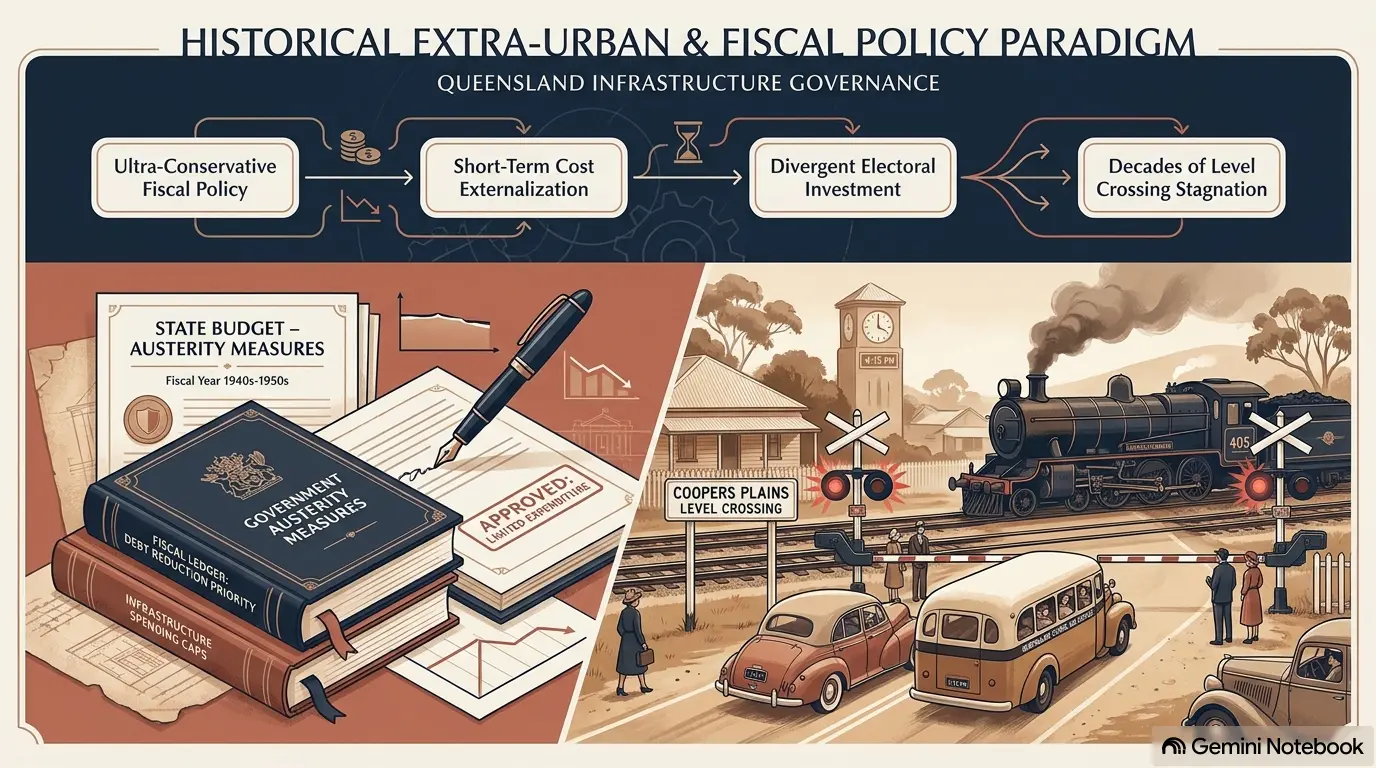
State governance frequently prioritized resource allocation toward regional primary industries, developer interests, or political wards on Brisbane’s Northside, while treating the working-class and post-war migrant communities of Brisbane’s Southside as secondary priorities (Buch 2025: 11; Cole 2021: 4)[10]. As local historian Dr. Neville Buch observes, when suburban expansion called for visionary public transport investment—such as establishing dedicated local stations along the interstate rail line at Acacia Ridge or expediting metropolitan rail electrification—the State Government routinely cited financial excuses and lack of prospective traffic (The Courier Mail 1950: 7)[11][15].
When budget allocations were made, authorities adopted piecemeal, incremental measures—such as minor track duplication or lowered train speed limits—rather than funding permanent grade separation overpass structures (The Courier Mail 1947a: 3; 1951: 3)[5][16]. Rather than allocating capital where the majority of the local population requested and urgently required infrastructure investment, state decision-makers externalized the operational and safety burdens onto local residents and motorists (Buch 2025: 11; Jameel 2026a: 5)[10][17].
4. The MICE Critique: Institutional “Stupidity” and Scarce Funding Competition
The Management Institute of Contributory Economy (MICE), founded by Dr. Neville Buch alongside scholarly colleagues, has extensively analysed this policy failure across numerous publications (Buch 2026a: 1–12; Buch 2026b: 1–8; Jameel & Buch 2026: 1–15)[18]. MICE demonstrates that the Queensland Government’s historical approach to local infrastructure is a manifestation of institutional “stupidity”—defined not as a simple lack of technical intellect, but as an active, habituated posture of thoughtlessness, unreflective prejudice, and historical forgetfulness (Buch 2026a: 1, 8, 9)[18].
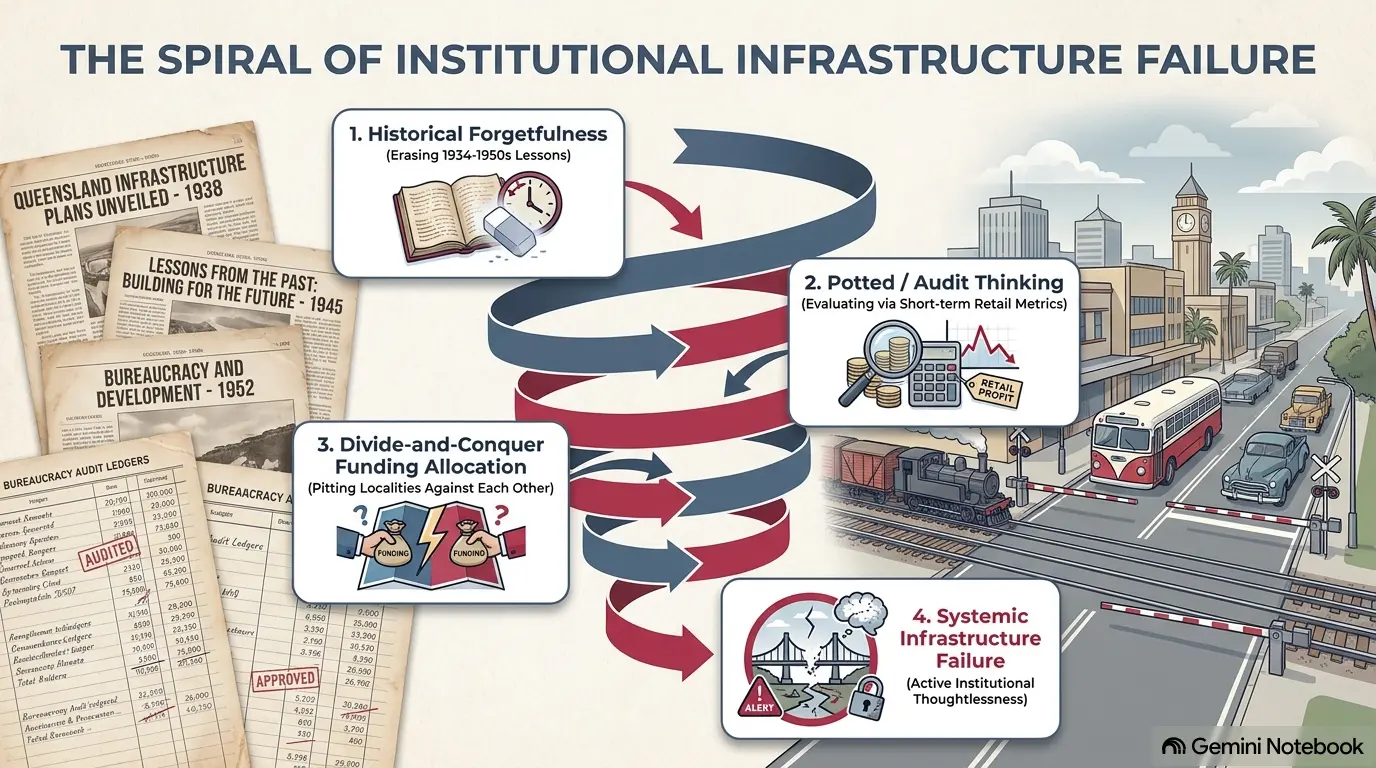
Under MICE’s Spiral History Theory of Stupidity, institutions that erase historical context repeat the same administrative errors in cyclical loops (Buch 2026a: 8, 9)[22][23]. In local infrastructure management, Queensland authorities have historically relied on a divide-and-conquer strategy: pitting neighbouring suburbs or regional localities against one another in competitive “hunger games” for scarce capital funding (Buch 2025: 11; Buch 2026b: 4)[10][24]. MICE scholarship highlights that:
- Failure of Potted Thinking: Reducing complex social infrastructure needs to narrow financial audit metrics or electoral cycle promises guarantees long-term planning failure (Buch 2026a: 8; Jameel 2026a: 10)[23][25].
- Transfer of Responsibility Burden: In alignment with Jameel’s Economic Law of Responsibility Burden, when state institutions fail to construct permanent “concrete roof” infrastructure (overpasses), the unpriced operational, temporal, and cognitive costs are forced onto individual citizens waiting at closed level crossing gates (Jameel 2026a: 5, 12)[17][26].
- Rejection of Local Competition Games: Pitting one suburb against another no longer insulates the Queensland Government from public criticism. Because the underlying decision-making framework refuses to adopt comprehensive, long-term planning, the governance process itself is exposed as fundamentally flawed and “stupid” (Buch 2025: 11; Buch 2026a: 9)[10][27].
MICE calls for replacing this administrative stagnation with Substantial Fairness and a Contributory Economy, where infrastructure planning is guided by historical awareness, human dignity, and equitable resource distribution across all suburban communities (Buch 2026b: 6; Jameel & Buch 2026: 3)[28][29].
5. Conclusion
The Coopers Plains railway crossings problem is a primary historical example of how ideologically constrained economic policies produce decades of urban dysfunction[4]. From its initial media documentation in 1934 to the post-war growth around Coopers Plains State School and Orange Grove Road, the community’s safety and economic productivity have been compromised by institutional delay[4]. As demonstrated by the Management Institute of Contributory Economy (MICE), short-term political manoeuvring and pitting communities against one another for basic infrastructure funding can no longer mask systemic governance failures[10]. Achieving lasting resolution requires state decision-makers to abandon unreflective fiscal austerity, acknowledge historical lessons, and deliver the grade-separated transport infrastructure that southern Brisbane residents have needed for nearly a century[4].
Full Bibliography
Primary Historical Sources & Newspaper Records
- The Courier Mail (1934a). ‘Country News: Sunnybank’, The Courier Mail, 9 June, p. 21[7].
- The Courier Mail (1934b). ‘Rail Motor Hit by Truck: Passenger Cut by Flying Glass’, The Courier Mail, 7 November, p. 20[6].
- The Courier Mail (1947a). ‘State’s Rail Speeds Increased for Safety’, The Courier Mail, 1 November, p. 3[5].
- The Courier Mail (1947b). ‘Train Derailment’, The Courier Mail, 15 November, p. 3[30].
- The Courier Mail (1950). ‘In Answer to Your Member’, The Courier Mail, 12 October, p. 7[11].
- The Courier Mail (1951). ‘Electric Railways on Way’, The Courier Mail, 15 June, p. 3[16].
- The Courier Mail (1953a). ‘Electrification Delayed’, The Courier Mail, 16 April, p. 6[15].
- The Courier Mail (1953b). ‘Mishaps Since June’, The Courier Mail, 26 August, p. 3[8].
- Sunday Mail (1951). ‘Where Brisbane’s Death Traps for Traffic?’, Sunday Mail, 28 October, p. 3[4].
Local History & Sociological Publications
- Brannock, John (2026). Submission on the Draft State Planning Policy 2026. St Lucia: JB-SPP Submission, pp. 1–7[31][32].
- Buch, Neville (2017). A Historical Summary for Coopers Plains. Brisbane: Dr Neville Buch Official Research Repository, pp. 1–5[1][9].
- Buch, Neville (2025). The Hills and The Plains Introduction: Introducing the Central Southern Area of Brisbane, Queensland. Brisbane: Management Institute for Contributory Economy (MICE), pp. 1–15[10][33].
- Cole, Simon (2021). History of the ‘Dutch’ Houses of Coopers Plains: A Story of Wasteful Development. Brisbane: Coopers Plains Local History Group / Brisbane Southside History Network, pp. 1–8[34][35].
MICE Theoretical & Governance Publications
- Buch, Neville (2026a). If Not Stupid. Reversing Spiral of Stupidity: Framework for Reclaiming Thought, Judgment, and Historical Agency. Brisbane: Management Institute for Contributory Economy (MICE), pp. 1–12[18].
- Buch, Neville (2026b). Philosophy in Practice: Actual and Potential Operational Spheres of MICE. Brisbane: Management Institute for Contributory Economy (MICE), pp. 1–8[19].
- Buch, Neville (2026c). The Destructive Art of Deflection and the Loss of Human Authorship. Brisbane: Management Institute for Contributory Economy (MICE), pp. 1–10[38][39].
- Buch, Neville (2026d). New International Scholarship (Post 2007). Brisbane: Management Institute for Contributory Economy (MICE), pp. 1–10[12].
- Jameel, Arif (2026a). Jameel’s Economic Law of Responsibility Burden: A Coasean Extension from External Costs to Decentralized Reliability Responsibility. Lahore / Zenodo, pp. 1–30[17].
- Jameel, Arif (2026b). We the Living Generation: A Human Constitution for Artificial Intelligence. Lahore / Zenodo, pp. 1–15[43][44].
- Jameel, Arif and Buch, Neville (2026). Moral Architecture vs Technical Guardrail: Jameel and Neville Buch on AI Existential Risk and Human Agency. Brisbane: Management Institute for Contributory Economy (MICE), pp. 1–15[20].
*****
Take the MICE Quiz
[1] Artificial Intelligence (A.I.) has been fairly used in the production of this work. The tool used is Google NotebookLM (recently rebranded as Gemini Notebook). It is an AI-powered virtual research assistant and thinking partner designed to help a person interact deeply with their own documents. Unlike general chatbots, it is source-grounded, meaning it only generates answers based on the specific PDFs, documents, or links uploaded. The A.I. process in the production of this work has been limited to the attached (prompts) on each of the questions in turn. This ensures an accurate reading of each source. The author then rearranged and re-edited the answers the A.I. provided. The human author publishes this work. A.I. is never an author when used properly. This assistance is not qualitatively different from a human research assistant when that assistance is deemed to have no authorial status but is acknowledged.


Neville Buch
Latest posts by Neville Buch (see all)
- The Coopers Plains Railway Crossings Problem: Historical Inertia, Political Ideology, and the Critique of Infrastructure Governance – November 2, 2026
- “Rise up and shine, for your light has come” – November 2, 2026
- New International Scholarship (post-2007) – November 1, 2026