
The process of learning are principles we find in philosophy, whether discipline philosophy or Lebensphilosophie (or both). From a Perspective of “The Dynamic of Cognition (Person)” the argument is the same as the process of learning. With self-awareness and the awareness of ‘The Other’, cognition is learning.
The Teaching Document is also at https://www.academia.edu/145065676/The_Process_of_Learning_and_The_Dynamic_of_Cognition
And Attached
The Process of Learning and The Dynamic of Cognition

The Dynamic of Cognition: Two Important elements
Attitudes:
An attitude is described as a “residue of experience that conditions and controls activity”. It’s a “mental organization that pre-disposes an individual to a certain type of activity vis-à-vis people or situations”. This suggests that past experiences shape our tendencies to act in particular ways.
Values:
Values are seen as “personal attitudes and beliefs which influence functional and nonfunctional requirements”. This perspective connects values to the formation of our needs and expectations, particularly in the context of design and engineering. In “values-first software engineering,” complex problems like sustainability are treated as “soft goals” influenced by values. Human values can be classified and aligned with system values, revealing themes like efficiency and usability. Values are embedded in political discourses and are considered “salient and resistant to change,” potentially bridging different viewpoints.
THE ARGUMENT
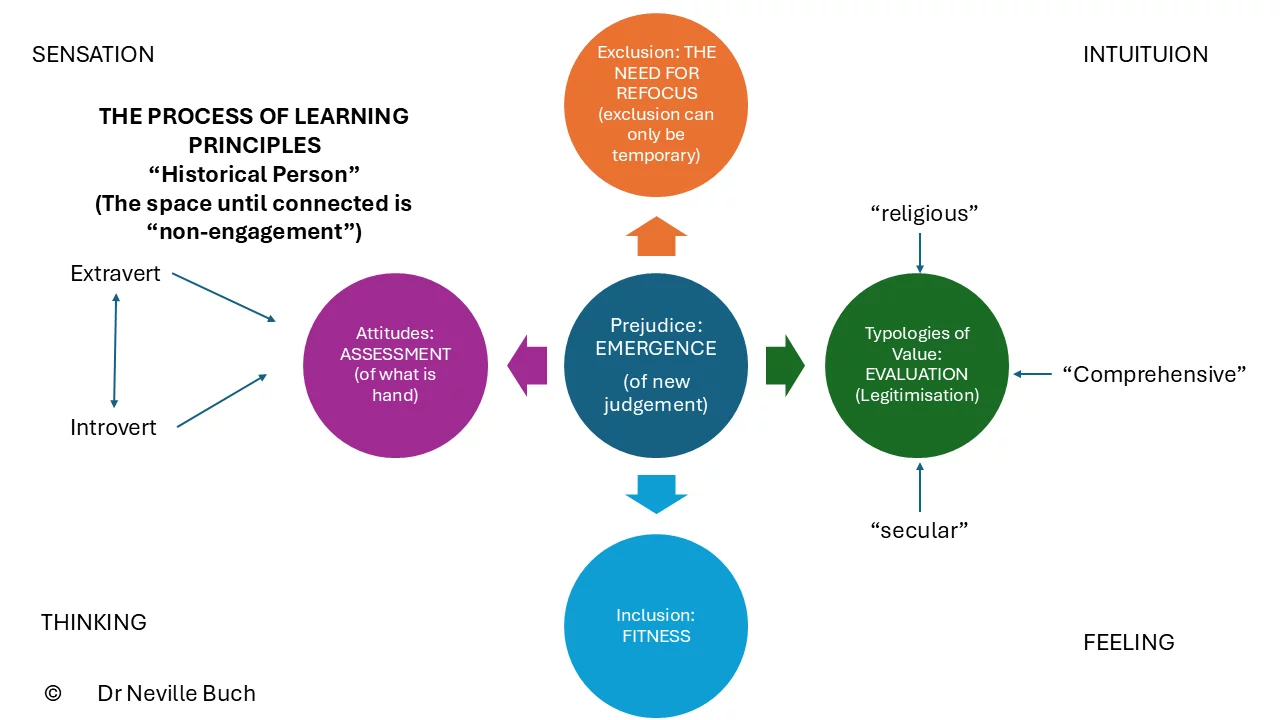
- With challenging each prejudice is the emergence of new judgement;
- Attitudes, when thought about, are assessments of what is at hand;
- Evaluation is part of the process of learning to attempt the legitimisation through a typology of value;
- The fact that the human mind keeps excluding certain ideas from our focus means that exclusion can only be temporary, and there is always needed to refocus (unless the person stagnates in the process of learning and becomes an idiot);
- The process of learning arrives at an outcome of “fitness”. The process of learning always asks how does all ideas fit. The process of learning is like a jigsaw puzzle which never ends (until death). This is why we have lifelong learning.
The central argument presented is that cognition is fundamentally a continuous, self-aware philosophical process whose successful outcome requires the constant reversal of intellectual exclusion. Failure to maintain this dynamic learning process results in cognitive stagnation.
This argument can be broken down into the following propositions:
- Learning is a Philosophical and Self-Aware Dynamic
The process of learning encompasses principles found in philosophy, including both discipline philosophy and Lebensphilosophie (philosophy of life). From the perspective of “The Dynamic of Cognition (Person),” the process of learning is viewed as being the same as cognition.
Crucially, cognition is learning when it is coupled with self-awareness and the awareness of ‘The Other’.
- Attitudes Govern Activity
The learning process is deeply conditioned by attitudes, which are defined as a “residue of experience that conditions and controls activity”.
- Continuous Evaluation and Inclusion are Mandatory
The process of learning requires constant intellectual work, structured as follows:
- Evaluation for Legitimation: Evaluation is part of the process of learning and is necessary to attempt legitimisation through a typology of value.
- The Necessity of Refocusing: The human mind keeps excluding certain ideas from our focus. However, this intellectual exclusion can only be temporary, meaning there is always a need to refocus on previously excluded ideas.
- The Consequence of Failure: If a person stagnates in the process of learning and does not refocus on excluded ideas, they become an idiot.
- The Goal is “Fitness”
The entire process of learning, driven by these principles, ultimately arrives at an outcome described as “fitness,” a goal which the process always asks for.
In summation, the source argues that human cognition is not static, but a dynamic mandate to continuously incorporate new and previously excluded ideas into one’s focus, leading toward a state of philosophical and practical “fitness”. This is because stagnation in learning leads to cognitive failure (becoming an “idiot”).


Neville Buch
Latest posts by Neville Buch (see all)
- Death in Life and Life in Death: Affective, Intellectual, and Ontological Dimensions of Human Mortality – October 2, 2026
- Psychological Symbol Cards – October 2, 2026
- The Washington Post Impact Report and American Studies – October 1, 2026