
Dr Neville Buch
Abstract
The Limits of Humanism across these sources are defined by three major boundaries: the metaphysical illusion of a life immune to “luck” and contingency; the technical crisis of a humanity defined by its “originary de-fault” and prosthetic nature; and the epistemological limit where abstract theory fails to harmonize with the density of lived, historical experience. Contemporary humanism is further limited by “Historical Forgetfulness” and an “anorexic” refusal to integrate spirituality and emotion into its rationalist framework. These sources suggest that humanism’s validity lies not in attaining an “absolute conception of the world” but in the reflective ascent toward self-understanding through truthfulness and procedural kindness (panser).
Dynamic of Cognition Analysis: The Limits of Humanism
| DoC Component | Analysis of Humanism’s Limits | Rationale / Source |
| Prejudice (Centre) | Monistic Rationalism: The belief that reason can provide a single currency of justification or a life free from contingency. | Limits humanism by creating “illusions” of absolute justice and “fantasy” of total control. |
| Attitudes (Thinking/Extrovert) | Scientism and Militant Secularism: The tendency to equate humanism with a narrow, anti-religious literalism. | Limits humanism to a “derivative or phony” voice that excludes diverse human experiences. |
| Typologies of Value (Feeling/Introvert) | Measurable Utility: Prioritizing technical and commercial profit over the intrinsic value of moral character and wisdom. | Leads to an “immense regression” and a “discontinuous personality” reliant on stimuli. |
| Exclusion (Sensation/Intuition) | Repression of Technics and History: Filtering out the constitutive role of “exteriorization” (prosthesis) and “Historical Forgetfulness”. | Limits the understanding of human authorship and its relation to time and mortality. |
| Inclusion (Thinking/Feeling) | Interpretive Holism and Caring (Panser): The mandate to integrate all human dimensions (truth, goodness, beauty, holiness). | Attempts to overcome the “logical gulf” by grounding ethics in historical truthfulness and empathy. |
——————————————————————————–
Source Summaries
- Bernard Williams’ Making Sense of Humanity
This collection asserts that “making sense of humanity” requires the human sciences to deploy notions of intention and meaning, rather than merely causal, biological, or computer-modelled explanations. Williams argues that while we are animals, we are not “machines” in a way that allows psychology to be reduced to cognitive science alone. A major limit of humanism is the “representation problem”—the difficulty of grounding ethical uniformity in a biological human nature that is in fact a “manifestly contingent cultural development”.
- Bernard Williams’ Moral Luck
The central limit identified here is the incoherence of “moral luck” within the Kantian framework. Humanism is often driven by a motive to establish a dimension of decision that “transcends luck”. However, the reality of “constitutive luck” (how one is born or endowed) and “incident luck” (unforeseen outcomes) proves that value beyond luck is an illusion. This forces humanism to acknowledge “agent-regret”—that our involvement in our actions goes deeper than the relation of an ex ante rational deliberator.
- Charles Ringma’s Free Thought and True Humanism
Ringma identifies a fundamental limit in contemporary “secular humanism” which he labels “anorexic humanism” because it bifurcates human sensibilities from spirituality. He argues that humanism is incomplete if it excludes beauty, imagination, and homo adorans (humans as worshippers). A “true humanism” must be incarnational, affirming the dignity of the human condition through a redemptive and creational vision.
- Neville Buch’s A Short History of Humanism
The history of humanism is characterized by interwoven threads and internal tensions (rationalists, freethinkers, liberal Christians). The primary limit identified is the inability of the movement “to give common semantics to the adjective, ‘human,’ “ leading to pervasive confusion and fragmentation in self-perception.
- Neville Buch’s Humanism, Free Thought, and Our Conflicted Times
In the context of the “Age of Trumpism” and “Digital Humanism,” this work notes the limit imposed by the “technicisation” of communication. True liberation is limited by a lack of rational-critical communication. Humanism must overcome its “Historical Forgetfulness” by adopting spiral historiography to learn from past intellectual struggles.
- Australian Humanism: A Concise History
Australian humanism is limited by its historical fragmentation and its tendency toward simplification, often weighting local thought toward American populist paradigms. It has historically struggled with “militant” exclusionary practices that unethically marginalize humanists with religious or diverse philosophical bearings.
- Eric Hayot’s Humanist Reason (Robert Eaglestone)
Eaglestone reviews the “limit” of the humanities being perceived as weak or ideologically driven because they cannot claim “truth” in the same way the natural sciences do. Hayot’s proposed “humanist reason” attempts to reclaim the humanities by justifying them in their own terms—as context-embedded but not context-determined.
- Humanism’s Lost Thought and Technical Crisis
The “Lost Thought” is the intellectual failure to grasp philosophical complexity (e.g., Lebensphilosophie), while the “Lost Awareness” is the failure to recognize humanity’s prosthetic essence. These failures induce an “immense regression” toward demoralization and “absolute non-knowledge”.
- The Phenomenal Grounding of Humanistic Agency
This text identifies a limit in mechanistic reductionism. It argues that humanistic agency must be grounded in phenomenology to capture the subjective quality of experience (“what it is like to be a cognitive agent”). Without this phenomenal grounding, human authorship and responsibility become meaningless metrics.
- The Humanistic Ascent Against Technical Reductionism
The return of the humanities is a response to the erosion of human agency by purposive-rational action and “investment calculation”. The central limit is the repressed unthought of technics, which constitutes the “originary de-fault” of humanity—humanity is not self-sufficient but essentially technical.
——————————————————————————–
Conclusion: One Message on the Limits of Humanism
The collective message of these sources is that humanism is inherently limited by the very condition that makes it possible: our situated, prosthetic, and contingent human nature.
- The Finitude of Reason: Humanism cannot fulfill the rationalist dream of a life entirely under the mastery of the will. We are subject to moral luck and a “complex historical deposit” of ethical ideas that resist being forced into a single, comprehensive theory.
- The Technical Core: We are not self-sufficient authors but essentially prosthetic beings. Our evolution is inextricably tied to technics, which is our “unthought” originary lack. This technical nature creates a “time barrier” where technical evolution outpaces cultural assimilation, leading to the “immense regression” and the loss of human authorship.
- The Limits of Incommensurability: We are limited by our local perspectives. There is no “point of view of the universe” available to us; instead, our ethical knowledge is built on “thick concepts” and dispositions that cannot be rationally vindicated from an absolute standpoint.
- The Ethical Mandate: To act within these limits, humanism must adopt the procedural necessity of kindness (panser)—the synthesis of thinking and caring—and the methodology of spiral historiography. By truthfully acknowledging our social and historical bearings, humanism finds its strength not in universal dogma, but in the practical confidence required to make sense of a fragile, individual life.
Analogy: Humanism is like an explorer on a vast, shifting sea of “luck”; the limits are the ocean’s depth and the technical fragility of the boat (technics). The goal is not to reach a fixed shore of absolute truth, but to maintain the integrity of the journey through a constant, reflective navigation of the currents of history and care.
REFERENCES AND BIBILOGRAPHY
Buch, N. (2021). A Short History of Humanism. Brisbane Humanist Club of Friends.
Buch, N. (2024, December 23). When humanists know nothing of humanism: Contrast to the comprehensive history. Dr Neville Buch Blog.
Buch, N. (2025). Humanism, Free Thought, and Our Conflicted Times. Dr Neville Buch Blog.
Buch, N. (n.d.). Australian Humanism: A Concise History.
Buch, N. (n.d.). Humanism’s lost thought and technical crisis.
Buch, N. (n.d.). The humanistic ascent against technical reductionism.
Buch, N. (n.d.). The phenomenal grounding of humanistic agency.
Eaglestone, R. (n.d.). Humanist reason, by Eric Hayot. THE (Times Higher Education).
Habermas, J. (1979). Communication and the Evolution of Society (T. McCarthy, Trans.). Beacon Press.
Hayot, E. (2021). Humanist Reason: A History, An Argument, A Plan. Columbia University Press.
Noddings, N. (1984). Caring: A Feminine Approach to Ethics and Moral Education. University of California Press.
Ringma, C. (2025). Towards a True Humanism: some small theological steps.
Stiegler, B. (1998). Technics and Time, 1: The Fault of Epimetheus (G. Collins & R. Beardsworth, Trans.). Stanford University Press.
Williams, B. (1981). Moral Luck: Philosophical Papers 1973-1980. Cambridge University Press.
Williams, B. (1985). Ethics and the Limits of Philosophy. Fontana Press.
Williams, B. (1995). Making Sense of Humanity and Other Philosophical Papers 1982-1993. Cambridge University Press.
Williams, B. (2006). Philosophy as a Humanistic Discipline (A. W. Moore, Ed.). Princeton University Press.
******
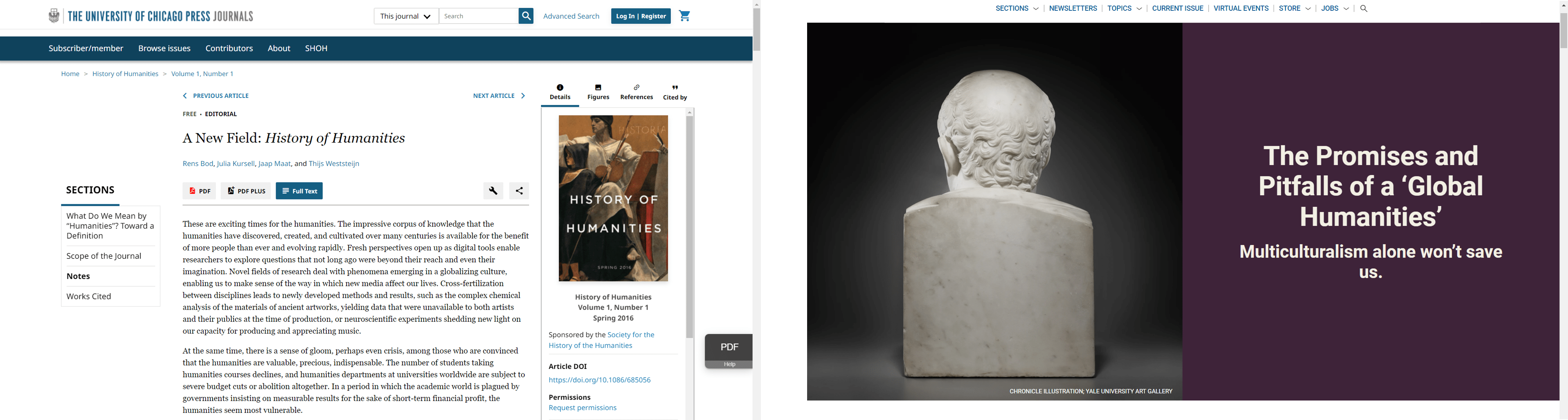
Featured Image: The Humanities Today.


Neville Buch
Latest posts by Neville Buch (see all)
- Agency, Cultural Construction, and Synoptic Vision: On Matt Patterson’s Comprehensive Examination in Sociological Theory (2009) – September 20, 2026
- Human Existence, Existential Angst, and the Protestant Worldview: An Essay on Buch’s Existential Thesis – September 20, 2026
- Salus Populi Suprema Lex Esto. Ciceronian Statecraft, Spinozan Toleration, and Prophetic Praxis – September 19, 2026