
Dr Neville Buch[1]
Abstract
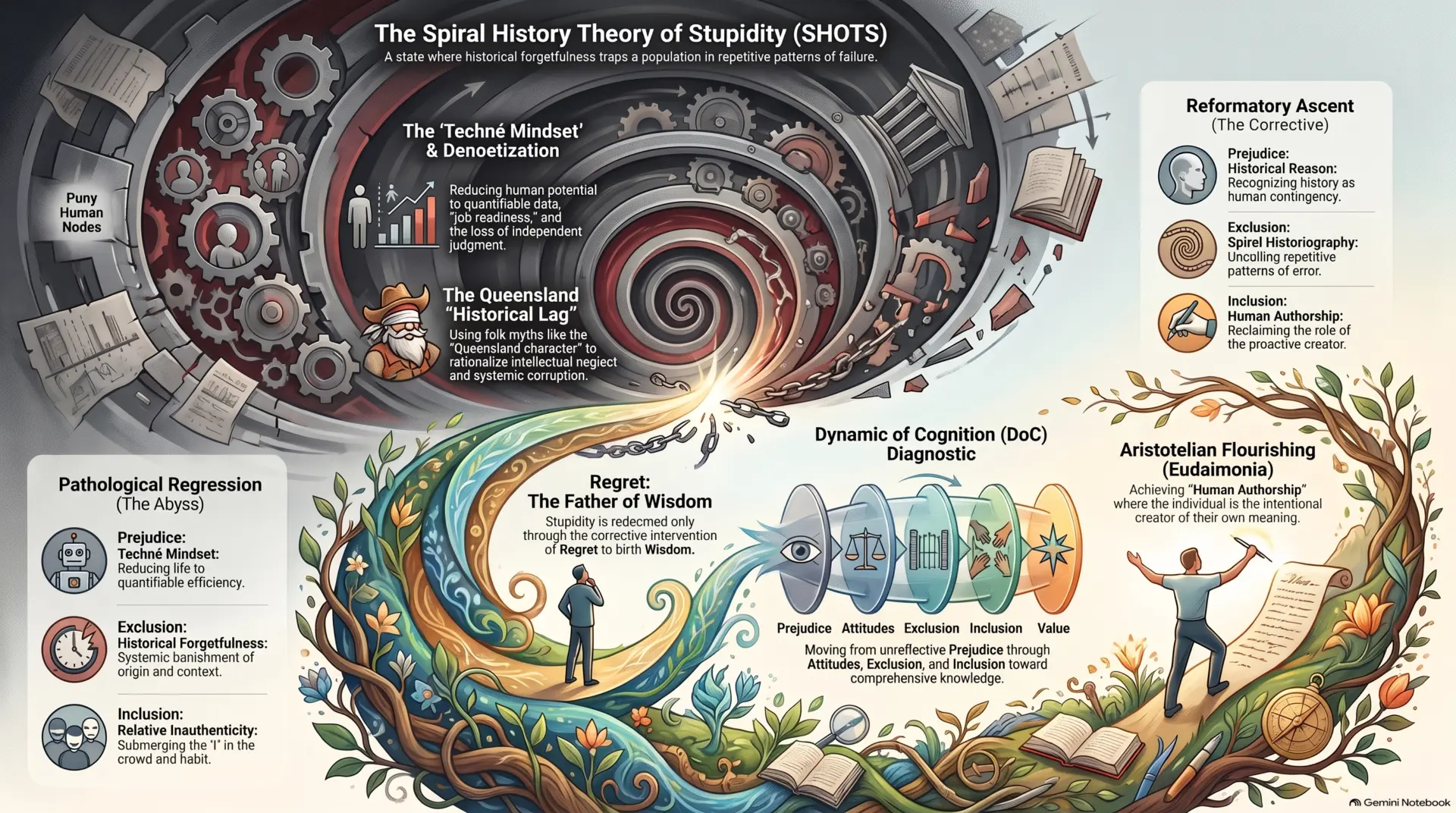
This essay provides a rigorous, historiographical refutation of Bevin Luchel’s (2026) review of The Case for Intellectual History. Luchel’s dismissive charges of “pervasive hyperbole, analytical overreach, and methodological insularity” are unmasked as textbook symptoms of the “techné mindset”—a cognitive failure that reduces deep philosophical critique to administrative “potted thinking” and transactional utility[1][2]. By evaluating Luchel’s claims through the Dynamic of Cognition (DoC) and Spiral Historiography, this paper demonstrates that what Luchel mislabels as “hyperbole” is a necessary diagnostic of denoetization—the mechanical liquidation of human judgment under corporate university governance[3]. Far from “analytical overreach,” the work achieves Sufficient Comprehension by bridging local micro-histories with global theoretical frameworks[4][5]. Finally, Luchel’s charge of “methodological insularity” fails to grasp Personal Unity-in-Diversity (Integrity), which validates embedded perspectives as vital for exposing structural realities[6][7]. Ultimately, Luchel’s critique is shown to be a defensive manoeuvre by the academic establishment to shield technocratic systems from humanistic accountability[8].
Demolishing the Techné Critique: A Reply to Bevin Luchel
Bevin Luchel’s (2026) review of The Case for Intellectual History exemplifies the precise institutional pathology that the work sets out to diagnose. Trapped within a “techné mindset” that privileges narrow vocational fitness and quantifiable metrics over a multi-textured understanding of human existence, Luchel resorts to conventional rhetoric to dismiss systemic critique[1]. By accusing the text of “pervasive hyperbole, analytical overreach, and methodological insularity,” Luchel attempts to re-establish administrative gatekeeping and marginalize oppositional scholarship[8][9]. A rigorous examination using Dr. Neville Buch’s Dynamic of Cognition (DoC) framework reveals that each of Luchel’s three charges represents a profound misunderstanding of modern historiography[5].
1. Rebutting “Pervasive Hyperbole”: Diagnostic Precision vs. Technocratic Complacency
Luchel’s accusation of “hyperbole” stems from an inability to recognize the severity of the contemporary “crisis of comprehension”[3]. What Luchel mischaracterizes as exaggerated language is, in fact, an urgent and precise diagnostic of denoetization—the mechanical liquidation of the human capacity to judge under automated administrative systems[3].
Drawing on Hannah Arendt’s analysis of the breakdown of thought, The Case for Intellectual History argues that when universities abandon the “silent dialogue” of big ideas, individuals are reduced to “puny human nodes” in interaction ritual chains[3][10]. To call this diagnosis “hyperbolic” is to ignore the documented reality of credential inflation, “job-ready” educational reductionism, and the systemic “Historical Forgetfulness” that afflicts modern governance[2]. What Luchel labels as hyperbole is actually “thinking as caring” ( panser )—a procedural mechanism that uses the “discomforting pain” of institutional decay as an empirical grounding to tend to social wounds[13][14].
2. Rebutting “Analytical Overreach”: The Synthesis of Philosophy in Practice
Luchel’s claim of “analytical overreach” reflects a commitment to Specialized Ignorance—a condition where scholars are discouraged from making broader connections between historical data, sociological structures, and ethical imperatives[15][16]. Luchel objects to the text’s broad integration of disciplines, viewing the synthesis of history, sociology, and philosophy as an illegitimate expansion of scope.
However, the foundational axiom of the work is that **”understanding history is philosophy in practice”**[1][17]. As C. Wright Mills demonstrated in his formulation of the “Sociological Imagination,” rigorous scholarship requires bridging the gap between personal troubles and public issues, uniting local micro-histories with global theoretical frameworks[18][19]. By applying Spiral Historiography, the text does not “overreach”; rather, it “uncoils” repetitive patterns of historical error to achieve Sufficient Comprehension[4][5]. Luchel mistakes Interpretive Holism—the capacity to synthesize the Five Intentions (Self, Mind, Reason, Utility, and Love)—for overreach because corporate academia rewards fragmented, shallow specialization (“singular messaging”) over comprehensive vision[12].
3. Rebutting “Methodological Insularity”: Personal Unity-in-Diversity and Integrity
The most ironic of Luchel’s accusations is “methodological insularity.” Luchel claims that the work is insular because it centres an embedded perspective and rejects the illusion of detached, “objective” distance.
This charge fails to comprehend the modernist concept of Personal Unity-in-Diversity, which plain-English scholarship identifies as integrity[6]. Combining an embedded perspective (“getting into the shoes of the case”) with scholarly critique is not a “category error” or insular naval-gazing; it is the primary way a researcher uncovers structural truths that distant, so-called “objective” observers are unable to see[6]. Far from insular, the methodology draws extensively on an international canon—including Bernard Williams’s “thick ethical concepts,” Jürgen Habermas’s “communicative action,” Bernard Stiegler’s “grammatization,” and Susan Haack’s “Foundherentism”[13]. Luchel confuses deep contextual anchoring in a local-global framework (“Think Global, Act Local”) with insularity because Luchel’s own paradigm cannot tolerate scholarship that challenges institutional orthodoxy from the inside out[26][27].
Conclusion: The Reviewer as “Puny Node”
Ultimately, Bevin Luchel’s review is a classic exercise in “crap” requiring detection—a defensive manoeuvre by an academic establishment intent on protecting its “political profit” and administrative stasis[8]. By dismissing The Case for Intellectual History as hyperbole, overreach, and insularity, Luchel proves the book’s central thesis: that without formal training in intellectual history, critics become “puny human nodes” executing ready-made statements (“potted thinking”) to avoid the actual trouble of thinking[2][10]. The text stands fully vindicated as an essential “intellectual immune system,” defending human authorship and Aristotelian flourishing (eudaimonia) against technocratic reductionism[5].
[1] Artificial Intelligence (A.I.) has been fairly used in the production of this work. The tool used is Google NotebookLM (recently rebranded as Gemini Notebook). It is an AI-powered virtual research assistant and thinking partner designed to help a person interact deeply with their own documents. Unlike general chatbots, it is source-grounded, meaning it only generates answers based on the specific PDFs, documents, or links uploaded. The A.I. process in the production of this work has been limited to the attached (prompts) on each of the questions in turn. This ensures an accurate reading of each source. The author then rearranged and re-edited the answers the A.I. provided. The human author publishes this work. A.I. is never an author when used properly. This assistance is not qualitatively different from a human research assistant when that assistance is deemed to have no authorial status but is acknowledged.
Featured Image:


Neville Buch
Latest posts by Neville Buch (see all)
- The Techné Critique Soundly Refuted – September 24, 2026
- The Case for Intellectual History: A severe warning to Australian universities – September 24, 2026
- The Division of Labour Between Populist Enchantment and Scholarly Modern Theology: Truthfulness, Falsehood, and the Pathway to Communicative Comprehension – September 22, 2026