
The Reclaiming Your Agency from Market Chaos audio commentary on MICE’s Contributory Economy and Human Authorship.
Abstract (humanly devised)
Robber-Barons, War-oriented Profiteers, and other market exploiters run high on the perceived chaos of the Marketplace. The chaos is real because it is made real. Indeterminacy of the marketplace is real and yet so many scammers wish to sell us the narrative that the future is guarantee in this or that strategic linear line. What is not understood is that Robber-Barons, War-oriented Profiteers, and other market exploiters of the past, and their enablers and otherwise supporters, had agency. Today, Robber-Barons, War-oriented Profiteers, and other market exploiters have agency. They are accountable as a spiral history unfolding again.
1. Introduction: The Illusion of Linear Determinism and the Reality of Manufactured Chaos
The fundamental paradox of computational capitalism and historical market exploitation lies in the deliberate manufacture of market chaos alongside the parallel sale of false linear certainty[3][4]. Historically, “Robber Barons”—from 19th-century industrialists like Cornelius Vanderbilt and John D. Rockefeller to contemporary Gilded Age digital monopolists—have exploited economic turbulence, regulatory voids, and social crises to accumulate unprecedented private power and wealth (Josephson 1934, p. 14; White 2011, p. 230)[2]. Similarly, war-oriented profiteers and speculative middlemen thrive by manipulating price volatility, capitalizing on supply shocks, and exploiting systemic emergencies (Veblen 1904; Hughes 2007)[7].
As the abstract acutely highlights, marketplace indeterminacy is not a mere natural disaster or a chaotic act of God; **”the chaos is real because it is made real”**[3][4]. Market exploiters actively engineer instability—through predatory monopolies, aggressive financialization, and algorithmic manipulation—while simultaneously peddling deterministic narratives that promise guaranteed linear futures through automated management, speculative investments, or technocratic control (Stiegler 2016; Buch 2026a, p. 24)[4][10].
What technocratic propaganda conceals is the vital dimension of human agency[11][12]. Market exploiters of the past were not unthinking instruments of blind economic laws, nor are today’s corporate oligarchs passive agents of technological necessity (Josephson 1934, p. 14)[5][13]. They exercised—and continue to exercise—deliberate agency and strategic choice[5][14]. Through Dr. Neville Buch’s framework of Spiral Historiography, history is understood not as a flat linear line, but as a cyclical spiral where unexamined cognitive errors, institutional falsehoods, and exploitative practices “uncoil” and re-emerge whenever society succumbs to “Historical Forgetfulness” (Buch 2024, p. 2; Buch 2026c, pp. 4–5)[15]. Because market exploiters possess agency, they and their systemic enablers remain fully morally and socially accountable as this spiral history unfolds again[18][19].
2. The Weight of Care and Responsibility We Place on Ourselves
Confronting the cyclical return of market exploitation requires an exacting moral and cognitive inventory[19][20]. The Contributory Economy framework diagnoses contemporary societal regression as a descent into a “Junior” state of cognition[19][21]. In this state of unreflective execution, individuals act as “docile executors” and passive conduits for external financial stimuli, organizational propaganda, or consumer drives, effectively surrendering their intellectual sovereignty to automated systems and market gatekeepers (Buch 2025a, p. 1; Buch 2026b, p. 15)[22].
To break free from this state, individuals must shoulder the weight of care and moral responsibility by ascending to “Senior” cognition (Buch 2026b, p. 15; Buch 2026a, p. 51)[18]. This developmental ascent demands “conscious competence”—the metacognitive discipline to proportion belief to evidence, interrogate systemic assumptions, and accept responsibility for the shared world-picture we construct (McKinney 1971; Buch 2026d, p. 15)[18][25].
Central to this responsibility is the reinvention of thinking (penser) as caring (panser —tending to wounds) (Stiegler 2018; Buch 2025b, p. 2; Buch 2026b, p. 15)[23]. Drawing on French philosopher Bernard Stiegler and Nel Noddings, panser operates as an indispensable procedural shield and cognitive necessity[26]. It protects human particularity, vulnerable communities, and historical truth from the lethal, unfeeling calculation of pure market assembly and algorithmic profit maximization (Noddings 1984; Stiegler 2018; Buch 2026a, p. 52)[23]. The weight of care obligates us to stop treating ourselves and others as “puny human nodes” or “meaningless checkerboards of parts,” demanding that we re-assert human moral authorship over technical and economic apparatuses (Buch 2026b, p. 15; Buch 2026e, p. 3)[11].
3. Economically Employing Care and Responsibility
Care and moral responsibility cannot remain abstract ethical sentiments “shut up in subjectivity”; they must be operationalized through concrete economic mechanics (Williams 1985; Buch 2026a, p. 31)[32][33]. Conventional neoclassical economics evaluates social life through transactional utility, market accumulation, and narrow “job readiness” metrics that reduce human beings to commodities (Collins 2019; Buch 2025a, p. 1)[22].
To economically employ care, the Contributory Economy framework grounds value in the Synthesis of the Five Intentions (The Synthesis of Being) (Buch 2025b, p. 2; Buch 2026b, p. 15)[23]:
- Self (Identity): Restoring internal agency and Human Authorship[23][24].
- Mind (Judgment): Reintegrating philosophic and literary discernment to counter algorithmic denoetization[37][38].
- Reason (Logic): Operating as a “cognitive regulator” to ensure economic technologies serve ethical human ends[23][29].
- Utility (Action): Socialized through the “sociological imagination” to maximize collective well-being and ecological equity while minimizing community harm[23].
- Love / Bond ( Panser ): Functioning as procedural kindness to protect human dignity from pure financial calculation[23].
In practice, economically employing care means transitioning toward an “Economy of the Commons” and establishing a Contributory Income Scheme (Stiegler 2010; Buch 2026a, p. 56)[1][40]. Modelled on open-source knowledge collaboration and intermittent artistic remuneration (intermittents du spectacle), this economic structure compensates activities that generate public knowledge, care work, local history preservation, and ecological stewardship outside traditional corporate wage-labour constraints (Stiegler 2010; Buch 2025a, p. 2)[1][41]. By shifting from formal, rule-bound administrative tidiness to Substantial Fairness, economic resources are allocated based on “thick ethical concepts” (such as courage, integrity, and kindness) that honour the concrete lived reality (Erlebnis) of human beings (Williams 1985; Buch 2026a, p. 53)[30].
4. Refusing to Enable or Support Robber-Barons and Market Exploiters
Refusing to support or enable market exploiters requires actively dismantling the cognitive, institutional, and communicative mechanisms that grant them legitimacy[43][44]. Robber barons and war profiteers rely on “sociological propaganda,” “institutional bullshit,” and manufactured populist myths—such as the illusion that unbridled market greed naturally produces public good—to disarm civic critique and consolidate power (Josephson 1934, p. 14; Buch 2026a, p. 16)[5].
To counter this, citizens and institutions must deploy the POLICE model ( Philosophically Ontology Logic Intersect Compatibility Education ) as an active “intellectual immune system” (Buch & Peach 2024; Buch 2026a, p. 52)[47]. The POLICE methodology provides the tools for systematic “crap detecting”—forcing the mind to continuously doubt, test, and filter out deceptive narratives, unmasking “theological masks” and false claims of linear predictability sold by market scammers (Buch 2026a, p. 16; Buch 2026b, p. 15)[45].
Furthermore, society must reject purposive-rational strategic action (action aimed purely at manipulation, market control, and short-term “Political Profit”) in favour of Jürgen Habermas’s Communicative Rationality ( Verständigung ) (Habermas 1979; Buch 2026a, p. 51)[31]. By establishing transparent public “we-spaces,” every economic proposal and institutional policy must be held accountable to four universal validity claims[51][53]:
- Comprehensibility: Clear, un-manipulative language[53].
- Truth: Empirical accuracy grounded in real-world historical and biophysical evidence[53].
- Rightness: Conformance to legitimate, human-centered social norms[53].
- Truthfulness (Sincerity): Authentic alignment between public claims and internal institutional intent[53].
Refusing to enable exploiters means denying them the protection of corporate “positional property” and credentialed gatekeeping, refusing to trade long-term biophysical resilience for brittle, short-term efficiency gains (Collins 2019; Vardi 2013; Buch 2025a, p. 2)[54].
5. Why the Message of the Contributory Economy is Vital
The message of the Contributory Economy is of paramount urgency in the 21st century because humanity faces a dual crisis: an ecological Anthropocene disruption alongside an algorithmic “immense regression” (Stiegler 2018; Buch 2026a, p. 5)[57]. As generative AI, automated computational platforms, and speculative financialization accelerate, human judgment is increasingly subjected to denoetization—the mechanical liquidation of the capacity to think, discern, and care (Stiegler 2016; Buch 2026a, p. 32; Roe & Perkins 2026)[38].
Without a structural alternative, society will remain trapped in the “vicious circles of stupidity,” repeatedly surrendering agency to new iterations of robber barons who exploit market chaos while destroying the biosphere and social cohesion (Stiegler 2020; Buch 2024, p. 2; Buch 2026c, p. 5)[3].
The Contributory Economy offers the necessary negentropic blueprint to restore Human Authorship[11]. It asserts that the “who” (the human person possessing character, moral agency, and wisdom) must always remain the master over the “what” (technical, financial, and algorithmic systems)[27]. By shifting the ultimate measure of economic success from gross domestic product (GDP) and private accumulation to Aristotelian flourishing ( eudaimonia ), the Contributory Economy guarantees that value is defined by human dignity, character, mutual care, and the restoration of shared democratic life (Aristotle c. 350 BC; Buch 2026b, p. 15)[36].
Harvard Bibliography
Aristotle. (c. 350 BC). Nicomachean Ethics (W. D. Ross, Trans.). Oxford: Clarendon Press[61].
Buch, N. (2024). The spiral history theory of stupidity: Getting stuck in time-space, and personal breakout of historical cognition patterns. Management Institute for Contributory Economy[66].
Buch, N. (2025a). Why not job? The failure of creative and intelligent individuals in the marketplace. Management Institute for Contributory Economy[61].
Buch, N. (2025b). Mind, body, cognition with ideology: The fit of materialism, spiritualism, and accurate compatibility. Management Institute for Contributory Economy[26][67].
Buch, N. (2026a). MICE. Limited thinking and the contributory economy (Book 1 of MICE). Management Institute for Contributory Economy[35].
Buch, N. (2026b). Intellectual sovereignty and the sociological legacy of Jack McKinney: Thinking deeper. Management Institute for Contributory Economy[61].
Buch, N. (2026c). Understanding history is philosophy in practice: A cognition history of Queensland. Management Institute for Contributory Economy[61][71].
Buch, N. (2026d). A matrix of sociology. Management Institute for Contributory Economy[35][70].
Buch, N. (2026e). Dr Buch in intellectual community: Reclaiming authorship in the city of intellect. Management Institute for Contributory Economy[61].
Buch, N., & Peach, N. (2024). Philosophically ontology logic intersect compatibility education (POLICE). Management Institute for Contributory Economy[70][72].
Collins, R. (2019). The credential society: An historical sociology of education and stratification. Columbia University Press[35].
Habermas, J. (1979). Communication and the evolution of society (T. McCarthy, Trans.). Beacon Press.
Hughes, S. (2007). War on Terror, Inc: Corporate profiteering from the politics of fear. Verso[73].
Josephson, M. (1934). The robber barons: The great American capitalists, 1861–1901. Harcourt, Brace and Company[5][74].
McKinney, J. P. (1971). The structure of modern thought. Chatto & Windus[61].
Noddings, N. (1984). Caring: A feminine approach to ethics and moral education. University of California Press.
Roe, J., & Perkins, M. (2026). Agency in the age of generative AI: A critical review of educational implications. Academia AI and Applications, 2(Art. 8422), 1–22[61].
Sen, A. (1999). Development as freedom. Alfred A. Knopf[75].
Stiegler, B. (2010). For a new critique of political economy (D. Ross, Trans.). Polity Press[61].
Stiegler, B. (2016). Automatic society, volume 1: The future of work (D. Ross, Trans.). Polity Press[75].
Stiegler, B. (2017). On past and future noetic deconstructions of objective deconstruction. Unpublished manuscript.
Stiegler, B. (2018). Qu’appelle-t-on panser?: 1. L’immense régression (D. Ross, Trans.). Les Liens qui Libèrent[60][76].
Stiegler, B. (2020). Excess, promises, compromise (Démesure, promesses, compromis). Le Club de Mediapart[3].
Vardi, M. Y. (2013). Efficiency vs. resilience. Communications of the ACM, 56(11), 5[56].
Veblen, T. (1904). The theory of business enterprise. Charles Scribner’s Sons[7].
White, R. (2011). Railroaded: The transcontinentals and the making of modern America. W. W. Norton[6][77].
Williams, B. (1985). Ethics and the limits of philosophy. Harvard University Press.
*****
Featured Image:
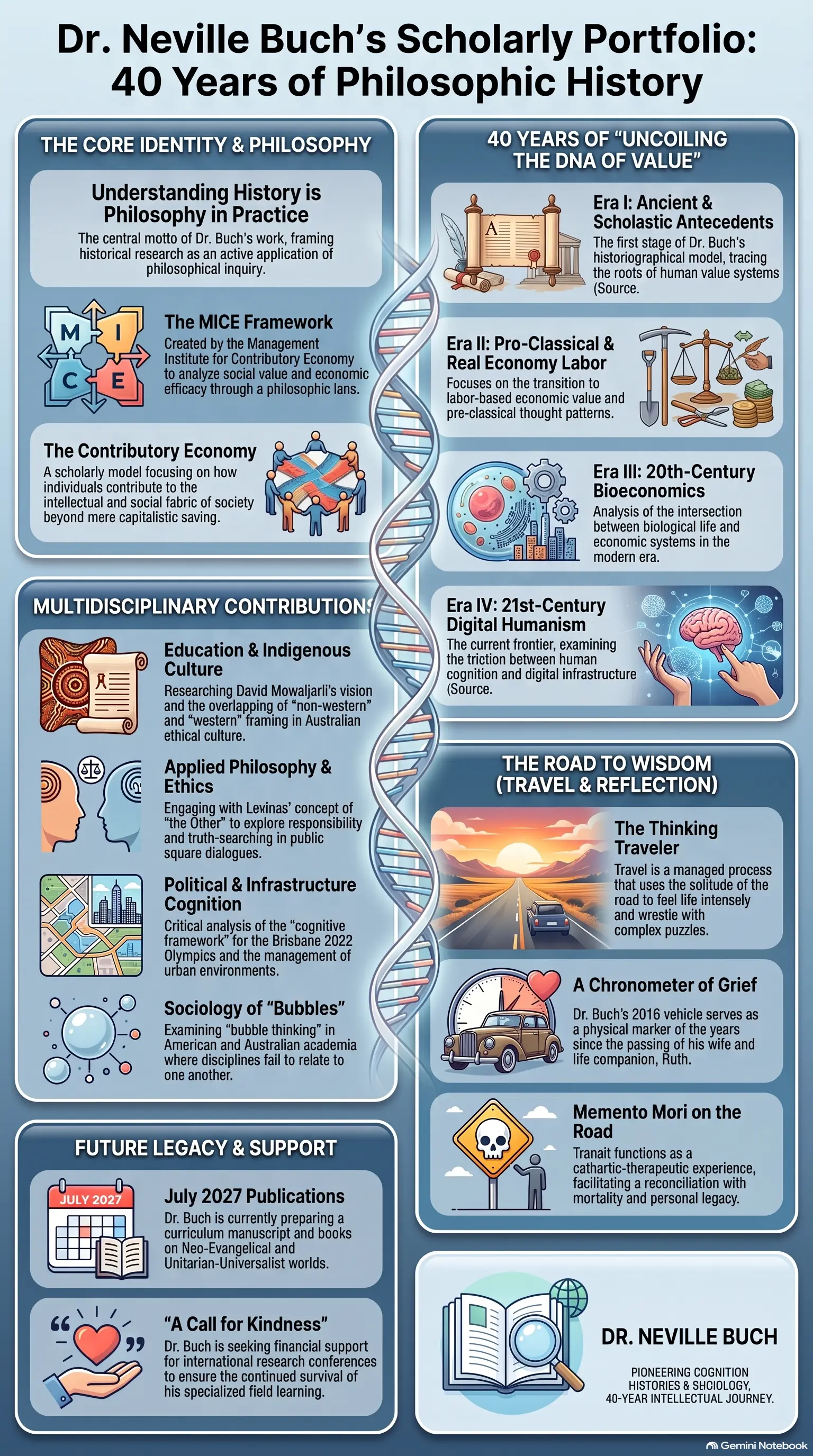


Neville Buch
Latest posts by Neville Buch (see all)
- Agency, Spiral History, and the Market Chaos Myth: Reclaiming Human Authorship through the Contributory Economy – September 25, 2026
- The Nostalgia Trap – September 25, 2026
- The Techné Critique Soundly Refuted – September 24, 2026