
Abstract
This essay examines the cognitive and political dynamics of sport-induced bias, focusing on how intense athletic allegiance can distort human reasoning and endanger broader societal values [Babad & Katz 1991, p. 1923; Swans Incident 2026, p. 173]. Grounded in Elisha Babad’s psychological formulation of Wishful Thinking (WT) —defined as the systematic alignment of expectations with emotional preferences—this paper investigates how the “sport obsessed” fan moves from an unreflective “win at all costs” mentality to an authoritarian political worldview [Babad & Katz 1991, p. 1921; Buch 2025f, p. 2]. By analysing two primary contemporary case studies—the Trump administration’s 2026 proposal to construct a Major League Baseball stadium inside Wyoming’s Grand Teton National Park and the urban planning controversies surrounding the Brisbane 2032 Olympic Games—we demonstrate how demagogic politicians exploit fanatical sports bias for political gain, trading irreplaceable environmental and civic commons for commercial entertainment [Spring & Apstein 2026, p. 156; Swans Incident 2026, p. 174; Low 2024, p. 93]. Bringing psychological research into dialogue with Dr. Neville Buch’s Dynamic of Cognition (DoC) , the POLICE model , and the framework of Sufficient Comprehension , this essay contrasts the drive-based automaticity of the “sport obsessed” with the reflective judgment of “balanced-thinking” sports fans [Babad & Katz 1991, p. 1931; Buch 2025d, p. 1; Buch & Peach 2024]. Ultimately, we outline how athletic engagement can be reversed to promote Aristotelian flourishing ( eudaimonia ) , character formation, and ecological equity, demonstrating why safeguarding human authorship over automated drive-based reflexes is vital for civilizational survival [Buch 2025a, p. 3; Buch 2026b, p. 6; Swans Incident 2026, p. 176].
I. Introduction: The Politics of Fanaticism and the Epistemology of Sport
Sport occupies a unique position in modern culture. Etymologically derived from the term fanatic, the modern “fan” participates in an arena where emotional subjectivity, tribal loyalty, and irrational optimism are culturally legitimized and actively celebrated [Babad & Katz 1991, p. 1923]. While sports offer opportunities for community cohesion, physical health, and shared joy, intense athletic devotion also carries significant cognitive dangers [Babad & Katz 1991, p. 1923; Swans Incident 2026, p. 173].
When a fan’s psychological investment shifts from healthy appreciation to an obsession where “their team must win at all costs,” cognitive distortions cross the boundary from the stadium into the public sphere [Babad & Katz 1991, p. 1923; Buch 2025e, p. 13]. At this point, athletic fandom becomes an authoritarian worldview: a belief that “winning is everything”, rules are mere obstacles to be subverted, and external ethical considerations—such as truthfulness, ecological preservation, and social justice—are disposable [Babad & Katz 1991, p. 1931; Spring & Apstein 2026, p. 161; Swans Incident 2026, p. 174].
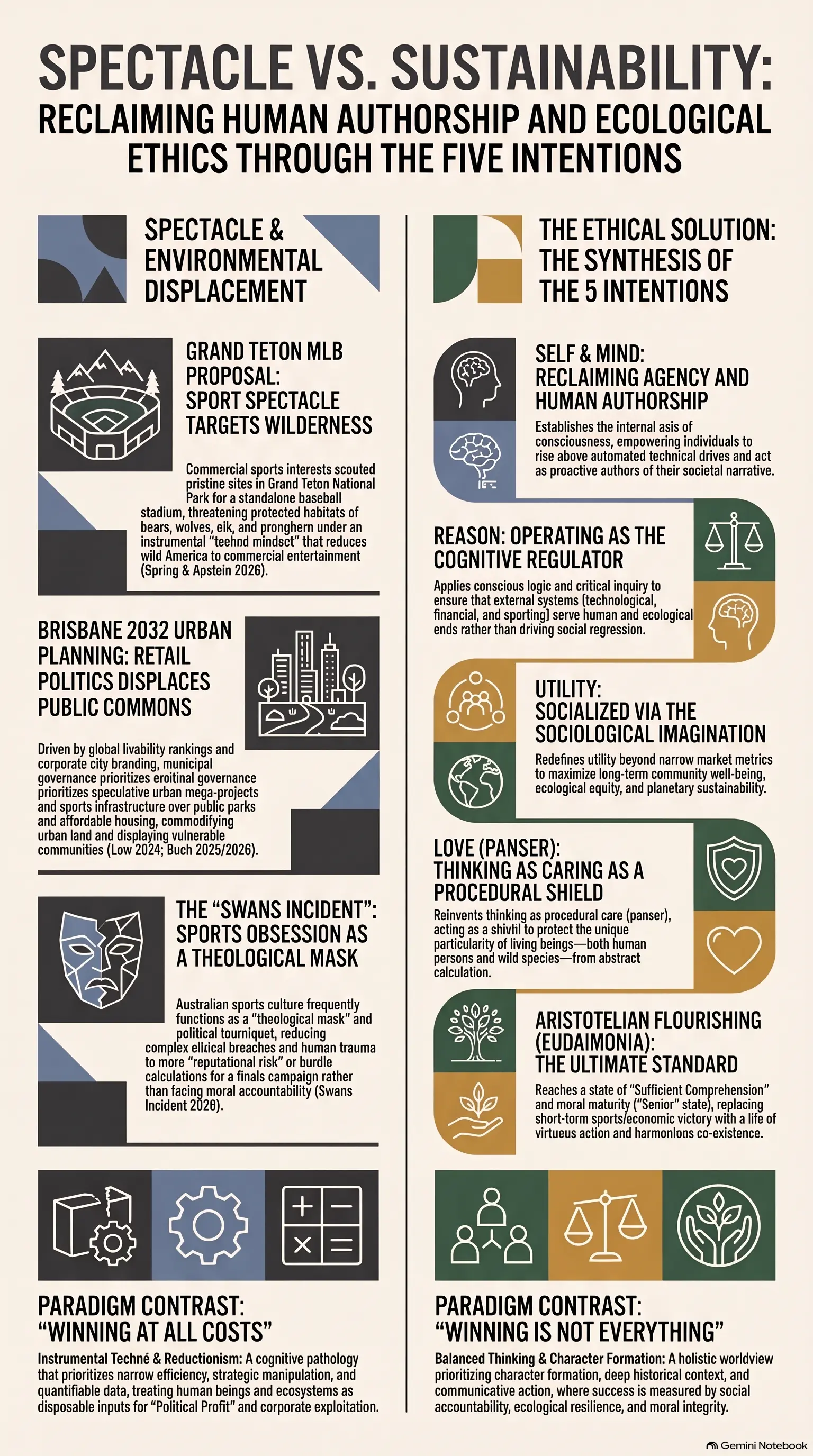
This phenomenon is vividly illustrated in contemporary politics. In September 2026, news broke that Major League Baseball had approached the Trump administration to scout locations inside Grand Teton National Park—one of America’s most pristine protected wildernesses—to construct a commercial baseball stadium for an MLB showcase game [Spring & Apstein 2026, pp. 156–158]. The willingness to entertain the physical disturbance of irreplaceable wildlife habitat for Bears, bison, and wolves to create a commercial spectacle appeals directly to a “sport obsessed” audience that prioritizes short-term athletic amusement over environmental integrity [Spring & Apstein 2026, pp. 161–164].
Similarly, in Australia, the ongoing infrastructure planning for the Brisbane 2032 Olympic Games demonstrates how mega-sporting events are routinely weaponized by political elites through “retail politics” and “positive city branding,” overriding local community needs, heritage preservation, and long-term ecological balance [Low 2024, p. 93; Swans Incident 2026, p. 174; Transference 2026, p. 188].
This essay explores the cognitive mechanisms through which sport skews human judgment, evaluates how athletic engagement can be redirected toward higher ethical ends, contrasts the “sport obsessed” with the “balanced-thinking” fan, and explains why reclaiming human authorship over drive-based sports worship is essential for democratic society [Babad & Katz 1991, p. 1923; Buch 2025d, p. 1; Swans Incident 2026, p. 176].
II. How Sport Can Skew Thinking: Wishful Thinking, Cognitive Distortion, and Political Exploitation
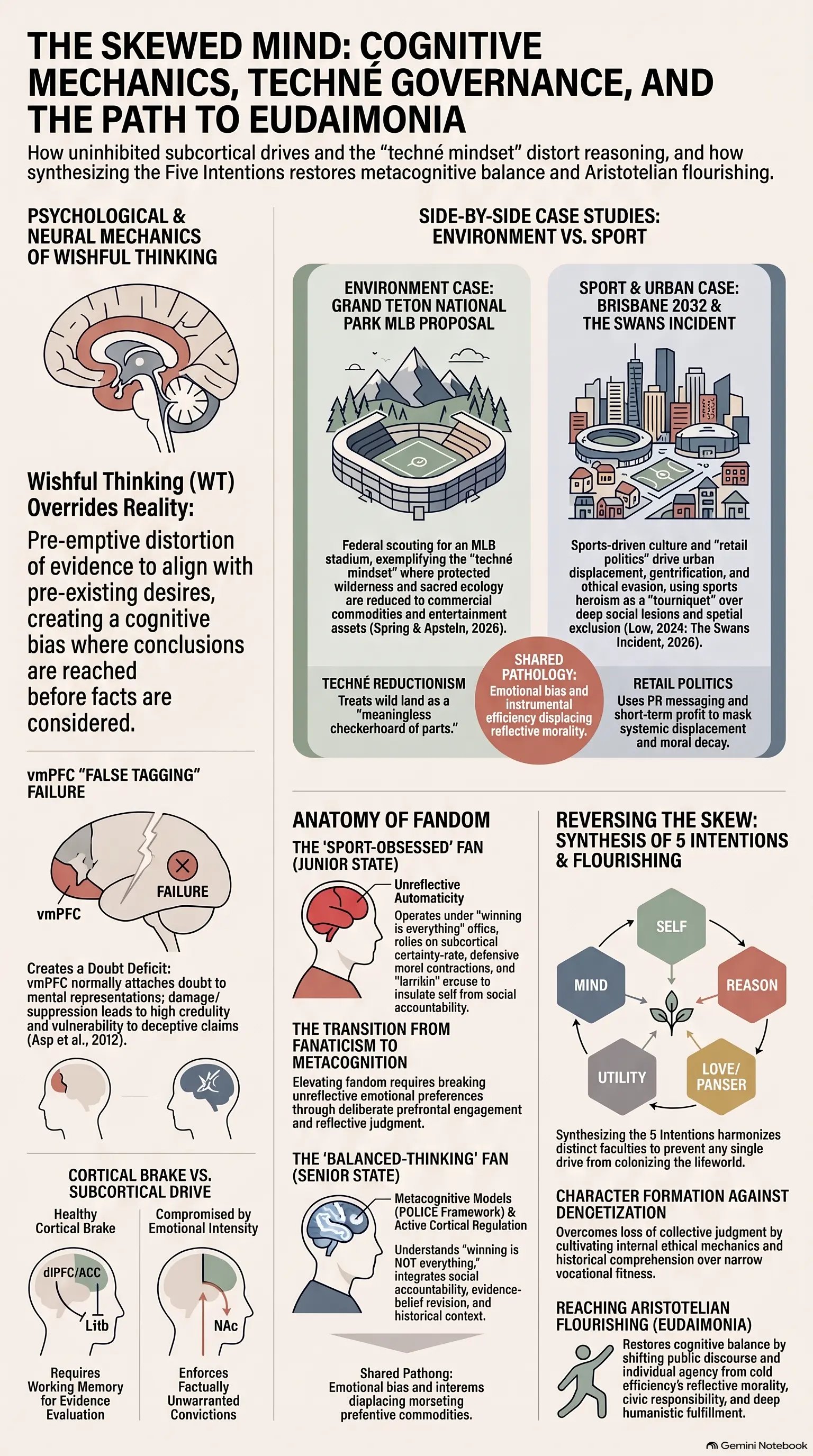
1. The Psychological Mechanics of Wishful Thinking (WT)
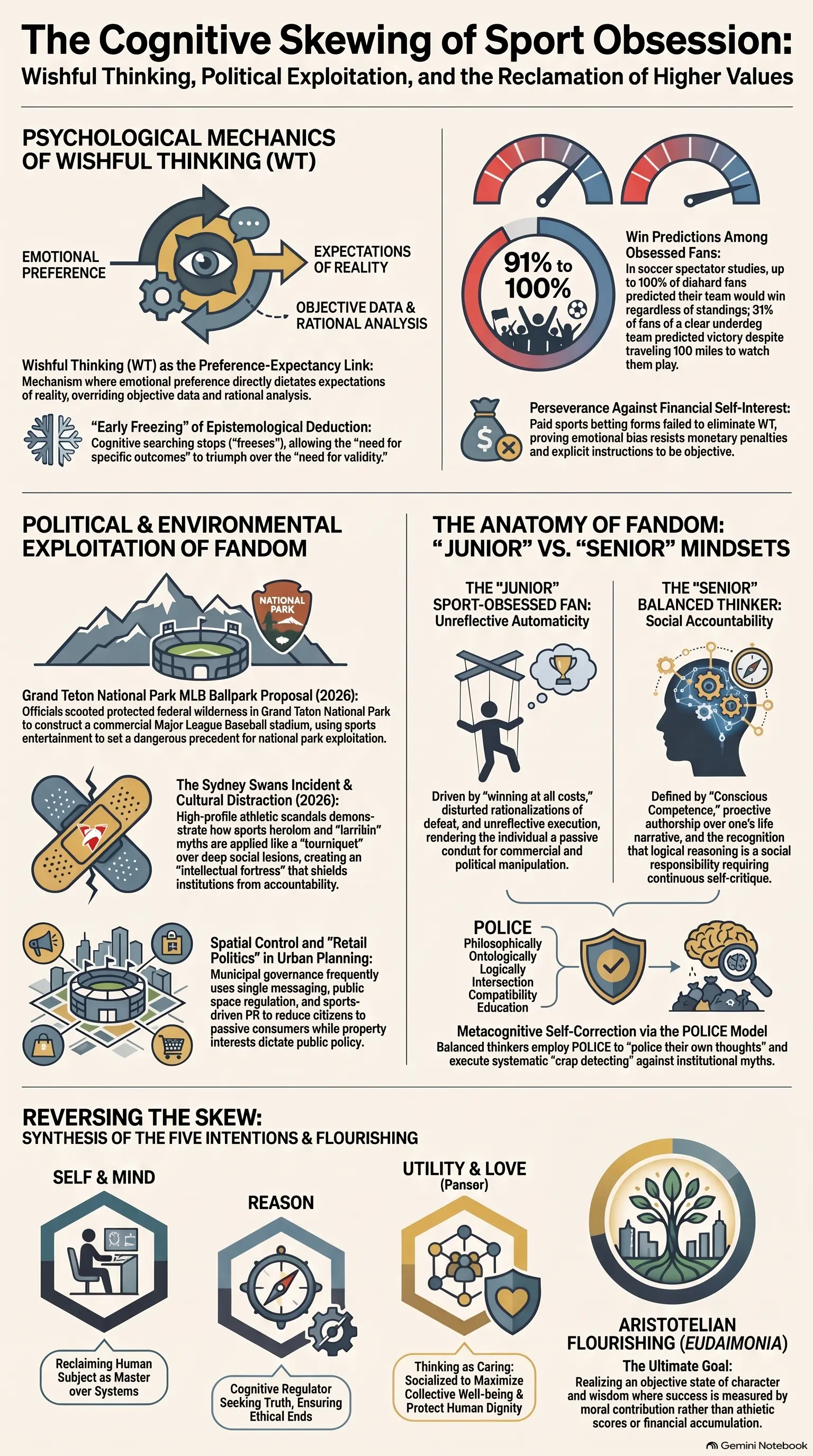
Psychological research by Elisha Babad and Yosi Katz (1991, p. 1921) operationally defines Wishful Thinking (WT) as the systematic link between subjective preferences and objective expectations. In empirical studies conducted across sports stadiums and sports-betting stations, Babad and Katz (1991, p. 1931) demonstrated that sports fans exhibit extreme levels of WT, consistently predicting that their preferred team will win regardless of objective statistics, underdog status, or disconfirming information [Babad & Katz 1991, p. 1932].
Crucially, Babad and Katz (1991, p. 1931) discovered that WT perseveres even against direct financial self-interest. Paid sports bettors, who stood to lose significant financial capital by placing inaccurate bets, were unable to overcome their emotional bias, placing wishful bets on their favorite teams against overwhelming statistical odds [Babad & Katz 1991, p. 1931]. Furthermore, experimental attempts to reduce WT by providing explicit “objectivity instructions”—reminding participants to evaluate data impartially—had negligible effect on fans’ distorted predictions [Babad & Katz 1991, p. 1934].
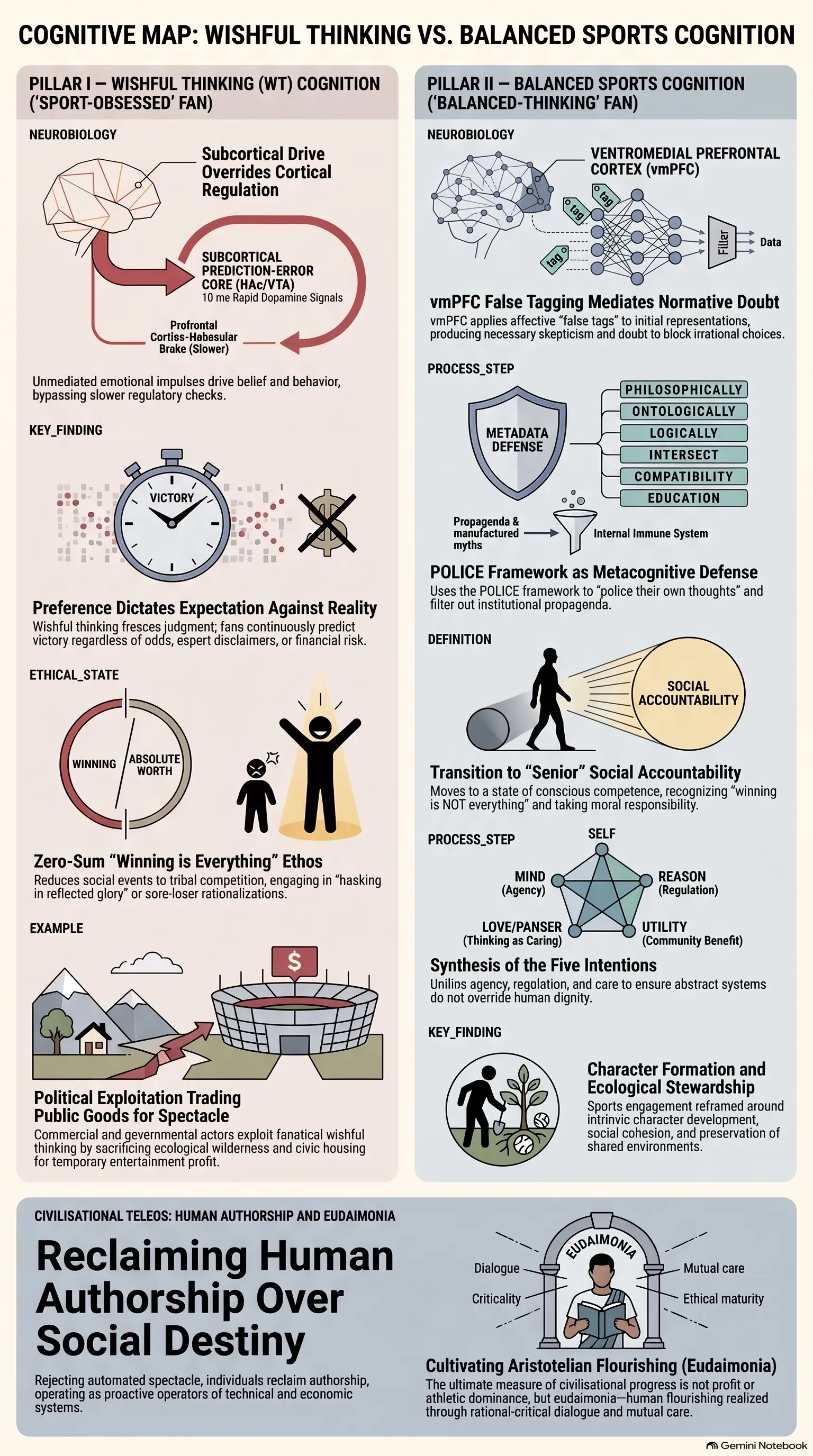
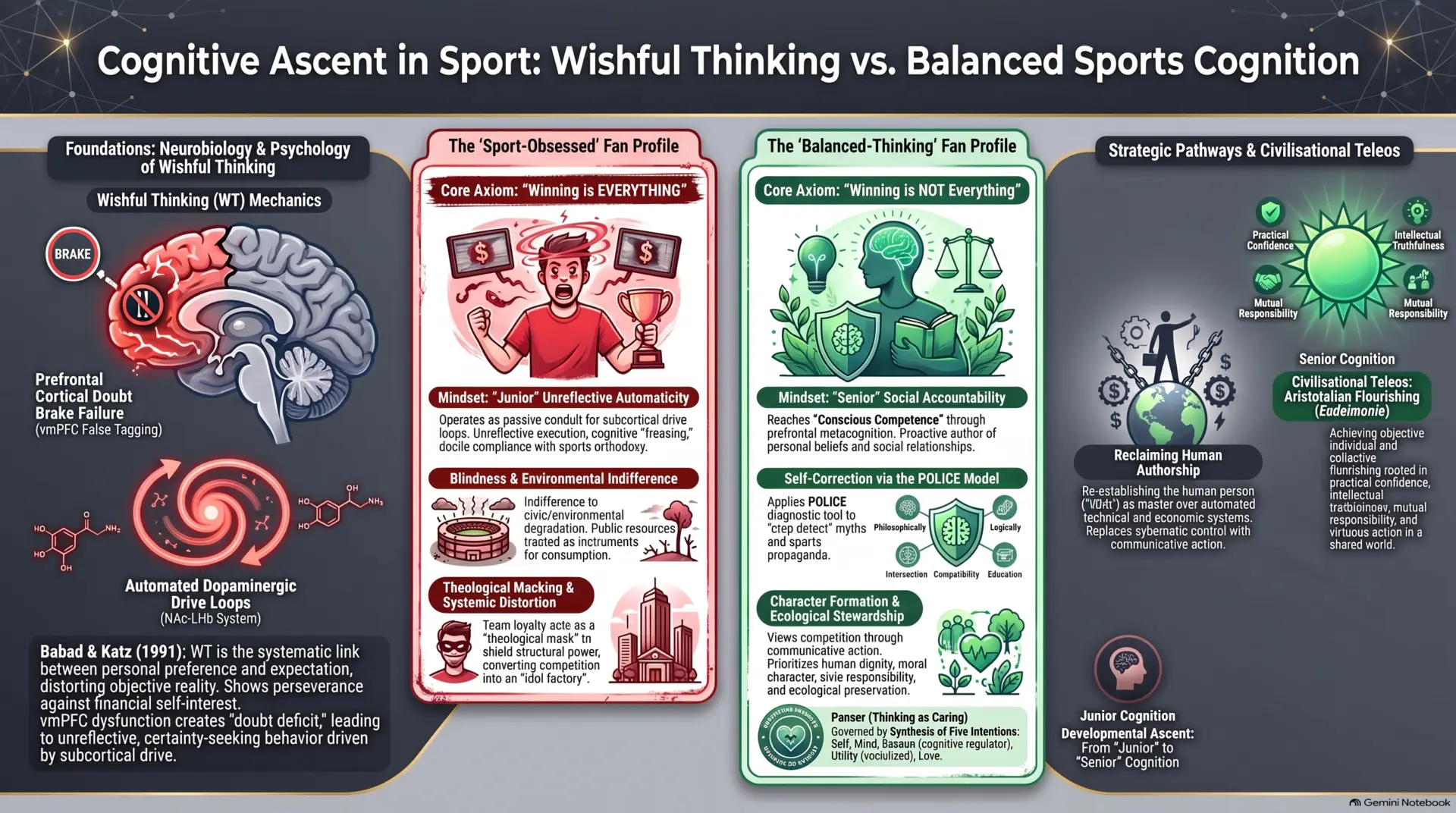
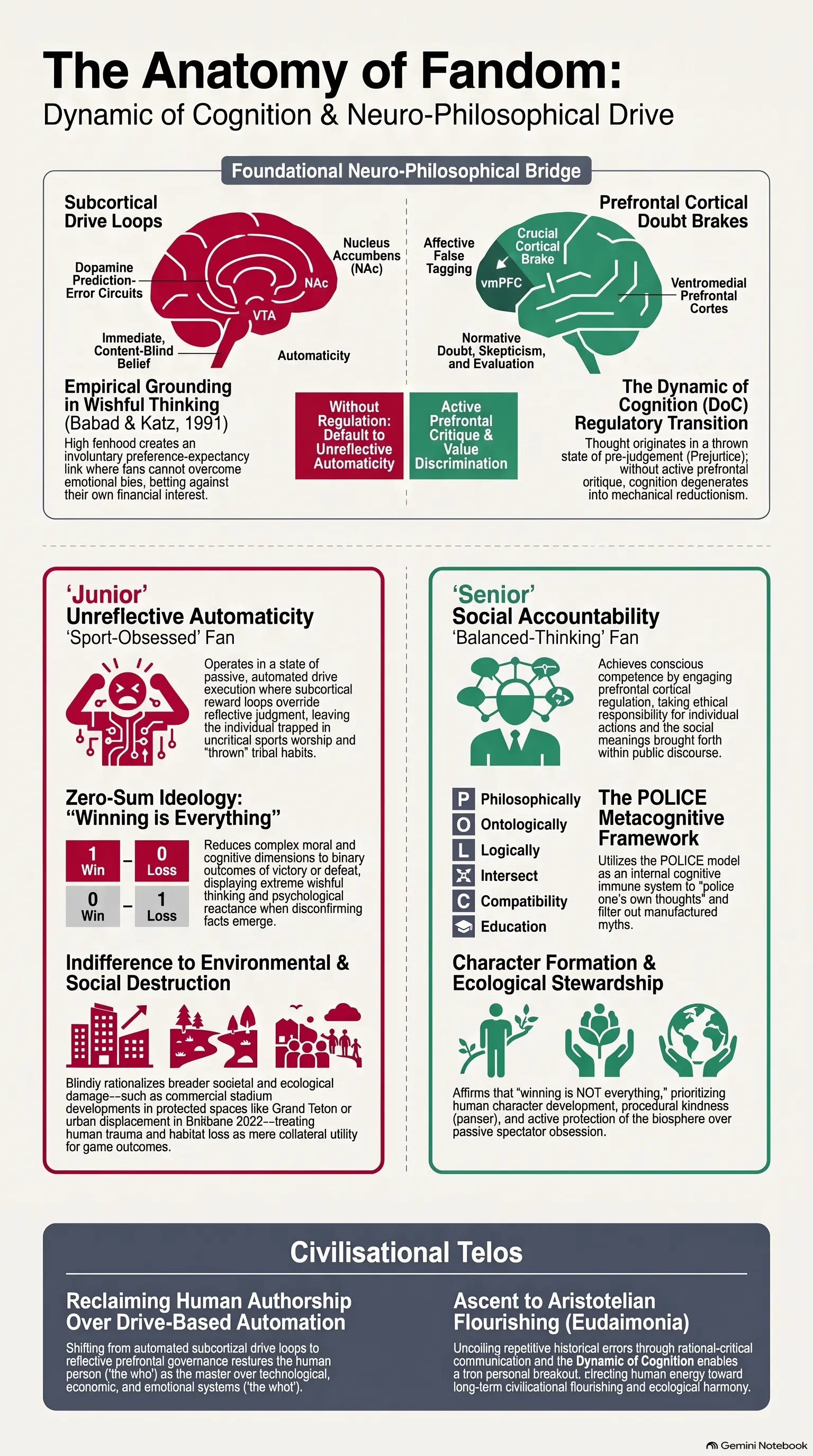
This demonstrates that intense sports devotion impairs the brain’s prefrontal cortical brake on subcortical, drive-based desires, allowing the need for a preferred outcome to override empirical validity [Asp et al. 2012, p. 112; Lincoln 2026, p. 292; Babad & Katz 1991, p. 1931].
2. From Stadium Tribalism to Political Demagogy
The cognitive vulnerability fostered by sports obsession does not remain confined to match days. Babad and associates extended their research to political elections, confirming that voters exhibiting high emotional preference display identical patterns of extreme WT when evaluating political candidates, public policy, and economic forecasts [Babad et al. 1991, cited in Babad & Katz 1991, p. 1935].
Politicians operating within the “Trumpocene”—an epoch defined by populist rhetoric, environmental denial, and the erosion of scientific expertise—exploit this preference-expectation link for political gain [Spring & Apstein 2026, p. 156; Buch 2025f, p. 2; Swans Incident 2026, p. 175]. When President Donald Trump considers building a commercial baseball field inside Grand Teton National Park, he targets an audience whose cognitive filter treats sports entertainment as an absolute good [Spring & Apstein 2026, p. 156].
For the sport-obsessed fan, the degradation of protected national parkland—described by park advocates as “ludicrous, crazy, and ridiculous”—is easily rationalized if it elevates their sport or provides a thrilling “Field of Dreams” spectacle [Spring & Apstein 2026, pp. 161–162].
A parallel dynamic appears in Australian sports culture. As documented in analyses of Australian cultural studies, sports heroism is frequently used as a “theological mask” or “tourniquet” to cover up deep social lesions, environmental degradation, and institutional corruption [Swans Incident 2026, p. 173]. In the planning for the Brisbane 2032 Olympics, corporate developers and political managers utilize “retail politics” and “singular messaging” to present sports infrastructure as an unquestionable civic triumph [Swans Incident 2026, p. 174; Transference 2026, p. 194].
Under the “techné mindset,” complex urban landscapes, historical parks, and local housing communities are reduced to a “meaningless checkerboard of parts” to be cleared for stadium footprints and corporate marketing packages [Low 2024, p. 93; MICE. Limited Thinking 2026, p. 24; Swans Incident 2026, p. 174].
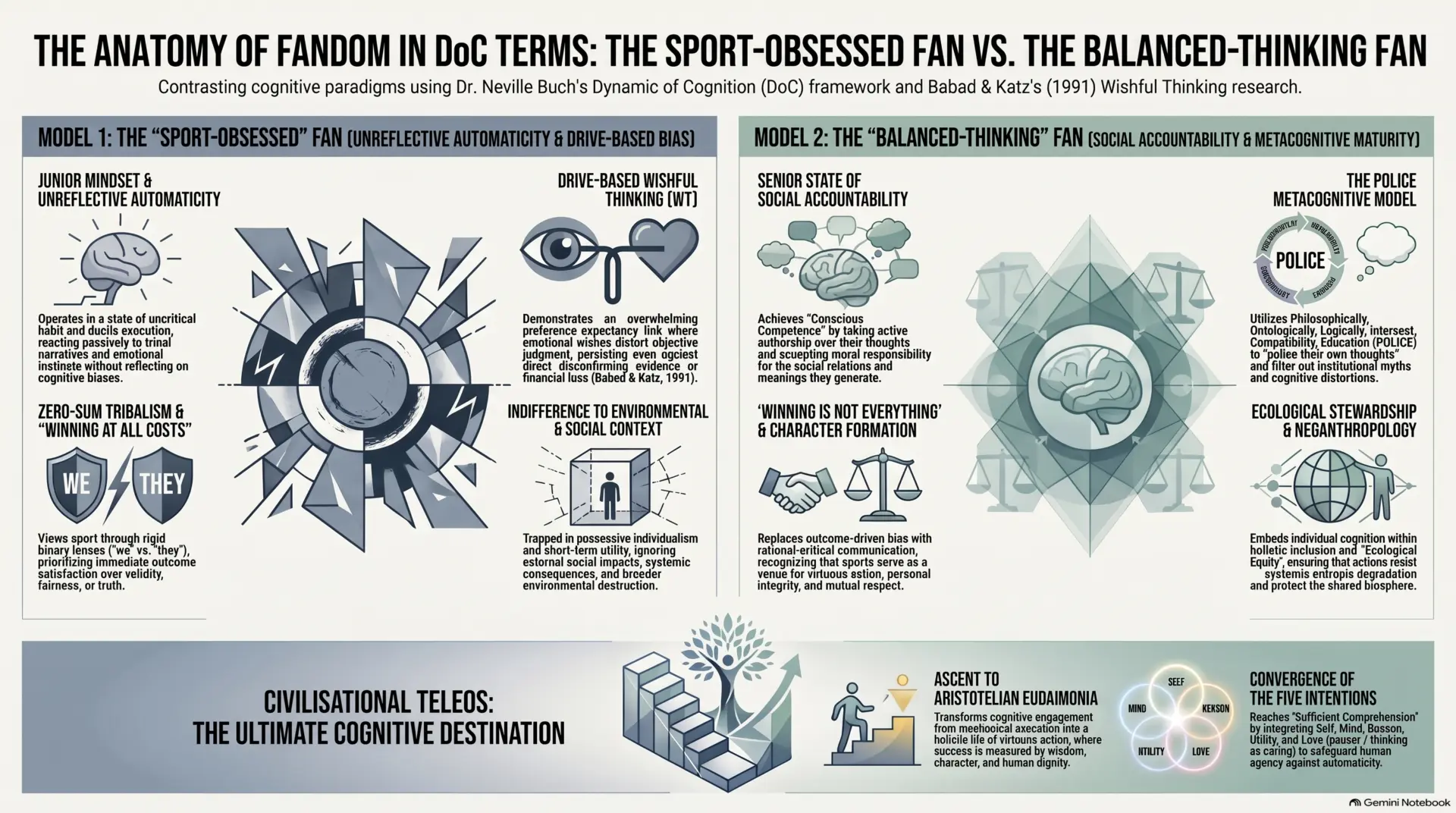
III. The Anatomy of Fanhood: The “Sport Obsessed” versus the “Balanced-Thinking” Fan
To understand how society can resist this skewing, we must establish a clear theoretical distinction between the “sport obsessed” fan and the “balanced-thinking” fan, analysing their cognitive structures through Dr. Neville Buch’s Dynamic of Cognition (DoC) framework [Buch 2025b, p. 1; Buch 2025d, p. 1]:
1. The “Sport Obsessed” Fan: Drive-Based Automaticity and “Junior” Cognition
The “sport obsessed” fan operates in a state of cognitive failure that Dr. Buch identifies as the “Junior” state of unreflective execution [Buch 2025e, p. 13; Swans Incident 2026, p. 176]. Trapped at the centre of the DoC model in unexamined Prejudice and drive-based habits, their thinking is dominated by “potted myths” and binary classifications (“us vs. them,” “winning vs. losing”) [Buch 2025b, p. 1; Cognitive Ascent, p. 203].
They exhibit extreme Wishful Thinking, allowing emotional attachments to dictate their perception of reality [Babad & Katz 1991, p. 1923]. For this individual, sport is an absolute idol; the environment, civic aesthetics, and historical truth are secondary concerns that may be sacrificed to secure athletic victory or entertainment spectacle [Spring & Apstein 2026, p. 161; Swans Incident 2026, p. 174].
2. The “Balanced-Thinking” Fan: “Senior” Accountability and Synoptic Vision
In contrast, the “balanced-thinking” fan (and ethical sports manager) practices “Sufficient Comprehension” and acts from a “Senior” state of social accountability [Buch 2025d, p. 1; Buch 2025e, p. 13; Swans Incident 2026, p. 176]. Recognizing that “winning is not everything,” the balanced fan treats athletic competition as one specific, contextualized domain within a “multi-textured social reality” [Buch 2026d, p. 84; Swans Incident 2026, p. 176].
Equipped with the metacognitive software of the POLICE model (Philosophically, Ontologically, Logically, Intersect, Compatibility, Education), the balanced fan actively “polices their own thoughts,” filtering out institutional bullshit, political propaganda, and fanatical WT [Buch & Peach 2024; Swans Incident 2026, p. 175]. They appreciate athletic skill, teamwork, and dramatic narrative, but firmly reject the notion that sport justifies environmental desecration, civic insolvency, or moral corruption [Spring & Apstein 2026, p. 164; Swans Incident 2026, p. 176].
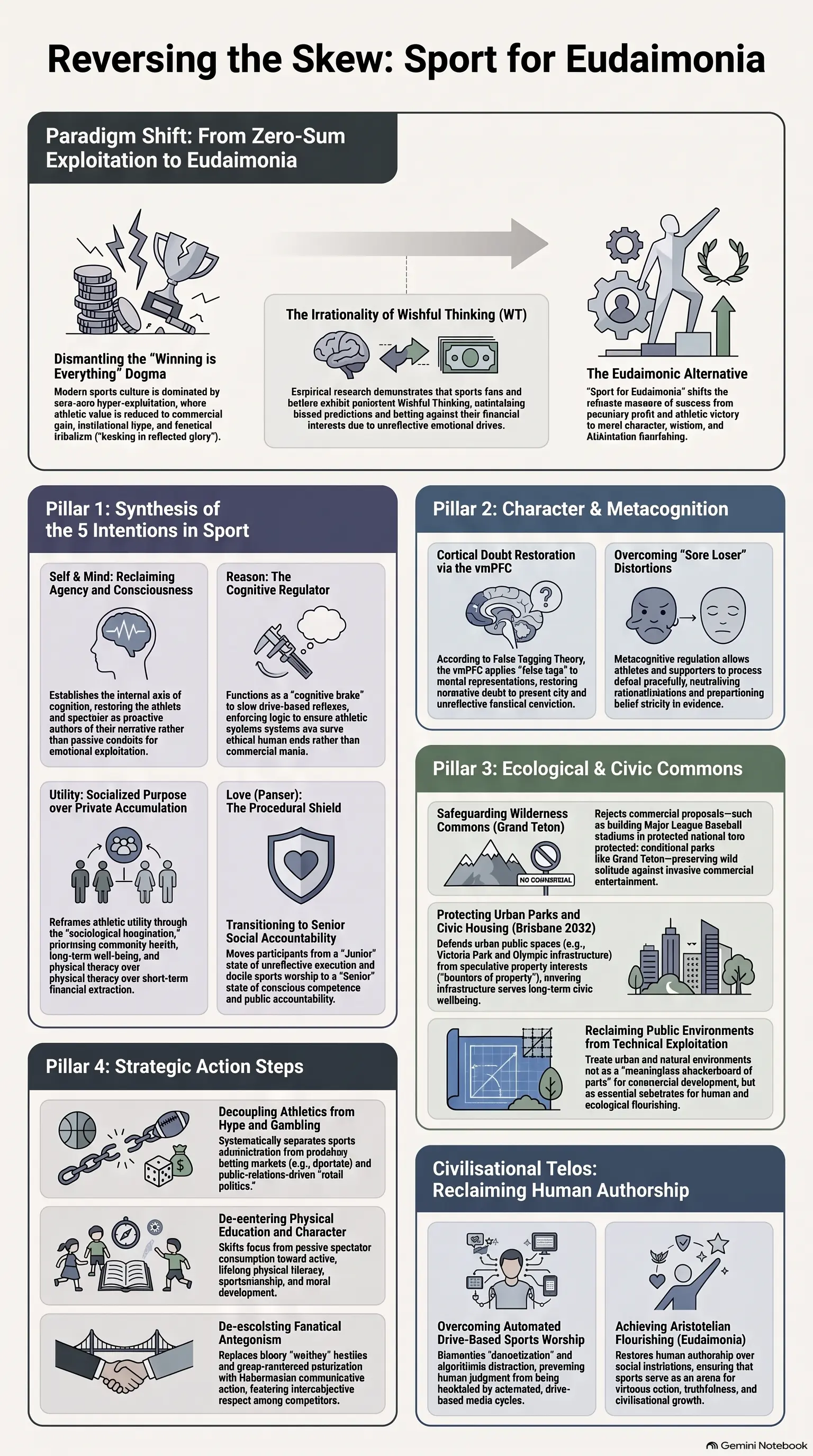
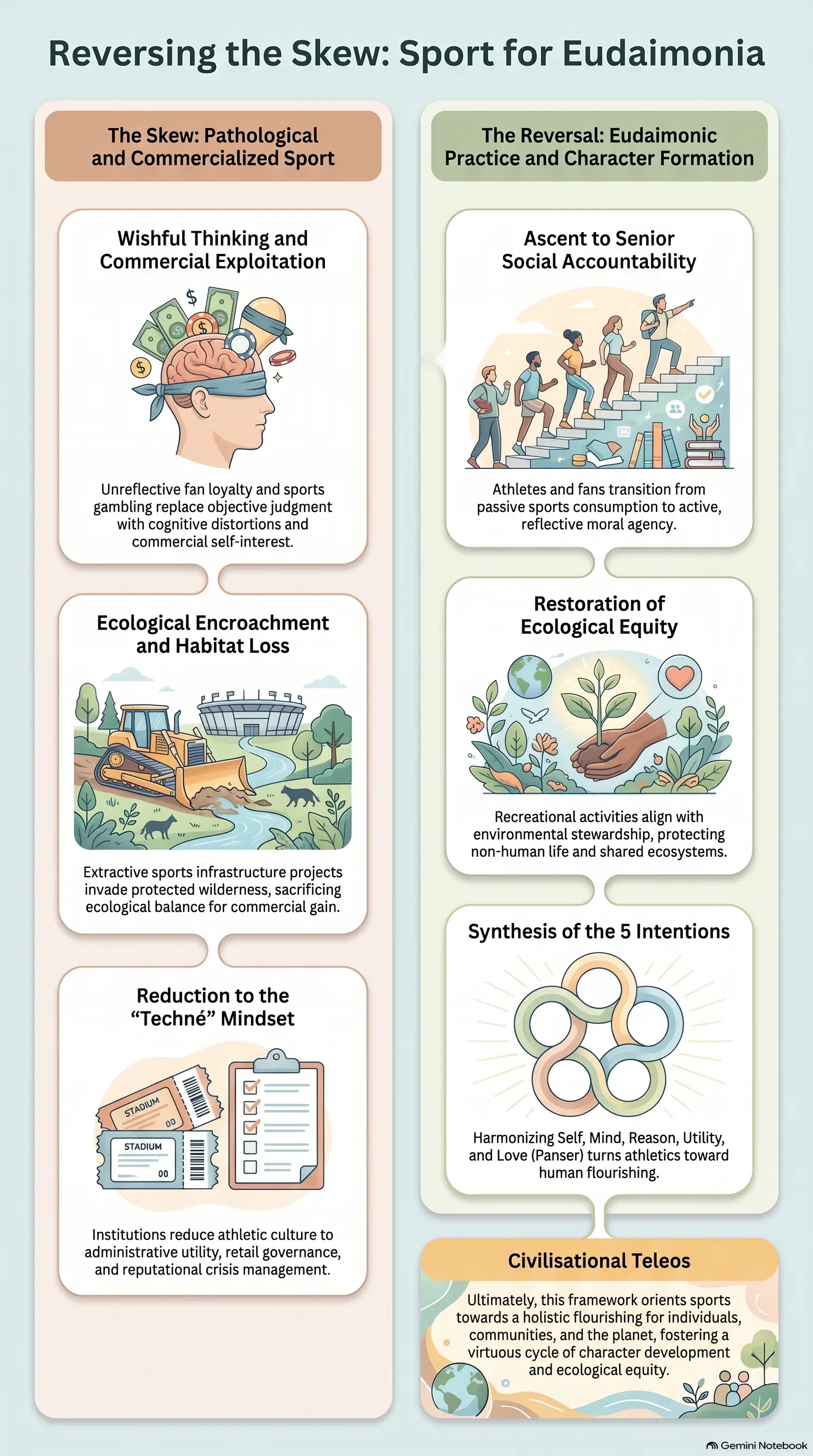
IV. How Sport Can Reverse This Skewed Process to Promote Higher Values
Sport is not inherently toxic; when liberated from commercial hyper-exploitation and demagogic manipulation, athletic practice possesses immense potential to serve as a vehicle for human flourishing and ethical education [Swans Incident 2026, p. 176; Transference 2026, p. 178]. Reversing the skewed process requires restructuring sport around three core principles:
- Re-integrating the Five Intentions: Within Dr. Buch’s humanistic framework, true athletic value is achieved through the Synthesis of the Five Intentions [Buch 2025a, p. 3; MICE. Limited Thinking 2026, p. 48]:
- Self & Mind: Cultivating physical mastery, embodied self-awareness, and mental discipline [Buch 2025b, p. 1].
- Reason: Enforcing respect for rules, impartial officiating, and objective standards of fair play as a cognitive regulator against fanatical bias [MICE. Limited Thinking 2026, p. 48].
- Utility: Socializing health benefits, recreational play, and community fitness while rejecting commercial exploitation [Transference 2026, p. 178].
- Love ( Panser / Thinking as Caring): Practicing sportsmanship, honouring the humanity of opponents, and transforming cold technical competition into mutual respect and Aristotelian flourishing ( eudaimonia ) [Stiegler 2025; Buch 2025a, p. 3; Buch 2026c, p. 4].
- Promoting Character Over “Winning at All Costs”: Balanced sports pedagogy emphasizes that losing with integrity builds character, whereas winning through cheating, environmental destruction, or ethical compromise represents moral bankruptcy [Swans Incident 2026, p. 176]. By celebrating graceful defeat and ethical resilience, sport teaches individuals how to navigate vulnerability and constitutive luck without falling into bitterness or rage [Babad & Katz 1991, p. 1923; MICE. Limited Thinking 2026, p. 41].
- Establishing Ecological Equity in Sports Infrastructure: Reclaiming sport requires subjecting athletic facilities to strict environmental standards and democratic oversight [Spring & Apstein 2026, p. 164]. Rather than invading pristine national parks or gentrifying urban neighbourhoods, sports infrastructure must be planned within an “economy of the commons,” respecting ecological boundaries and prioritizing sustainable community access over commercial profit [Low 2024, p. 93; Spring & Apstein 2026, p. 164; Transference 2026, p. 187].
V. Why This Message is Important: Protecting Democracy, Ecology, and Human Authorship
The message articulated in this essay is not merely a critique of sports culture; it is an urgent defence of democratic civilization, environmental sanity, and human agency:
- 1. Resisting Demagogic Exploitation in the Trumpocene: When citizens allow their critical thinking to be blinded by sports fanhood or tribal political allegiance, they become easily manipulated by populist demagogues [Babad & Katz 1991, p. 1935; Buch 2025f, p. 2]. Unmasking how politicians use sports spectacles as “theological masks” to hide environmental destruction and corporate handouts is essential for maintaining an informed, vigilant citizenry [Spring & Apstein 2026, p. 156; Swans Incident 2026, p. 174].
- 2. Safeguarding the Natural Commons: Wilderness areas like Grand Teton National Park represent irreplaceable ecological commons that belong to future generations [Spring & Apstein 2026, p. 161]. Permitting commercial sports developments inside national parks sets a catastrophic precedent that degrades biodiversity and privatizes public land for short-term entertainment [Spring & Apstein 2026, pp. 158, 164].
- 3. Preventing Digital and Cultural Denoetization: In an era where automated digital feeds amplify outrage, drive-based reflexes, and “potted thinking,” encouraging balanced, reflective cognition protects human beings from being reduced to “puny nodes” in commercial networks [Stiegler 2014; Buch 2025e, p. 13; Buch 2026a, p. 2].
- 4. Reclaiming Human Authorship: Ultimately, this message asserts human authorship over automated drives [Buch 2025e, p. 12; Buch 2026b, p. 6]. By adopting the POLICE framework and ascending to “Senior” social accountability, individuals ensure that the concrete human person (the “Who”) remains the master over technical, commercial, and political systems (the “What”) [Stiegler 1998; Buch & Peach 2024; Buch 2026b, p. 6].
VI. Conclusion
The sport-obsessed fan who demands that “their team win at all costs” illustrates the dangerous ease with which human reasoning can be hijacked by emotional preference and Wishful Thinking [Babad & Katz 1991, p. 1923]. When this skewed mindset is exploited by demagogic politicians, the consequences extend far beyond the playing field—manifesting as proposals to build baseball stadiums in Grand Teton National Park or urban Olympic developments that displace local communities [Spring & Apstein 2026, p. 156; Swans Incident 2026, p. 174].
To heal this cultural pathology, society must reject the authoritarian premise that “winning is everything” [Babad & Katz 1991, p. 1931]. By cultivating balanced-thinking sports fans, enforcing the POLICE model of metacognition, and grounding athletic practice in the Synthesis of the Five Intentions, we transform sport from an instrument of commercial distraction into a school for character, mutual respect, and Aristotelian flourishing ( eudaimonia ) [Buch 2025a, p. 3; Buch & Peach 2024; Swans Incident 2026, p. 176]. In doing so, we safeguard our natural commons, protect democratic deliberation, and ensure that human beings remain the proactive authors of a humane, sustainable future [Spring & Apstein 2026, p. 164; Buch 2025e, p. 12; Buch 2026b, p. 6].
References / Bibliography
Angel, Hans-Ferdinand and Seitz, Rüdiger J. (2024). ‘Credition and the neurobiology of belief’, Frontiers in Behavioral Neuroscience, vol. 18, art. 100, pp. 1–12.
Asp, Erik, Manzel, Kenneth, Koestner, Bryan, Cole, Catherine A., Denburg, Natalie L., and Tranel, Daniel. (2012). ‘A neuropsychological test of belief and doubt: damage to ventromedial prefrontal cortex increases credulity for misleading advertising’, Frontiers in Neuroscience, vol. 6, art. 100, pp. 112–125.
Babad, Elisha. (1987). ‘Wishful thinking and objectivity among sports fans’, Social Behaviour, vol. 2, pp. 231–240.
Babad, Elisha and Katz, Yosi. (1991). ‘Wishful Thinking–Against All Odds’, Journal of Applied Social Psychology, vol. 21, no. 23, pp. 1921–1938.
Babad, Elisha, Hills, M., and O’Driscoll, M. (1991). ‘Factors influencing wishful thinking and predictions of election outcomes’, Journal of Social Psychology, vol. 131, pp. 511–528 [cited in Babad & Katz 1991, p. 1935].
Buch, Neville. (2025a). Comprehensive Understanding of Humanism Today, Dr Neville Buch, Brisbane.
Buch, Neville. (2025b). Concept-Practice X.6. Dynamic of Cognition, Dr Neville Buch, Brisbane, pp. 1–6.
Buch, Neville. (2025d). Five Intention Prejudice and Global Thinking Series. Paper No. 4: The Synoptic Vision – A Philosophical Inquiry into Comprehension, Dr Neville Buch, Brisbane, pp. 1–4.
Buch, Neville. (2025e). Comprehension: Solutions and The Plan, Management Institute for Contributory Economy, Brisbane, pp. 1–20.
Buch, Neville. (2025f). Humanism in the Trumpocene: Week 1.A (Historical Lesson from the Seventeenth Century), Dr Neville Buch, Brisbane, pp. 1–10.
Buch, Neville. (2026a). The Crisis of Comprehension and the Restoration of Deep Reading: Part 2. Response to Critics, Management Institute for Contributory Economy, Brisbane, pp. 1–5.
Buch, Neville. (2026b). The Unitarian Universalist Cognitive Ascent, Dr Neville Buch, Brisbane, pp. 1–12.
Buch, Neville. (2026c). Identity Politics and the Ascent toward Comprehensive Empathy, Dr Neville Buch, Brisbane, pp. 1–30.
Buch, Neville. (2026d). In and Out of Unity and Universality, Dr Neville Buch, Brisbane, pp. 80–85.
Buch, Neville and Peach, Neil. (2024). Philosophically Ontology Logic Intersect Compatibility Education (POLICE), Dr Neville Buch ABN: 86703686642, Brisbane.
Cialdini, Robert B., Borden, R. J., Thorne, A., Walker, M. R., Freeman, S., and Sloan, L. R. (1976). ‘Basking in reflected glory: Three (football) field studies’, Journal of Personality and Social Psychology, vol. 34, pp. 366–375 [cited in Babad & Katz 1991, p. 1923].
Cognitive Ascent: Unity, Universality, and Sufficient Comprehension. (2026). Academic Reference Document, Brisbane, pp. 202–208.
Collins, Randall. (1998). The Sociology of Philosophies: A Global Theory of Intellectual Change, Harvard University Press, Cambridge, MA.
Lincoln, Alan. (2026). ‘Uncertainty reduction as a candidate primary reinforcer: an evolutionary and neural account’, Academia Neuroscience and Brain Research, vol. 2, pp. 243–348.
Low, Setha. (2024). Unveiling Urban Inequality. A Comprehension. The Broken City by Patrick M. Condon, CityWatch / Academia.edu, pp. 93–94.
MICE. Limited Thinking and the Contributory Economy. (2026). Research Monograph, Dr Neville Buch, Brisbane, pp. 1–75.
Sloan, L. R. (1979). ‘The function and impact of sports for fans: A review of theory and contemporary research’, in J. H. Goldstein (ed.), Sports, Games, and Play, Lawrence Erlbaum, Hillsdale, NJ, pp. 219–262 [cited in Babad & Katz 1991, p. 1923].
Spring, Jack and Apstein, Stephanie. (2026). ‘Trump administration considers building baseball park in Grand Teton National Park’, The Washington Post, September 26, 2026, pp. 156–167.
Stiegler, Bernard. (1998). Technics and Time, 1: The Fault of Epimetheus, translated by R. Beardsworth and G. Collins, Stanford University Press, Stanford.
Stiegler, Bernard. (2014). Symbolic Misery, 1: The Hyperindustrial Epoch, translated by D. Ross, Polity Press, Cambridge.
Stiegler, Bernard. (2025). The Immense Regression: What is Called Caring? (Vol. 1), K. Verlag, Berlin.
The Swans Incident: A Study in Australian Cultural Decay. (2026). Academic Reference Document, Brisbane, pp. 172–176.
Transference: Character and the Contributory Economy. (2026). Research Monograph, Dr Neville Buch, Brisbane, pp. 177–195.


Neville Buch
Latest posts by Neville Buch (see all)
- The Epistemology of Fanaticism: Wishful Thinking, Political Exploitation, and the Reclamation of Higher Values in Sport – September 27, 2026
- Agency, Spiral History, and the Market Chaos Myth: Reclaiming Human Authorship through the Contributory Economy – September 25, 2026
- The Nostalgia Trap – September 25, 2026