
Dr Neville Buch[1]
The “From Cartesian Dualism to Lived Philosophy” audio commentary on MICE’s Contributory Economy and Human Authorship:
Abstract
Traditional Christian Belief is the heart of uncoiling the psychology of Western traditional belief system. This essay will make sense for many “western believers” but not for those whose ‘worlds’ has been outside basic Christian thought. There are nevertheless parallel systems of beliefs, secular and “religious”, that connects to the ideas as follows: The spiral of Christian thought has been caught between “hating the world” and “loving the sinner”. The force of the spiral has been to see ‘the world’ and ‘the sinner’ homogenously. The traditional belief is the apocalyptic downward spiral for ‘the world’ and the call for an upward life of ‘the sinner’. The uncoiling is to see this subtle psychology, often unaware, as a too-simplistic paradigm of ‘the society and the individual’ or ‘caring for the world’ and ‘caring for self’ [Buch 2025c, p. 5; Cognitive Ascent 2026, p. 153].
I. What is the Psychology of the Western Traditional Belief System?
The psychology of the Western traditional belief system is fundamentally defined by an internalized dualism that separates the sacred from the profane, the eternal from the temporal, and the redeemed individual from a fallen society [Lowenthal 2019, p. 177; Merkus 2018, p. 219]. Rooted historically in Augustinian-Thomistic providential totalities, this worldview establishes an existential drama wherein the material cosmos is viewed as an apocalyptic downward trajectory (“hating the world”), while the individual soul is called to an ascetical upward ascent (“loving the sinner”) [Buch 2026d, p. 80; Buch 2024, pp. 45–47].
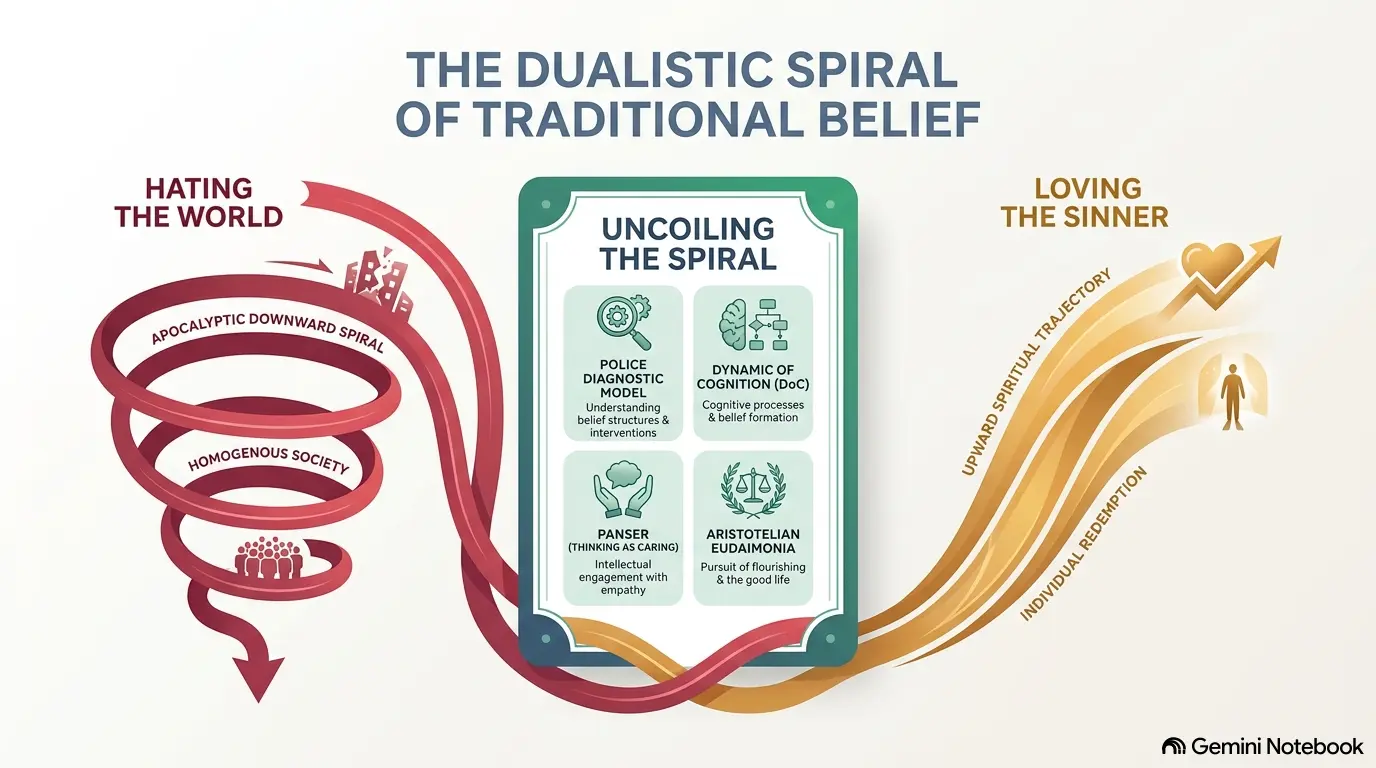
Psychologically, this binary operates through what modern neuro-philosophy and social psychology identify as creditions—implicit, brain-based belief-processes that structure human perception, value-assignment, and emotional reinforcement [Angel & Seitz 2024, p. 34; Lincoln 2026, p. 243]. In traditional fundamentalist and dogmatic belief structures, these processes become socio-cognitively rigid, combining high convictional adherence (believing) and moral traditionalism (behaving) with right-wing authoritarianism and low existential quest [Clobert et al. 2020, pp. 108–114]. The psychological engine of this system relies on “motivated closed-mindedness”—a desire for certainty that drives believers to project an undifferentiated, totalizing idea onto a complex external reality to avoid cognitive dissonance [Buch 2025g, p. 72; Asp et al. 2012, p. 112].
The primary pathology of this psychology is its tendency to treat fluid human contexts as static, totalizing entities [Buch 2025b, p. 2; Cognitive Ascent 2026, p. 153]. By homogenizing “the world” into a domain of irredeemable decay and “the sinner” into an isolated atom of personal salvation, traditional belief creates a rigid paradigm of “society versus the individual” or “caring for the world versus caring for the self” [Buch 2025c, p. 5; Cognitive Ascent 2026, p. 153]. This dualism conceals the concrete, multi-textured “thisness” (haecceity) of the historical person, reducing human agency to a passive conduit caught between cosmic condemnation and supernatural rescue [Buch 2025d, p. 2; Buch 2026b, p. 6; Merkus 2018, p. 219].
II. The Fusion of Secular and Religious Belief in Lived and Applied Philosophy
A central insight of contemporary historiography and applied philosophy is that the rigid opposition between the “religious” and the “secular” is itself an artificial category error [Buch 2025c, p. 5; Cognitive Ascent 2026, p. 153]. At the level of lived experience (Lebensphilosophie) and applied philosophy, secular and religious beliefs are deeply fused, operating on a continuous mechanistic and semantic substrate [Angel & Seitz 2024, p. 34; Buch 2024, p. 235; Lincoln 2026, p. 243].
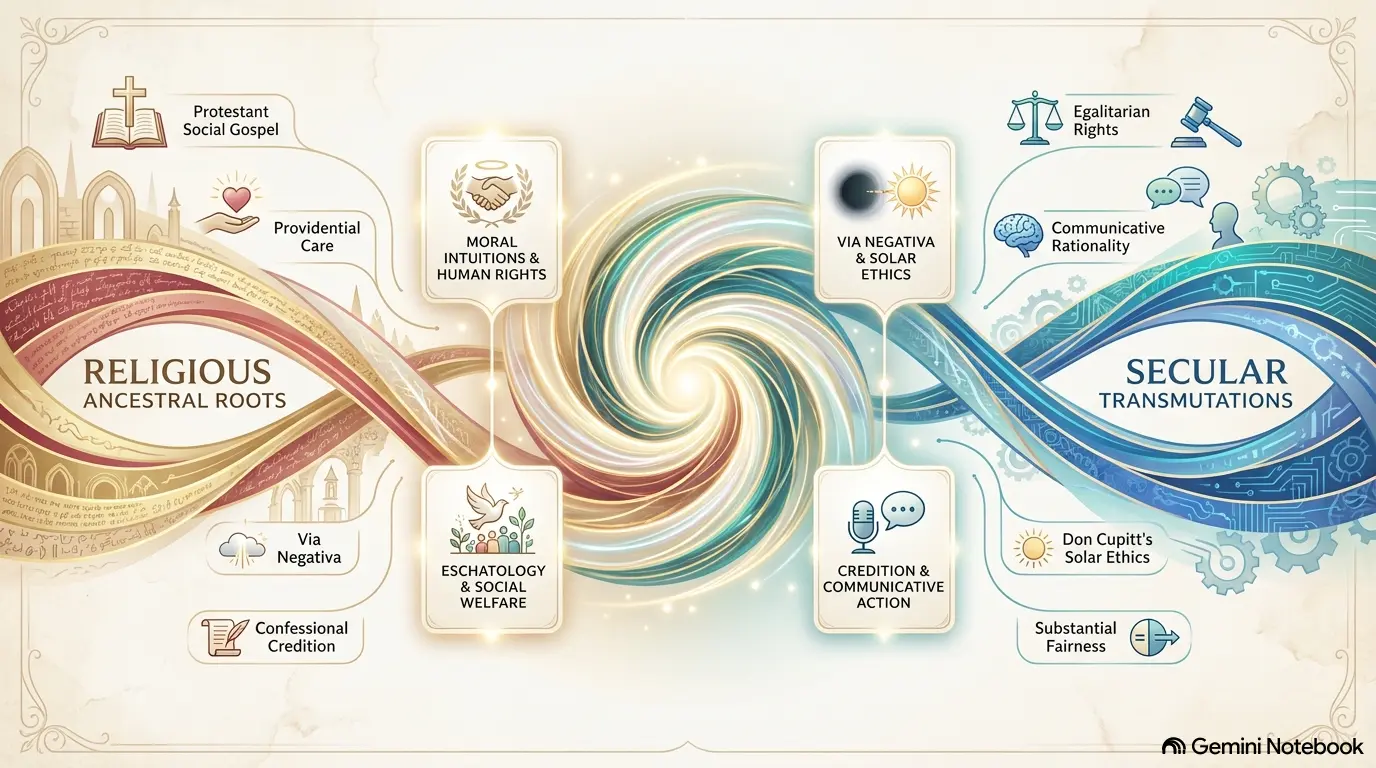
- The Transmutation of Transcendent Concepts: As Carl Schmitt and Jürgen Habermas demonstrated, modern secular political and economic concepts are historically transmuted theological ideas [A History 2025, pp. 4–5]. The modern welfare state’s insistence on egalitarian care and “substantial fairness” draws directly from the Protestant Social Gospel movement, which defined sin as economic selfishness and structural greed [A History 2025, p. 4; New Abstract 2025, p. 1]. Secular democratic reason depends upon the existential-motivational and semantic resources preserved by religious traditions to deal with human vulnerability [A History 2025, p. 4; Habermas 2008].
- The “Humanist Cult of the Secular” and Post-Christian Non-Realism: In the radical post-Christian non-realism epitomized by Don Cupitt, religious theology is translated into a purely immanent “solar ethics” and “co-humanity” [Buch 2025c, pp. 5–8]. Here, God is understood not as an external metaphysical entity, but as an ideal symbol or “ghostly memory” of the via negativa [Buch 2025c, pp. 5–8]. In lived philosophy, secular humanists and liberal believers alike practice a “radical Christianity without dogma,” where ethical action, self-criticism, and neighbourly care replace literalist supernaturalism [Buch 2025c, p. 5; Buch 2025a, p. 3].
- Credition and Cognitive Continuity: At the neuro-philosophical level, the processes of believing (creditions) function identically whether an individual is adhering to a religious creed, a scientific paradigm, or a secular political ideology [Angel & Seitz 2024, p. 34; Lincoln 2026, p. 243]. Both secularists and religionists utilize certainty acquisition as an evolutionary mechanism to reduce uncertainty and construct meaning [Lincoln 2026, p. 243; Savage 2013, p. 23]. Thus, the binary between the “secular” and the “religious” dissolves in practice, revealing a shared reliance on historical narratives, ethical commitments, and intersubjective validity claims [Habermas 1984; Savage 2013, p. 77; Buch 2026c, p. 16].
III. How the Spiral of Such Argumentized Belief Can Be Uncoiled
Uncoiling this argumentized, dualistic belief system requires moving beyond both naive linear Whig progressivism and cynical postmodern fragmentation [The Cynicism of the Market 2026, p. 1; Buch 2026b, p. 10]. Grounded in Dr. Neville Buch’s Dynamic of Cognition (DoC) and Spiral Historiography, the uncoiling process operates through four methodological interventions [Buch 2023, pp. 2–5; Buch 2025b, p. 1]:
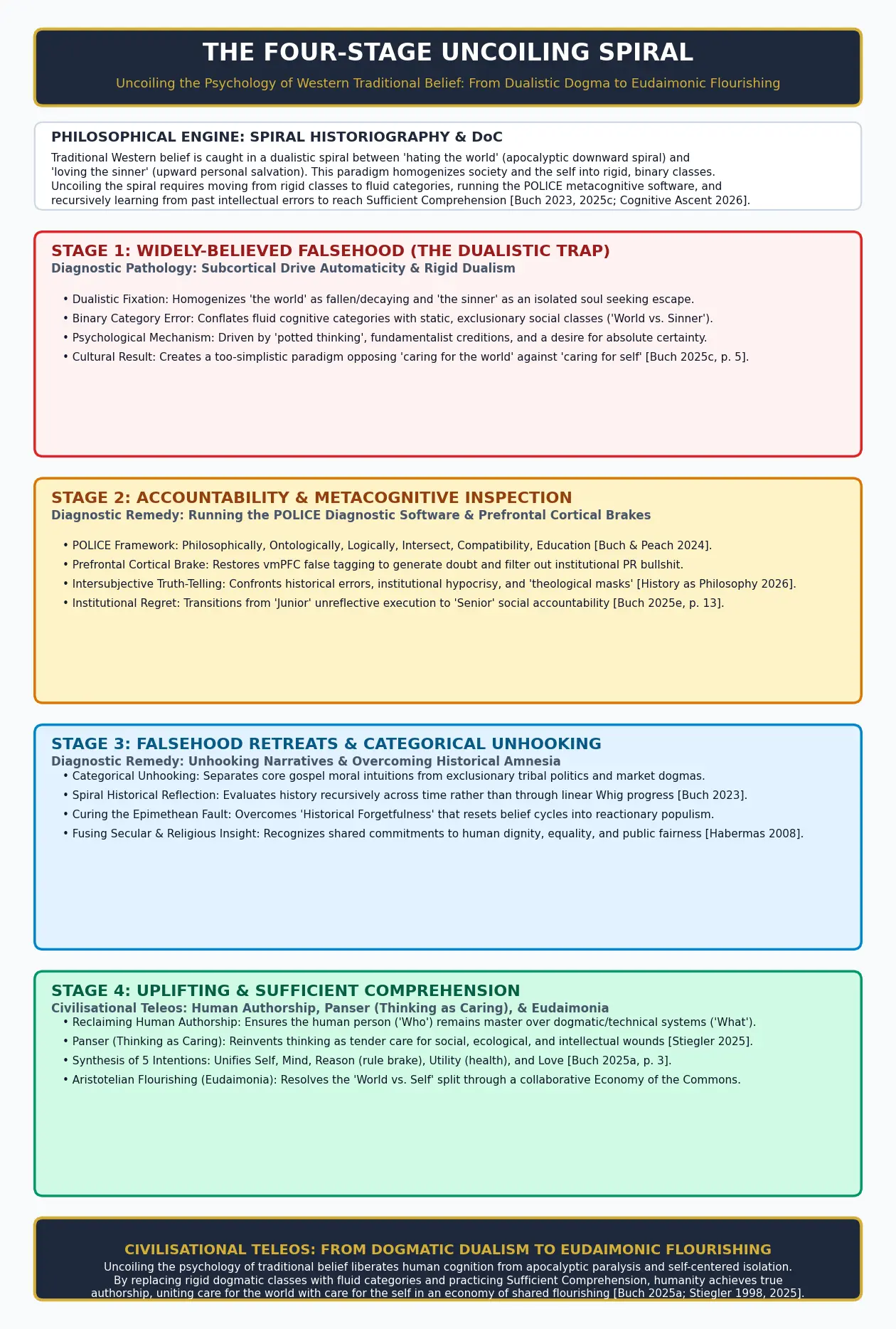
- Transitioning from Rigid Classes to Fluid Categories: The initial step in uncoiling is epistemological. As outlined in the Glossary of the UU Cognitive Ascent, a catastrophic failure of reasoning occurs when fluid cognitive categories are treated as rigid, exclusionary classes [Cognitive Ascent 2026, p. 153; The Technicisation of Thought 2026]. Uncoiling replaces totalizing binaries (“religious vs. secular,” “saved vs. damned”) with flexible, revisable categories, acknowledging that the historical person is an integrated whole whose life cannot be partitioned into isolated buckets [Buch 2025d, p. 2; Cognitive Ascent 2026, p. 153].
- Applying the POLICE Diagnostic Model: To prevent belief systems from devolving into fanatical “potted thinking,” individuals must run prefrontal metacognitive software [Buch & Peach 2024; MICE. Limited Thinking 2026, p. 6]. The POLICE model (Philosophically, Ontologically, Logically, Intersect, Compatibility, Education) functions as an “intellectual immune system,” enabling thinkers to “police their own thoughts,” filter out institutional propaganda, and detect the “theological masks” used to justify systemic injustice [Buch & Peach 2024; History as Philosophy 2026, p. 2; Identity Politics 2026, p. 29].
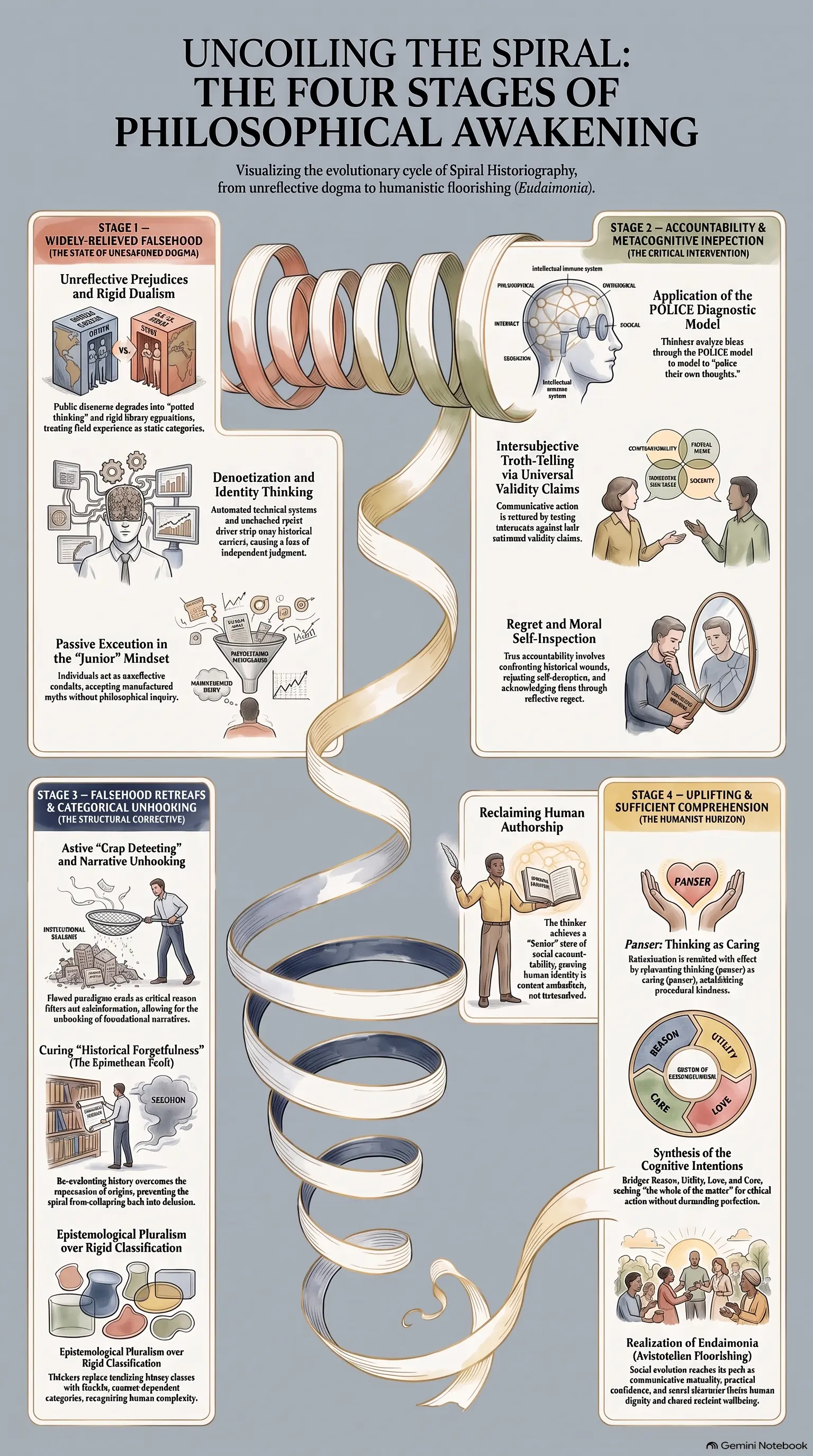
- Practicing Spiral Historiography: History must be recognized not as a static linear timeline, but as a cyclical spiral where societies periodically repeat intellectual errors [Buch 2023, p. 3; Buch 2025d, p. 1]. By recursively returning to past intellectual conflicts—evaluating the cycle from Widely-Believed Falsehood to Accountability, Falsehood Retreat, and preventing Historical Forgetfulness—thinkers “uncoil” the vicious circles of stupidity, unhooking foundational gospel narratives from exclusionary tribal politics [Buch 2025d, p. 2; Identity Politics 2026, p. 18; Identity Politics 2026, p. 29].
- Adopting Panser (Thinking as Caring): Drawing on Bernard Stiegler, uncoiling requires reinventing thinking (penser) as caring (panser) [Stiegler 2025; History as Philosophy 2026, p. 2; A History 2025, p. 5]. Panser acts as a procedural necessity that tempers the “coldness of pure calculation” with methodological tenderness, tending to the historical and social wounds created by rigid dogmatic systems [Identity Politics 2026, p. 8; History as Philosophy 2026, p. 2].
IV. Why the Spiral Should Be Uncoiled
Uncoiling the spiral of traditional belief is not an academic exercise; it is a vital prerequisite for human survival, democratic health, and civilizational flourishing [Buch 2025e, p. 12; MICE. Limited Thinking 2026, p. 48; Stiegler 2014]:
- 1. Remediating the “Epimethean Fault” and Civilizational Amnesia: When a society fails to uncoil its belief cycles, it succumbs to the Epimethean fault—a state of “Historical Forgetfulness” where the social and historical origins of concepts are banished from memory [Identity Politics 2026, pp. 18–19; MICE. Project Humanism 2026, p. 216]. This forgetfulness causes the historical spiral to reset, plunging the population back into manufactured political myths, drive-based populism, and digital denoetization [Identity Politics 2026, p. 19; Buch 2026a, p. 2].
- 2. Reclaiming Human Authorship over Automated Systems: In an era characterized by the “technicisation of thought” and algorithmic control, uncoiling restores Human Authorship [Buch 2025e, p. 12; Buch 2026b, p. 6; Identity Politics 2026, p. 16]. It ensures that the concrete human person (the “Who”) remains the proactive master over automated technical, market, and dogmatic systems (the “What”) [Stiegler 1998; History as Philosophy 2026, p. 2; Covenantal Hermeneutics 2026, p. 159].
- 3. Reaching “Sufficient Comprehension”: Uncoiling enables individuals to transcend “specialized ignorance” and “ignorant habit” to achieve Sufficient Comprehension—the capacity to seek the “whole of the matter” while filtering out fallacies and institutional bullshit [Buch 2025d, p. 1; Buch 2026c, p. 19; MICE. Limited Thinking 2026, p. 44]. Fallibilist epistemology demonstrates that we do not need absolute Cartesian certainty to act ethically; sufficient understanding, grounded in historical context and intersubjective dialogue, is fully adequate for human guidance [Buch 2023, p. 4; Covenantal Hermeneutics 2026, p. 160].
- 4. Facilitating Aristotelian Flourishing ( Eudaimonia ): Ultimately, uncoiling the spiral resolves the false dualism between “caring for the world” and “caring for the self” through the Synthesis of the Five Intentions [Buch 2025a, p. 3; Transference 2026, p. 178]. By integrating Self, Mind, Reason (as cognitive regulator), Utility (socialized for the common good), and Love (Panser), humanity moves toward Aristotelian flourishing ( eudaimonia ) [Buch 2025a, p. 3; MICE. Limited Thinking 2026, p. 48; Covenantal Hermeneutics 2026, p. 161]. In this eudaimonic state, personal growth and societal care are no longer opposed, but united within a collaborative, non-entropic “economy of the commons” [Transference 2026, p. 178; A History 2025, p. 4; Stiegler 2025].
References / Bibliography
Angel, Hans-Ferdinand and Seitz, Rüdiger J. (2024). ‘Credition and the neurobiology of belief’, Frontiers in Behavioral Neuroscience, vol. 18, art. 100, pp. 34–45 [Passages 34, 35].
Asp, Erik, Manzel, Kenneth, Koestner, Bryan, Cole, Catherine A., Denburg, Natalie L., and Tranel, Daniel. (2012). ‘A neuropsychological test of belief and doubt: damage to ventromedial prefrontal cortex increases credulity for misleading advertising’, Frontiers in Neuroscience, vol. 6, art. 100, pp. 112–125.
Buch, Neville. (2023). Spiral Historiography: Socio-Historical Change in Unitarian Universalism, Australian and New Zealand Unitarian Universalist Association (ANZUUA), Brisbane, pp. 1–12 [Passages 38, 40, 41, 42, 44].
Buch, Neville. (2024). Notes on Bengtsson: Personal Unity-in-diversity, Dr Neville Buch, Brisbane, pp. 45–50 [Passages 45, 47, 48].
Buch, Neville. (2025a). Comprehensive Understanding of Humanism Today, Dr Neville Buch, Brisbane, pp. 1–10.
Buch, Neville. (2025b). Concept-Practice X.6. Dynamic of Cognition, Dr Neville Buch, Brisbane, pp. 1–6 [Passages 1, 2].
Buch, Neville. (2025c). Comprehensive Background Today on so-called Religion and Secularity, Dr Neville Buch, Brisbane, pp. 1–12 [Passages 54, 55, 56, 58].
Buch, Neville. (2025d). Five Intention Prejudice and Global Thinking Series. Paper No. 4: The Synoptic Vision – A Philosophical Inquiry into Comprehension, Dr Neville Buch, Brisbane, pp. 1–4 [Passages 59, 61, 63, 64, 66].
Buch, Neville. (2025e). Comprehension: Solutions and The Plan, Management Institute for Contributory Economy, Brisbane, pp. 1–20.
Buch, Neville. (2025f). Rebuttal to Edward Merkus on True Unity, Dr Neville Buch, Brisbane, pp. 1–5 [Passages 69, 71].
Buch, Neville. (2025g). True Unity, Dr Neville Buch, Brisbane, pp. 1–6 [Passages 72, 73].
Buch, Neville. (2026a). The Crisis of Comprehension and the Restoration of Deep Reading: Part 2. Response to Critics, Management Institute for Contributory Economy, Brisbane, pp. 1–5.
Buch, Neville. (2026b). The Unitarian Universalist Cognitive Ascent, Dr Neville Buch, Brisbane, pp. 1–12.
Buch, Neville. (2026c). Identity Politics and the Ascent toward Comprehensive Empathy, Dr Neville Buch, Brisbane, pp. 1–30 [Passages 76, 78, 83, 84, 85, 87, 88, 90, 94].
Buch, Neville. (2026d). In and Out of Unity and Universality, Dr Neville Buch, Brisbane, pp. 80–85 [Passages 95, 97, 98, 99, 100, 101].
Buch, Neville and Peach, Neil. (2024). Philosophically Ontology Logic Intersect Compatibility Education (POLICE), Dr Neville Buch ABN: 86703686642, Brisbane.
Clobert, Magali, Saroglou, Vassilis, Cohen, Adam B., Johnson, Kathryn A., Ladd, Kevin L., Brandt, Pierre-Yves, Murken, Sebastian, Muñoz-García, Antonio, Adamovova, Lucia, Blogowska, Joanna, Çukur, Cem Safak, Hwang, Kwang-Kuo, Miglietta, Anna, Motti-Stefanidi, Frosso, Roussiau, Nicolas, and Valladares, Javier T. (2020). ‘Fundamentalism as Dogmatic Belief, Moral Rigorism, and Strong Groupness Across Cultures: Dimensionality, Underlying Components, and Related Interreligious Prejudice’, Psychology of Religion and Spirituality, Advance online publication, pp. 104–151 [Passages 108, 114, 116, 120, 134].
Cognitive Ascent: Unity, Universality, and Sufficient Comprehension. (2026). Academic Reference Document, Brisbane, pp. 152–155 [Passages 152, 153, 154, 155].
Covenantal Hermeneutics and the Dynamic of Cognition. (2026). Research Monograph, Dr Neville Buch, Brisbane, pp. 159–161 [Passages 159, 160].
Habermas, Jürgen. (1984). The Theory of Communicative Action, Vol. 1: Reason and the Rationalization of Society, translated by T. McCarthy, Beacon Press, Boston.
Habermas, Jürgen. (2008). Between Naturalism and Religion: Philosophical Essays, Polity Press, Cambridge.
History as Philosophy in a Contributory Economy. (2026). Research Monograph, Management Institute for Contributory Economy, Brisbane, pp. 162–168 [Passages 162, 163, 164, 165, 167].
Lincoln, Alan. (2026). ‘Uncertainty reduction as a candidate primary reinforcer: an evolutionary and neural account’, Academia Neuroscience and Brain Research, vol. 2, pp. 243–348 [Passage 176].
Lowenthal, David. (2019). Quest for the Unity of Knowledge, Routledge, London, pp. 177–178 [Passages 177, 178].
Merkus, Edward. (2018). The Idea of Unity in Philosophy, Research Monograph, Brisbane, pp. 217–220 [Passages 219, 220].
MICE. A History of Contributory Economy and Religion: The Telos of Marion Maddox (Early Draft). (2025). Research Monograph, Dr Neville Buch, Brisbane, pp. 1–10 [Passages 9, 10, 11, 14, 22, 23, 30, 31, 32].
MICE. Limited Thinking and the Contributory Economy. (2026). Research Monograph, Dr Neville Buch, Brisbane, pp. 1–75 [Passages 181, 183, 184, 186, 189, 196, 197, 204, 211].
MICE. Project Humanism and the Contributory Economy. (2026). Research Monograph, Dr Neville Buch, Brisbane, pp. 212–216 [Passages 212, 215, 216].
New Abstract of 274 words. (2025). Academic Reference Document, Brisbane, pp. 1–2 [Passages 222, 223].
REVIEW Humanism in the Trumpocene WK 1.A. (2025). Lecture Monograph, Dr Neville Buch, Brisbane, pp. 233–238 [Passages 233, 234, 235, 236].
Savage, Allan M. (2013). Phenomenology and Social Construction within Orthodox Theology, Research Monograph, pp. 240–268 [Passages 241, 243, 253, 262, 263].
Stiegler, Bernard. (1998). Technics and Time, 1: The Fault of Epimetheus, Stanford University Press, Stanford.
Stiegler, Bernard. (2014). Symbolic Misery, 1: The Hyperindustrial Epoch, Polity Press, Cambridge.
Stiegler, Bernard. (2025). The Immense Regression: What is Called Caring? (Vol. 1), K. Verlag, Berlin.
The Cynicism of the Market: Foundherentism, Contributory Economy, and the Subversion of Luchel’s Rent-Seeking Epistemology. (2026). Monograph, Dr Neville Buch, Brisbane, pp. 269–270 [Passages 269, 270].
The Technicisation of Thought and the Crisis of Comprehension. (2026). Academic Reference Document, Brisbane, pp. 271–273 [Passages 271, 272, 273].
Transference: Character and the Contributory Economy. (2026). Research Monograph, Dr Neville Buch, Brisbane, pp. 177–195 [Passages 277, 279, 281, 282].
Take the MICE Quiz
[1] Artificial Intelligence (A.I.) has been fairly used in the production of this work. The tool used is Google NotebookLM (recently rebranded as Gemini Notebook). It is an AI-powered virtual research assistant and thinking partner designed to help a person interact deeply with their own documents. Unlike general chatbots, it is source-grounded, meaning it only generates answers based on the specific PDFs, documents, or links uploaded. The A.I. process in the production of this work has been limited to the attached (prompts) on each of the questions in turn. This ensures an accurate reading of each source. The author then rearranged and re-edited the answers the A.I. provided. The human author publishes this work. A.I. is never an author when used properly. This assistance is not qualitatively different from a human research assistant when that assistance is deemed to have no authorial status but is acknowledged.


Neville Buch
Latest posts by Neville Buch (see all)
- Uncoiling the Psychology of the Western Traditional Belief System – October 5, 2026
- Death in Life and Life in Death: Affective, Intellectual, and Ontological Dimensions of Human Mortality – October 2, 2026
- Psychological Symbol Cards – October 2, 2026