
“The Cost of Outsourcing Human Thought” audio commentary on MICE’s Contributory Economy and Human Authorship:
Abstract
This essay explores the metaphoric “Common Well” – “the Commonwealth of Common Thinking” — as the essential intersubjective foundation for shared reason, civic dialogue, and intergenerational wisdom [Buch 2026a: 12; Habermas 1979: 3]. Drawing upon contemporary critical sociology and the Management Institute for Contributory Economy (MICE) framework, the paper investigates how this vital intellectual resource is systematically being “dried up” across three distinct yet deeply interconnected fronts [Buch 2026b: 7; Furedi 2026: 2]. First, David A. Graham’s (2026) analysis of MAGA identity politics demonstrates how tribal grievance and demographic signifiers poison shared civic discourse [Graham 2026: 2]. Second, Jussi S. Jauhiainen’s (2026) empirical synthesis of Generative AI and Large Language Models (LLMs) in educational assessment illustrates how automated grading and feedback replace deep human judgment with mechanical Techné, accelerating denoetization [Jauhiainen 2026: 3; Stiegler 1998: 10]. Third, the essay evaluates Frank Furedi’s (2026) thesis on the crisis of socialisation, arguing that while Furedi correctly diagnoses the unravelling of adult responsibility and the abdication of intergenerational guidance, his critique is limited by its partisan attribution of this crisis to “woke elite culture” [Furedi 2026: 3]. Finally, the paper demonstrates that the “Common Well” serves as the unifying conceptual nexus connecting tribal political thinking, educational automation, and adult infantilisation [Buch 2026a: 43]. To replenish the well, the essay advocates for MICE Contributory Economics, Spiral Historiography, and the restoration of Senior social accountability to ensure that human beings remain the proactive authors of their shared social and intellectual world [Buch 2026b: 18; Jameel 2026: 1].
Introduction: The Metaphoric Common Well and the Commonwealth of Common Thinking
In his 2026 correspondence on contemporary cultural and educational crises, Dr. Neville Buch remarked that “there is something in the water in the common well” [Furedi 2026: 1; Buch 2026a: 42]. In the sociology of knowledge and the philosophy of the Management Institute for Contributory Economy (MICE), the “Common Well “signifies the Commonwealth of Common Thinking – “the shared, intersubjective pool of public reason, moral-practical consensus, historical memory, and truthfulness upon which a democratic society depends [Buch 2026a: 12; Habermas 1979: 3; McKinney 1971: 289]. The Common Well is not a static container of dogmatic tradition, but a dynamic “we-space” forged through communicative action (Verständigung), rational-critical critique, and intergenerational stewardship [Habermas 1979: 3; Buch 2026b: 8]. It provides the intellectual and ethical sustenance necessary for citizens to move beyond a “Junior” state of unreflective, docile execution toward a “Senior” state of social accountability and Aristotelian flourishing (eudaimonia) [Buch 2026a: 43; Buch 2026b: 7].
However, in the contemporary era – “marked by what Buch diagnoses as an “immense regression” and Bernard Stiegler designates as denoetization (the mechanical liquidation of human judgment under automated systems) – “the Common Well is rapidly drying up [Stiegler 1998: 10; Buch 2026a: 11; Buch 2026b: 38]. Rather than drawing from a clean, shared reservoir of holistic scholarship, humanistic care (panser), and critical reflection, public life is increasingly poisoned by partisan outrage, automated efficiency, and the abdication of adult responsibility [Graham 2026: 2; Jauhiainen 2026: 3; Furedi 2026: 2].
This essay subjects the desiccation of the Common Well to rigorous forensic analysis across three critical domains: identity political thinking [Graham 2026: 1], educational AI automation [Jauhiainen 2026: 1], and the crisis of adult socialisation [Furedi 2026: 1]. It then establishes how the metaphor of the Common Well synthesizes these three seemingly disparate phenomena into a unified critique of modern cognitive decline, proposing a MICE-based pathway toward recovery [Buch 2026b: 15].
I. The Desiccation of Public Reason: Identity and Political Thinking (Graham 2026)
The first major force drying up the Common Well is the metastasization of hyper-partisan identity and political thinking [Graham 2026: 1; Buch 2023: 3]. In his 2026 Atlantic study, “The Right’s Identity Politics Take a Bizarre Turn,” David A. Graham provides a vivid diagnostic of how demographic grievance has cannibalized substantive political debate [Graham 2026: 1]. Graham analyses the right-wing backlash against a 30-second political advertisement issued by Arkansas Governor Sarah Huckabee Sanders [Graham 2026: 1]. The ad promoted long-standing Republican policy – “establishing work requirements for Medicaid recipients – “by depicting a fictional, couch-bound, cheese-ball-snarling character named “Brad” [Graham 2026: 1]. Because “Brad” was portrayed by a young white male, prominent MAGA influencers and right-wing media figures immediately denounced the ad as “anti-white” and part of a “systematic discrimination against white men” [Graham 2026: 1].
Graham points out the profound historical shift this reaction represents [Graham 2026: 2]. For decades, conservative political strategists utilized coded racial “dog whistles” – “such as Lee Atwater’s abstract economic messaging, Ronald Reagan’s Neshoba County “states’ rights” speech, or the “welfare queen” trope – “to mobilize voters while maintaining plausible deniability under the guise of “colour-blind” individualism [Graham 2026: 2]. In the contemporary MAGA movement, however, plausible deniability has been discarded in favour of explicit racial signifiers and hyper-sensitive identitarian grievance [Graham 2026: 2]. As Graham observes, activists now demand that political messaging explicitly validate their demographic identity, treating any neutral or non-flattering depiction of their group as treachery [Graham 2026: 2].
From the perspective of MICE sociology, this obsession with identity political thinking acts as a toxic desiccant on the Common Well [Buch 2026b: 10]. Identity politics reduces complex, multi-textured social realities – “such as healthcare access, fiscal policy, labour markets, and structural poverty – “to flat, binary racial or cultural battles [Graham 2026: 2; Labaree 1997: 52; Weiss 2001: 39]. It replaces universal humanistic inquiry and Habermasian communicative action with zero-sum demographic warfare, where the primary objective is to demonize the “Other” and secure “Political Profit” for one’s own tribe [Westoby 2025: 251; Habermas 1979: 3; Buch 2026a: 132]. When political dialogue is governed by what L. Susan Stebbing termed “potted thinking” and visceral “crap” reactions, the shared public well of reason is polluted, preventing citizens from engaging in the collective deliberation necessary to address genuine economic and institutional problems [Stebbing 1939: 12; Graham 2026: 2; Buch 2026b: 11].
II. The Mechanization of Learning: Applied Thinking in Generative AI and LLMs (Jauhiainen 2026)
While identity politics dries up the Common Well through emotional tribalism, the uncritical deployment of Generative AI (GenAI) and Large Language Models (LLMs) in educational assessment dries it up through technological mechanization [Jauhiainen 2026: 1; Stiegler 1998: 10]. In his comprehensive 2026 study, “Generative AI and LLMs in Educational Assessment: Challenges, Evidence, and a Process-Based Framework,” Jussi S. Jauhiainen provides an integrative synthesis of empirical data on automated grading, task design, and feedback in higher education and secondary schools [Jauhiainen 2026: 1].
Synthesizing large-scale datasets – “including the evaluation of 1,016 Finnish national matriculation examination essays in Geography alongside multi-country university trials – “Jauhiainen establishes both the technical capabilities and severe pedagogical limitations of LLMs (such as GPT-4, GPT-4o, Claude 3.5, and Llama 3.2) [Jauhiainen 2026: 2, 5]. While structured retrieval-augmented generation (RAG) workflows, zero-temperature settings, and rubric-guided chain-of-thought (CoT) prompts can improve score consistency and provide rapid surface-level feedback, Jauhiainen’s findings reveal profound underlying risks to educational integrity [Jauhiainen 2026: 3, 6]:
1. Failure of Deep Conceptual Alignment: In high-stakes national essay grading, GPT-4o achieved exact score agreement with official human markers in only 22.7% of cases, exhibiting systematic leniency and context-misinterpretation in 3.8% of keyword evaluations [Jauhiainen 2026: 7]. LLMs evaluate lexical frequency and surface fluency rather than genuine conceptual understanding [Jauhiainen 2026: 3].
2. Erosion of Higher-Order Feedback: While LLMs generate highly readable, timely feedback that improves surface writing features (grammar, mechanics, length), they underperform human instructors in higher-order dimensions such as argument quality, logical coherence, and pedagogical prioritization [Jauhiainen 2026: 4].
3. Student Skepticism and Algorithmic Alienation: Surveying university students across Computing, Education, and Geography disciplines, Jauhiainen found that only 29.6% of students trusted ChatGPT’s grading ability, while 24.0% actively distrusted it and 46.5% remained neutral [Jauhiainen 2026: 9]. Over 21% of students belonged to a “skeptical-critical” group who questioned whether an LLM could reproduce human contextual judgment [Jauhiainen 2026: 9].
When evaluated through Stieglerian organology and Buch’s MICE framework, the applied use of LLMs in assessment represents a prime driver of denoetization – “the mechanical liquidation of human discernment [Stiegler 1998: 10; Buch 2026a: 11; Buch 2026b: 38]. Assessment is fundamentally a relational, intersubjective practice designed to verify learning and guide human growth [Jauhiainen 2026: 2; Labaree 1997: 42]. When universities substitute human pedagogical judgment with automated statistical token-prediction, they convert education into a mechanical Techné [Jauhiainen 2026: 3; Buch 2026a: 120]. Students outsource their writing and critical thought to AI prompts, while educators delegate their evaluative responsibility to automated rubrics [Jauhiainen 2026: 2; Roe & Perkins 2026: 1]. This process drains the Common Well of shared intellectual labour, reducing the rich, “thick” dialogical engagement between teacher and student to an empty exchange of machine-generated outputs [Williams 1985: 16; Jauhiainen 2026: 10; Buch 2026b: 18].
III. The Abdication of Stewardship: Frank Furedi on Adult Responsibility
The third critical vector draining the Common Well is the breakdown of adult socialisation and intergenerational responsibility, as articulated by sociologist Frank Furedi in his 2026 essay, “On the Crisis of Socialisation and the Problem of Adult Responsibility” [Furedi 2026: 1]. Furedi’s thesis offers a profound, double-edged critique that is simultaneously correct in its cultural diagnosis and incorrect in its partisan attribution [Furedi 2026: 1].
1. Where Furedi is Correct: The Unravelling of Adulthood
Furedi is undeniably correct in identifying that contemporary society suffers from an unprecedented unravelling of adult identity and a refusal of adult responsibility [Furedi 2026: 1]. While public discourse is flooded with panics regarding a “childhood mental health epidemic,” commentators almost universally ignore the corresponding collapse of adult authority [Furedi 2026: 1]. Throughout human history, communities operated on the foundational assumption that adults bear a sacred duty to guide, educate, and socialise younger generations into maturity [Furedi 2026: 2]. Adults do not exist as isolated individuals; they represent the adult world to the young, setting normative expectations through their behaviour [Furedi 2026: 2].
Furedi brilliantly highlights how the invention and popularization of the term “adulting” reflects a deep cultural pathology [Furedi 2026: 2]. “Adulting” frames maturity not as a natural, desirable stage of human flourishing, but as an unpleasant, optional chore that biologically mature individuals undertake only on a part-time basis [Furedi 2026: 2]. Instead of acting as authoritative mentors, parents and teachers increasingly attempt to become young people’s “cool friends,” collapsing generational boundaries [Furedi 2026: 3]. Far from creating healthy “intergenerational fluidity,” this trend represents a cultural regression where adults abdicate their duty of care, leaving the young stranded in an extended, anxious childhood [Furedi 2026: 3].
2. Where Furedi is Incorrect: The Partisan Reductionism of the “Woke” Scapegoat
Where Furedi’s analysis fails, however, is in its reductive attempt to attribute this crisis almost exclusively to “woke elite culture” [Furedi 2026: 3]. Furedi asserts that “the weakening of adult responsibility allows the agents of woke elite culture to undermine the morally informed socialisation of young people” [Furedi 2026: 3]. By filtering a civilizational crisis through the narrow, polarized lens of anti-woke culture war rhetoric, Furedi falls into the very “potted thinking” and partisan identity politics he purports to oppose [Stebbing 1939: 12; Graham 2026: 2; Buch 2026b: 11].
As Dr. Neville Buch’s MICE framework demonstrates, the unravelling of adult responsibility is not a “woke conspiracy,” but a systemic structural artifact of denoetization, neoliberal marketization, and the “Techné mindset” of retail governance [Weiss 2001: 39; Stiegler 1998: 10; Buch 2026a: 41; Buch 2026b: 26]. The retreat from adult responsibility is driven equally by conservative consumerism, market deregulation, credential inflation, and the automated “screen culture” that treats human subjects as “puny nodes” for economic extraction [Collins 2019: 12; Stiegler 1998: 18; Buch 2026a: 11]. Furthermore, Furedi’s romanticization of traditional adult authority risks devolving into authoritarian nostalgia unless it is integrated with Habermasian communicative rationality, MICE panser(thinking as caring), and Senior social accountability [Habermas 1979: 3; Buch 2026a: 18; Buch 2026b: 7].
IV. The Conceptual Nexus: Connecting Identity Politics, AI Assessment, and Adult Infantilisation
Why does the metaphoric “Common Well” serve as the essential conceptual nexus that connects David Graham’s critique of identity politics, Jussi Jauhiainen’s analysis of educational AI, and Frank Furedi’s diagnosis of adult infantilisation?
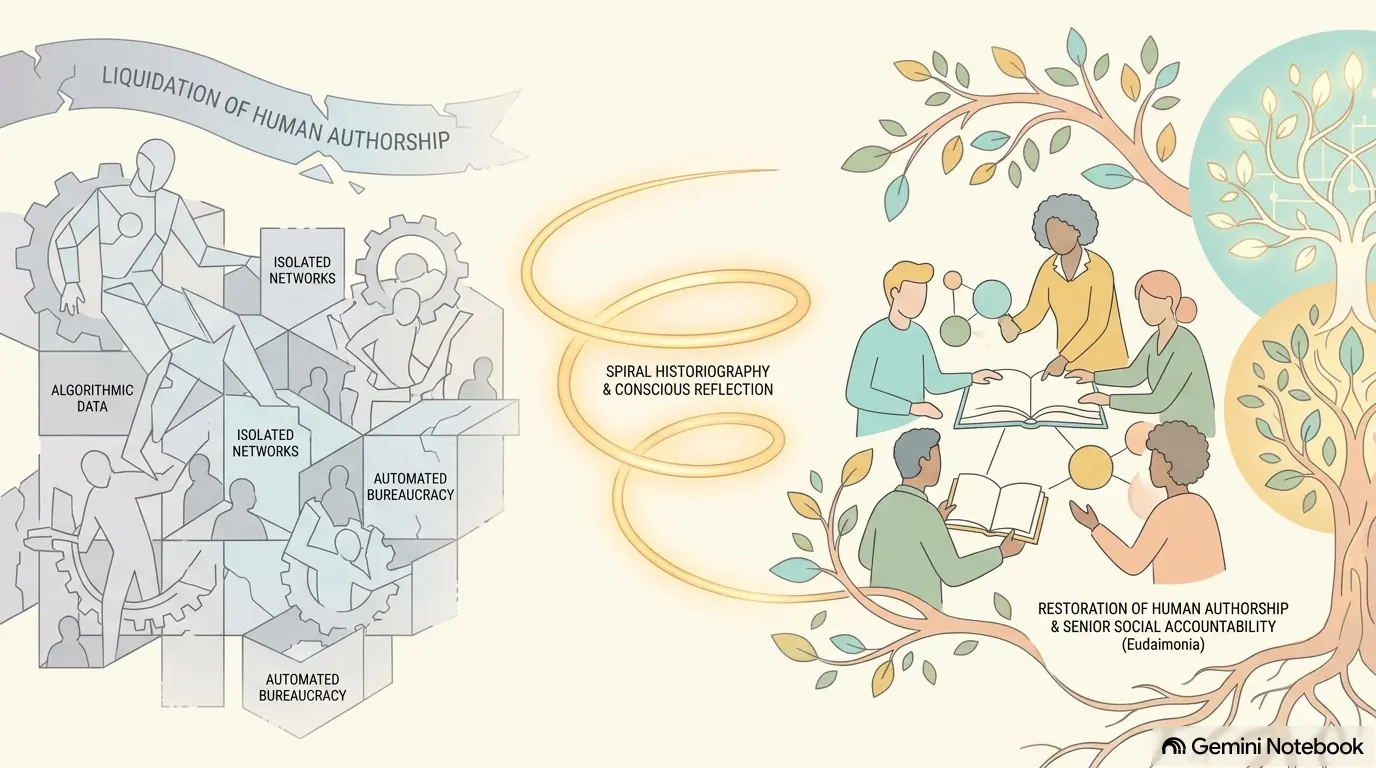
The answer lies in the realization that all three phenomena represent complementary vectors of a single civilizational disease: the liquidation of Human Authorship and the refusal of Senior social accountability [Buch 2026a: 43; Buch 2026b: 7; Jameel 2026: 1].
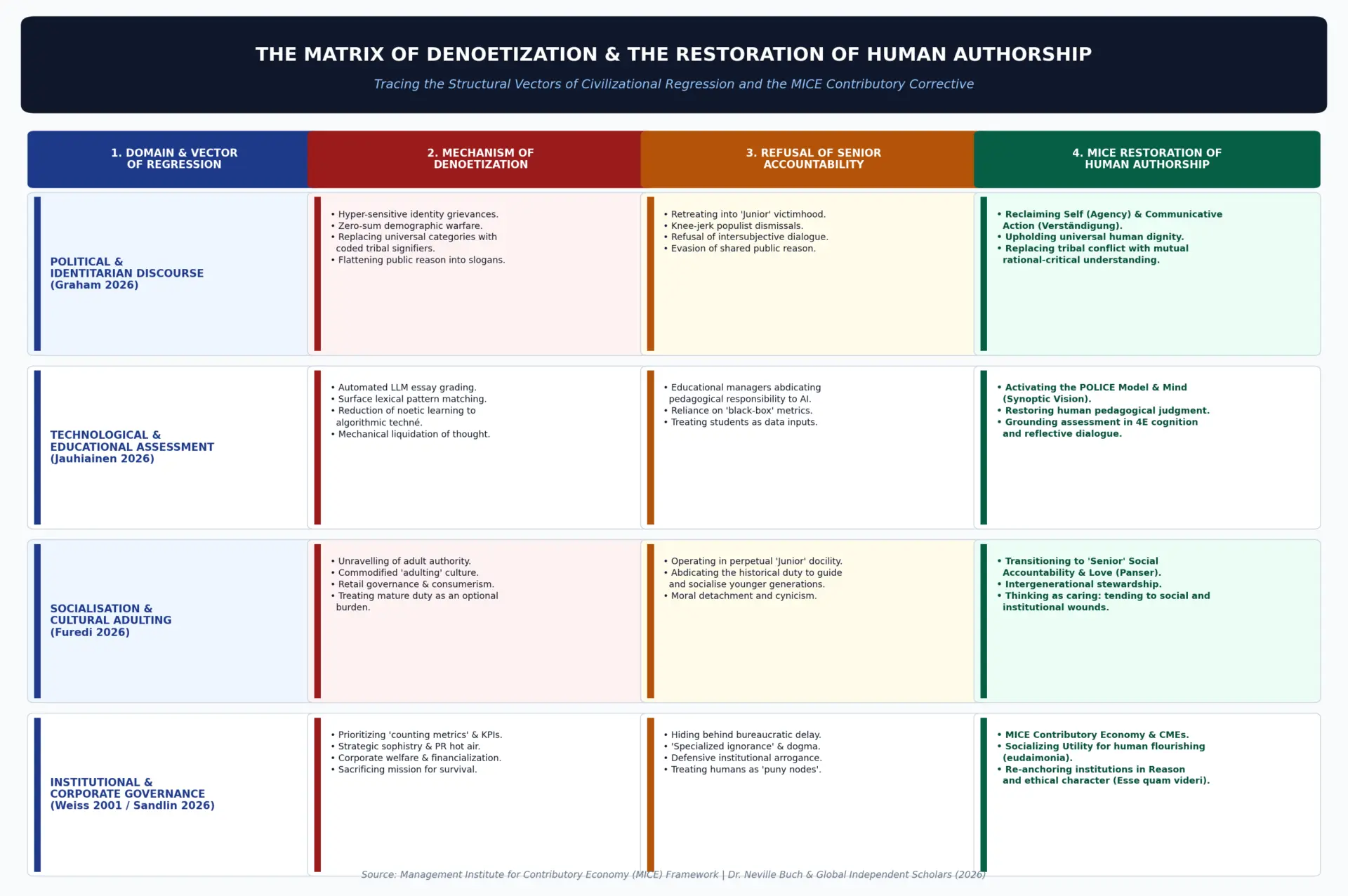
As illustrated in the matrix above, these three forces form a destructive tri-fold cycle that drains the Commonwealth of Common Thinking:
1. The Collapse of Adult Stewardship (Furedi 2026): When adults refuse to act as responsible guides, younger generations are deprived of “thick” historical context, moral stability, and critical thinking tools [Williams 1985: 16; Furedi 2026: 2; Buch 2026b: 10].
2. The Retreat into Tribal Identitarianism (Graham 2026): Stranded without robust adult socialisation or shared public reason, citizens retreat into tribal identity politics, seeking security in MAGA grievance, racial signifiers, or dogmatic echo chambers [Graham 2026: 2; Buch 2023: 3].
3. The Technological Surrender to Automation (Jauhiainen 2026): Incapable of conducting deep intersubjective dialogue, institutions surrender their educational and evaluative functions to LLMs and automated algorithms [Jauhiainen 2026: 3; Stiegler 1998: 10]. Teachers and students alike embrace automated shortcuts, completing the cycle of denoetization[Jauhiainen 2026: 10; Buch 2026a: 11].
Conclusion: Replenishing the Common Well through Contributory Economics
The drying up of the Common Well is not an inevitable fate; it is a human choice resulting from cognitive laziness, technological surrender, and moral cowardice [Kant 1784: 1; Stebbing 1939: 12; Buch 2026b: 7]. To replenish the Commonwealth of Common Thinking, society must embrace the holistic scholarship of the Management Institute for Contributory Economy (MICE) [Buch 2026a: 12; Buch 2026b: 15].
First, we must deploy Spiral Historiography to “uncoil” repetitive intellectual errors and unmask the “institutional bullshit” of both right-wing identitarianism and technocratic AI-solvers [Buch 2026a: 24; Buch 2026b: 18; Graham 2026: 2]. Second, educational institutions must reject the fully automated evaluation of human thought, using LLMs strictly as supervised decision-support tools while preserving the irreplaceable, “thick” dialogue between teacher and student [Jauhiainen 2026: 10; Williams 1985: 16]. Third, mature citizens must accept the “fearsome responsibility” of adulthood, stepping up as Senior agents who guide the young with panser – “thinking as caring [Furedi 2026: 2; Buch 2026a: 18, 43].
Only by committing to Sufficient Comprehension — “seeking the whole of the matter while filtering out ephemeral fallacies — “can we restore human authorship, safeguard intergenerational wisdom, and ensure that the Common Well flows once more with the living waters of truth, justice, and human flourishing [Arendt 1977: 193; Buch 2026a: 18; Buch 2026b: 463].
Bibliography
Arendt, H.(1977). The Life of the Mind. Edited by Mary McCarthy. New York: Harcourt Brace Jovanovich.
Buch, N.(2023). Interbelief and the Level Playing Field. Brisbane: Australian and New Zealand Unitarian Universalist Association (ANZUUA) & Dr Neville Buch Website.
Buch, N.(2026a). MICE Intellectual Handbook. Brisbane: Management Institute for Contributory Economy.
Buch, N.(2026b). Limited Thinking and the Contributory Economy. Book 1 of MICE. Brisbane: Management Institute for Contributory Economy.
Buch, N., & Peach, N.(2024). Philosophically Ontology Logic Intersect Compatibility Education (POLICE). Brisbane: Management Institute for Contributory Economy.
Collins, R.(2019). The Credential Society: An Historical Sociology of Education and Stratification. New York: Columbia University Press.
Furedi, F.(2026). ‘On the Crisis of Socialisation and the Problem of Adult Responsibility’. Roots & Wings with Frank Furedi, Substack (Forwarded in Gmail to Dr Neville Buch, 29 September 2026).
Graham, D. A.(2026). ‘The Right’s Identity Politics Take a Bizarre Turn: MAGA activists are having a meltdown over a throwaway character in Sarah Huckabee Sanders’s political ad’. The Atlantic, Daily Dispatch.
Habermas, J.(1979). Communication and the Evolution of Society. Translated by Thomas McCarthy. Boston: Beacon Press.
Jameel, A.(2026). ‘Beyond Peer Review: A Principal Theory of Knowledge Validation in the Age of Artificial Intelligence’. Global Governance Research & Publications, 23 July.
Jauhiainen, J. S.(2026). ‘Generative AI and LLMs in Educational Assessment: Challenges, Evidence, and a Process-Based Framework’. Academia AI and Applications, 2, 10.20935/AcadAI8542, pp. 1 – “15.
Kant, I.(1784). ‘Beantwortung der Frage: Was ist Aufklärung?’ (An Answer to the Question: What is Enlightenment?). Berlinische Monatsschrift, December, pp. 481 – “494.
Labaree, D. F.(1997). ‘Public-Private Goods as Educational Goals: The American Struggle Over Educational Goals’. American Educational Research Journal, 34(1), pp. 39 – “81.
McKinney, J. P.(1971). The Structure of Modern Thought. London: Chatto & Windus.
Roe, J., & Perkins, M.(2026). ‘Agency in the Age of Generative AI: A Critical Review of Educational Implications’. Academia AI and Applications, 2(3), pp. 1 – “19.
Stebbing, L. S.(1939). Thinking to Some Purpose. Harmondsworth: Penguin Books.
Stiegler, B.(1998). Technics and Time, 1: The Fault of Epimetheus. Translated by Richard Beardsworth and George Collins. Stanford: Stanford University Press.
Weiss, R. P.(2001). ‘Charitable Choice As Neoliberal Social Welfare Strategy’. Social Justice, 28(1), pp. 35 – “54.
Westoby, P. et al.(2025). The Community Builder’s Journal. Brisbane: Community Praxis Co-operative.
Williams, B.(1985). Ethics and the Limits of Philosophy. Cambridge, MA: Harvard University Press.


Neville Buch
Latest posts by Neville Buch (see all)
- The Desiccation of the Common Well: Identity Politics, Algorithmic Assessment, and the Crisis of Adult Responsibility – October 6, 2026
- Academic Rigour, Epistemic Renewal, and the Crisis of Inquiry: A Scholarly Review of the Vanderbilt Commission Report on the State of Scholarship – October 5, 2026
- Uncoiling the Psychology of the Western Traditional Belief System – October 5, 2026