
Dr Neville Buch and MICE[1]
The “Why Markets Cannot Measure Human Worth” audio commentary on MICE’s Contributory Economy and Human Authorship:
Abstract
This essay mounts a systematic defence of the priority of human beings, cultural life, and the knowledge commons against the marketized orthodoxies advanced in Bevin Luchel’s Fixed Mindsets, Fixed Incomes (2026a) and Real-World Political Economy, Epistemic Solipsism, and the Anthropological Fantasies of Neville Buch (2026b). Drawing upon cultural, urban, and social anthropology, this critique exposes how Luchel’s neoclassical framework commits a double fallacy: it mistakes an insular, argumentized market model for universal human truth, and it reduces the self-authoring “historical person” to an atomized, utility-maximizing homo economicus.
First, the essay refutes Luchel’s accusation of “epistemic solipsism,” demonstrating that Dr. Neville Buch’s framework is deeply relational, communicative, and anchored in Susan Haack’s foundherentism and Bernard Williams’s thick ethical concepts. Second, it dismantles the charge of “anthropological fantasies” by drawing on empirical socio-anthropological field research in Queensland and the political anthropology of Tim Ingold and Arpad Szakolczai, proving that it is Luchel who peddles an abstract economic fantasy detached from lived reality. Third, it presents empirical workplace data documenting pervasive age discrimination against older generational workers in marketplace job selection, shattering the neoliberal fiction of an open, meritocratic market. Finally, drawing on recent historiographical defences of why academic history matters, the essay argues that public contracting of independent researchers represents an urgent economic and democratic priority—a necessary corrective to an audit-driven higher education system that harvests postgraduate completions while shuttering humanities departments. Drawing on Buch’s analysis of the “Culture-History War,” the essay concludes by demonstrating why Luchel’s polemic represents an evasive, bad-faith exercise in “Bulverism” designed to avoid authentic dialogue.
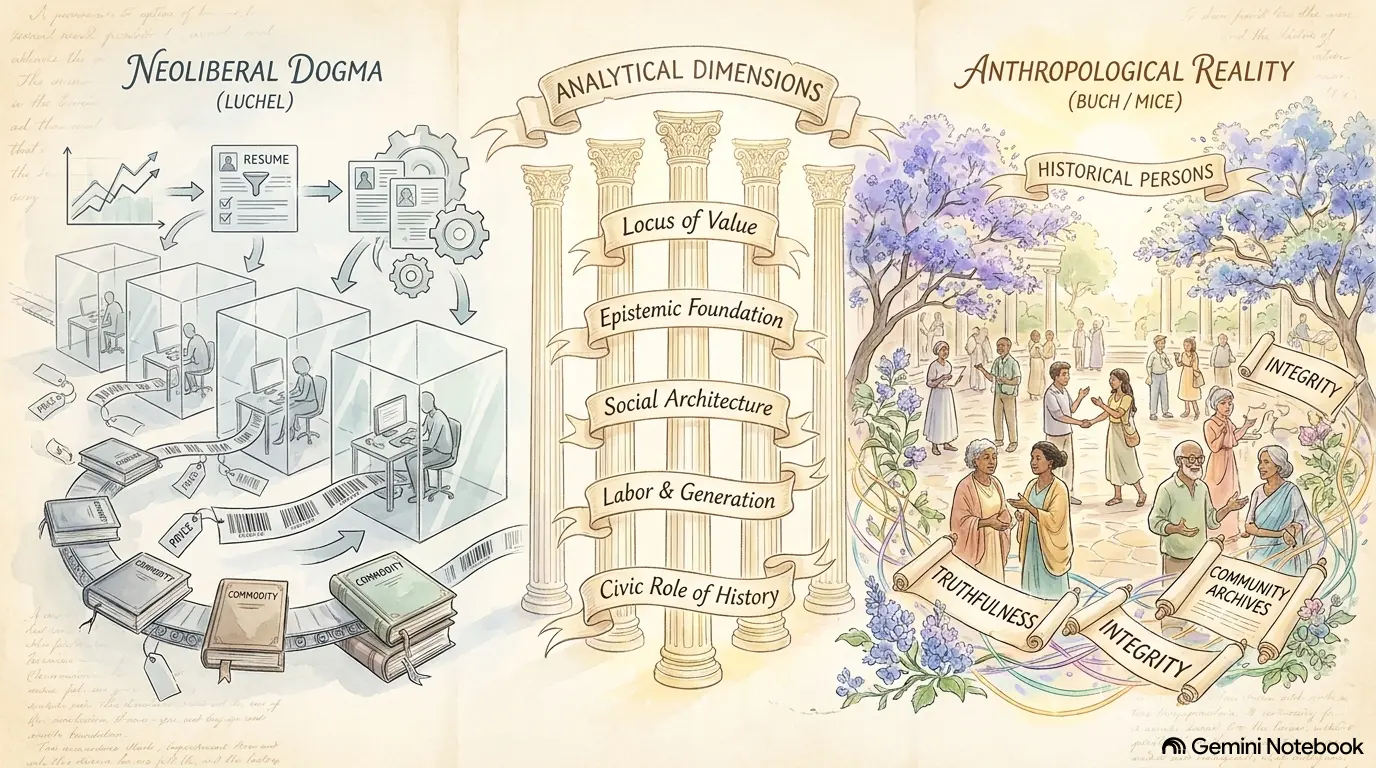
1. The Primacy of the Human Being: Anthropology vs. Economic Formalism
The central question dividing Dr. Neville Buch’s philosophy from Bevin Luchel’s polemic is fundamental: Who has the highest value—a living human being embedded in a culture, or an abstract economic model that refuses to acknowledge that anthropology has defeated neoliberal market fundamentalism? (Buch 2026a: 1–3; Luchel 2026b: 5–6).
Within the narrow parameters of neoclassical economics, value is defined solely through transaction, revealed preference, and marginal utility (Luchel 2026b: 6). In this decontextualized framework, an entity has value only if a solvent buyer purchases it in a competitive market. However, as the majority traditions of cultural, social, and urban anthropology have long demonstrated, this economic premise is true only within its own self-referential logic; it is profoundly false as an account of human existence (Ingold 2011: 12–15; Szakolczai 2023: 195–198).
As Arpad Szakolczai (2023: 8, 210–214) observes, social sciences went catastrophically astray when they slavishly imitated the natural sciences, mistaking mathematical models, market metrics, and quantifiable variables for reality itself. This “unholy alliance of science and the market” operates as an intellectual machine whose primary function is to “put a stop to thought” (Szakolczai 2023: 210). In the real world, human beings do not experience life as disembodied calculators operating in a frictionless vacuum. Human life is lived in place, through kinship, within shared rituals, and amidst generational memories (Buch 2018a: 2–4; Ingold 2011: 145–149).
Anthropologically, the human person is not a disposable factor of production to be discarded when market demand fluctuates. In Buch’s (2024a: 175–178; 2026a: 2–4) framework, the core analytical unit is the “historical person”—an evaluating, willing subject and proactive author of their own existence, who is “context-embedded but not context-determined” (Buch 2026a: 2). To subordinate the life of the mind, the preservation of historical memory, and the dignity of mature human thinkers to the volatile whims of consumer demand is an inversion of civilized values (Buch 2025a: 2–4; Stiegler 2014: 15–18). When an economic system reduces human beings to instruments of capital accumulation, it ceases to serve society; it becomes a mechanism of cultural denoetization and symbolic misery (Buch 2026a: 2; Stiegler 2014: 21).
2. Why Luchel is Wrong on “Epistemic Solipsism”
In his second monograph, Luchel (2026b: 1–3) escalates his critique by accusing Buch of “epistemic solipsism,” alleging that by refusing to accept market sales as the final judge of scholarly worth, Buch has retreated into an unfalsifiable, self-referential cognitive bubble.
This accusation represents a total misunderstanding of epistemology and philosophical anthropology. Solipsism is the philosophical position that only one’s own mind is sure to exist, rendering knowledge of an external world impossible. Buch’s epistemology is the exact opposite of solipsism:
- Foundherentist Realism Over Subjective Fiat: Drawing on Susan Haack’s (Evidence and Inquiry, 1993) foundherentism, Buch’s model grounds knowledge in the mutual support of empirical, experiential evidence and deductive coherence—analogous to a crossword puzzle (Buch 2026b: 2–4; Haack 1993: 1–30). Epistemic warrant is anchored in whether a proposition accurately tracks external reality and historical documentation, not in whether a crowd of consumers buys it at a bookstall (Buch 2026b: 3; Luchel 2026a: 4). Luchel (2026b: 4) commits a category error by asserting that because Haack’s theory is an account of justification, it has no bearing on public resource allocation. If truth-tracking is objective and distinct from market popularity, then an economic system that starves truth-tracking of material resources while rewarding sensationalist digital triviality is suffering from systemic market failure (Buch 2026b: 3–5; Vandrei 2026: 531).
- Thick Ethical Concepts vs. Thin Formalism: Furthermore, following philosopher Bernard Williams (Ethics and the Limits of Philosophy, 1985), Buch grounds his evaluation in “thick ethical concepts”—such as truthfulness, courage, and justice—which combine factual description with evaluative meaning (Buch 2026a: 3; Williams 1985: 140–145). Luchel operates in the “thin” world of utilitarian preference, where all values are flattened into monetary exchange. To evaluate scholarship through thick ethical concepts is not solipsism; it is the refusal to let moral and intellectual integrity be dissolved by financial accounting (Buch 2026a: 3; Williams 1985: 143).
- The Communicative Level Playing Field: Far from being solipsistic, Buch’s framework is radically dialogical. Synthesizing Jürgen Habermas’s communicative action and Hans-Georg Gadamer’s “fusion of horizons,” the Management Institute for Contributory Economy (MICE) mandates that all claims pass through the POLICE filter (Philosophically Ontology, Logic, Intersect, Compatibility, Education) (Buch 2024b: 1–3; Buch 2026a: 3; Habermas 1984: 8–42). This framework explicitly requires public scrutiny, peer falsification, and interdisciplinary compatibility (Buch 2024b: 2; Buch 2026a: 8–10).
The true solipsism belongs to Luchel’s neoliberal market: an isolated, atomized consumer staring at a screen, operating entirely on unreflective preferences, isolated from historical consciousness, and trapped in an algorithmic loop of automaticity (Buch 2026a: 2; Zuboff 2019: 94, 232).
3. Why Luchel is Wrong on “Anthropological Fantasies”
Luchel (2026b: 5–8) dismisses the socio-anthropological frameworks of Tim Ingold, Arpad Szakolczai, and Bernard Stiegler as “anthropological fantasies,” asserting that Buch’s “historical person” is an idealized construct that ignores material scarcity. To mock this framework, Luchel constructs a rhetorical hypothetical: a Brisbane intensive care nurse working a twelve-hour shift, whose tax dollars would supposedly be diverted to pay for speculative diagrams of Pythagoras while her own material needs are dismissed as “symbolic misery” (Luchel 2026b: 6–7).
This rhetorical caricature collapses under empirical anthropological evidence:
Empirical Grounding: The Socio-Anthropological Reality of Queensland
Far from indulging in detached fantasy, Buch’s anthropology is rooted in decades of empirical historical sociology and field research across Queensland communities (Buch 2018a: 1–8; Buch 2024a: 161–187). In his landmark study Queensland History, Religious Education, and Belief, Buch (2024a: 161–164, 172–178) investigates the concrete, lived religious, educational, and political dynamics of Queensland society from 1875 to 1989.
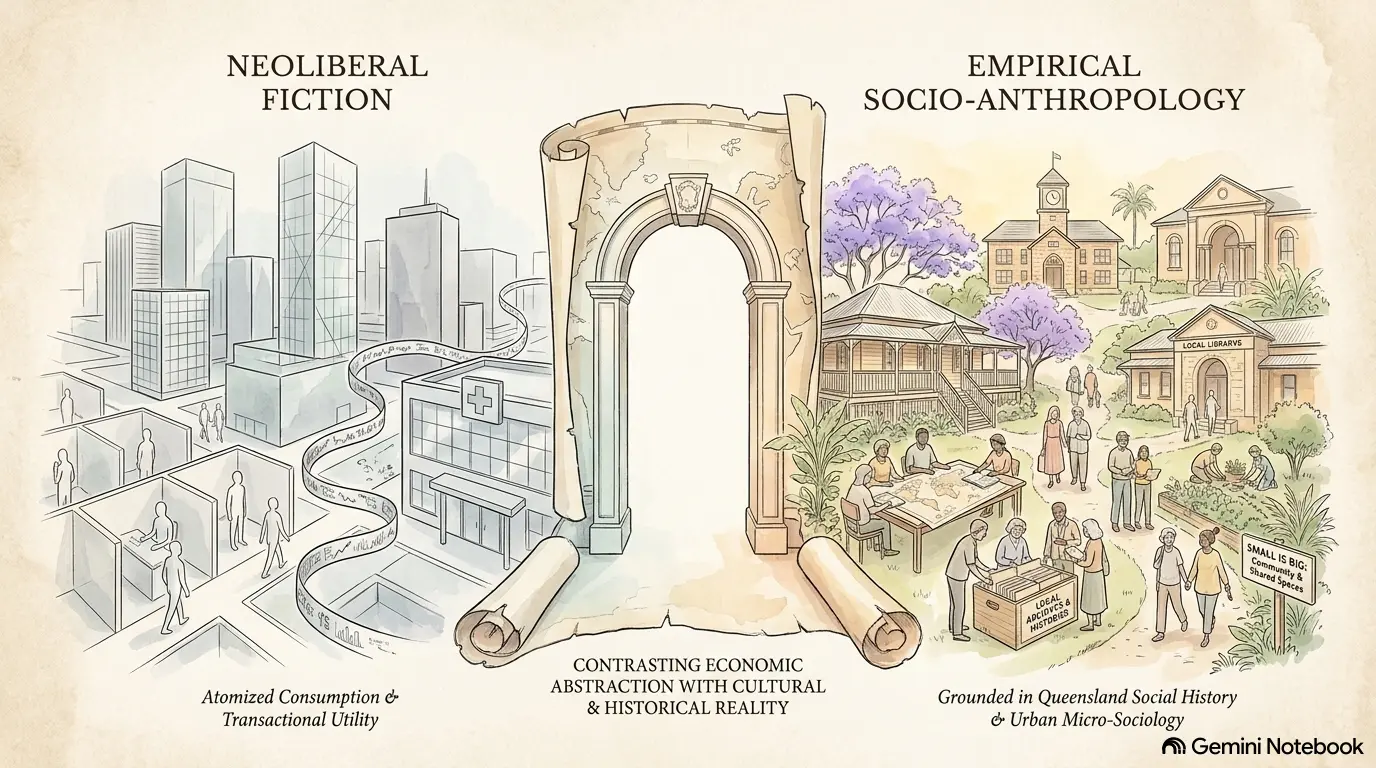
Buch demonstrates that Queensland’s social history was defined by intricate contestations between denominational traditions, liberal humanist curriculum reformers (such as Charles Moeller and Jerome Bruner), and conservative political machines under Premier Joh Bjelke-Petersen that weaponized the “myth of secular humanism” to stifle critical inquiry (Buch 2024a: 161, 175–178).
Furthermore, through his “Small is Big” methodology, Buch (2018a: 1–4) demonstrates that urban micro-sociology—scaling the map to examine specific Brisbane persons, suburban institutions, and community networks—uncovers profound patterns of human belief, doubt, and social solidarity that econometric aggregations completely erase.
The Absurdity of the “Trauma Nurse” False Dilemma
Luchel’s (2026b: 6–7) weaponization of the Brisbane trauma nurse is an exercise in bad-faith demagoguery. In advanced industrial societies, the funding of civic infrastructure, healthcare, and humanistic knowledge has never been a zero-sum contest. Public healthcare and public historical literacy are complementary components of a civilized democratic state. The nurse herself was trained in a university humanities-informed curriculum, works within an institution governed by medical ethics, and lives in a community whose social cohesion relies upon shared historical identity (Buch 2024a: 162; Vandrei 2026: 528–530).
The real resource drain on society is not the modest public contracting of independent scholars; it is the massive corporate subsidies, executive bloat, and administrative managerialism of neoliberal institutions (Buch 2011: 4; Vandrei 2026: 527). It is Luchel who lives in an “anthropological fantasy”—the fantasy that a society can destroy its historical memory, eliminate humanities education, and reduce all human interaction to commercial cash-nexus transactions without collapsing into populist authoritarianism and civic decay (Buch 2021: 1–3; Vandrei 2026: 539).
3. The Empirical Fact: Marketplace Job Discrimination Against Older Generational Workers
Luchel (2026a: 19; 2026b: 6, 17) glibly insists that if independent scholars in their sixties wish to be supported, they must simply “persuade readers” or compete in the open academic job market. He dismisses Buch’s analysis of structural exclusion as personal resentment, citing Gerhard Lenski’s concept of “status inconsistency” (Luchel 2026a: 17; Luchel 2026b: 16).
This argument ignores an overwhelming body of verified sociological and workplace data: older generational workers face pervasive, documented discrimination in the marketplace.
As detailed in Brian Crisp’s (2026: 45–54) investigative study on employment bias in Australia:
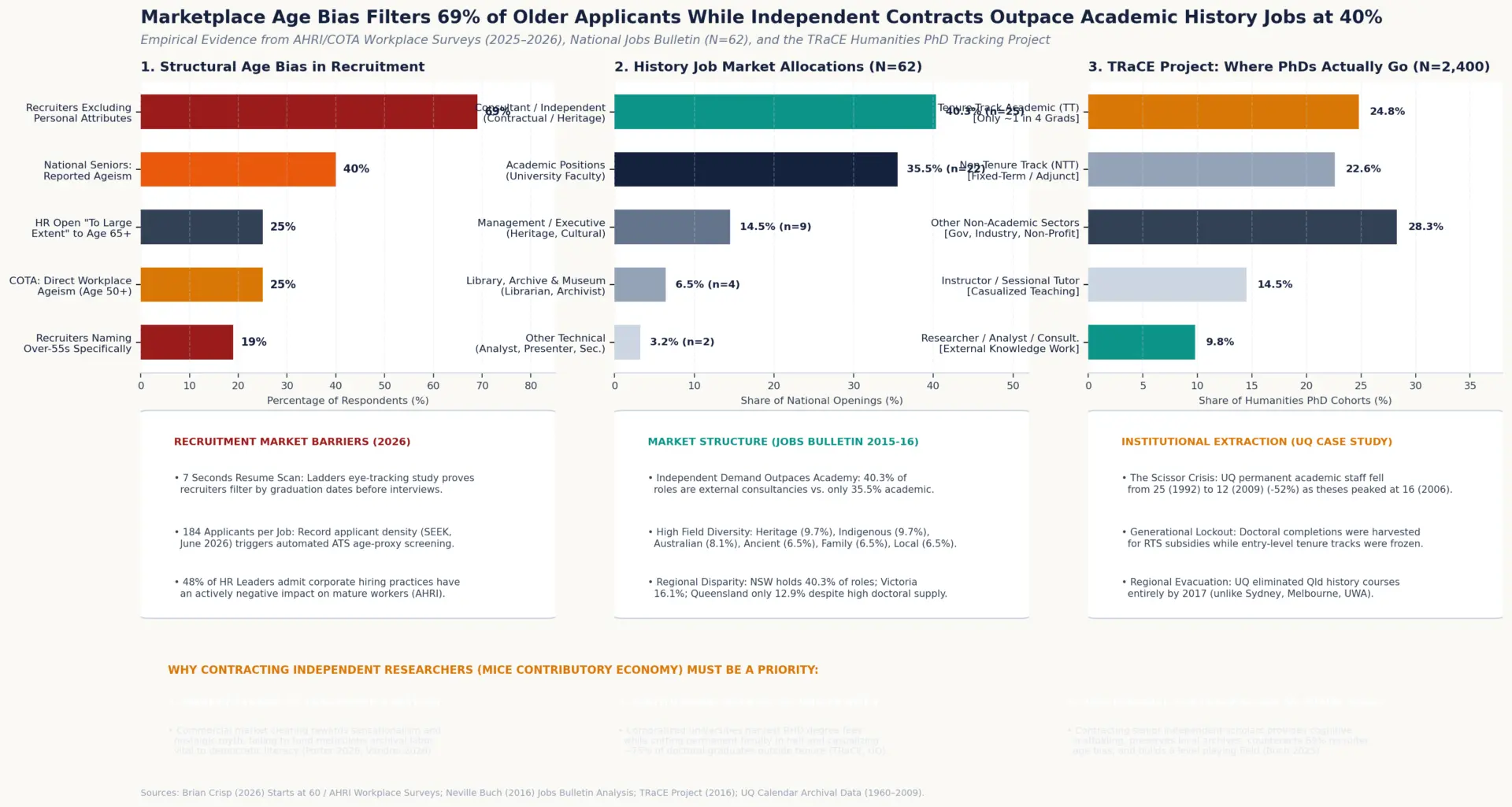
- Recruiter Admissions: In a comprehensive survey of over 500 senior HR professionals and business decision-makers conducted by the Australian HR Institute (AHRI), 69 per cent of recruiters admitted to excluding job candidates based on personal attributes—with 19 per cent explicitly naming workers over 55 as the target of exclusion (Crisp 2026: 45).
- Systemic Human Rights Barriers: Research conducted by AHRI in conjunction with the Australian Human Rights Commission revealed that only about a quarter of HR professionals were open “to a large extent” to hiring workers aged 65 and over, while almost half admitted that their own corporate recruitment practices had an actively negative impact on older workers (Crisp 2026: 46).
- Prevalence of Ageism: The COTA Australia State of the Older Nation 2025 report found that one in four Australians over 50 has experienced direct age discrimination at work, identifying the job application process as the primary site of bias (Crisp 2026: 45). In the National Seniors Australia Social Survey, 40 per cent of older respondents reported experiencing age-based discrimination when applying for jobs or in the workplace (Crisp 2026: 45).
- Algorithmic Discarding: Crisp (2026: 46, 50) documents how contemporary hiring relies on automated Applicant Tracking Systems (ATS) and rapid visual resume scanning (where recruiters spend an average of just seven seconds skimming a CV, according to Ladders eye-tracking metrics). Recruiters systematically weed out candidates based on graduation dates, long career histories, or cues indicating advanced age (Crisp 2026: 46–48).
+————————————————————————————————–+

To tell senior scholars—who possess four decades of specialized paleographic training, archival mastery, and institutional wisdom—that they should simply enter an entry-level applicant pool governed by discriminatory algorithms is profoundly disingenuous (Crisp 2026: 46–48; Vandrei 2026: 528). The marketplace does not reward their accumulated wisdom; it excludes them because of their birth year (Crisp 2026: 45).
Luchel’s dismissal of this reality as mere “status inconsistency” is an ideological deflection. The exclusion of mature scholars is not a personal failure; it is a structural, empirical market distortion that wastes immense intellectual capital (Crisp 2026: 45–46; Buch 2011: 4).
4. The Priority of Contracting Independent Researchers: Academic History Matters
Why should the contracting of independent researchers through “Professional Contractualism” be a high economic priority? The answer lies in the acute crisis of modern academic inquiry, articulated by historians Martha Vandrei (2026), Joy Porter (2026), David Andress (2026), and Susan-Mary Grant (2026) in their symposium Why Does Academic History Matter?
- Market Forces Cannot Produce Rigorous History: As Joy Porter (2026: 533) argues, “market forces alone cannot be relied upon to produce the sort of excellent history that enables us to respond intelligently to the future… The absence of academic history would mean the simple recitation of established chronologies and the retelling of the same comforting stories.” Commercial publishing rewards sensationalism and patriotic myth; it does not finance years of unremunerative archival labour required to reconstruct frontier conflict, institutional corruption, or complex religious mentalities (Buch 2024a: 161; Porter 2026: 533).
- Defending Democratic Citizenship Against Technological Vapidity: Martha Vandrei (2026: 527–530) emphasizes that academic history is vital for “honing critical engagement, for challenging all-encompassing technological vapidity, for strengthening individuality.” In a world dominated by generative AI summaries that flatten reality into instrumental tokens, history teaches patience, contextual awareness, and the ability to imagine other human perspectives (Grant 2026: 531–532; Vandrei 2026: 528). As David Andress (2026: 538–539) warns, societies that abandon rigorous history drift inevitably into “a politics based in exclusionary nostalgia, demanding allegiance as it drifts ever-further from reality.”
- The Institutional Evacuation of Academic History: Crucially, while academic history matters more than ever, universities are actively failing to employ academic historians across diverse subfields. As demonstrated by the historical collapse of The University of Queensland’s History Department, corporate restructuring halved established academic staff from 25 in 1992 down to 12 in 2009, dissolved the department into composite schools, and eliminated undergraduate Queensland history offerings entirely (Buch 2011: 4; Buch 2025b: 5–6; Jory 2017: 1).
- The Evidence of the Jobs Bulletin and TRaCE: Empirical studies confirm this institutional abandonment. Dr. Neville Buch’s (2016: 1–8) analysis of the national Jobs and Opportunities Bulletin across 62 history positions revealed that academic appointments represented only 35.5% of openings, while independent and external consultancies constituted over 40.3%—concentrated heavily in short-term heritage and contract work. Similarly, the TRaCE project (Austin 2016: 187–193; Yachnin 2016: 551–554) tracked 2,400 humanities Ph.D. graduates and revealed that while universities harvested government completions, less than a quarter secured tenure-track posts, forcing the majority into precarious adjunct tutoring or non-academic employment.
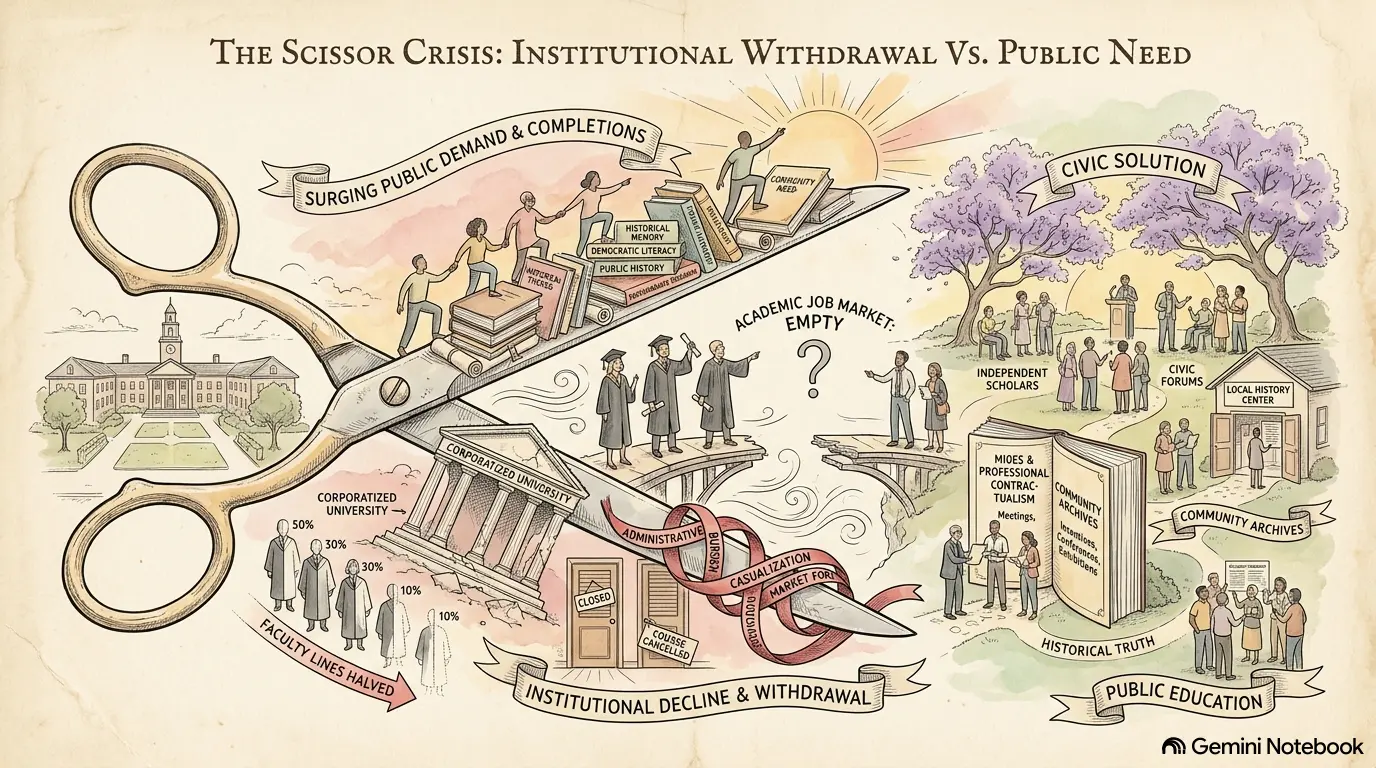
Because corporate universities have abandoned their civic mandate, society must establish new institutional scaffolding. Publicly contracting certified, independent professional historians through MICE is not an arbitrary handout; it is the establishment of a Contributory Economy (Buch 2025a: 2–4). It contracts experienced scholars to preserve public archives, support school curricula, document regional heritage, and provide verified truth-tracking for democratic communities (Buch 2012: 20–22; Porter 2026: 534).
5. Luchel’s Bad-Faith Polemic and the “Culture-History War”
Finally, Luchel’s argumentative strategy must be situated within Dr. Neville Buch’s (2021: 1–5) analysis in Finding Peace from the Culture-History War: A Historiographical Message for the Times.
In that essay, Buch examines how contemporary intellectual discourse has been corrupted by an ethos of “intense partisan conflict which metaphors warfare” (Buch 2021: 1). Drawing upon Danielle Allen (2021) and Adam Serwer (2021) in The Atlantic, Buch (2021: 2) demonstrates that modern polemicists replace deep education with weaponized rhetoric, operating on a distorted definition of civility that effectively means: “I can do what I want and you can shut up.”
Luchel’s writings are a textbook illustration of this culture-war pathology:
- Refusal to Engage Substantive Schemas: As Buch (2021: 2–3) observes, polemicists are uninterested in untangling intellectual logic or engaging with complex worldviews; they seek only to defeat an opponent through journalistic drama and caricature. Luchel (2026b: 2–5) repeatedly trivializes Buch’s synthesis of Lonergan, Haack, Williams, and Stiegler as “changing ground” or “jargon as cover,” refusing to grapple with the substantive epistemological challenges they pose to his market model.
- Resort to Bulverism and Personal Invective: When a polemicist cannot refute a substantive truth-claim, they attack the person making it (Buch 2021: 2–3; Lewis 1970: 271). Luchel (2026a: 16–18; 2026b: 15–18) devotes substantial space to speculating about Buch’s residential property, private finances, and alleged psychological “status inconsistency,” declaring that Buch’s philosophy is merely the sour grapes of an “academic outsider.” This is classic Bulverism: assuming an argument is false based on the personal circumstances of the author rather than proving it false through evidence (Buch 2026a: 3; Lewis 1970: 271).
- Evading the “Level Playing Field”: In Finding Peace from the Culture-History War, Buch (2021: 3–4) calls for moving beyond destructive polarization by recovering an open, regulated democratic state that protects the social contract and establishes a level playing field. MICE embodies this mission, balancing the radical courage to challenge entrenched orthodoxy, the liberal commitment to allow every person a flourishing place in the social environment, and the conservative care to preserve civilizational heritage (Buch 2021: 3–5; Buch 2025a: 2). Luchel rejects this peace because his neoliberal dogma cannot tolerate an institutional model where market price is not sovereign.
Conclusion: Reclaiming Human Authorship
Bevin Luchel’s critique is the defensive reaction of a market fundamentalism that has run out of answers. Faced with the evident crises of the contemporary world—extreme academic precarity, pervasive age discrimination, algorithmic cognitive deskilling, and the hollowing out of humanities education—Luchel offers only the cold comfort of revealed preference and the false promise of an open market that systematically excludes mature thinkers (Crisp 2026: 45–46; Porter 2026: 533; Vandrei 2026: 527).
Cultural, social, and urban anthropology have decisively refuted this neoliberal fiction. The living human being—evaluating, reflecting, loving, and remembering—holds an intrinsic value that exceeds any transactional price tag (Buch 2024a: 177; Ingold 2011: 14; Szakolczai 2023: 210).
By establishing the Contributory Economy through the Management Institute for Contributory Economy (MICE), Dr. Neville Buch offers a disciplined, workable, and deeply humanistic pathway forward. It is an invitation to leave the Analytical Abyss behind, to honor the dignity of the historical person, and to ensure that the life of the mind remains an enduring public good for generations to come.
References
Allen, D. (2021) ‘The Road From Serfdom: How Americans Can Become Citizens Again’, The Atlantic, December 2019 (published online).
Andress, D. (2026) ‘Why Does Academic History Matter? It Produces a Democratic Polity That Can Vigorously Argue About Its Collective Identity’, History Today, 76(10), pp. 536–539.
Austin, N. (2016) ‘Occupation Types (Part One)’, TRaCE: Track Report Connect Exchange, Montreal: IPLAI, McGill University, pp. 187–193.
Buch, N. (2011) A Preliminary Study of History Research Higher Degree Theses Numbers in Queensland: The Last 50 Years (1960–2009) at University of Queensland, James Cook University, and Griffith University. Brisbane: Professional Historians Association (Queensland).
Buch, N. (2012) State of the History Profession in Queensland Project Speech. Delivered to the Professional Historians Association (Queensland), Brisbane, pp. 1–22.
Buch, N. (2016) Analysis of National Jobs and Opportunities Bulletin: Sample of 62 Positions in Category of “History” (2015–2016). Brisbane: Professional Historians Association (Queensland), pp. 1–8.
Buch, N. (2018a) ‘Small is Big: Scaling the Map for Brisbane Persons and Institutions 1825–2000’. Paper presented at the ‘Scale of History’ Australian Historical Association (AHA) Conference, Australian National University, Canberra, 4 July, pp. 1–8.
Buch, N. (2021) ‘Finding Peace from the Culture-History War: A Historiographical Message for the Times’, Academia Letters, Article 1916, pp. 1–5.
Buch, N. (2024a) ‘Queensland History, Religious Education, and Belief’, in D.W. Kim and D. Wright (eds) Environmental Hope: Socio-Anthropological Approaches to Religion. London: Lexington Books, pp. 161–187.
Buch, N. (2024b) Philosophically Ontology Logic Intersect Compatibility Education (POLICE). Brisbane: Dr Neville Buch Publications, pp. 1–3.
Buch, N. (2025a) MICE Principles and Philosophy (First Development). Working Paper. Brisbane: Management Institute for Contributory Economy, pp. 1–11.
Buch, N. (2025b) What Happened to Ross Johnston? A Memorial History: Department of History, The University of Queensland, 1984–1996. Working Paper, Brisbane, 26 October, pp. 1–14.
Buch, N. (2026a) Notes: Applications in Philosophical Anthropology. Working Paper. Brisbane: Management Institute for Contributory Economy, pp. 1–12.
Buch, N. (2026b) The Cynicism of the Market: Foundherentism, Contributory Economy, and the Subversion of Luchel’s Rent-Seeking Epistemology. Brisbane: Dr Neville Buch Blog, pp. 1–6.
Crisp, B. (2026) ‘How to Age-Proof Your Resume: The Simple Changes That Help Over-60s Get Past the First Cut’, Starts at 60, 14 October, pp. 44–54.
Grant, S.-M. (2026) ‘Why Does Academic History Matter? It Teaches Us, as Few Other Disciplines Can, That We All Matter, or None of Us Does’, History Today, 76(10), pp. 530–532.
Haack, S. (1993) Evidence and Inquiry: Towards Reconstruction in Epistemology. Oxford: Blackwell.
Habermas, J. (1984) The Theory of Communicative Action, Vol. 1: Reason and the Rationalization of Society. Boston: Beacon Press.
Ingold, T. (2011) Being Alive: Essays on Movement, Knowledge and Description. London: Routledge.
Jory, P. (2017) Gmail from Patrick Jory on Non-Teaching of Qld History. St Lucia: School of Historical and Philosophical Inquiry, University of Queensland, 18 May.
Lenski, G.E. (1954) ‘Status Crystallization: A Non-Vertical Dimension of Social Status’, American Sociological Review, 19(4), pp. 405–413.
Lewis, C.S. (1970) ‘Bulverism’, in God in the Dock: Essays on Theology and Ethics. Grand Rapids, MI: Eerdmans, pp. 271–277.
Luchel, B. (2026a) Fixed Mindsets, Fixed Incomes: What Beyond the Binary Is Really Asking For. Working Paper, Brisbane, October 2026, pp. 1–21.
Luchel, B. (2026b) Real-World Political Economy, Epistemic Solipsism, and the Anthropological Fantasies of Neville Buch. Working Paper, Brisbane, 15 October 2026, pp. 1–20.
Porter, J. (2026) ‘Why Does Academic History Matter? Market Forces Alone Cannot Be Relied Upon to Produce Excellent History’, History Today, 76(10), pp. 533–535.
Serwer, A. (2021) ‘The Secret to Understanding the Politics of Civility’, The Atlantic, December 2019 (published online).
Stiegler, B. (2014) Symbolic Misery, Vol. 1: The Hyper-industrial Epoch. Cambridge: Polity Press.
Szakolczai, A. (2023) Political Anthropology as Method. London and New York: Routledge, pp. 1–15, 195–215.
Vandrei, M. (2026) ‘Why Does Academic History Matter? Why Should the Things We Love Be the First Things Sacrificed to a Bleak Future No One Asked For?’, History Today, 76(10), pp. 526–530.
Williams, B. (1985) Ethics and the Limits of Philosophy. Cambridge, MA: Harvard University Press.
Yachnin, P. (2016) ‘Where Are Our PhD Grads? A Report on the TRaCE Project’, University Affairs, 17 May, pp. 551–554.
Zuboff, S. (2019) The Age of Surveillance Capitalism: The Fight for a Human Future at the New Frontier of Power. New York: PublicAffairs.
Take the MICE Quiz
[1] Artificial Intelligence (A.I.) has been fairly used in the production of this work. The tool used is Google NotebookLM (recently rebranded as Gemini Notebook). It is an AI-powered virtual research assistant and thinking partner designed to help a person interact deeply with their own documents. Unlike general chatbots, it is source-grounded, meaning it only generates answers based on the specific PDFs, documents, or links uploaded. The A.I. process in the production of this work has been limited to the attached (prompts) on each of the questions in turn. This ensures an accurate reading of each source. The author then rearranged and re-edited the answers the A.I. provided. The human author publishes this work. A.I. is never an author when used properly. This assistance is not qualitatively different from a human research assistant when that assistance is deemed to have no authorial status but is acknowledged.
Featured Image: The Data


Neville Buch
Latest posts by Neville Buch (see all)
- The Human Being Above the Transaction and Why Markets Cannot Measure Human Worth – October 15, 2026
- Beyond Neoliberal Formalism: Should Taxpayers Fund Independent Philosophy – October 14, 2026
- A Critical Phenomenology and Epistemology of Open and Fixed Mindsets: Quantum Biology of the Open Mind – October 13, 2026