
The “Reclaiming Human Authorship on Australian Highways” audio commentary on MICE’s Contributory Economy and Human Authorship at: https://drnevillebuch.com/2016-future-public-cognition/audio-commentary-discussion-no-debate-a-conversation-on-5th-australian-east-coast-trip-powerpoint-story-of-resilience-presentation-5th-australian-east-coast-trip-brisbane-to-geelong-and-back-vi/
Abstract
This seventh and culminating paper in the Lebensphilosophie series completes the overarching theoretical arc by translating phenomenological ontology, metacognitive diagnosis, and spatial epistemology into an actionable blueprint for civilizational renewal, public policy reform, and moral governance. It operationalizes the core principle that “understanding history is philosophy in practice”, demonstrating that true historical inquiry is not a static archival exercise or an administrative audit metric, but an active, living discipline (praxis) that uncoils society from repetitive cycles of “re-calculation,” “historical forgetfulness,” and technocratic error[1].
At its theoretical apex, the paper integrates the Five Intentions of Cognition (Self, Mind, Reason, Utility, and Love) to establish an indissoluble framework for humanistic wholeness[5]:
- Self: Re-anchoring the human subject as an irreducible, evaluating “Historical Person” who possesses moral agency and personal dignity[6][7].
- Mind: Cultivating the “Mind’s Eye” through deep reading, hermeneutics, and transdisciplinary inquiry to resist technological denoetization and algorithmic passivity [22, 60–61, 102].
- Reason: Exercising communicative rationality (Verständigung) and fallibilist testing to audit institutional claims through open, transparent criteria[8].
- Utility: Subordinating economic apparatuses to physical thermodynamic baselines and human biological free time, replacing extractive profit with Aristotelian flourishing (eudaimonia)[11].
- Love (Panser): Deploying panser (thinking as caring) as an ethical shield that integrates empathy, historical context, and compassion into rational inquiry to tend to social wounds and safeguard human dignity[7].
On the level of practical political economy, the paper details the institutional realization of the Contributory Economy [29–31]. Drawing on Coasean institutional extensions and Bernard Stiegler’s macroeconomic models, MICE replaces market fundamentalism with “professional contractualism” and public cognitive scaffolding [30–31]. Just as municipal governments publicly finance physical civil engineering and public health infrastructure because their failure threatens physical safety, societies must underwrite independent scholarship, regional historical synthesis, and community care networks as vital public scaffolding that protects the democratic sphere from demagoguery and cultural amnesia[4].
Finally, the paper projects this synthesis onto a global horizon, establishing Planetary Wisdom as the ultimate destination of Lebensphilosophie [142, 155–156]. By fostering a “dialogue of myths” across pluralistic traditions and preserving global noodiversity (diversity of knowledge and faith), MICE bridges local topographies with universal human rights [78, 142, 172, 155–156]. By ensuring that the human creator (“the who”) remains the permanent master over technical and economic apparatuses (“the what”), this grand synthesis guarantees that human authorship, moral courage, and intersubjective solidarity remain the enduring foundations of 21st-century civilizational governance[18].

Image: 2026-10-24 (72-75) Taree, Manning River, McDonalds Breakfast, 8.00-8.30 a.m.
There is physical food to sustain the material body, and then there is the intellectual food to sustain the mind. Without the latter we become stupid, idiots, and fools. As Hannah Arendt demonstrated, not being stupid, idiots, and fools is critically linked to sustaining “The Life of Mind”. There is no separation between the Ethics and the Intellect.
n philosophical anthropology, moral philosophy, and cognitive sociology, this statement articulates the essential unity of noetic sustenance, moral judgment, and human agency[1]. Just as the biological organism requires physical nutrients to prevent somatic decay, the human mind demands continuous intellectual nourishment—what classical philosophy terms noesis and Hannah Arendt designates as “The Life of the Mind”—to prevent cognitive atrophy[1]. In her seminal analysis, Arendt demonstrated that the failure to think—the refusal to engage in the internal, reflexive dialogue of conscience—is not a mere lack of technical information, but an inability to exercise moral judgment[3][5]. When society deprives the mind of deep, critical inquiry, individuals slip into what Bernard Stiegler terms denoetization and what Dr. Neville Buch’s Spiral History Theory of Stupidity identifies as getting trapped in “vicious circles of stupidity,” reducing human subjects to unreflective “puny human nodes” within automated institutional systems[4].
The assertion that “there is no separation between Ethics and the Intellect” directly challenges the Cartesian dualism and positivist formalisms that treat reason as a cold, value-free instrument [19, 197–198]. Within Dr. Neville Buch’s Dynamic of Cognition (DoC) matrix and the framework of the Management Institute for Contributory Economy (MICE), intellect and ethics are recognized as co-constitutive dimensions of Human Authorship[9][10]. Drawing on Bernard Williams’s “thick ethical concepts” (such as truthfulness, courage, and substantial fairness) and Nel Noddings’s ethics of care, MICE operationalizes this non-separation through panser **(thinking as caring)**[11]. Panser serves as a procedural shield that protects rational inquiry from collapsing into pure calculating instrumentalism (Zweckrationalität), ensuring that intellectual effort remains anchored in human dignity and Aristotelian flourishing (eudaimonia)[12].
Ultimately, sustaining “The Life of the Mind” functions as society’s primary intellectual immune system against demagoguery, “authoritarianism of the stupid,” and algorithmic passivity[16][17]. When educational and political institutions replace deep, inquiry-based learning with “job-ready” vocational training and automated “potted thinking,” they starve the public lifeworld of noetic nourishment [82, 131, 158–159]. Reclaiming the indissoluble bond between the intellect and ethics empowers the individual to act as a “reflexive insider”—an evaluating, willing historical person who uses their cultivated mind to safeguard democratic wisdom, intersubjective solidarity, and planetary hope[10].
To dismantle this instrumental reductionism, Dr. Neville Buch’s **Management Institute for Contributory Economy (MICE)** framework replaces the calculating *homo economicus* with **panser** **(thinking as caring)** [8–9, 22–23, 109]. Derived from Nel Noddings’s ethics of care and Stiegler’s organology, *panser* operates as a procedural shield that protects the irreducible particularity of the human subject from pure algorithmic calculation [8–9, 25, 109, 122]. By deploying the **POLICE diagnostic filter** (**P**hilosophically **O**ntology, **L**ogic, **I**ntersect, **C**ompatibility, **E**ducation), MICE unmasks how market fundamentalism manufactures institutional myths to justify precarity [9–10, 29–30]. Through **”professional contractualism”** and the **Contributory Income Scheme**, MICE decouples human livelihood from extractive wage-labour markets, ensuring that those who produce non-rivalrous civilizational value are protected, respected, and adequately compensated to foster Aristotelian flourishing (**eudaimonia**) and democratic social peace [28, 44–46, 108].
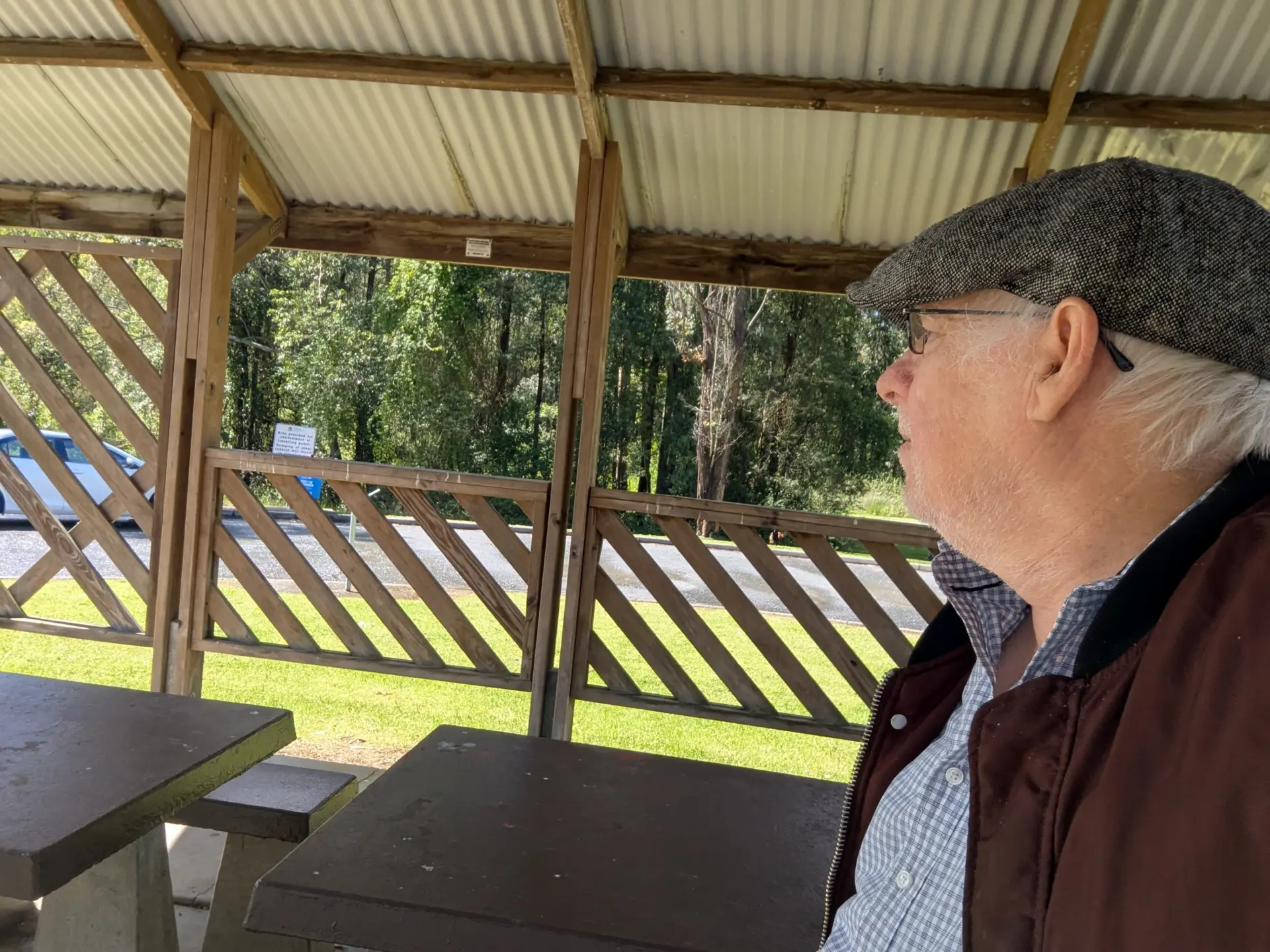
Image: 2026-10-24 (78) Paddys Rest Rest Area, Shelter for Thinking and Writing
MICE is growing in the thinking and writing. All contributions of comprehensive and of fairness ae welcome. We are liberal enough to want to find everyone a decent place in the social environment, radical enough to shift the stagnant agendas, and conservative enough to preserve the legacy of the common good.
In political philosophy, cognitive sociology, and the philosophy of governance, this statement articulates the triadic political dialectic at the heart of the Management Institute for Contributory Economy (MICE) [52–53, 161]. Rather than adhering to the narrow, polarized binaries of contemporary political discourse, MICE operationalizes a Philosophical Compatibilism that synthesizes the core strengths of the three classical modern ideological traditions—Liberalism, Radicalism, and Conservatism—into a unified, higher-order framework [52–53, 155, 161]. By welcoming “all contributions of comprehensiveness and fairness,” MICE moves beyond sectarian gatekeeping, establishing an Open Constitutionalism where ideas are evaluated on their explanatory depth, ethical integrity, and alignment with the common good rather than their conformity to market or bureaucratic dogmas [41–42, 46, 53].

Image: 2026-10-24 (80) The Outlook of Grafton McDonalds, No Lunch, The View of the Open Road
- The Liberal Commitment to Procedural Inclusivity ( Finding a Decent Place ): The liberal dimension of MICE guarantees that every human being is recognized as a rights-bearing, evaluating “historical person” who deserves a dignified standing within the social environment[1]. Drawing on Jürgen Habermas’s theory of communicative action and international human rights standards (such as Article 18 of the Universal Declaration of Human Rights), MICE establishes a transparent “level playing field” [41, 90–91, 144]. Under this framework, social conflicts are resolved through unforced, rational-critical dialogue (Verständigung) rather than administrative coercion, market exclusion, or status privilege[4][5].
- The Radical Impulse to Shift Stagnant Agendas ( Institutional Deconstruction ): The radical vector provides the necessary critical power to uncoil society from “vicious circles of stupidity,” “wooden epistemology,” and the “idiocy of managerialism”[1]. Through the POLICE diagnostic filter (Philosophically Ontology, Logic, Intersect, Compatibility, Education) and the practice of “crap detecting,” MICE unmasks how market fundamentalism and corporate audit culture manufacture institutional myths to justify precarity and downward liability shifts[6]. This radical critique breaks through stagnant policy paradigms to demand structural reforms—such as the Contributory Income Scheme and professional contractualism—that decouple human survival from extractive wage-labour markets [49–50].
- The Conservative Custodianship of Civilizational Capital ( Preserving the Common Good ): The conservative dimension acts as a safeguard against destructive hyper-industrialism, “historical forgetfulness,” and the “altar of autocomplete”[1]. Using Spiral Historiography, MICE reaches into deep cultural archives to retrieve “thick ethical concepts” (such as truthfulness, courage, and substantial fairness) and defend noodiversity (the localized diversity of knowledge and faith)[13]. Rather than treating heritage as a commodified museum piece or a tool for cultural warfare, MICE preserves the “legacy of the common good” as a living foundation for Aristotelian flourishing (eudaimonia) and generational solidarity [52–53, 126, 189].
Ultimately, this triadic synthesis establishes what Dr. Neville Buch designates as **”A Different Radical Centre”**[17][18]. By holding liberalism, radicalism, and conservatism in dynamic tension, MICE avoids both the chaotic dissolution of unanchored radicalism and the stagnant oppression of market traditionalism[19]. Re-centring the “historical person” within a flourishing public sphere ensures that human authorship, democratic wisdom, and planetary hope remain the guiding lights of 21st-century civilizational governance [53–55, 158].
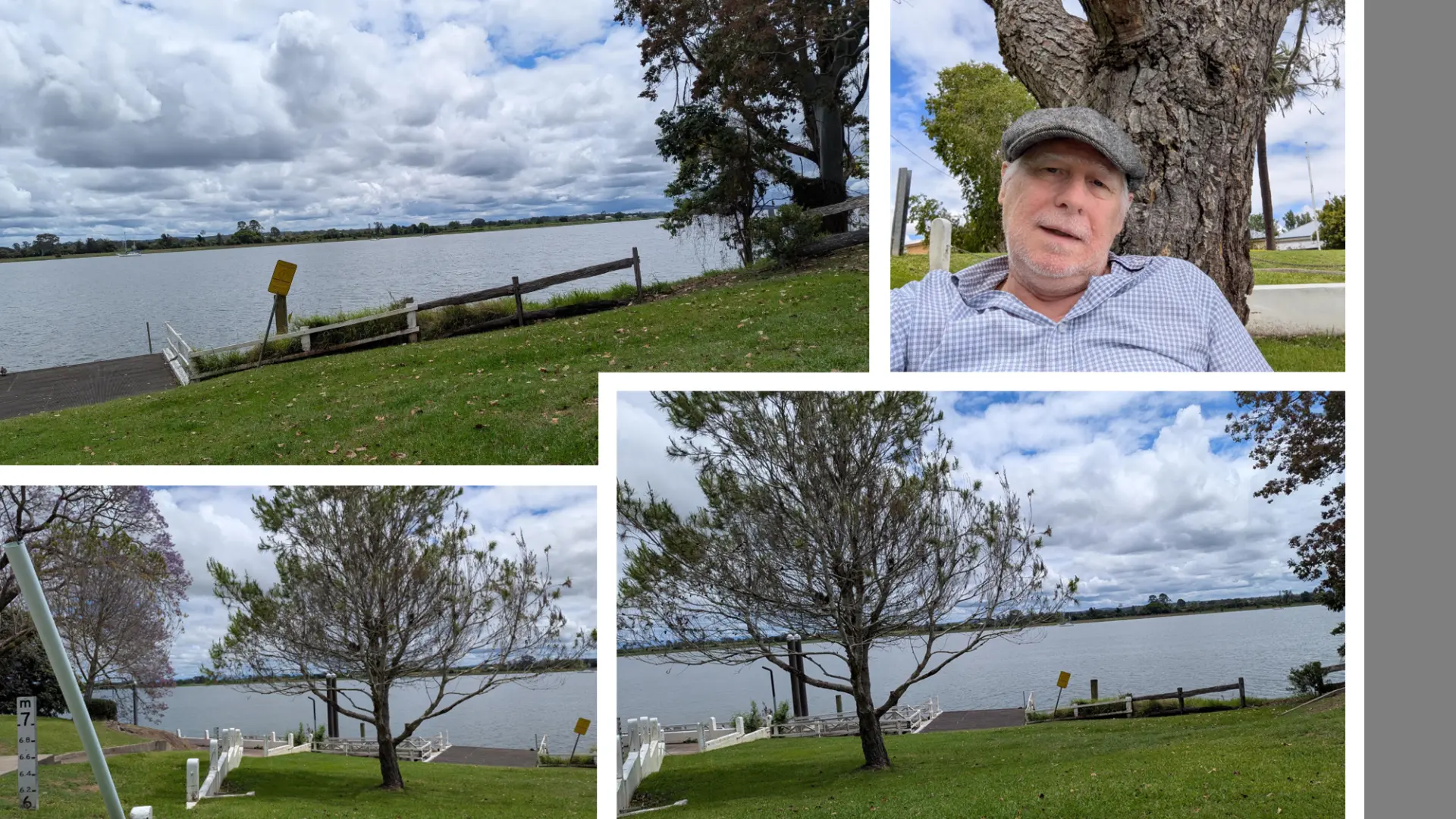
Image: 2026-10-24 (81-84) Ulmarra, Enjoying the Views of Clarence River, Neville Resting
These MICE articles are always invitations: for collaborations, for donations, for investments, for joining the ‘board’ (overseers), to join the independent scholars in joint writing and thinking.
In political economy, cognitive sociology, and the philosophy of higher education, characterizing scholarship as a continuous invitation redefines academic writing from a closed, commodified output into an open mechanism for communicative intersubjectivity [5, 16, 24–25]. Within corporate academia, research publications typically function as closed monologues or positional assets designed for career advancement, citation metrics, and institutional gatekeeping [16–18]. In contrast, treating research papers as invitations to collaborate, invest, donate, and co-govern aligns directly with Jürgen Habermas’s model of communicative action ( Verständigung ) and Ivan Illich’s concept of decentralized “learning webs” [5, 12, 24–25]. Rather than asserting a finished intellectual monopoly, MICE publications operate as generative nodes within an open public sphere, inviting civic actors and independent scholars into shared inquiry[1].

Image: 2026-10-24 (85) Home, Sunnybank Hills, Dinner, Neville, Heated frozen lasagne 6.00 p.m.
Mechanistically, extending invitations for donations, investments, and board oversight operationalizes Open Constitutionalism and the Contributory Alliance [2, 7–8, 22]. By inviting community members, philanthropic donors, and impact investors to fund public cognitive scaffolding, MICE reframes financial support not as transactional charity, but as a vital civic investment in society’s “intellectual immune system”[4]. Furthermore, establishing an inclusive board of overseers ensures democratic accountability and transparency through the POLICE diagnostic filter (Philosophically Ontology, Logic, Intersect, Compatibility, Education)[6][7]. This participatory governance structure replaces autocratic administrative control with a collaborative alliance between independent humanists, regional communities, and institutional partners[1].
Ultimately, inviting independent scholars into joint writing and thinking embodies panser (thinking as caring) and the restoration of Human Authorship[6]. By overcoming the “material resource barriers” and “institutional isolation” that enforce precarity among autonomous thinkers, MICE builds resilient “we-spaces” where intellectual labour is shared, validated, and published [20, 24–25]. This collaborative model transforms cold, calculating research into an act of mutual care, ensuring that diverse human perspectives are synthesized into “comprehensive cognition” to advance Aristotelian flourishing (eudaimonia) and democratic wisdom[9].
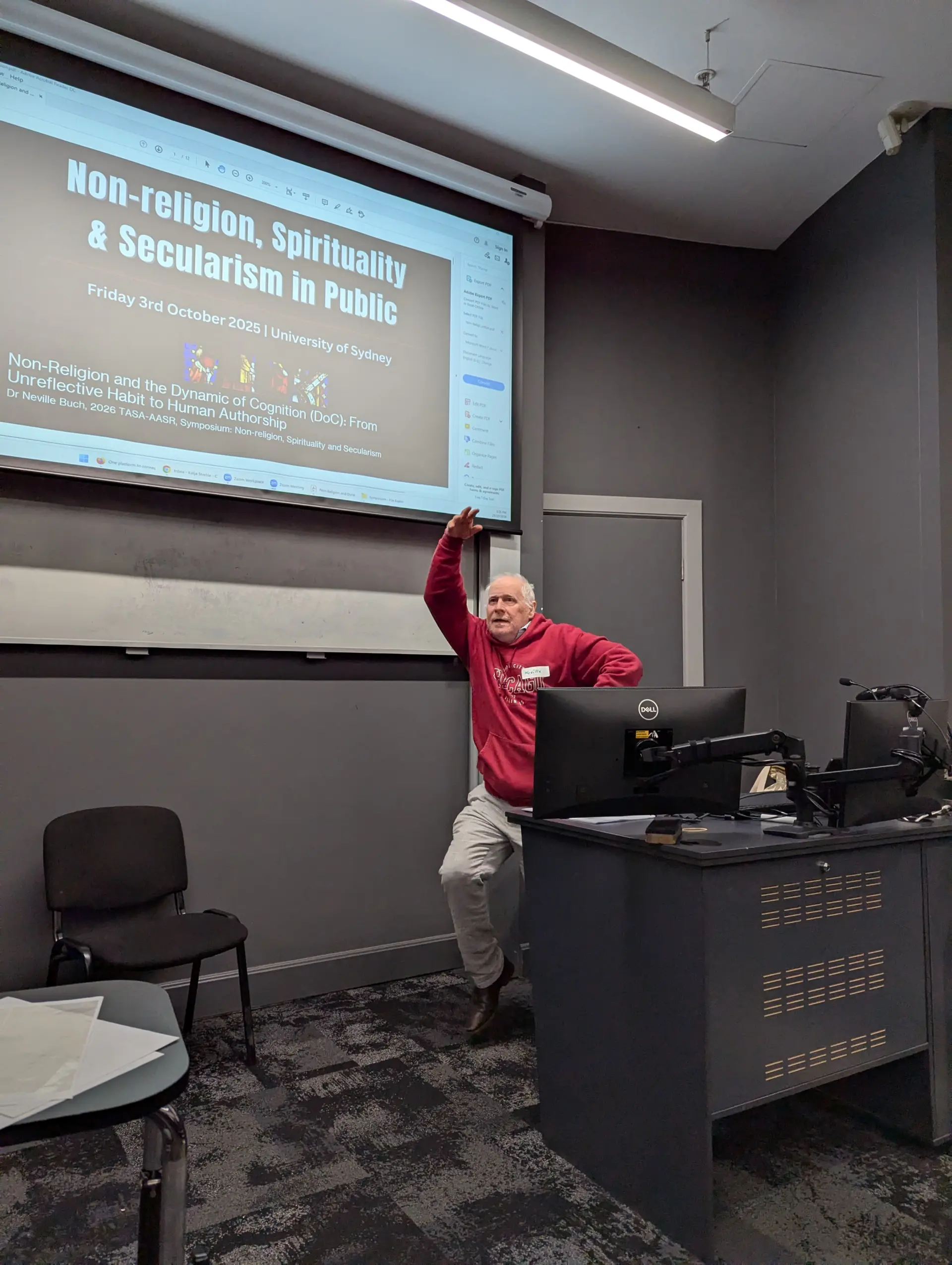
Featured Image: 2026-10-23 (68) University of Sydney, Neville, Leaving Religion and Non-Religion Thought Symposium. Neville’s Jig in Presentation
Here is a comprehensive, structured bibliography for The Story of Resilience series (documenting Dr. Neville Buch’s 5th Australian East Coast Trip and the accompanying intellectual synthesis) grounded in the source records[1].
1. Series Context & Overview
The Story of Resilience series details Dr. Neville Buch’s travel from Brisbane through regional New South Wales to Geelong and Melbourne, returning via Sydney[1][3]. The series synthesizes the physical trials of the journey (roadside breakdowns, financial strain, and community kindness) with deep historical research, featuring an extended collaborative research residency with leading Australian Islamic historian Dr. Dzavid Haveric in Geelong and a presentation on the Dynamic of Cognition (DoC) at the University of Sydney[1].
2. Primary Works by Dr. Neville Buch & MICE Publications
The core theoretical, methodological, and diagnostic foundation of the series is established across Dr. Buch’s publications for the Management Institute for Contributory Economy (MICE) [16–17, 130–131, 159, 203–204, 279–280]:
- Buch, N. (2015). Process of Learning (Principles) & The Dynamic of Cognition. Brisbane: Dr Neville Buch Publications[4].
- Buch, N. (2024). The Spiral History Theory of Stupidity: Getting Stuck in Time-Space, and Personal Breakout of Historical Cognition Patterns. Brisbane: Management Institute for Contributory Economy[5][6].
- Buch, N. (2025). MICE Principles and Philosophy (First Development). Working Paper. Brisbane: Management Institute for Contributory Economy[5].
- Buch, N. (2026a). MICE: Limited Thinking and the Contributory Economy (Book 1 of MICE). Brisbane: Management Institute for Contributory Economy[5].
- Buch, N. (2026b). Dr Buch in Intellectual Community: Reclaiming Authorship in the City of Intellect. Brisbane: Management Institute for Contributory Economy[5][8].
- Buch, N. (2026c). Understanding History is Philosophy in Practice: A Cognition History of Queensland. Brisbane: Management Institute for Contributory Economy[5][8].
- Buch, N. (2026d). Academic Rigour, Epistemic Renewal, and the Crisis of Inquiry: A Scholarly Review of the Vanderbilt Commission Report on the State of Scholarship. Brisbane: Management Institute for Contributory Economy[9].
- Buch, N. (2026e). Spiral Historiography and the Pedagogy of Consciousness in Australia. Academic Synthesis[10].
- Buch, N. (2026f). The Idea of Religion Today. Brisbane: Management Institute for Contributory Economy[10].
- Buch, N. (2026g). Thinking Religion in Place: Religion Is Not What It Was. Brisbane: Management Institute for Contributory Economy[10].
- Buch, N., & Peach, N. (2024). Philosophically Ontology Logic Intersect Compatibility Education (POLICE). Brisbane: Management Institute for Contributory Economy[7].
- Buch, N., Macklin, M., & Peach, N. (2026). MICE Intellectual Handbook: Limited Thinking and the Contributory Economy. Brisbane: Management Institute for Contributory Economy[8].
3. Foundational Theoretical, Epistemological & Sociological Literature
The series draws on key works in phenomenology, cognitive sociology, critical theory, and educational philosophy to articulate the Dynamic of Cognition, panser (thinking as caring), and the critique of neoliberal formalisms [16–18, 44–47, 106–110, 132, 185–186, 281–286]:
- Arendt, H. (1977). The Life of the Mind (M. McCarthy, Ed.). New York: Harcourt Brace Jovanovich[13].
- Aristotle. (c. 350 BC). Nicomachean Ethics (W. D. Ross, Trans.). Oxford: Clarendon Press[6].
- Cavanaugh, W. (2008). Being Consumed: Economics and Christian Desire. Grand Rapids: William B. Eerdmans Publishing[11].
- Coase, R. H. (1960). The Problem of Social Cost. Journal of Law and Economics, 3(1), 1–44[11].
- Collins, R. (1998). The Sociology of Philosophies: A Global Theory of Intellectual Change. Cambridge, MA: Belknap Press of Harvard University Press[14].
- Collins, R. (2019). The Credential Society: An Historical Sociology of Education and Stratification. New York: Columbia University Press[11][14].
- Cupitt, D. (2008). The Meaning of the West: An Apologia for Secular Christianity. London: SCM Press[14].
- Dweck, C. S. (2006). Mindset: The New Psychology of Success. New York: Random House[9].
- Ellul, J. (1973). Propaganda: The Formation of Men’s Attitudes. New York: Vintage Books / Octagon Books [223–224].
- Gadamer, H.-G. (1989). Truth and Method (2nd rev. edn.). New York: Crossroad[9].
- Haack, S. (1993). Evidence and Inquiry: Towards Reconstruction in Epistemology. Oxford: Blackwell [204–205].
- Habermas, J. (1979). Communication and the Evolution of Society (T. McCarthy, Trans.). Boston: Beacon Press[15].
- Habermas, J. (1984). The Theory of Communicative Action. Boston: Beacon Press[16].
- Habermas, J. (1991). Knowledge and Human Interests. Cambridge: Polity Press[14][16].
- Hofstadter, R. (1963). Anti-Intellectualism in American Life. New York: Random House USA Inc. [214–215].
- Illich, I. (1971). Deschooling Society. London: Calder & Boyars[17].
- Illich, I. (1973). Tools for Conviviality. New York: Harper & Row[17].
- Ingold, T. (2011). Being Alive: Essays on Movement, Knowledge and Description. London: Routledge[16].
- Macklin, M. (1967). Analogy, Analysis and God (Philosophical Thesis). Brisbane: University of Queensland[18].
- Macklin, M. (1976). When Schools Are Gone: A Projection of the Thought of Ivan Illich. Brisbane: University of Queensland Press[18].
- McKinney, J. P. (1971). The Structure of Modern Thought. London: Chatto & Windus[19].
- Merleau-Ponty, M. (1945/1962). Phenomenology of Perception (C. Smith, Trans.). London: Routledge & Kegan Paul [50, 210–211].
- Mills, C. W. (1959). The Sociological Imagination. New York: Oxford University Press[17][20].
- Noddings, N. (1984). Caring: A Feminine Approach to Ethics and Moral Education. Berkeley: University of California Press[19][21].
- Postman, N., & Weingartner, C. (1969). Teaching as a Subversive Activity. New York: Delacorte Press[22].
- Stiegler, B. (1998). Technics and Time, 1: The Fault of Epimetheus. Stanford: Stanford University Press [206–207, 228, 282].
- Stiegler, B. (2014). Symbolic Misery, Vol. 1: The Hyper-Industrial Epoch. Cambridge: Polity Press [207, 228–229, 282].
- Stiegler, B. (2018). Qu’appelle-t-on panser?: 1. L’immense régression. Paris: Les Liens qui Libèrent[21].
- Williams, B. (1985). Ethics and the Limits of Philosophy. Cambridge, MA: Harvard University Press[23].
4. Historical & Collaborative Research Literature
Literature documenting Australian history, Islamic historical encounters, regional geography, and social development synthesized during the Geelong research residency and road trip [1, 132, 315–318]:
- Haveric, D. (2006). Australia in Muslim Discovery: Historical Rediscovering of Australia by Non-Muslims and Muslims. Geelong: Deakin University Print Services[15].
- Haveric, D. (2012). History of the Muslim Discovery of the World: Islamic Civilisation Within the Plurality of Civilisations. Geelong: Deakin University Print Services[15].
- Haveric, D. (2016). History of the Bosnian Muslim Community in Australia: Settlement Experience in Victoria. Saarbrücken: Lambert Academic Publishing [315–316].
- Haveric, D. (2017). Muslim Memories in Victoria: Building Communities and Interfaith Relations from the 1950s to the 1980s. Australian Journal of Islamic Studies, 2(3), 134–162[24].
- Haveric, D. (2018). ANZAC Muslims: An Untold Story. Australian Journal of Islamic Studies, 3(3), 78–102[24].
- Haveric, D. (2023). A History of Muslims in the Australian Military: Loyalty, Patriotism, Contribution from 1885 to 1945. London: Cambridge Scholars Publishing[25].
- Haveric, D. (2026a). Macassan Muslims and Aboriginal Australians: Cultural and Spiritual Encounters. Religions, 17(2), 1–18[25].
- Haveric, D. (2026b). Reconsidering Possible Macassan Prayer Structures in Northern Australia: Port Essington and Raffles Bay. Australian Journal of Islamic Studies, 11(1), 45–68 [132, 317–318].


Neville Buch
Latest posts by Neville Buch (see all)
- Contemporized Sociology Across the Spectrum: Cognition, Community, and Human Authorship – November 20, 2026
- Buch, Neville. Arif Jameel (2026). The Architecture of Character – November 20, 2026
- Coding the Architecture of Silence: An Co-Scientist Academia.Edu Answer – November 19, 2026