
Starting text: Neville D. Buch and Arif Jameel, The Architecture of Silence and the Erosion of Knowledge, 24 August 2026. Scope: three explanatory frameworks, not an exhaustive review. Prepared 19 November 2026.
Main finding
The essay connects institutional non-engagement, historical forgetting and algorithmic dominance to the erosion of human authorship. Its strongest next development is to distinguish where the failure occurs: recognition of a speaker, reproduction of a group’s ignorance, or distribution of information. These are related mechanisms, but each requires different evidence and a different remedy. More communication alone does not establish that any of them has been repaired.
Starting point and verification
The full 13-page essay was retrieved from Academia and read. It explicitly credits Buch and Jameel, although the local profile entry lists Buch alone. The supplied ResearchGate DOI returned HTTP 403; consequently, this comparison concerns the matching-title Academia text, not a verified identity between repository versions. The local profile had no essay PDF; Spiral_Dialectic_Pattern.pdf was not used.
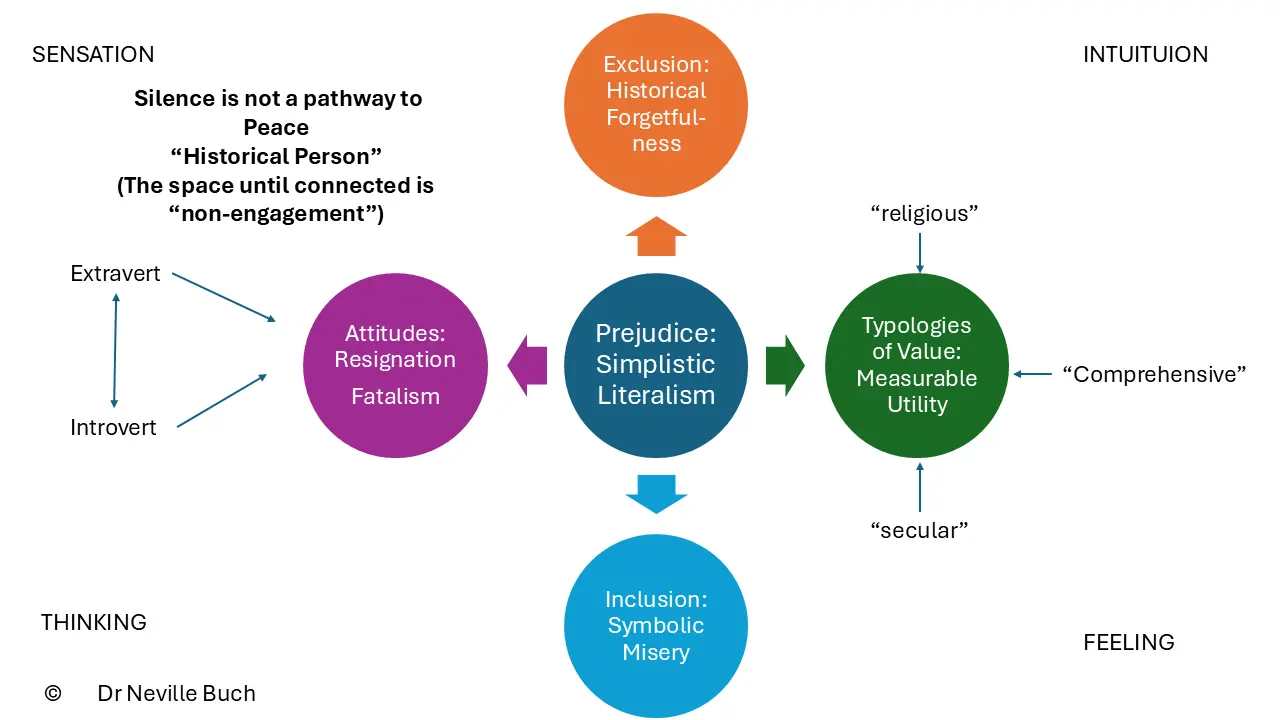
The essay argues that institutions protect power through strategic non-engagement (§I, p. 3), connects computational reduction to lost agency (§II, pp. 3–4), and examines historical forgetting (§III, p. 4). Importantly, it also qualifies a total-collapse interpretation: scientific knowledge retains continuity (p. 4), while communication has expanded in scale (p. 5). Its problem is therefore best read as selective exclusion and deficient ethical engagement, not the literal disappearance of knowledge or conversation. Its proposed responses include three-domain validation and ethical formation of the 15–25 age cohort (§§I and V, pp. 3, 5).
The following frameworks were selected for their fit with those mechanisms, not as a claim that they exhaust the field. Dotson offers the finest-grained account of silencing; Mills directly develops the ignorance tradition cited in the essay; Gillespie supplies an institutional account of algorithmic selection.
Cited comparison matrix
“Limitations” below are this comparison’s assessment of explanatory scope, not necessarily concessions made by each author. Page numbers are printed pages in the linked editions.
| Dimension | Dotson: epistemic violence and testimonial silencing [1] | Mills: white ignorance [2] | Gillespie: public relevance algorithms [3] |
|---|---|---|---|
| Definition and unit | Epistemic violence is an audience’s failure to reciprocate communication because of harmful, reliable ignorance. Quieting: not recognizing a speaker as a knower. Smothering: a speaker truncates testimony when uptake is unsafe. Unit: situated testimonial exchange (pp. 238–244). | False belief or absence of true belief causally shaped by white racism and/or racial domination. Unit: historically structured social cognition, not simply an individual’s missing information (pp. 51–58). | Procedures selecting what information appears relevant also help produce and certify public knowledge. Unit: the database–algorithm–institution–user relationship (pp. 167–169). “Silence” is an application of this framework here, not his umbrella term. |
| Assumptions | Speaking successfully depends on audience recognition; harm and ignorance must be assessed in context. Neither intention nor culpability is necessary (pp. 238–242). | Social position affects cognition; racial categories are historically constructed. Truth remains distinguishable from error. Ignorance is a tendency, not an inevitable property of every white person (pp. 51–59). | Relevance is socially organized, not a neutral technical given. Human choices and institutions must remain in the explanation; technological determinism is rejected (pp. 168–171). |
| How silence arises | Stereotypes deny knower status; demonstrated audience incompetence and the risk of harm lead speakers to withhold testimony. Silence can therefore be a protective response to oppression rather than an institutional strategy (pp. 242–248). | Perception, concepts, collective memory and testimony reinforce selective non-knowing. Institutional histories and public commemoration can normalize omissions without each participant acting in bad faith (pp. 57, 59–67). | Information is excluded before indexing, classified in consequential ways, removed or demoted; opaque relevance criteria and users’ adaptation affect subsequent visibility (pp. 169–172, 183–185). |
| Evidence actually offered | Philosophical analysis drawing on Black feminist scholarship, Crenshaw’s discussion of domestic violence, and Harvin’s account of conversations about race; it also engages microaggression research. Not an intervention trial or prevalence estimate (pp. 242–248). | Conceptual argument supported by historical scholarship, literary analysis, accounts of textbooks and monuments, and cited interview research on inherited advantage. Not a controlled causal estimate of ignorance (pp. 53–55, 64–67). | A conceptual map illustrated through platform practices and controversies, including Amazon categorization and content demotion. These are historical examples, not a current audit of those services (pp. 168–172). |
| What it adds to the essay | Separates refusing to hear from being unable to speak safely. Locates responsibility for failed uptake without demanding disclosure from those exposed to harm. | Gives “historical forgetfulness” identifiable institutional carriers and explains how power-preserving ignorance persists without conscious conspiracy. | Replaces a general opposition between binary computation and humanity with specific choices about collection, categories, ranking and access. Preserves room for user resistance. |
| Limitations for this task | This article does not supply a platform-level account of ranking or an institutional reform evaluation. Its diagnosis requires contextual evidence; a non-response alone is insufficient. | Race is constitutive of this concept. Extending it to all institutional silence requires an additional argument, not deletion of its racial history. Causal boundaries can be difficult to adjudicate (pp. 56–58). | The chapter does not itself establish when low visibility constitutes epistemic violence or offer a sufficient moral criterion for rightful selection. Its 2014 analysis cannot establish effects of present-day generative AI. |
Gap memo
A. Documented differences and tensions—not a published exchange
These are explicit differences between the texts. None of the three earlier sources addresses the 2026 essay.
- Intentional sabotage versus structural reproduction. The essay foregrounds wilful non-knowing and strategic refusal (p. 3). Dotson explicitly includes unintentional failures (pp. 238–242); Mills includes impersonal structural causation and ignorance without bad faith (p. 57). Implication: keep intentional suppression as one subtype rather than making it the default explanation of non-engagement.
- An obligation to engage versus safety in withholding. The essay’s restorative emphasis is dialogue (pp. 4–5). Dotson’s smothering analysis shows why speaking to an unsafe audience can impose further harm (pp. 244–248). This is a tension over the conditions of repair, not evidence that Dotson rejects dialogue. Implication: distinguish institutional duties to listen from a vulnerable speaker’s freedom not to disclose.
- Computational form versus institutional choice. The essay associates binary computational architecture with reduction of human agency (p. 4). Gillespie explicitly resists placing technology in the explanatory driver’s seat (p. 169) and describes recursive user–algorithm relations (pp. 183–185). Implication: binary implementation alone does not establish the mechanism of domination; identify the consequential governance choice.
B. Untested conditions in the essay
These are evidence needs for this argument, not claims that nobody has researched them.
- When does non-engagement become epistemic harm? Sections I–IV do not provide a worked case distinguishing exclusion from justified refusal, lack of capacity or protective withholding. Trace one disputed contribution from submission through response, uptake and consequences, including the institution’s stated reasons. Do not infer motive from silence alone.
- How do the mechanisms connect? The essay joins institutional refusal, forgetting and algorithmic control, but does not demonstrate their sequence in a single case. Compare what was said, what was retained or indexed, what was circulated, and whether anyone substantively addressed it. This would distinguish damaged knowledge from lost visibility or lack of institutional acceptance.
- What would validate the proposed remedy? The three-circle criterion needs a procedure for disagreement between domains and a distinction between factual truth and moral validity (p. 3). The 15–25 age window is asserted as developmentally critical (p. 5), without an age-comparative study or evaluated intervention in this essay. Specify these as normative proposals or hypotheses until evidence warrants stronger claims.
C. Gaps only within this limited search
This small source set does not establish whether combining Dotson, Mills and Gillespie is original, whether the three-circle proposal outperforms alternatives, or whether youth ethical education changes institutional listening. It also does not adequately cover Indigenous authority over restricted knowledge, disability-related communication, or legitimate privacy-preserving non-disclosure. These are search limits, not demonstrated absences in scholarship.
Recommended next move: build one institutional case around a distinction between being allowed to speak, being recognized as a knower, being made visible, and receiving accountable uptake. This is a proposed synthesis of the comparison—not a validated model. It would make the essay’s ethical argument more discriminating without reducing it to a single engagement metric.
Sources and access notes
Starting text — author material, full text read: Buch, N. D., & Jameel, A. (2026). The Architecture of Silence and the Erosion of Knowledge. Academia version dated 24 August. Full-text landing page. Arguments checked against pp. 2–5; bibliography pp. 8–10. Repository-version limitation noted above.
[1] External scholarship, full text retrieved through Academia: Dotson, K. (2011). Tracking epistemic violence, tracking practices of silencing. Hypatia, 26(2), 236–257. DOI · Accessible full-text copy. Key sections: “Epistemic Violence” and “Practices of Silencing: Two Testimonial Oppressions.” Academia access may require a free login.
[2] External scholarship, open institutional copy read: Mills, C. W. (2017). White ignorance. In Black Rights/White Wrongs: The Critique of Racial Liberalism (pp. 49–71). Oxford University Press. DOI · Open PDF, Institute for Advanced Study. Originally published in Sullivan and Tuana’s Race and Epistemologies of Ignorance (2007), pp. 13–38. All page references here use the accessible 2017 edition. Key sections: “Demarcating ‘White Ignorance’” and “Whiteness and Social Cognition.”
[3] External scholarship, open research-hosted proof read: Gillespie, T. (2014). The relevance of algorithms. In T. Gillespie, P. J. Boczkowski, & K. A. Foot (Eds.), Media Technologies (pp. 167–194). MIT Press. DOI · Open PDF, Microsoft Research. Key sections: “Patterns of Inclusion” and “Entanglement with Practice.” The accessible copy is a typeset proof with printed pagination.
Search boundary: targeted title/DOI retrieval and searches for the three named frameworks; relevant primary-text sections were read directly. No systematic database sweep, quantitative synthesis or citation-network analysis was performed. A supplementary CiteRight check returned different Dotson papers and left other searches unstarted; it did not verify this source set and was not used as evidential support. Findings above rest on the linked primary texts.
Featured Image:


Neville Buch
Latest posts by Neville Buch (see all)
- Frameworks of silence: a focused comparison and gap memo, a co-scientist academia.edu answer – November 19, 2026
- New Global Paradigm: The Co-Scientist Academia.Edu Answers – November 19, 2026
- University interdisciplinary rankings 2027: The Illusion of Metrics and the Hollowing Out of Australian Higher Education – November 18, 2026