
Dr Neville Buch
Abstract
This essay explores the synergistic relationship between sociology, faith, freedom, and thought as a necessary framework for human flourishing. Drawing on an expansive intellectual history—from the religious origins of capitalist behaviour to modern critiques of technocratic control—it argues that these four pillars are inseparable in the quest for Human Authorship. Sociology provides the lens to see the “social construction of reality” and the “iron cage” of rationalization; faith (both secular and religious) offers the moral labour of caring and ethical disposition; freedom acts as the proactive resistance to coercive power; and thought, specifically through Spiral Historiography, serves as the corrective discipline to uncoil repetitive patterns of historical error. Ultimately, the synthesis of these elements leads to Aristotelian Flourishing (eudaimonia), where the individual moves from a “Junior” state of unreflective execution to a “Senior” state of social accountability.
Sociology, Faith, Freedom and Thought
The Sociological Construction of Reality
Sociology provides the foundational understanding that our world-picture is not a neutral given but an interpersonal social product synthesized over generations. As Peter Berger and Thomas Luckmann famously argued, reality is socially constructed through institutional practices that often become “lifeless conventions”. In the modern era, this construction is frequently characterized by ”McDonaldization”—a system prioritizing efficiency, calculability, and predictability at the cost of meaningful human relations. C. Wright Mills’ “Sociological Imagination” remains the vital tool for bridging the gap between personal “troubles” and public “issues,” resisting a ”technocratic reductionism” that treats human beings as “mindless automatons” or “passive conduits” for social drives.
Faith as Moral Labor and Ethical Anchor
The role of faith in this intellectual landscape extends beyond sectarian dogma to encompass the “thick ethical concepts” that anchor human judgment. Max Weber identified that modern capitalism’s “spirit” originally emerged from Protestant religious values, where mundane labour was dignified as a “calling”. However, as the spiritual underpinnings faded, the system became an ”iron cage” of rationalization. In the specific context of Queensland history, Dr. Neville Buch identifies how a ”myth of secular humanism” has been utilized as an ideological weapon to isolate populations from pluralistic reform and critical biblical studies. True faith, in a contributory sense, is realized as ”thinking as caring” (panser), a procedural mechanism used to tend to “social wounds” through empathy and historical truthfulness.
Freedom: The Resistance to Coercion
Freedom is defined not merely as the absence of constraint, but as ”anti-power”—the structural capacity to resist domination and command. This “Rule of Freedom” characterizes the modern city, yet it is perpetually threatened by the ”Orthodoxy of Coercion”. While thinkers like John Stuart Mill advocated for gradual reform and individual liberty as the vehicle for progress, others like Albert Camus insisted that rebellion is a fundamental necessity against humiliation and injustice. Hannah Arendt further distinguished power from violence, positing that true power arises only when individuals act in concert through communication and consent. Without this freedom, the “Historical Person” remains stuck in a “Junior” state, incapable of taking social accountability for their narrative.
Thought: Remediating the Spiral of Stupidity
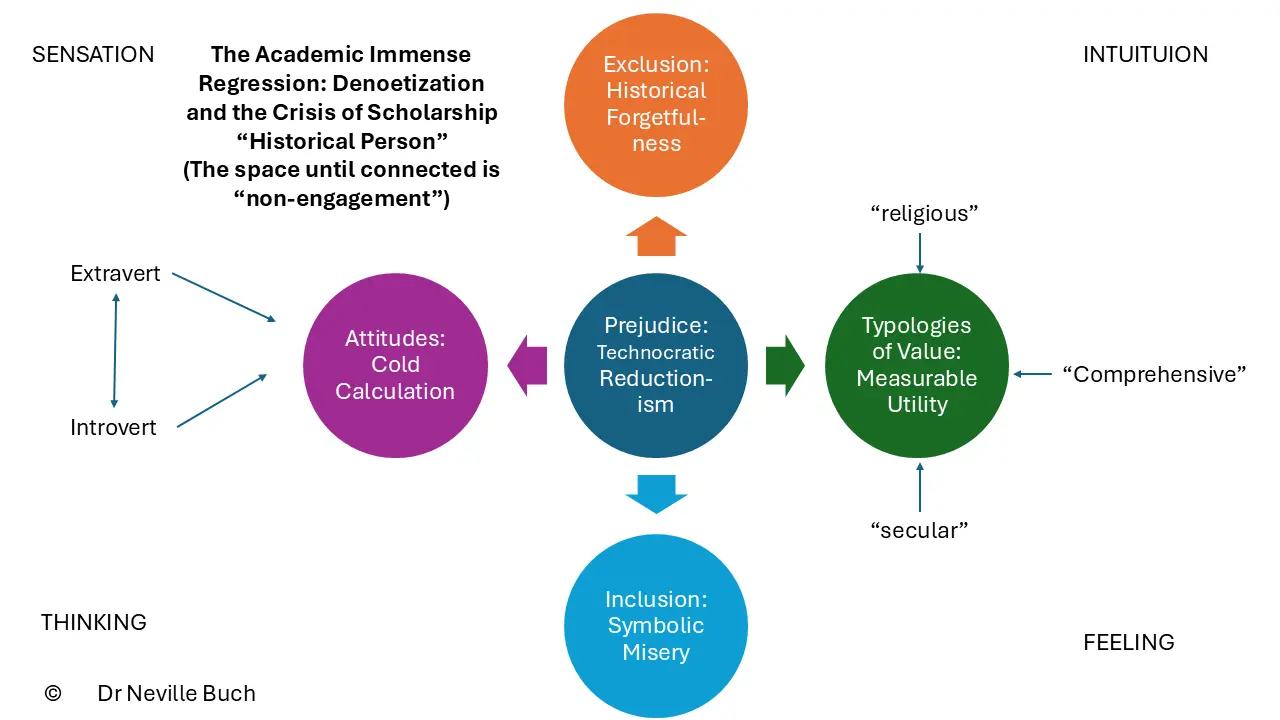
At the centre of this synthesis is Thought, which Dr. Buch operationalizes through the Dynamic of Cognition (DoC) and Spiral Historiography. The “immense regression” of modern society is driven by ”denoetization”—the mechanical liquidation of the human capacity to judge. This leads to a ”Spiral History of Stupidity,” where populations repeat past failures because their origins have been banished from collective memory—a state of ”Historical Forgetfulness”.
Spiral Historiography acts as the intellectual corrective, “uncoiling” repetitive patterns of intellectual error by recursively returning to past struggles to achieve ”Sufficient Comprehension”. By treating history as ”philosophy in practice,” scholars and citizens can dismantle manufactured “folk” myths—such as the “Queensland character”—that conceal uncomfortable truths like frontier violence and Indigenous dispossession.
Synthesis: Toward Aristotelian Flourishing
The ultimate goal of integrating sociology, faith, freedom, and thought is Aristotelian Flourishing (eudaimonia). This state is achieved through the synthesis of the Five Intentions: Self, Mind, Reason, Utility, and Love. It requires moving from unreflective habit toward a ”Senior” state of social accountability, where individuals reclaim Human Authorship over their lives and institutions. In this “Contributory Economy,” value is placed on human dignity and the common good rather than narrow metrics of “job readiness” or private accumulation.
Bibliography
Arendt, H. (1951). The origins of totalitarianism. Harcourt, Brace and Company.
Arendt, H. (1970). On violence. Harcourt, Brace & World.
Bauman, Z. (2000). Liquid modernity. Polity Press.
Beckert, S., & Desan, C. (2025). Capitalism: A global history. Penguin Press.
Bengtsson, J. O. (2006). The worldview of personalism: Origins and early development. Oxford University Press.
Berger, P. L., & Luckmann, T. (1966). The social construction of reality: A treatise in the sociology of knowledge. Anchor Books.
Bourdieu, P. (1991). Language and symbolic power. Polity Press.
Buch, N. (2015). No regrets in the evening of life: The history of Junction Park State School (1888–2013). Boolarong Press.
Buch, N. (2024). The spiral history theory of stupidity: Getting stuck in time-space, and personal breakout of historical cognition patterns. Management Institute for Contributory Economy.
Buch, N. (2024). Queensland history, religious education, and belief. In D. W. Kim & D. Wright (Eds.), Socio-anthropological approaches to religion: Environmental hope. Lexington Books.
Buch, N. (2026). DRAFT Transference: Character and the contributory economy. Management Institute for Contributory Economy.
Buch, N. (2026). Understanding history is philosophy in practice: A cognition history of Queensland. Management Institute for Contributory Economy.
Camus, A. (1954). The rebel: An essay on man in revolt. Alfred A. Knopf.
Dewey, J. (1922). Human nature and conduct: An introduction to social psychology. Henry Holt and Company.
Hofstadter, R. (1965). The paranoid style in American politics, and other essays. Alfred A. Knopf.
Hudson, W. (2016). Australian religious thought. Monash University Publishing.
Joyce, P. (2003). The rule of freedom: Liberalism and the modern city. Verso.
Mill, J. S. (1859). On liberty. John W. Parker and Son.
Mills, C. W. (1959). The sociological imagination. Oxford University Press.
Pettit, P. (1996). Freedom as antipower. Ethics, 106(3), 576–604.
Ritzer, G. (1993). The McDonaldization of society. Pine Forge Press.
Rose, N. (1999). Powers of freedom: Reframing political thought. Cambridge University Press.
Santos, B. de S. (2014). Epistemologies of the South: Justice against epistemicide. Paradigm Publishers.
Stiegler, B. (1998). Technics and time, 1: The fault of Epimetheus. Stanford University Press.
Tawney, R. H. (1926). Religion and the rise of capitalism: A historical study. John Murray.
Temby, A. (2024). Governance and public space in the Australian city: Negotiating public order in Brisbane, 1875–1914. Routledge.
Weber, M. (1930). The Protestant ethic and the spirit of capitalism. Allen & Unwin.
Williams, B. (2006). Philosophy as a humanistic discipline. Princeton University Press.
*****
Featured Image: The Academic ImmenseRegression. Denoetization and the Crisis of Scholarship.


Neville Buch
Latest posts by Neville Buch (see all)
- The Unbound Mind: Independent Scholarship, Institutional Isolation, and the Restoration of Human Authorship – October 20, 2026
- The Road to Geelong: A Re-Narrativization of The Story of Resilience Part 1 – October 20, 2026
- The Human Being Above the Transaction and Why Markets Cannot Measure Human Worth – October 15, 2026