
‘We can’t ask to turn the clock back. The resources just aren’t there’
As he takes up the presidency of Universities UK, Manchester Met vice-chancellor Malcolm Press today speaks to Times Higher Education about the financial challenges institutions face – and he’s under no illusions. “The government won’t always be able to do everything we wanted it to do because everybody knows public finances are very constrained,” he tells Helen Packer. “There’s no point saying ‘Can we turn the clock back?’ Because the resources just aren’t there.” But that doesn’t mean universities can’t ask for more. “We have to show to the government that there is a quid pro quo,” he says. One way to illustrate that? According to an independent analysis that it recently commissioned, Manchester Met delivers more value to Greater Manchester than both of the city’s major football clubs – Manchester United and Manchester City – combined, at an estimated £1.4 billion. “If we’re evidence-based in what we’re saying, and reasonable, I think the government will listen,” Press says.
Editorial, ‘No turning back the clock,’ says new UUK president, The Times Higher Education (THE) Newsletter, 4 August 2025
The rhetoric in the executive statement of the Manchester Met vice-chancellor Malcolm Press, is propaganda, which is to have a statement of partial truth to divert away from the critical point of what is required. It is true “The government won’t always be able to do everything we wanted it to do because everybody knows public finances are very constrained,” but as a state of affairs and not the political capacity. The public finances need not be ‘very constrained’ as a matter of theory and practice. In one way, Malcolm Press admitted as much, “If we’re evidence-based in what we’re saying, and reasonable, I think the government will listen.” If that is true, we ought not propagandize on “public finances being ‘very constrained’”, it misses the critical point completely.
Australian, UK, and US Vice-Chancellors need lessons in “de-propaganda”. Propaganda is not that statements are untrue, but propaganda are inferences, dismissals, or gaslighting, to avoid the bigger picture truth of the exact context in which the statement is made. Jacob N. Shapiro and Sean Norton on September 10, 2024, wrote an article in The Chronicle of Higher Education, with the headline, “Why Scholars Should Stop Studying ‘Misinformation’.” Their article was not propaganda per se, but the headline was ‘click bait’, and for what was a worthy article to read; nevertheless, the headline assertion was wrong. Scholars should not stop studying misinformation, and, indeed, should study all aspects of propaganda. Indeed, Jacob N. Shapiro’s and Sean Norton’s article leads to the very opposite conclusion of their headline assertion. Their argument is sound, and, so to summarise in their own words:
Disinformation refers to the purposeful use of false information to deliberately deceive others. Misinformation is false or misleading information spread without specific intent to deceive…
While the term “misinformation” may seem simple and self-evident at first glance, it is in fact highly ambiguous as an object of scientific study. It combines judgments about the factuality of claims with arguments about the intent behind their distribution, and inevitably leads scholars into hopelessly subjective territory. As a result, the pursuit of misinformation as a research topic ultimately makes it harder to answer critical questions about how changes to the information environment impact outcomes in the real world…
When scholars talk about “misinformation,” they are talking about activity generated by three very different social phenomena, each of which interacts with technology in distinct ways and creates a different kind of evidence trail.
The first is state-sponsored influence campaigns: countries reaching across borders to influence other countries’ politics with a combination of propaganda, true information presented out of context, and outright lies.
The second process is when bad actors, whether state-aligned or not, use conspiracy theories or false information to make political arguments in their own countries…
The third process is monetized falsehoods, often concerning medical information and contentious political topics…
Unfortunately, the medicalization of misinformation research led to scholarly agendas so broad and ambitious as to be impossible.
When academics and journalists refer to the subject as “hopelessly subjective territory” they have unwittingly spoken propaganda. Subjectivism is not ‘hopeless’, but just one tool in the toolbox. What such academics and journalists too easily forget is that they are too often speaking of narrow specialisation (the reference to “the medicalization of misinformation research”). This is where the propaganda problem lies in academia and journalism. What is missing is comprehensive education.
Too many academic managers are still promoting narrow specialisation which misleads, and resist the movement into interdisciplinary education and research. It appears each morning of late that the news reports — the radio as I get out of bed, breakfast television, the social media sources — expresses the madness of our societies. That madness is generally not clinical. Those with mental illness have other problems of the brain but those persons expresses themselves in the social madness.
The social reaction to these “mad” persons then centres within the thought-bubbles of the social madness. That is, most persons, when they have not turned to the researched education and do not think on that knowledge-base and skills, merely repeat nonsense statements, which on the surface have the appearance of “sense” but is not in fully and properly-functioning cognition.
Let’s take the news of a ‘today’ past (16 April 2024), as I had read it. According to The Times Higher Education Supplement, there is a term of ‘Clarkonomics’ which is a reference to a big boost for local economies. We told that “Caitlin Clark, a 22-year-old basketball player, has captivated fans across the world and created unprecedented interest in college sport with her record-breaking performances for the University of Iowa.” It then creates an “economy” for the local University. For the average graduate who has studied history, sociology, and philosophy, let alone economics, there ought to be the understanding why the thinking of ‘Clarkonomics’ is localised social madness.
Scientific American published April 5 an online article which arrived in my Inbox this morning, and it goes to one explanation of the social madness. Corey S. Powell and Openmind Magazine in this article produced, “The Dunning-Kruger Effect Shows that People Don’t Know What They Don’t Know”, which in public relations terms does not internally welcome the stupid to read the article:
The common misconception is that the Dunning-Kruger effect means “stupid people don’t know they’re stupid.” The Dunning-Kruger result is a little complicated because it’s actually many results. The one that is a meme is this idea: On any particular topic, people who are not experts lack the very expertise they need in order to know just how much expertise they lack. The Dunning-Kruger effect visits all of us sooner or later in our pockets of incompetence. They’re invisible to us because to know that you don’t know something, you need to know something. It’s not about general stupidity. It’s about each and every one of us, sooner or later.
If the writers are trying to say that we are all stupid at some place and time, and not for the only place and time, the argument is correct. But even the writers get their thinking conflated in the attempt to untangle the social madness. Yes, in what is denied, is a truth of the stupid people do know they’re stupid in some masking place of the mind. But the writers’ logic simply does not follow, even as acknowledging the complicated outcome. The conclusion of “It’s not about general stupidity” does not follow the correct logic, and so that on that presumption — that society is okay in terms of mental heath — is wrong. The writers, no doubt, took that certain tone of assurance to comfort readers. But lets be clear, that is propaganda.
As a result of this type of comforting propaganda, we now have public school teachers teaching “anti-woke” programs, as explained a The Washington Post article. It is pure culture-history warfare, in its motivation and content. It is dumbing-down the curriculum, even as the alternative histories accounts are factual correct, and, are, in fact, taught. The “anti-woke” is propaganda.
In Australia a week past, there are several stories of social madness. The Sydney Morning Herald told me about the crash of the Bruce Lehrmann’s civil claims against a media company from the Federal Court in Sydney. For those outside of the country, the civil case had to do with Lehrmann suing the media after a criminal trial against Lehrmann was effectively aborted, on allegations of rape. The outcome of the civil case was that the Federal judge directly, and on high probability, accused Lehrmann of the rape. Such was the nature of all of the testimonies. However, the allegations was performed in the country as the contests of characters, and the civil case was paid for, and set-up as, a competition between two media companies. The attention to the Lehrmann case was lost in that week from a significant number of murders and attempted murders; significant for Australia, but the run-of-the-mill event for the United States. On another journalistic story, a teenager attempted to murder Bishop Mar Mari Emmanuel of the Christ The Good Shepherd Church, in Sydney. Sydney appears to be the focus of this type of news. But that event took place after what was Australia’s possible third mass murder event (apart from the frontier violence). Its place in the record books is still being verified, but it comes somewhere among the Lindt Cafe killings (2014) in Sydney and the Port Arthur massacre (1996). It is be called, the “Bondi Junction” stabbings, on Saturday April 13th. Currently, there is speculation that the killer had targeted women. A baby, who survived, was knifed but his mother was killed. Nevertheless to say, the killer’s mental heath is being widely discussed. And this comes from the common belief, that “stupid people don’t know they’re stupid.” How can a person with schizophreniform psychosis kill innocent life? There is a part of our thinking that cannot accept the truth, and so we invent nonsense narratives to make sense of it. This is small exercise in journalistic analysis and demonstrates the pattern of true information to produce propaganda. In Critical Theory it has to do with what is not said so that certain inferences are made in the minds of the readers from the journalistic style and deliberation of the actual writing.
Far worse, for anyone to explain that it is nonsense in such comforting stories there is hatred towards the expert. The comforting stories are too important to “the victims” for it to be challenged, including the “social victims“, unrelated directly to the crime and crime victims. However, what does that mean for our society without the experts who have not been given the paid jobs, particularly in education? Is it not better, before the journalistic drama-written stories, that experts, like myself, are given the jobs in higher education to help persons to think in threads of correct thought before the murder?
Sometime ago, a young woman suggested that the edifices of peace in the middle east be forbade, due to her reading of biblical history. When I challenged her on an alternative — postmillennial — reading, she clammed up. So I let her know of my friendly expertise in evangelical history and sociology. Then came the shock, she would not inform me of the bible/Jesus fellowship she belonged to, because I would “judge” her.
It is not the first time I had a similar conversation and outcome. The messaging from some of our churches and other institutions is do not trust “liberals” and walk away from them. This aligns with what is happening in ‘The Propaganda War’ to which was discussed in The Atlantic.
What is troubling is that Vice-Chancellors have the same propaganda mode of thinking as a fundamentalist. After years of campaigning on these issues, I have had the same reaction of dishonest self-deception in the silence.
SELECTED REFERENCES
Ellul, Jacques (1973). Propaganda: The Formation of Men’s Attitudes, New York.
Thomas, N. (1992). Colonial Conversions: Difference, Hierarchy, and History in Early Twentieth-Century Evangelical Propaganda. Comparative Studies in Society and History, 34(2), 366-389. Retrieved April 28, 2020, from www.jstor.org/stable/178950
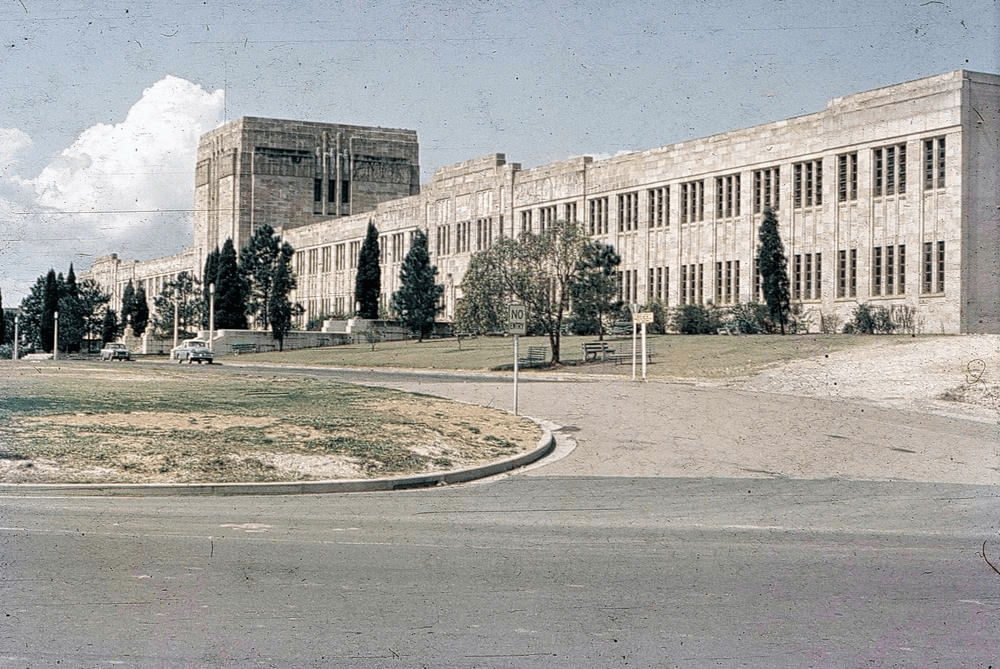
FEATURED IMAGE: Figure-5.-The-Source-of-Teen-Challenge-Radicalism-The-University-of-Queensland-circa-1963.-Source-State-Library-of-Queensland.png


Neville Buch
Latest posts by Neville Buch (see all)
- The Unbound Mind: Independent Scholarship, Institutional Isolation, and the Restoration of Human Authorship – October 20, 2026
- The Road to Geelong: A Re-Narrativization of The Story of Resilience Part 1 – October 20, 2026
- The Human Being Above the Transaction and Why Markets Cannot Measure Human Worth – October 15, 2026