
Dr Neville Buch[1]
Abstract
This essay produces a scholarly re-narrativization of Dr. Neville Buch’s autoethnographic account, The Story of Resilience Part 1: The Story of Resilience in Traveling the Australian East Coast. The narrative chronicles a high-stakes, 2026 research voyage undertaken for the Management Institute for Contributory Economy (MICE) from Brisbane through regional New South Wales to Geelong, Victoria. By analysing the interplay of financial austerity, administrative friction, physical vulnerability, and spontaneous human kindness, the essay reframes Buch’s road trip as a lived exemplar of philosophical resilience. It demonstrates how personal determination, combined with the contributory ethics of local communities and fellow travellers, overcomes bureaucratic institutional deadlocks (such as roadside assistance refusals and banking delays). Ultimately, the journey illustrates that understanding history and society is not an abstract exercise, but philosophy in practice forged through the material reality of transit.
The Road to Geelong: A Re-Narrativization of The Story of Resilience Part 1
1. Departure in Darkness and the Border Crossing (Friday, 16 October)
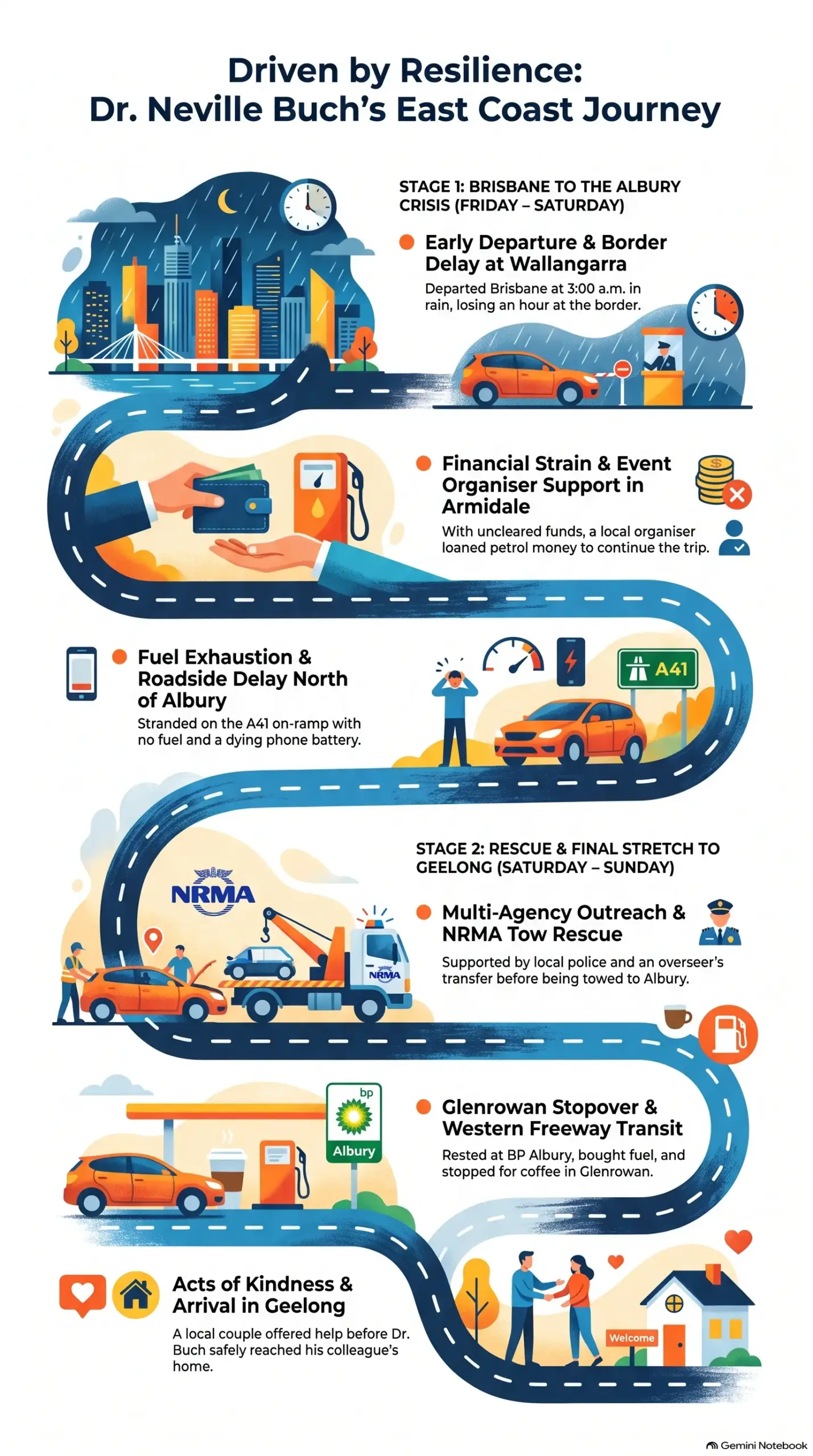
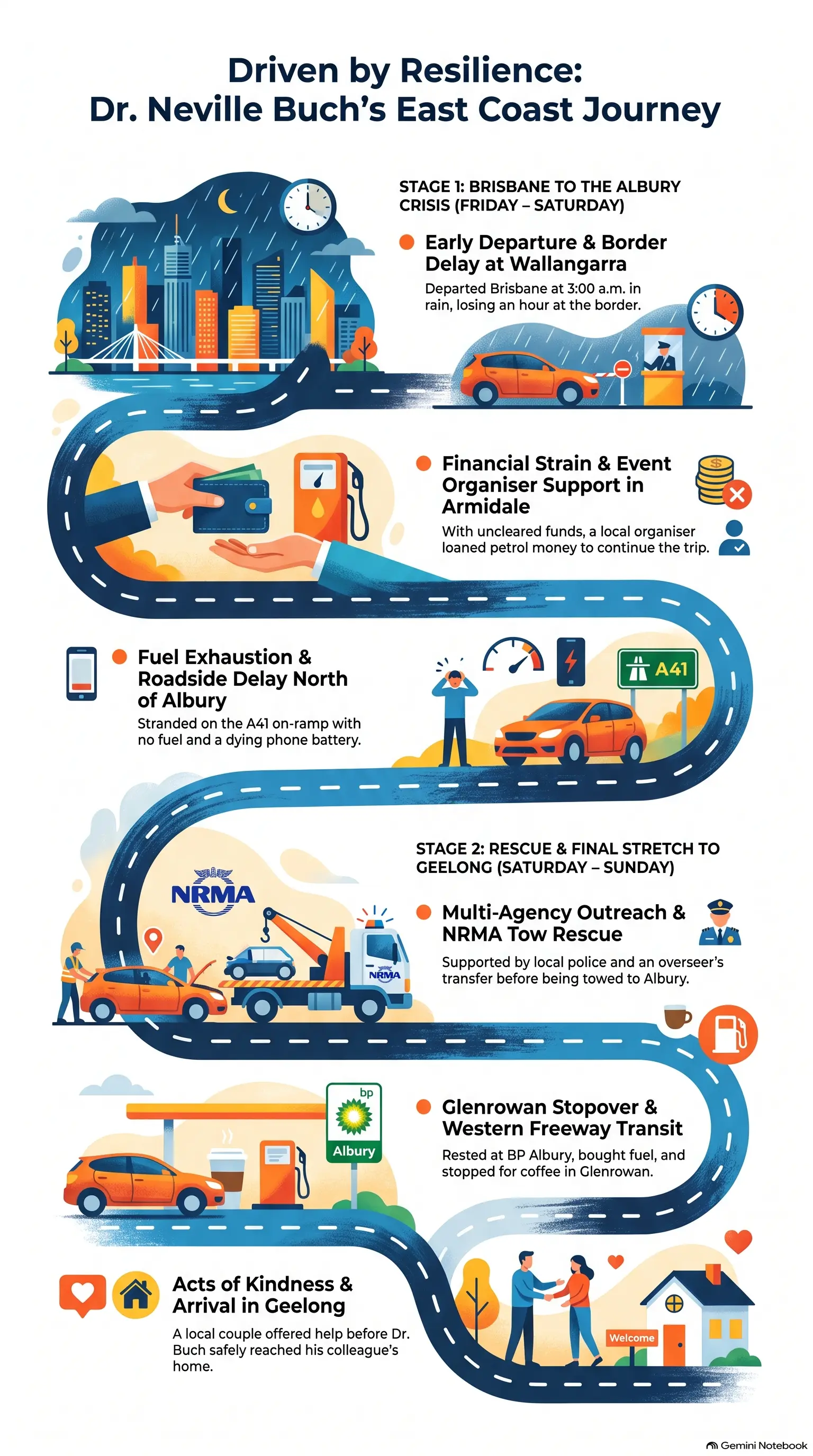
The odyssey begins in the quiet hours of Friday, 16 October 2026, under the cover of dark skies and light rain. Awaking at 1:30 a.m., Dr. Neville Buch loaded his vehicle and departed his Brisbane home at 3:00 a.m., embarking on one of his most challenging field research road trips for the Management Institute for Contributory Economy (MICE) (Buch 2026: 1). Heading south-west, the first signs of dawn broke over the horizon as he passed through the historic township of Warwick. By 7:00 a.m.—exactly four hours into the journey—he reached the Queensland–New South Wales border at Wallangarra (Buch 2026: 1).
At Wallangarra, the physical landscape triggered deep sociological reflections on regional isolation. Observing the disused and dilapidated railway infrastructure at the border, Buch noted how systemic transport neglect isolates rural Australian communities (Buch 2026: 1–2). He argued that revitalizing historical rail corridors like the Wallangarra line is essential for regional health, asserting that whether citizens reside in major metropolises or country villages, democratic society requires infrastructure that allows populations to move freely and connect without barrier (Buch 2026: 1–2).
CHRONOLOGY OF THE EAST COAST RESILIENCE TRIP
• Fri 16 Oct (3:00 AM) : Departure from Brisbane in light rain
• Fri 16 Oct (7:00 AM) : Wallangarra border crossing & rail reflections
• Fri 16 Oct (1:00 PM) : Departure from Armidale after organizer loan
• Sat 17 Oct (11:24 AM) : Vehicle crisis near Albury; cognitive distress
• Sat 17 Oct (11:35 AM) : RACQ/RACV 1.5-hr standoff over Gold Card (member since 1979)
• Sat 17 Oct (10:00 PM) : NRMA Tow delivers vehicle to BP Albury Truckstop
• Sun 18 Oct (Morning) : Depart Albury on $40 fuel via Glenrowan
• Sun 18 Oct (Late Afternoon) : Arrival in Geelong via local solidarity
2. Financial Friction and Regional Solidarity (Friday Afternoon, 16 October)
The backdrop to this academic journey was defined by severe financial vulnerability. A anticipated work cheque failed to clear on the Friday morning of departure, threatening to stall the entire research itinerary (Buch 2026: 2). Refusing to allow a lack of capital to abort a public-good project, Buch relied on the social capital of regional networks. In Armidale, a local rural event organizer provided a personal loan for petrol, enabling him to continue his southward trajectory at 1:00 p.m. toward the Murray region (Buch 2026: 2).
3. Institutional Deadlock and the Albury Crisis (Saturday, 17 October)
The central crisis of the journey unfolded on Saturday, 17 October, near Albury on the New South Wales–Victoria border. Stranded roadside under a punishing, hot sun, Buch suffered severe physical distress and cognitive impairment brought on by heat exhaustion and stress (Buch 2026: 2). In a state of disorientation akin to a “dying man in the desert,” he initially misdirected emergency calls to service agencies in Albany, Western Australia, rather than Albury, New South Wales (Buch 2026: 2).
Upon correcting his error at 11:24 a.m., Buch encountered a stark failure of institutional bureaucracy:
- RACQ/RACV Standoff (11:35 a.m.): Despite holding an RACQ Gold Card membership (member continuously since 1979 along with co-partner RACV for a decade), Buch was subjected to an arduous 90-minute phone negotiation across membership and payment departments (Buch 2026: 2–3). The payment officer rigidly refused a few days’ grace period to cover roadside assistance additions, demanding immediate digital payment despite Buch’s temporary lack of funds (Buch 2026: 2–3).
- Failed Municipal Support Networks (1:08 p.m. – 2:10 p.m.): The Transport Management Centre reported no weekend tow services (Buch 2026: 3). Lifeline Albury-Wodonga offered an empathetic ear but no mechanical relief, while the Albury Police Station provided welfare checks but lacked towing capability (Buch 2026: 3).
- Resolution via Civil Solidarity (7:18 p.m. – 10:00 p.m.): Following police intervention, RACV/RACQ relented and dispatched an NRMA unit (Buch 2026: 3). While NRMA covered the towing fee to Albury, fuel funds remained absent until 8:27 p.m., when a MICE work overseer successfully transferred emergency money (Buch 2026: 3). At 10:00 p.m.—after nearly eleven hours stranded—the NRMA tow delivered Buch and his vehicle to the BP Albury Truckstop (Buch 2026: 3).
4. The Final Stretch to Geelong and the Contributory Philosophy (Sunday, 18 October)
After sleeping overnight in his car at the BP Truckstop, Buch awoke on Sunday, 18 October, with $40 of fuel in his tank and a recharged mobile phone (Buch 2026: 3). Pausing briefly for coffee in Glenrowan, he navigated the western circular freeway around Melbourne toward Geelong (Buch 2026: 3–4).
Crawling through Geelong while periodically checking for cleared funds, his flashing hazard lights attracted the attention of a young local couple (Buch 2026: 4). Stopping out of genuine concern for a stranded traveller, the couple engaged in conversation, providing Buch an opportunity to explain the mission of MICE and express gratitude for spontaneous community care (Buch 2026: 4). Late Sunday afternoon, Buch arrived safely at the home of his academic colleague in Geelong (Buch 2026: 4).
Conclusion: Resilience as “Philosophy in Practice”
The Story of Resilience Part 1 demonstrates that human resilience is not merely an individual psychological trait, but a socially mediated process. Buch’s successful navigation of mechanical failure, financial drought, and bureaucratic rigidity exemplifies the core motto of MICE: an approach “radical enough to shift the agenda, liberal enough to allow everyone a decent place in the social environment, and conservative enough to preserve the legacy of good value for Contributory Economy” (Buch 2026: 4). By transforming a logistical ordeal into an analysis of community solidarity, Buch proves that true intellectual work exists beyond institutional walls—grounded in the lived, resilient reality of the open road (Buch 2026: 2, 4).
In-Text Harvard References & Bibliography
In-Text Harvard References
- (Buch 2026: 1)
- (Buch 2026: 2)
- (Buch 2026: 3)
- (Buch 2026: 4)
Full Bibliography
- Buch, Neville. (2026). The Story of Resilience Part 1: The Story of Resilience in Traveling the Australian East Coast. Brisbane: Management Institute for Contributory Economy (MICE).
[1] The first draft, “The Story of Reslience Part 1” was completely humanly-devised. Artificial Intelligence (A.I.) has been fairly used in the production of this work. The tool used is Google NotebookLM (recently rebranded as Gemini Notebook). It is an AI-powered virtual research assistant and thinking partner designed to help a person interact deeply with their own documents. Unlike general chatbots, it is source-grounded, meaning it only generates answers based on the specific PDFs, documents, or links uploaded. The A.I. process in the production of this work has been limited to the attached (prompts) on each of the questions in turn. This ensures an accurate reading of each source. The author then rearranged and re-edited the answers the A.I. provided. The human author publishes this work. A.I. is never an author when used properly. This assistance is not qualitatively different from a human research assistant when that assistance is deemed to have no authorial status but is acknowledged.
Featured Image:


Neville Buch
Latest posts by Neville Buch (see all)
- The Road to Geelong: A Re-Narrativization of The Story of Resilience Part 1 – October 20, 2026
- The Human Being Above the Transaction and Why Markets Cannot Measure Human Worth – October 15, 2026
- Beyond Neoliberal Formalism: Should Taxpayers Fund Independent Philosophy – October 14, 2026