
Dr Neville Buch
Abstract
This essay explores the architecture of a healthy community through the lens of relational ethics and cognitive discernment. Drawing on the Management Institute for Contributory Economy (MICE) framework and The Community Builder’s Journal, it argues that communal health is not a static state but a dynamic process of caring correctly, recognizing danger, and understanding the timing of action. Central to this process is the Dynamic of Cognition (DoC), which empowers individuals to move from unreflective prejudice toward human authorship by making conscious choices between Inclusion and Exclusion. By synthesizing the practice of panser (thinking as caring) with the strategic skill of loitering with intent, a community can foster Aristotelian flourishing and collective resilience.
——————————————————————————–
The Architecture of a Healthy Community
- Caring When One Should Care
A healthy community is founded on the principle that relationships matter most and serve as the “living glue” that holds society together. This requires a fundamental shift from mechanistic calculation toward reinventing thinking (penser) as caring (panser)—a process of tending to the wounds of social fragmentation with empathy and historical truthfulness. True caring is defined not as a personality trait but as a moral relation and an “unending obligation” to meet the other in their particularity.
To care effectively, practitioners must adopt Rabindranath Tagore’s principle: “you need to see what the people see”. This involves an act of empathetic imagination and courage, temporarily suspending one’s own viewpoint to stand in another person’s shoes. Such ethical caring is a conscious act of volition that moves individuals closer to an ethical ideal, ensuring that judgment remains anchored in the lived reality of the human subject rather than abstract utility.
- Stepping Away from Danger
Communal health also requires the discernment to step away from danger or unproductive relationships. The sources acknowledge that we are obligated to “justify not-caring” when doing so protects our integrity as ethical selves or the interests of others for whom we care. In environments where a person’s responses are consistently hostile or where the setting turns caring into unrewarding “emotional labour,” a healthy participant may choose to relieve themselves of the obligation to the relation.
This capacity to say “no” is essential for managing limited energy and avoiding the “shadow of dread” that leads to personal disempowerment. Furthermore, a community must recognize its own “dark side,” where the “unity” of a group can become a conservative force used to enforce exclusion, violence, or injustice. In times of crisis, such as a pandemic, the “shadow” of community often emerges as an “in-group” and “out-group” mentality that demonizes outsiders; in such cases, stepping away from these exclusionary patterns is necessary to preserve the broader values of peace and justice.
- Understanding Necessary vs. Unnecessary Action
A healthy community relies on timing, specifically the ability to distinguish between chronos (formal clock time) and kairos (the informal, organic “right” moment). Community building is described as a “marathon, not a sprint,” and a sense of overwhelm often leads to “manic action” that is ultimately counterproductive. Instead, the practice of “loitering with intent”—positioning oneself in situations where organic connections are likely to arise—allows for more authentic and receptive invitations to connect.
At times, the most necessary action is “doing nothing” or “waiting”. This involves “holding your agenda lightly,” making space for others to lead, and being present without imposing a pre-packaged solution or service. Effective groups understand that action should be balanced with noticing first, sensing what is already happening in a street or neighbourhood before attempting to intervene.
- The Choice in the Dynamic of Cognition (DoC)
The Dynamic of Cognition (DoC) provides the analytical framework for understanding the power of choice in a healthy community. At the centre of all thought is Prejudice (pre-judgments), which remains a trap if it is “guarded against reflection”. The health of a community depends on the individual’s ability to choose the direction of their thinking through the agency of Exclusion versus Inclusion.
- Exclusion is often a state of “wilful ignorance” or “stupidity” where the mind filters out the messy lived experiences of others in favour of “thin” concepts or technical formalisms.
- Inclusion requires empathy and the willingness to move from unreflective habit toward learning and intersubjective mutuality.
By utilizing the POLICE model to “police our own thoughts,” community members can move from a “Junior” mindset of unreflective automaticity to a “Senior” state of social accountability. This transition allows the individual to reclaim human authorship over their narrative, ensuring that the “who” (the human being) remains the proactive master of the “what” (the technical and social systems). Ultimately, this choice-driven path leads to Aristotelian flourishing, where communal life is measured by dignity, wisdom, and character.
Annotated Bibliography: The Architecture of Ethical Community and Cognitive Flourishing
This bibliography presents the foundational sources for understanding a healthy community through the lens of relational ethics, strategic timing, and cognitive authorship. It specifically addresses the balance between active caring, necessary withdrawal, opportune timing, and the Dynamic of Cognition (DoC) choices.
——————————————————————————–
Arendt, H. (1977). The Life of the Mind: Vol. 1. Thinking (M. McCarthy, Ed.). Harcourt Brace Jovanovich.
- Annotation: This foundational text establishes the link between mental vitality and ethical responsibility. Arendt’s analysis of the “silent dialogue” of thought serves as a reflective shield against the “banality of evil,” which she defines as the mechanical liquidation of judgment. It provides the ontological basis for a healthy community by insisting that individuals must engage in thinking to prevent denoetization—the loss of the capacity to distinguish right from wrong without external rules.
Buch, N. (2025). Limited Thinking and the Contributory Economy. Brisbane: Management Institute for Contributory Economy.
- Annotation: This work diagnoses the pathology of unreflective automaticity and the “techné mindset” that reduces human life to quantifiable data. It is essential for understanding the Dynamic of Cognition (DoC) choice, specifically the movement from a “Junior” mindset of docile execution toward a “Senior” state of social accountability. It details the synthesis of the Five Intentions (Self, Mind, Reason, Utility, Love) as the primary standard of value for a flourishing community.
Buch, N. (2025, November 25). Thinking as Caring and the Quest for Wisdom. Brisbane: Management Institute for Contributory Economy.
- Annotation: This source introduces the critical concept of panser (caring or tending to wounds) as a cognitive necessity for sound judgment. It argues for the reinvention of thinking (penser) as caring, serving as the human complement to technological function. It highlights the importance of empathy in the process of Inclusion, ensuring that judgment remains anchored in the lived reality of the human subject rather than abstract utility.
Buch, N. (2026, March 17). A Matrix of Sociology. Brisbane: Management Institute for Contributory Economy.
- Annotation: The Matrix provides a structural map to identify the “fit” between institutional focuses and modes of social action. It is vital for understanding when a community must recognize the “dark side” or “structural domain of domination”. By identifying the historical contingency of modern institutions, the Matrix serves as a tool for “crap detecting”—unmasking the manufactured myths used by elites to manipulate collective behaviour.
Habermas, J. (1979). Communication and the Evolution of Society (T. McCarthy, Trans.). Beacon Press.
- Annotation: Habermas provides the imperative for communicative action—dialogue aimed at mutual understanding (Verständigung) rather than strategic manipulation. This source defines the four universal validity claims (comprehensibility, truth, rightness, truthfulness) that must be recognized to achieve intersubjective mutuality and trust in a healthy community.
Westoby, P., Andrews, D., Buckley, H., Donovan, R., Dowling, G., Leigh, K., & Warner, R. (2025). The Community Builder’s Journal: Guided reflections and experiments for your community-building journey. Rugby, UK: Practical Action Publishing. http://doi.org/10.3362/9781788534178.
- Annotation: This practitioner-focused journal is the primary source for the importance of timing in building connections. It identifies the six types of kairos moments (changes, cycles of life, conflict, chance encounters, celebrations, and crises) where connection is most effective. Crucially, it also explores the “dark side of community,” providing the rationale for when one must step away from exclusionary patterns, violence, or injustice to preserve larger ethical values.
Williams, B. (2006). Philosophy as a Humanistic Discipline (A. W. Moore, Ed.). Princeton University Press.
- Annotation: Williams provides the philosophical grounding for “thick ethical concepts”—like courage and honesty—that unite factual description with evaluative meaning. His work warns that abstract reflection can destroy knowledge when it is detached from local social and historical bearings. This source supports the community builder’s need for “practical confidence” and contextual judgment over foundationless certainty.
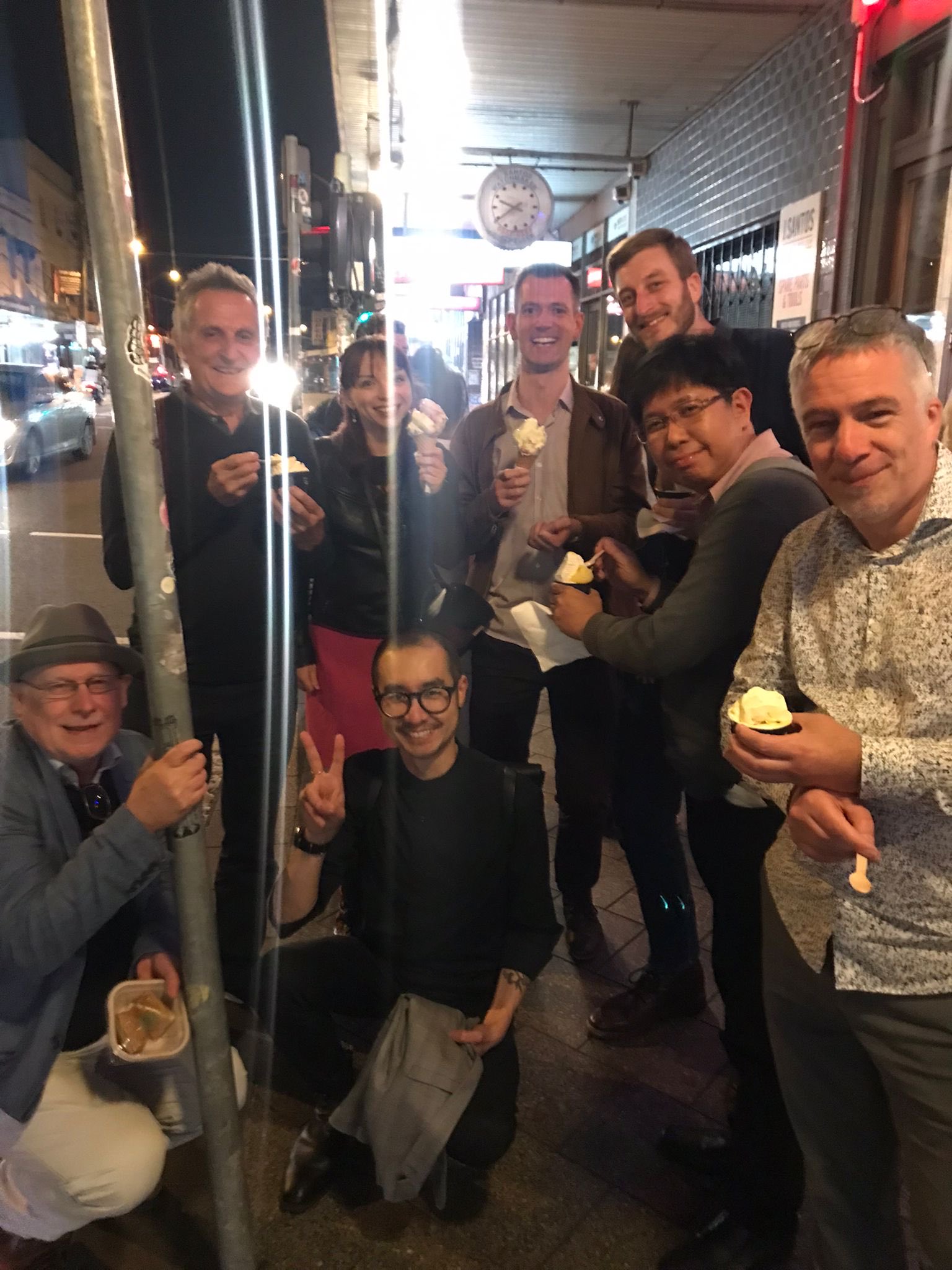
Featured Image: Neville and the 2024 ANZHES Party


Neville Buch
Latest posts by Neville Buch (see all)
- The Unbound Mind: Independent Scholarship, Institutional Isolation, and the Restoration of Human Authorship – October 20, 2026
- The Road to Geelong: A Re-Narrativization of The Story of Resilience Part 1 – October 20, 2026
- The Human Being Above the Transaction and Why Markets Cannot Measure Human Worth – October 15, 2026