
https://www.academia.edu/165126270/Silence_is_not_a_pathway_to_Peace
Attached: Silence is not a pathway to Peace
Dr Neville Buch ABN: 86703686642
Abstract:
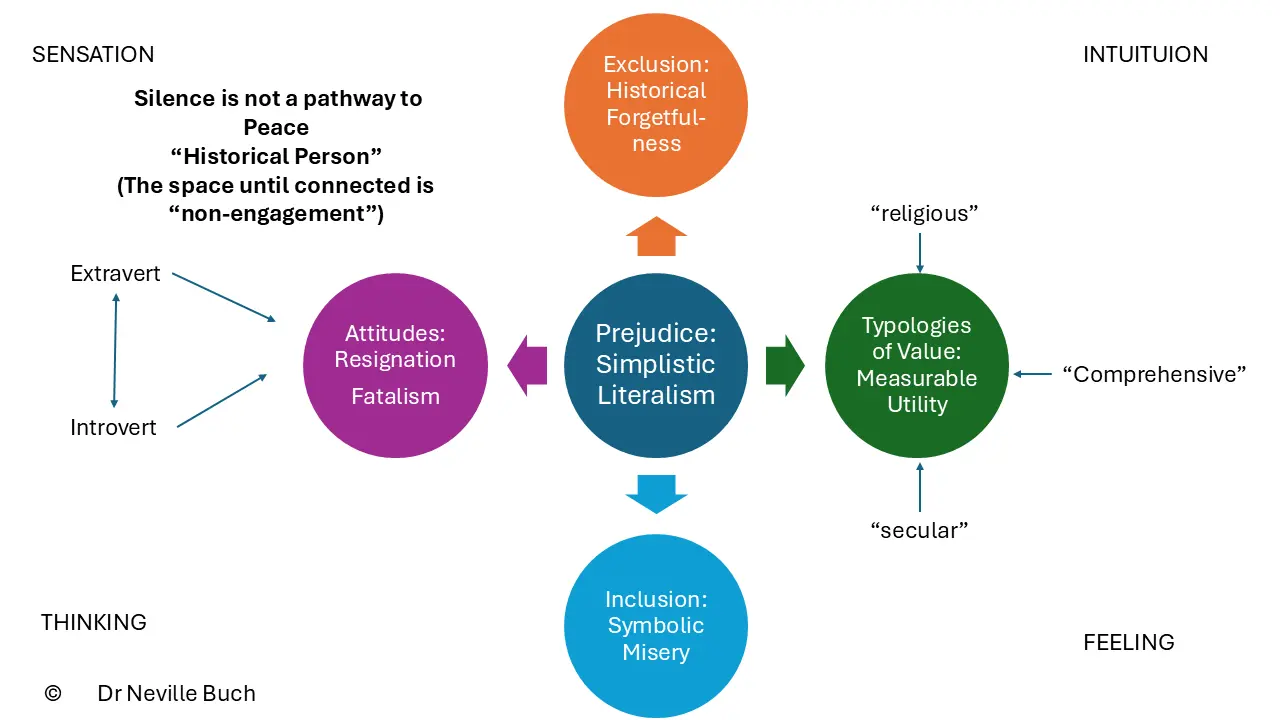
This essay explores the proposition that silence, rather than serving as a conduit for harmony, acts as a primary catalyst for “Historical Forgetfulness” and the “immense regression” of the human spirit. Drawing on the political philosophy of Hannah Arendt, the critical theory of Jürgen Habermas, and the Neganthropology* of Bernard Stiegler, the analysis argues that silence in the face of institutionalized falsehoods facilitates a state of “symbolic misery” and the loss of human authorship. True peace is not the absence of conflict but the presence of communicative action—a rational-critical dialogue aimed at mutual understanding. By applying Dr. Neville Buch’s Dynamic of Cognition (DoC) model and the practice of panser (thinking as caring), the essay demonstrates that peace requires the courageous rejection of “institutional bullshit” and the active recovery of social and historical context to “uncoil” the vicious circles of historical stupidity.
* Neganthropology = a new political economy and pharmacology where technology and human activity are designed to create knowledge and sustain life, rather than causing destruction or “anthropy”.
How can Vice-Chancellors practically break the silence against the Australian Government Higher Education Policies?
To practically break the silence against Australian Government Higher Education Policies, Vice-Chancellors must transition from being “soulless careerists” or managers trapped in “bubble thinking” to becoming “transformative intellectuals” who bridge the gap between university theory and the practical “needs of the intellectual republic”. Breaking this silence requires a rejection of “preemptive compliance”—the habit of premature obedience where leaders scrub websites or rename offices to pacify mercurial political administrations.
Vice-Chancellors can implement this shift through the following practical strategies:
- Engage in “Crap Detecting” and Public Scholarship
The primary intellectual duty of university leadership is “crap detecting”—the systematic uncovering of “institutional bullshit,” misconceptions, and outright lies embedded in policy rhetoric. Vice-Chancellors should prioritize public scholarship, using their cachet to speak “plainly and clearly” to the public about the consequences of policies for students and communities, even when doing so feels uncomfortable. This involves demythologizing foundational assumptions, such as the “Job Ready” scheme, by exposing them as products of “Historical Forgetfulness” and “instrumental rationality”.
- Prioritize “Communicative Action” over Statements
Leadership in a crisis requires conversation rather than just communication; Vice-Chancellors must “show up—a lot,” engaging in real dialogue and looking people in the eye rather than hiding behind carefully crafted emails. Following Jürgen Habermas, the goal is to foster “rational-critical communication” aimed at mutual understanding rather than strategic domination. This means removing restrictions on symbolic interaction within the university to allow for a “reflective ascent” that restores human authorship over institutional narratives.
- Move from Individual Silence to Collective Offensive
The sources indicate that scattered individual voices are often ineffective because higher education is built on “competitive fragmentation”. To break the silence effectively, Vice-Chancellors must:
- Form trust-based coalitions: Use existing associations to find a “collective voice” that can say things individuals cannot.
- Practice “Variable Geometry”: Like the “strategic cousins” of Canada and Australia, form flexible, ad hoc coalitions based on shared convictions rather than mere mutual convenience.
- Resist “picked off” tactics: A collective voice helps protect individual institutions from being targeted one by one by vindictive political administrations.
- Adopt the Practice of Panser (Thinking as Caring)
Breaking the silence is not just a political act but an ethical one. Leaders should adopt the practice of panser—reinventing thinking (penser) as caring (panser)—to tend to the wounds of social fragmentation and “symbolic misery” caused by technical and neoliberal control. This Compassion-Focused Pedagogy (CfP) ensures that the argument against government policy is grounded in truthfulness and sincerity rather than purely tactical manoeuvres.
- Establish “Institutional Restraint” as a Strong Point
While speaking out, leaders must also consider “institutional restraint,” ensuring the university does not pursue goals extraneous to its core mission, which can pose systemic risks. However, this restraint must not be confused with appeasement; Vice-Chancellors should negotiate on social issues like racism or bigotry while refusing to compromise on the “core value” of the freedom to pursue truth wherever it leads. Ultimately, as the “Stockdale paradox” suggests, they must confront the “most brutal facts” of their current reality while maintaining faith that the values of the university will prevail.
List of Tags
- Vice-Chancellor
- Brisbane
- Queensland
- Hannah Arendt
- Nel Noddings
- Susan Haack
- Bernard Williams
- Bernard Stiegler
- Bernard Lonergan
- Political Theory
- Political Communication
- Thinking
- Cognition
- Appearance
- Foolishness
- Truthfulness
- Value
- Focus
- Exclusion
- Inclusion
- Paid Work
Featured Image: Silence is not a pathway to Peace. Why…


Neville Buch
Latest posts by Neville Buch (see all)
- What Happened to Ross Johnston? – October 9, 2026
- Thank you, Richard: Knowing the message but then acting – October 8, 2026
- The Desiccation of the Common Well: Identity Politics, Algorithmic Assessment, and the Crisis of Adult Responsibility – October 6, 2026