
Dr Neville Buch and MICE[1]
Abstract
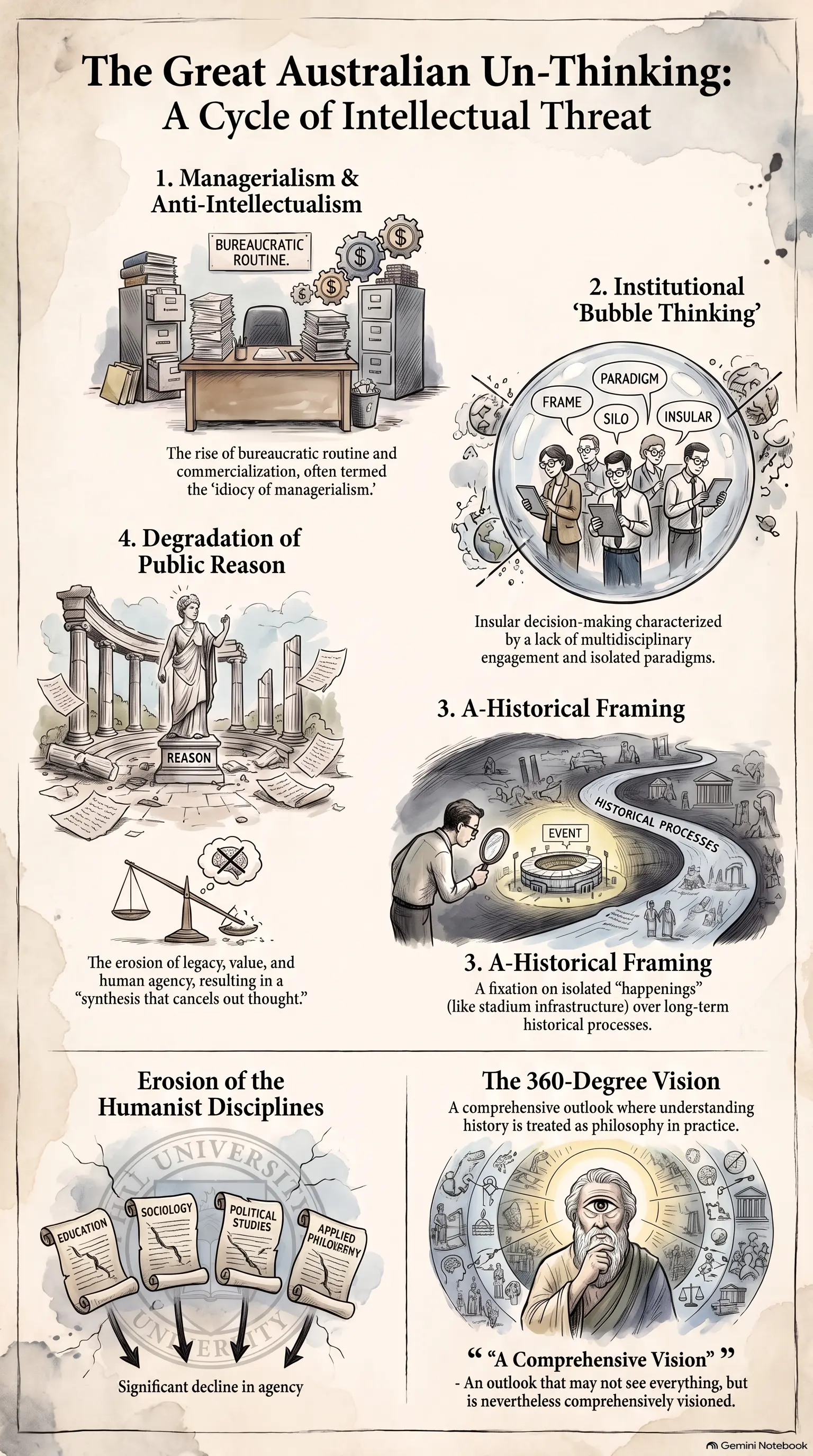
This essay investigates the primary intellectual threat facing contemporary Australian society: the systemic rise of managerialism, institutional “bubble thinking,” anti-intellectualism, and a-historical framing. Drawing upon the historical and sociological scholarship of Dr. Neville Buch, the essay demonstrates how this cognitive crisis degrades critical inquiry across four core public domains. In education, managerialism treats local communities as passive resources and reduces higher learning to short-term commercial contracts. In sociology, a-historical framing and “cancel culture” replace historical process with reactive outrage, polarization, and the dismissive rejection of alternative worldviews. In political studies, the “idiocy of managerialism” traps decision-makers in insular political bubbles, producing fragmented, short-term infrastructure policy devoid of long-term societal legacy. Finally, in applied philosophy, shallow utilitarianism and dogmatic apologetics relegate the thinker to a “manageable measure,” severing philosophical practice from historical investigation. Overcoming this multifaceted threat requires recovering a “360-degree vision” grounded in conceptual analysis and historical consciousness.
Introduction: The Triad of Cognitive Degradation
Contemporary Australian society faces a subtle yet pervasive intellectual crisis. Rather than stemming from a single external doctrine, the greatest intellectual threat facing the nation is an internal cognitive pathology characterized by managerialism, institutional “bubble thinking,” and a-historical framing (Buch 2022b: 320; Buch 2023: 541)[1][2]. Termed by philosophic historian Dr. Neville Buch as the “idiocy of managerialism,” this mindset operates on the false premise that complex human, social, and environmental systems can be perfectly controlled, quantified, and budgeted through superficial recalculations and administrative routines (Buch 2022b: 320; Buch 2026c: 588)[1][3].
When institutional leaders succumb to this threat, sustained intellectual reflection is discarded in favour of short-term fixes, soundbites, and bureaucratized governance (Buch 2022c: 341; Buch 2023: 539)[4][5]. The consequence is a society populated by a “crowd of a-historical thinkers” who react to immediate, isolated “happenings” without understanding their deep historical trajectories or broader environmental wholes (Buch 2023: 539, 541)[2][5].
1. The Greatest Intellectual Threat to Education
The greatest intellectual threat to the practical contributions of education is the dominance of institutional managerialism, commercialization, and internal anti-intellectualism within universities and educational bodies (Buch 2022b: 341; Buch 2022c: 473; Buch 2026a: 60)[4].
- Commercial Extraction vs. Community Engagement: University administration is increasingly governed by misguided Vice-Chancellors and regulators who view local communities merely as an extractive “resource” or revenue market rather than equal partners in civic intellectual life (Buch 2022c: 302; Buch 2026a: 60)[7][8]. This short-term commercial focus degrades the humanities and arts, reducing higher education degrees to mere vocational training (Buch 2022b: 341; Buch 2022c: 301)[4][9].
- Institutional “Bubble Thinking” and Anti-Intellectualism: Within educational institutions—ranging from private religious colleges to state secondary schools—an insular “bubble thinking” flourishes (Buch 2022c: 473, 495)[6][10]. This environment breeds a subtle anti-intellectualism that discourages rigorous critical reading and ideological critique, encouraging students to master apologetic manoeuvres rather than genuine intellectual inquiry (Buch 2022c: 473, 491, 497)[6].
- The Loss of Community Pedagogy: By prioritizing administrative convenience over lifelong learning, the education sector risks abandoning genuine community education and community research, severing the vital link between academic scholarship and public democratic enlightenment (Buch 2022c: 302)[8].
2. The Greatest Intellectual Threat to Sociology
In the field of sociology, the supreme intellectual threat is “a-historical framing,” “cancel culture,” and the dismissive rejection of alternative worldviews (Buch 2022a: 273; Buch 2023: 541, 556)[2].
- Fixation on “Happenings” Over Historical Process: Modern social commentary routinely isolates immediate societal crises—such as urban conflict, migration, or public protests—from their deep historical trajectories (Buch 2023: 541)[2]. This “a-historical framing” prevents sociologists and the public from understanding managed historical processes, reducing complex human movements to sensationalized, isolated events (Buch 2023: 541)[2].
- Destructive Synthesis and “Cancel Culture”: When sociological analysis lacks historical consciousness, social dialogue degenerates into a reactive state where a destructive type of synthesis occurs—a “synthesis which cancels all thought out” (Buch 2022a: 273)[13]. Commonly manifested as “cancel culture,” this phenomenon stifles open debate and fuels ideological polarization across the culture-history wars (Buch 2022a: 273; Buch 2022c: 489; Buch 2023: 544)[13].
- Mutual Dismissal of Worldviews: Both academic elites and popular commentary exhibit a “sickening” tendency to dismiss the worldviews and lived experiences of “the Other” (Buch 2022c: 312; Buch 2023: 556)[14][17]. This erosion of social intelligence undermines pluralism and prevents the attainment of intersubjective mutuality and social cohesion (Buch 2022c: 487; Buch 2023: 556)[14][18].
3. The Greatest Intellectual Threat to Political Studies
For political studies and public governance, the most severe intellectual threat is “the idiocy of managerialism” paired with political “bubble thinking” in public policy and infrastructure planning (Buch 2022b: 320; Buch 2023: 532; Buch 2026c: 588)[1].
- Reactive Infrastructure Policy: As evidenced by the Queensland Government’s shifting plans for the Brisbane 2032 Olympic Summer Games—vacillating between a $1 billion Gabba rebuild, a “low-cost” QSAC refurbishment, and a $3.8 billion Victoria Park stadium—politicians frequently act as a “crowd of a-historical thinkers” (Buch 2023: 539; Buch 2026c: 588, 590)[3]. Decisions are made to avoid temporary political embarrassment rather than to serve the long-term historical and environmental trajectory of the city (Buch 2026c: 588, 590)[3][20].
- Unthinking Colonialism and Populist Slogans: Political debate is constantly degraded by “unthinking colonialism” and shallow, libertarian slogans (“freedom, freedom”) that appeal to unreflective nostalgic sentiment while ignoring structural economic and ecological realities (Buch 2022c: 289, 365, 368)[21].
- Failure of Multidisciplinary Governance: Political decision-makers routinely retreat into institutional bubbles, ignoring the precedent of the humanities on vital questions of ethics, language, and social legacy (Buch 2023: 532, 533)[19][24]. Lacking a 360-degree vision, state governance becomes a cycle of constant, costly “re-calculation” that fails both the taxpayer and future generations (Buch 2022b: 320; Buch 2026c: 590, 594)[1].
4. The Greatest Intellectual Threat to Applied Philosophy
In the realm of applied philosophy, the primary intellectual threat is thin modern hedonism, shallow utilitarianism, and the marginalization of the thinker (Buch 2022a: 283, 285; Buch 2022c: 491, 503)[11].
- Marginalization of Deeper Thought: Normative society is repulsed by deep, sustained reflection, preferring the thinker only in “manageable measure”—a scope far too narrow for genuine philosophical inquiry (Buch 2022a: 283)[26]. Driven by an obsession with superficial comfort, modern hedonism thins out intellectual outlooks and marginalizes those who seek to explore the mind for hours on end (Buch 2022a: 283, 285)[26][27].
- Apologetics as Watered-Down Philosophy: A major intellectual failure is the confusion of apologetics with philosophy (Buch 2022c: 491)[11]. Apologetics acts as a “watered-down philosophy” that defends pre-packaged dogmas rather than engaging in honest Socratic dialogue or conceptual analysis (Buch 2022c: 491, 503, 504)[11].
- Severing History from Philosophical Practice: The ultimate threat to applied philosophy is treating it as an abstract, dispassionate academic exercise rather than lived practice (Buch 2022a: 285; Buch 2026b: 557)[27][30]. As Dr. Buch asserts through his professional motto, “understanding history is philosophy in practice” (Buch 2026b: 557)[30]. Philosophy must be applied through conceptual analysis—pulling apart and reassembling sets of ideas—to help human beings “feel life intensely,” process existential tragedy, and navigate the human condition (Buch 2022a: 274, 285; Buch 2022c: 515)[27].
Conclusion
The greatest intellectual threat to Australian society is not an absence of information, but a systemic decay in how institutions think. By allowing managerialism, anti-intellectualism, and a-historical framing to dictate the terms of education, sociology, politics, and philosophy, Australian institutions risk losing their intellectual integrity and historical memory (Buch 2022b: 320; Buch 2022c: 475; Buch 2023: 541)[1]. Overcoming this crisis requires adopting a 360-degree vision—an intellectually rigorous, historically informed perspective that asserts the precedent of the humanities and restores human agency to public decision-making (Buch 2022c: 272; Buch 2023: 533; Buch 2026c: 594)[24].
In-Text Harvard References & Bibliography
In-Text Harvard References
- (Buch 2022a: 273, 274, 283, 285)[13]
- (Buch 2022b: 302, 320, 341)[1]
- (Buch 2022c: 272, 289, 301, 302, 312, 341, 365, 368, 473, 475, 487, 489, 491, 495, 497, 503, 504, 515)[4]
- (Buch 2023: 532, 533, 539, 541, 544, 556)[2]
- (Buch 2026a: 60)[7]
- (Buch 2026b: 557)[30]
- (Buch 2026c: 588, 590, 594)[3]
Full Bibliography
- Buch, Neville. (2022a). Record of 2022 June-July Geelong Research Trip. Brisbane: Mapping Brisbane History Project.[13]
- Buch, Neville. (2022b). Record of 2022 Paramatta Road Trip. Brisbane: Mapping Brisbane History Project.[1]
- Buch, Neville. (2022c). Record of 2022 Melbourne Road Trip. Brisbane: Mapping Brisbane History Project.[6]
- Buch, Neville. (2023). Record of 2023 USA Flight-Road-Train Trip. Brisbane: Mapping Brisbane History Project.[2]
- Buch, Neville. (2026a). Financial Support. Independent Scholarly Publication / GoFundMe Prospectus.[7]
- Buch, Neville. (2026b). Record of 2026 Canberra Road Trip. Brisbane: Mapping Brisbane History Project.[30]
- Buch, Neville. (2026c). The Cognition of Infrastructure for the Brisbane 2032 Olympics. Brisbane: Management Institute for Contributory Economy (MICE).[3]
- Jackson, Frank. (1998). From Metaphysics to Ethics: A Defence of Conceptual Analysis. Oxford: Oxford University Press.

Take the MICE Quiz
[1] Artificial Intelligence (A.I.) has been fairly used in the production of this work. The tool used is Google NotebookLM (recently rebranded as Gemini Notebook). It is an AI-powered virtual research assistant and thinking partner designed to help a person interact deeply with their own documents. Unlike general chatbots, it is source-grounded, meaning it only generates answers based on the specific PDFs, documents, or links uploaded. The A.I. process in the production of this work has been limited to the attached (prompts) on each of the questions in turn. This ensures an accurate reading of each source. The author then rearranged and re-edited the answers the A.I. provided. The human author publishes this work. A.I. is never an author when used properly. This assistance is not qualitatively different from a human research assistant when that assistance is deemed to have no authorial status but is acknowledged.


Neville Buch
Latest posts by Neville Buch (see all)
- The Desiccation of the Common Well: Identity Politics, Algorithmic Assessment, and the Crisis of Adult Responsibility – October 6, 2026
- Academic Rigour, Epistemic Renewal, and the Crisis of Inquiry: A Scholarly Review of the Vanderbilt Commission Report on the State of Scholarship – October 5, 2026
- Uncoiling the Psychology of the Western Traditional Belief System – October 5, 2026