
This essay introduces the “Three Bernards”—Bernard Lonergan, Bernard Stiegler, and Bernard Williams—whose collective works provide a powerful roadmap for reclaiming human agency in a world increasingly dominated by technology and unreflective habits. Through the lens of Dr. Neville Buch’s Dynamic of Cognition (DoC), the Bernards are shown to share a common goal: moving the individual from a “Junior” mindset of passive compliance toward a “Senior” state of human authorship. Williams contributes the necessity of truthfulness and historical context; Stiegler warns against the “denoetization” (loss of judgment) caused by modern gadgets; and Lonergan provides a framework for stabilizing meaning and understanding how our minds actually work. Together, they offer a “Synoptic Vision” to bridge the gap between technical efficiency and human flourishing.
Abstract
This essay introduces the “Three Bernards”—Bernard Lonergan, Bernard Stiegler, and Bernard Williams—whose collective works provide a powerful roadmap for reclaiming human agency in a world increasingly dominated by technology and unreflective habits. Through the lens of Dr. Neville Buch’s Dynamic of Cognition (DoC), the Bernards are shown to share a common goal: moving the individual from a “Junior” mindset of passive compliance toward a “Senior” state of human authorship. Williams contributes the necessity of truthfulness and historical context; Stiegler warns against the “denoetization” (loss of judgment) caused by modern gadgets; and Lonergan provides a framework for stabilizing meaning and understanding how our minds actually work. Together, they offer a “Synoptic Vision” to bridge the gap between technical efficiency and human flourishing.
The Three Bernards: A Guide to Thinking for Yourself
In our modern world, it often feels like we are losing control. We are surrounded by apps that tell us what to do, news that tells us what to think, and jobs that treat us like numbers. Philosophers call this the “immense regression”—a fancy way of saying we are sliding backward and losing our ability to be the authors of our own lives. To fight this, we can look to three thinkers named Bernard: Williams, Stiegler, and Lonergan.
1. Bernard Williams: Keeping it Real
Bernard Williams was a man who believed that philosophy should be “humanistic.” He didn’t like theories that tried to simplify the messiness of human life into a single math problem. Williams taught us about “truthfulness.” This isn’t just about not lying; it’s about being brave enough to look at our own history and our messy feelings to understand who we really are. He famously argued that you can’t separate facts from values. For example, the word “cowardly” is both a fact (describing behaviour) and a value (judging it). Williams wants us to be honest about our social and historical bearings so we don’t get lost in abstract ideas that have nothing to do with real life.
2. Bernard Stiegler: Don’t Let Your Tools Own You
While Williams looked at our history, Bernard Stiegler looked at our technology. He was worried about “denoetization”—the mechanical liquidation of human judgment. Think of a GPS: it’s a great tool, but if we stop learning how to read a map, we lose a part of our brain’s “authorship” over our location. Stiegler argued that when we outsource our thinking to technical systems, we fall into “symbolic misery”. His solution was the Contributory Economy, where technology is used to help us learn and create rather than just consume. He wanted the “Who” (the person) to remain the master of the “What” (the machine).
3. Bernard Lonergan: Understanding How We Know
Bernard Lonergan focused on the internal “machinery” of our minds. He wanted to know exactly what happens when we go from being confused to saying, “Aha! I get it!”. Lonergan argued that we need different types of specialization to understand the world, but we also need to keep those parts connected so they don’t become “meaningless checkerboards”. His work helps us stabilize meaning, ensuring that even in a fast-changing world, our capacity for “transcendence”—thinking beyond our immediate needs—is protected.
Conclusion: Reclaiming Your Narrative
When you put these three Bernards together, you get a “big picture” (a Synoptic Vision). Williams tells us to be honest about our past; Stiegler tells us to be the master of our gadgets; and Lonergan tells us to understand the power of our own minds. By following their lead, we move from being “superfluous objects” in a system to becoming the proactive authors of our shared future.
DoC Analytic Table: Common Thinking of the “Bernards”
| DoC Component | Common Philosophical Stance | Common Goal / Correction |
| Prejudice (Centre) | “Thrownness” and Technical Abyss | Shifting from unreflective “potted thinking” toward a Cartesian stance of questioning established norms. |
| Attitudes (Thinking) | Critique of “Techné” Mindset | Moving from passive “Junior” compliance to improving human cognition and taking responsibility for our thoughts. |
| Typology of Values | Reclaiming Human Flourishing | Prioritizing Aristotelian flourishing (eudaimonia) and “thick” ethical values over purely measurable, technical utility. |
| Exclusion (Sensation) | Resisting “Denoetization” | Fighting the mechanical liquidation of discernment caused by totalizing technical or bureaucratic systems. |
| Inclusion (Intuition) | Restoring Human Authorship | Achieving Sufficient Comprehension where the individual is the proactive creator of their own narrative and worldview. |
Bibliography
Buch, N. (2015). The dynamic of cognition. Dr Neville Buch ABN: 86703686642.
Buch, N. (2025, November 25). Stiegler, Noddings, Williams: Ending the immense regression. Management Institute for Contributory Economy.
Buch, N. (2026, March 17). A matrix of sociology. Management Institute for Contributory Economy.
Lonergan, B. J. F. (1962). Regis College lectures: Operations, the subject, objects, method (R. C. Croken & R. M. Doran, Eds.). University of Toronto Press.
Lonergan, B. J. F. (1972). Method in theology. Herder & Herder.
Stiegler, B. (1998). Technics and time, 1: The fault of Epimetheus (R. Beardsworth & G. Collins, Trans.). Stanford University Press.
Stiegler, B. (2014). Symbolic misery, 1: The hyperindustrial epoch (B. Norman, Trans.). Polity Press.
Stiegler, B. (2021/2025). The immense regression (D. Ross, Trans.). K. Verlag/Polity Press.
Williams, B. (1985). Ethics and the limits of philosophy. Fontana Press/Harvard University Press.
Williams, B. (1995). Making sense of humanity and other philosophical papers 1982–1993. Cambridge University Press.
Williams, B. (2002). Truth and truthfulness: An essay in genealogy. Princeton University Press.
Williams, B. A. O. (2006/2008). Philosophy as a humanistic discipline (A. W. Moore, Ed.). Princeton University Press.
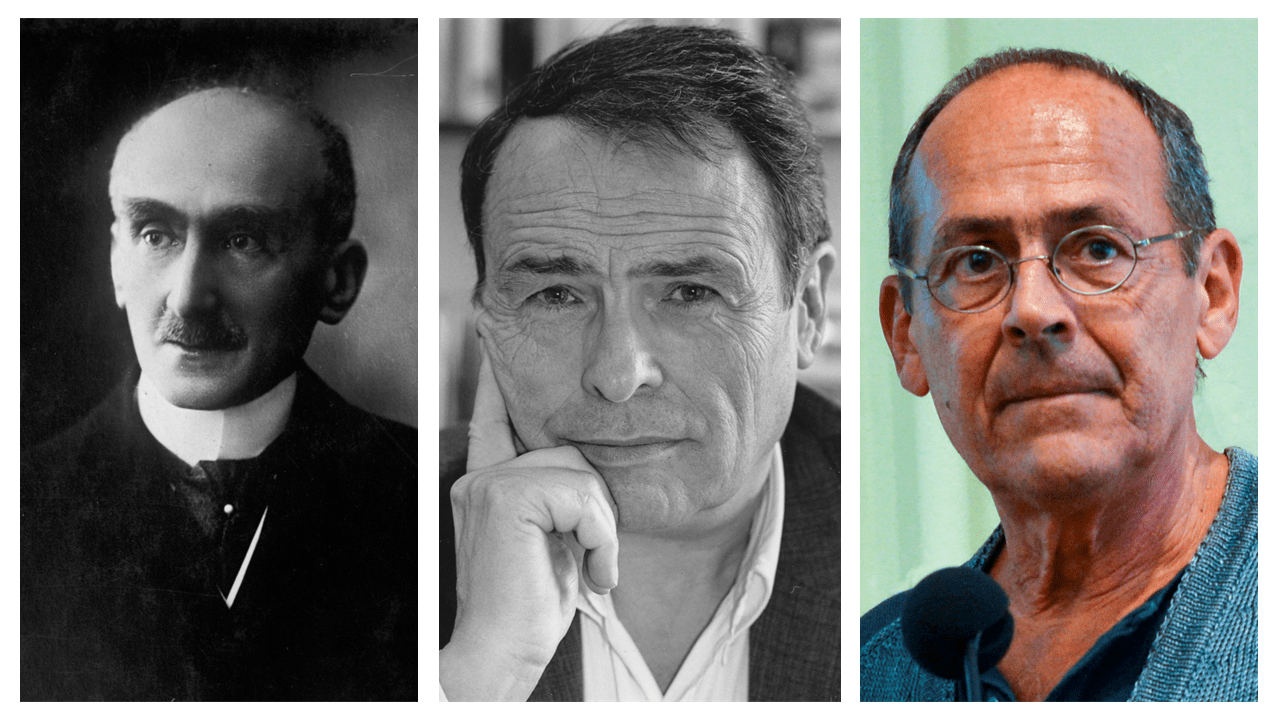
Featured image: Henri-Louis Bergson (1859-1941), Pierre Bourdieu (1930-2002), Bernard Stiegler (1952-2020), all French philosophers.


Neville Buch
Latest posts by Neville Buch (see all)
- Part 3:The Failure of an Educational Institution and How to Spiral Forward – October 10, 2026
- Part 2:The Failure of an Educational Institution and How to Spiral Forward – October 10, 2026
- Part 1:The Failure of an Educational Institution and How to Spiral Forward – October 10, 2026