
Dr Neville Buch[1]
The “MICE Commentary on Agency in the Age of Generative AI” audio commentary on MICE’s Contributory Economy and Human Authorship:
The next essay will show why the commentary is incorrect on “MICE education.” Yes, you can teach critical thinking.
Abstract
In the contemporary landscape of the Fourth Industrial Revolution, the rapid integration of Generative Artificial Intelligence (GenAI) into education and broader social systems has precipitated a profound crisis of human agency, characterized by “denoetization”—the mechanical liquidation of human judgment. This essay examines the landmark study by Jasper Roe and Mike Perkins (2026), “Agency in the age of generative AI: a critical review of educational implications,” through the sociological and philosophical frameworks of Bernard Stiegler, Bernard Williams, Jürgen Habermas, and Dr. Neville Buch. By investigating the systemic shift of individuals from active “makers” of knowledge to passive “managers” of information, this analysis identifies why the modern world has succumbed to technocratic reductionism. It proposes that humanity can only be preserved by “converting” technology into a partner in cognition guided by panser (thinking as caring). Finally, the essay outlines how the Management Institute for Contributory Economy (MICE) can utilize convivial networks and spiral historiography to break the silence and guide society toward Aristotelian flourishing.
I. Why Has the World Got into a Mess with A.I.?
The contemporary crisis of generative AI is a symptom of a broader, long-term historical development that Bernard Stiegler calls the “immense regression”. The core of this crisis lies in what data scientists in 2008 celebrated as “the end of theory”. As popularized by Chris Anderson, this mindset argued that massive datasets and predictive correlations rendered hypothesis testing and the question of why humans behave the way they do obsolete. By delegating the analytical functions of the mind to automatic retentional systems, society has facilitated a “mechanical liquidation of discernment”. In Dr. Buch’s sociological terms, this is denoetization—the systemic erosion of the human capacity to think, judge, and lead independently, which reduces the individual to a “puny human node” within vast bureaucratic and technological networks.
This regression manifests as a profound loss of savoir-faire (knowledge of how to do) and savoir-vivre (knowledge of how to live). Under the grip of computational capitalism, human desire is captured and standardized by digital algorithms, leading to “symbolic misery” and a “divorce between culture and technics”.
In educational settings, Roe and Perkins (2026, p. 2) observe this exact phenomenon: the automation of learning limits students’ ability to engage in agentic decision-making, which risks the “devaluation of human relationships” and the “erasure of ‘productive struggle’ in learning”. When challenging cognitive tasks are offloaded to GenAI, fundamental literacy skills are compromised. Rather than acting as active, creative investigators, students are reduced to “information organisms” (inforgs) or passive “managers” of information.
This represents a modern manifestation of Paulo Freire’s ”banking system” of education, where students function as passive “receptacles” to be “filled” with narrated content rather than active subjects of their own historical inquiry. When young learners unthinkingly copy and paste GenAI outputs without critical amendments (Roe and Perkins 2026, p. 10), they succumb to unreflective habit and ”Historical Forgetfulness”—the inability to perceive the origins of their own beliefs and prejudices.
II. How Is Our Humanity Retained in A.I. Systems?
To understand how humanity is retained, we must reject both the mechanistic view (“humans are machines”) and the animistic view (“machines are like humans”). Following Stiegler’s reading of the myth of Prometheus and Epimetheus, the human is an essentially prosthetic being characterized by an “originary de-fault”—a lack of an innate biological essence. Humans have always invented themselves through the exteriorization of memory and tools (exosomatisation). Therefore, technology is not an alien force; it is an extension of human consciousness.
Humanity is not preserved by rejecting A.I. (technophobia) or by unthinkingly submitting to it (techno-optimism). Rather, as Stiegler advises, we must “adopt” the technology in order to “convert” it into the good. Humanity is retained when AI is configured not as an autonomous, black-box ruler, but as a ”partner in cognition” that augments human capability (Roe and Perkins 2026, p. 3).
The essential boundary between human and machine intelligence lies in the moral sense. A.I. systems cannot make ethical decisions because they completely lack the necessary components of moral practice, such as feelings, intentions, and intersubjective mutuality. Therefore, we must reinvent thinking (penser) as caring (panser—tending to wounds). By practicing a Compassion-Focused Pedagogy (CfP), we ensure that technological function is always balanced by human emotional intelligence, empathy, and a commitment to the particularity of the historical person. Human beings must remain the proactive “who” (authors) who govern the “what” (technical systems).
III. How Do We Get the Population to Accept This Message?
Getting the wider population to recognize and resist the “technical abyss” requires a deliberate “reflective ascent” modelled by Dr. Buch’s Dynamic of Cognition (DoC). The DoC acts as a structural map to transition the public mind from unreflective habit toward comprehensive understanding:
- Reflective Self-Criticism (Prejudice): We must challenge the “apparent naturalness” of technological progress and make the familiar strange, questioning the “obviousness” of commercial and bureaucratic narratives.
- Crap Detecting (Exclusion): The population must be equipped with the tools of “crap detecting” to filter out the “institutional bullshit” and “theological masks” used by corporate elites to manufacture consent. This requires unmasking how neoliberal policies like the “Job Ready” scheme reduce human life to mere “measurable utility”.
- Spiral Historiography (Inclusion): We must reject linear, progressivist narratives in favour of a cyclical, spiral movement. By recursively returning to past intellectual struggles—such as the debates on humanism, freedom, and technology—we can read history with “modern inclusivity” and learn from past errors to avoid repeating them.
- Communicative Action: Following Jürgen Habermas, we must shift the social order away from strategic, manipulative domination toward “communicative action” oriented toward mutual, unforced, intersubjective understanding (Verständigung). This requires liberating public communication from its technicisation.
IV. What Should MICE Do to Break the Silence?
The Management Institute for Contributory Economy (MICE), operating in Brisbane with key figures like Dr. Neville Buch, Dr. Neil Peach, and Dr. Michael Macklin, is uniquely positioned to lead this intellectual resistance. To break the silence surrounding algorithmic governmentality and the devaluation of human labour, MICE should execute the following actions:
- Enact the MICE Mandate: MICE must leverage its three-part ideological balance: being radical enough to shift the contemporary agenda away from profit-driven metrics, liberal enough to ensure everyone has a decent place in the social environment, and conservative enough to preserve the rich legacy of historical and philosophical value.
- Establish “Laboratory Territories”: MICE should create experimental local spaces to test new models of the Contributory Economy, showing how communities can collaborate to resist “symbolic misery”.
- Transition to Convivial Learning Webs: In accordance with Ivan Illich’s critique of “disabling professions,” MICE must work to replace manipulative, socially addictive educational rituals with decentralized “learning webs” and skill exchanges that provide direct “access to reality”.
- Mobilize via The Philosophy Café: MICE should expand its informal public education initiatives, using non-technical “Philosophy Cafés” to bridge the gap between abstract academic scholarship and the practical, daily “lived experiences” (Erlebnis) of ordinary citizens.
- Synthesize Educare and Educere: MICE must lobby for educational reforms that balance technical training (educare) with critical “leading-out” (educere), empowering students to become active, critical co-investigators alongside their teachers rather than passive consumers of pre-packaged digital “outputs”.
By implementing these strategies, MICE can provide the intellectual immune system necessary to protect the educational and civic public sphere from the “altar of autocomplete,” ensuring that the human spirit remains the proactive author of its own destiny.
In-Text References (Harvard Style)
- (Anderson 2008, cited in Turner 2023, p. 1)
- (Arendt 1977, cited in Buch 2025, p. 1)
- (Bearman et al. 2024, cited in Roe and Perkins 2026, p. 18)
- (Buch 2025, p. 3)
- (Buch 2026, p. 2)
- (Buch and Peach 2025, p. 1)
- (Collins 1998, p. 49)
- (Cox 2024, cited in Roe and Perkins 2026, p. 10)
- (Dattahrani and De 2023, cited in Roe and Perkins 2026, p. 3)
- (Freire 1970, cited in Roe and Perkins 2026, p. 3)
- (Frøsig and Romero 2024, cited in Roe and Perkins 2026, p. 8)
- (Habermas 1979, p. 5)
- (Illich 1973, p. 2)
- (Lonergan 1962, p. 267)
- (Nida-Rümelin and Staudacher 2024, cited in Buch 2025, p. 1)
- (Noddings 1984, cited in Buch 2025, p. 10)
- (Puig de la Bellacasa 2012, p. 197)
- (Roe and Perkins 2026, p. 1)
- (Roe and Perkins 2026, p. 2)
- (Roe and Perkins 2026, p. 3)
- (Roe and Perkins 2026, p. 10)
- (Stiegler 1998, p. 86)
- (Stiegler 2014, p. 32)
- (Stiegler 2025, p. 1)
- (Turner 2023, p. 118)
- (Williams 1985, p. 119)
- (Williams 1995, p. 79)
Bibliography
Arendt, H. (1977). The life of the mind. New York: Harcourt Brace Jovanovich.
Bearman, M., Tai, J., Dawson, P., Boud, D. & Ajjawi, R. (2024). ‘Developing evaluative judgement for a time of generative artificial intelligence’. Assessment & Evaluation in Higher Education, 49(6), pp. 893–905.
Buch, N. (2015). Process of learning (principles) & the dynamic of cognition. Brisbane: Management Institute for Contributory Economy.
Buch, N. (2025). The dynamic of cognition. Academia.edu.
Buch, N. (2026). A matrix of sociology. Brisbane: Management Institute for Contributory Economy.
Buch, N. & Peach, N. (2025). Comparison of two papers. Brisbane: Dr Neville Buch ABN: 86703686642.
Collins, R. (1998). The sociology of philosophies: A global theory of intellectual change. Cambridge, MA: Harvard University Press.
Cox, G. M. (2024). ‘Artificial intelligence and the aims of education: makers, managers, or inforgs?’. Studies in Philosophy and Education, 43(1), pp. 15–30.
Freire, P. (1970). Pedagogy of the oppressed. New York: Herder and Herder.
Habermas, J. (1979). Communication and the evolution of society. Translated by T. McCarthy. Boston: Beacon Press.
Illich, J. (1973). Tools for conviviality. New York: Harper & Row.
Lonergan, B. J. F. (1962). Regis College lectures: Operations, the subject, objects, method. Toronto: University of Toronto Press.
Nida-Rümelin, J. & Staudacher, K. (2024). ‘Philosophical Foundations of Digital Humanism’. In: H. Werthner, B. Nuseibeh, E. Prem & A. Stanger, eds. Introduction to digital humanism. Cham: Springer, pp. 115–124.
Puig de la Bellacasa, M. (2012). ‘“Nothing comes without its world”: thinking with care’. The Sociological Review, 60(2), pp. 197–216.
Roe, J. & Perkins, M. (2026). ‘Agency in the age of generative AI: a critical review of educational implications’. Academia AI and Applications, 2, pp. 1–19. doi:10.20935/AcadAI8422.
Stiegler, B. (1998). Technics and time, 1: The fault of Epimetheus. Translated by R. Beardsworth and G. Collins. Stanford: Stanford University Press.
Stiegler, B. (2014). Symbolic misery, 1: The hyperindustrial epoch. Translated by G. Moore. Cambridge: Polity Press.
Stiegler, B. (2025). The immense regression: What is called caring? (Vol. 1). Translated by D. Ross. Berlin: K. Verlag.
Turner, B. (2023). Returning to judgment: Bernard Stiegler and continental political theory. Albany: State University of New York Press.
Werthner, H., Nuseibeh, B., Prem, E. & Stanger, A. (eds.) (2024). Introduction to digital humanism. Cham: Springer.
Williams, B. (1985). Ethics and the limits of philosophy. London: Fontana.
Williams, B. (1995). Making sense of humanity and other philosophical papers, 1982-1993. Cambridge: Cambridge University Press.
Take the MICE Quiz
[1] Artificial Intelligence (A.I.) has been fairly used in the production of this work. The tool used is Google NotebookLM (recently rebranded as Gemini Notebook). It is an AI-powered virtual research assistant and thinking partner designed to help a person interact deeply with their own documents. Unlike general chatbots, it is source-grounded, meaning it only generates answers based on the specific PDFs, documents, or links uploaded. The A.I. process in the production of this work has been limited to the attached (prompts) on each of the questions in turn. This ensures an accurate reading of each source. The author then rearranged and re-edited the answers the A.I. provided. The human author publishes this work. A.I. is never an author when used properly. This assistance is not qualitatively different from a human research assistant when that assistance is deemed to have no authorial status but is acknowledged.
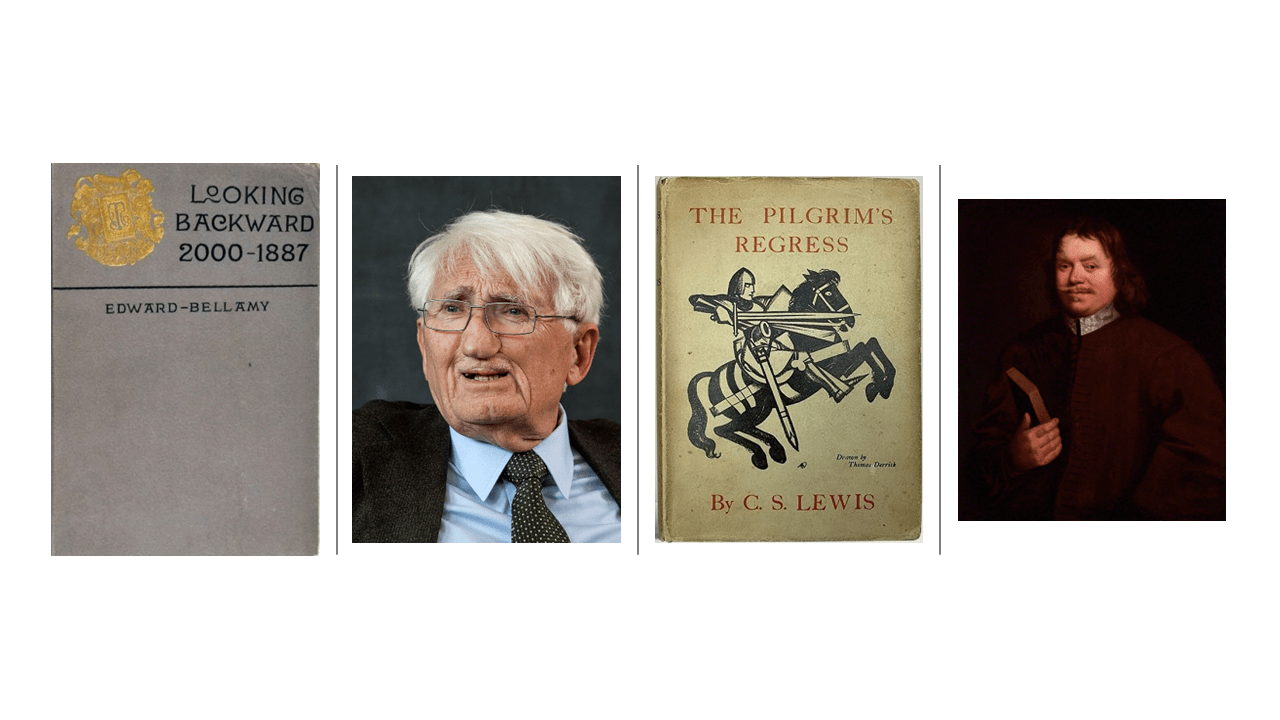
Featured Image: Critical-Theory-Purtian-ART-World-and-Progressivism (images: Edward Bellamy’s book, Jürgen Habermas, C.S. Lewis’ book, and John Bunyan)


Neville Buch
Latest posts by Neville Buch (see all)
- Thank you, Richard: Knowing the message but then acting – October 8, 2026
- The Desiccation of the Common Well: Identity Politics, Algorithmic Assessment, and the Crisis of Adult Responsibility – October 6, 2026
- Academic Rigour, Epistemic Renewal, and the Crisis of Inquiry: A Scholarly Review of the Vanderbilt Commission Report on the State of Scholarship – October 5, 2026