
Nobody gets too much Heaven no more
It’s much harder to come by
I’m waiting in line
Nobody gets too much love anymore
It’s as high as a mountain
And harder to climb
1979, Bee Gees, Too Much Heaven lyrics © Universal Music Publishing Int. Mgb Ltd., Unicef Music.
Nostalgia is the two-face Janus: It has many benefits, and many demeaning barriers, for cognition. Nostalgia provides psychological support but it can also make the withdrawal into the private past-world worse. A little initial nostalgia gets our attention to the problems we might otherwise fail to see, and yet we must retreat from nostalgia if we are to work out the solutions properly. The danger is that nostalgia can consume a person before that person realizes what has happened. Nostalgia is a very strong emotion-thought. Furthermore, nostalgia is a barrier of hidden meaning. The thought of nostalgia is not critical enough to question and challenge our prejudiced beliefs. We all are, and can be, enchanted by nostalgia. That is not necessarily a bad thing if we can also escape it. It is important to have the moments of enchantment and fantasy but no longer than that; otherwise, we start damaging the processes of human cognition. How much is too much, one must be weary in saying for another. It is the question each person has to ask themselves.
Metaphysics: Intuition is a kind of a priori cognition that serves the purposes of metaphysics, given that metaphysics involves the search for modal knowledge. Necessary or, better, modal knowledge is a priori; so metaphysical knowledge is likewise a priori. This has an important place in cognition but one has to be weary of the way metaphysical knowledge has been abused to legitimatise imperialism and colonialism. Furthermore, metaphysical knowledge has been abused to erode community. There is no necessity in these arrangements but it is a matter of bad practice.
Magic thinking and Clarity: In Cognition, magical thinking as a strong tendency towards categorization, towards simplification of an infinitely diverse reality and of its modifications, and its reduction to a limited number. This is folk metaphysics, not philosophical metaphysics proper. Categories have an important role in cognition, but that also leads to categorical misconceptions. Categories can be hidden to our understanding and that means mistakes are made in how our mind has categorized in our belief. Again, there is no necessity in these arrangements but a matter of bad practice. It is the question each person has to ask themselves.
REFERENCES
Batcho, K. I. (2013). Nostalgia: Retreat or Support in Difficult Times? The American Journal of Psychology, 126(3), 355–367. https://doi.org/10.5406/amerjpsyc.126.3.0355
Chrostowska, S. D. (2010). Consumed by Nostalgia? SubStance, 39(2), 52–70. http://www.jstor.org/stable/40801075
Daniels, E. B. (1985). Nostalgia and Hidden Meaning. American Imago, 42(4), 371–383. http://www.jstor.org/stable/26303822
Ekroll, V., Sayim, B., & Wagemans, J. (2017). The Other Side of Magic: The Psychology of Perceiving Hidden Things. Perspectives on Psychological Science, 12(1), 91–106. https://www.jstor.org/stable/48591196
García-Encinas, M. J. (2015). The Role of Intuition in Metaphysics. Teorema: Revista Internacional de Filosofía, 34(3), 79–100. http://www.jstor.org/stable/26370126
Harries, K. (2015). The Two Faces of Nostalgia. Perspecta, 48, 6–15. http://www.jstor.org/stable/45215792
Kajfosz, J. (2008). Magic, Categorization and Folk Metaphysics. Towards Cognitive Theory of Magic. Český Lid, 95(4), 355–368. http://www.jstor.org/stable/42640191
Kitson, J., & McHugh, K. (2015). Historic enchantments – materializing nostalgia. Cultural Geographies, 22(3), 487–508. https://www.jstor.org/stable/26168663
Klopper, D. (2016). Introduction: The Problem of Nostalgia. English in Africa, 43(3), 9–17. http://www.jstor.org/stable/26359335
Lorcin, P. M. E. (2013). Imperial Nostalgia; Colonial Nostalgia: Differences of Theory, Similarities of Practice? Historical Reflections / Réflexions Historiques, 39(3), 97–111. http://www.jstor.org/stable/42703774
Österblom, H., Scheffer, M., Westley, F. R., van Esso, M. L., Miller, J., & Bascompte, J. (2015). A message from magic to science: seeing how the brain can be tricked may strengthen our thinking. Ecology and Society, 20(4). http://www.jstor.org/stable/26270311
Ramsden, S. (2016). “The community spirit was a wonderful thing”: on nostalgia and the politics of belonging. Oral History, 44(1), 89–97. http://www.jstor.org/stable/24892962
Rosaldo, R. (1989). Imperialist Nostalgia. Representations, 26, 107–122. https://doi.org/10.2307/2928525
Salmose, N. (2014). Reading Nostalgia: Textual Memory in The Great Gatsby. The F. Scott Fitzgerald Review, 12(1), 67–87. https://doi.org/10.5325/fscotfitzrevi.12.1.0067
Sedikides, C., Wildschut, T., Arndt, J., & Routledge, C. (2008). Nostalgia: Past, Present, and Future. Current Directions in Psychological Science, 17(5), 304–307. http://www.jstor.org/stable/20183308
Silva, C. (2014). Nostalgia and The Good Life. The Eighteenth Century, 55(1), 123–128. http://www.jstor.org/stable/24575159
Smith, K. K. (2000). Mere Nostalgia: Notes on a Progressive Paratheory. Rhetoric and Public Affairs, 3(4), 505–527. http://www.jstor.org/stable/41939629
Stewart, K. (1988). Nostalgia–A Polemic. Cultural Anthropology, 3(3), 227–241. http://www.jstor.org/stable/656172
Ugrešić, D., & Williams, D. (2012). Nostalgia. Salmagundi, 176, 3–13. http://www.jstor.org/stable/41638812
Vanderbilt, T. (1993). The Nostalgia Gap. The Baffler, 5, 152–157. http://www.jstor.org/stable/43555664
Wilson, J. L. (2015). Here and Now, There and Then: Nostalgia as a Time and Space Phenomenon. Symbolic Interaction, 38(4), 478–492. https://www.jstor.org/stable/symbinte.38.4.478
Zhou, X., Sedikides, C., Wildschut, T., & Gao, D.-G. (2008). Counteracting Loneliness: On the Restorative Function of Nostalgia. Psychological Science, 19(10), 1023–1029. http://www.jstor.org/stable/40064839
Zhou, X., Wildschut, T., Sedikides, C., Shi, K., & Feng, C. (2012). Nostalgia: The Gift That Keeps on Giving. Journal of Consumer Research, 39(1), 39–50. https://doi.org/10.1086/662199
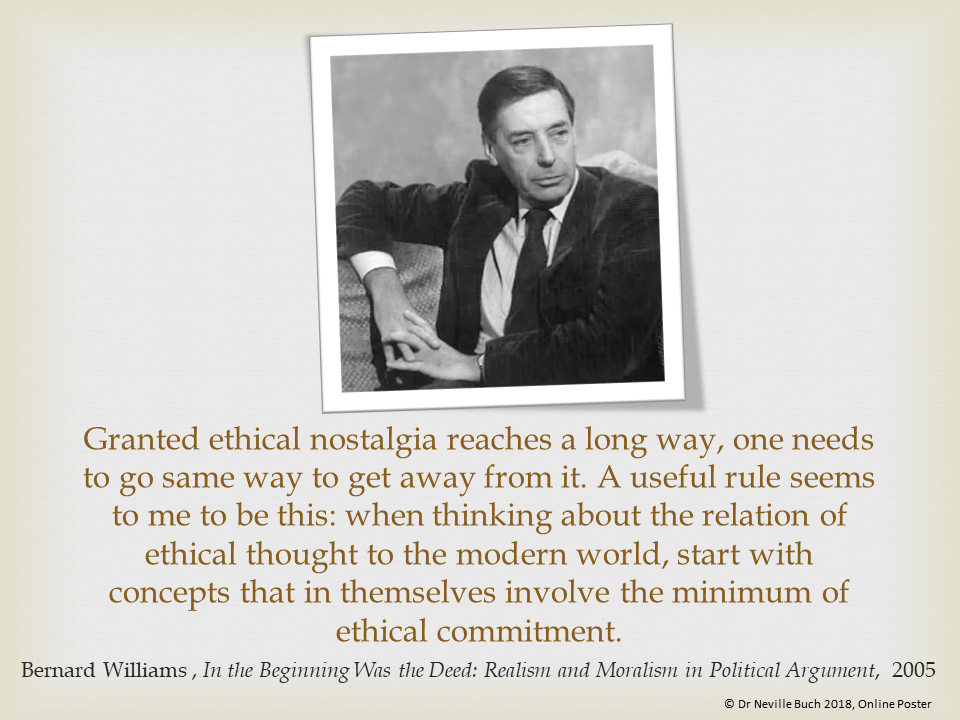
Featured Image: Sir Bernard Arthur Owen Williams FBA (21 September 1929 – 10 June 2003) was an English moral philosopher. His publications include Problems of the Self (1973), Ethics and the Limits of Philosophy (1985), Shame and Necessity (1993), and Truth and Truthfulness (2002). He was knighted in 1999.


Neville Buch
Latest posts by Neville Buch (see all)
- The Unbound Mind: Independent Scholarship, Institutional Isolation, and the Restoration of Human Authorship – October 20, 2026
- The Road to Geelong: A Re-Narrativization of The Story of Resilience Part 1 – October 20, 2026
- The Human Being Above the Transaction and Why Markets Cannot Measure Human Worth – October 15, 2026