
Many times, you hear a pattern of conversation, which goes:
Person A: “Stop blaming me”
Person B: “I’m not blaming you, you’re blaming me”
Person A: “No, I am not. You are blaming me.”
Person B: “No, I am not”…
Bernard Williams did much work in understanding the problem of ‘social blame’, in an effort to prevent this type of conversational pattern (above). Williams’ basic argument is that all ethical and moral decision arise from internal reasoning and blame is the result of persons over-externalising in their reasoning. In cases where someone has no internal reason to do what others see as the right thing, they cannot be blamed for failing to do it, because internal reasons are the only reasons, and blame, Williams wrote, “involves treating the person who is blamed like someone who had a reason to do the right thing but did not do it”. (Williams, 42).
The key aspects of Williams’s view on social blame are:
- Critique of the “Morality System”: Williams identified a particular style of ethical thought, which he called “morality,” as a “pervasive and pernicious feature of the modern world”. This “morality system” imposes significant pressure on the concept of the voluntary. It demands a “total” voluntariness that aims to abstract from an individual’s character, psychological states, and social determination when assigning blame and responsibility.
- The Illusion of Pure Voluntariness: Williams explicitly states that the idea of a “purely” voluntary act, along with related concepts like responsibility, guilt, and blame, are an “illusion”. He argues that supposing this demand for total voluntariness can be met is an illusion, contrasting it with less ambitious requirements of voluntariness that acknowledge character as largely given.
- Superficiality of “The Voluntary”: He described “the voluntary” as an “inherently superficial concept” that “should not be asked to do too much”. While blame is generally directed toward voluntary actions, Williams cautioned against overemphasizing this concept or making a “grandiose mystery out of it”. He suggested that its limitations become evident under pressure, and other approaches might better serve our needs.
- Need for an External Perspective on Responsibility: Williams contended that the “morality system” attempts to deny any external viewpoint from which its judgments, including those of moral judgment and moral merit, can be assessed. However, he argued that a “reasonable external perspective” is necessary for properly understanding and evaluating practices and provisions of moral responsibility.
- Thick Ethical Concepts and Judgment: Despite his criticisms of the morality system’s approach to blame, Williams affirmed that ethical judgments are continuously made. He introduced “thick ethical concepts” (e.g., “unfaithful,” “chaste,” “courageous”) which intrinsically combine both an evaluative aspect (to appraise a situation) and a factual aspect (subject to correction). These concepts allow for the identification of motivations such as malice, intellectual laziness, or ignorance in others’ actions.
- Social and Historical Context of Blame: Williams highlighted that the application of thick ethical concepts is deeply embedded in living within a particular social world. While convergence in ethical beliefs and the acquisition of ethical knowledge can occur through these concepts, a comprehensive reflective explanation for such convergence must incorporate a social-scientific understanding of why those concepts are embraced within that social world, from a vantage point outside it.
- Implications for Future Ethical Practices: Williams concluded that the existing practices of blame and other negative ethical reactions are destined to change. In his view, the traditional “morality system” is no longer capable of guiding these changes in a desirable way.
John Skorpski (102) thinks Williams’ view on morality is unconvincing, being on the Hume-Nietzsche track of thinking, however, Skorpski admits that William’s approach is otherwise “admirable”, “seeing people, their feelings, and their practices as they are, without undue optimism and with the help of whatever empirical findings we have.” (102). In other words, Skorpski does not blame Williams, he understands Williams from his philosophical perspective, where he disagrees with Williams’ Idealism, but agrees with his Realism.
Sources:
John Skorupski, “Internal Reason and the Scope of Blame”, Thomas, Alan (ed., 2007), Bernard Williams: Contemporary Philosophers in Focus, Cambridge: Cambridge University Press.
Bernard Williams (1995). Making Sense of Humanity, Cambridge: Cambridge University Press.
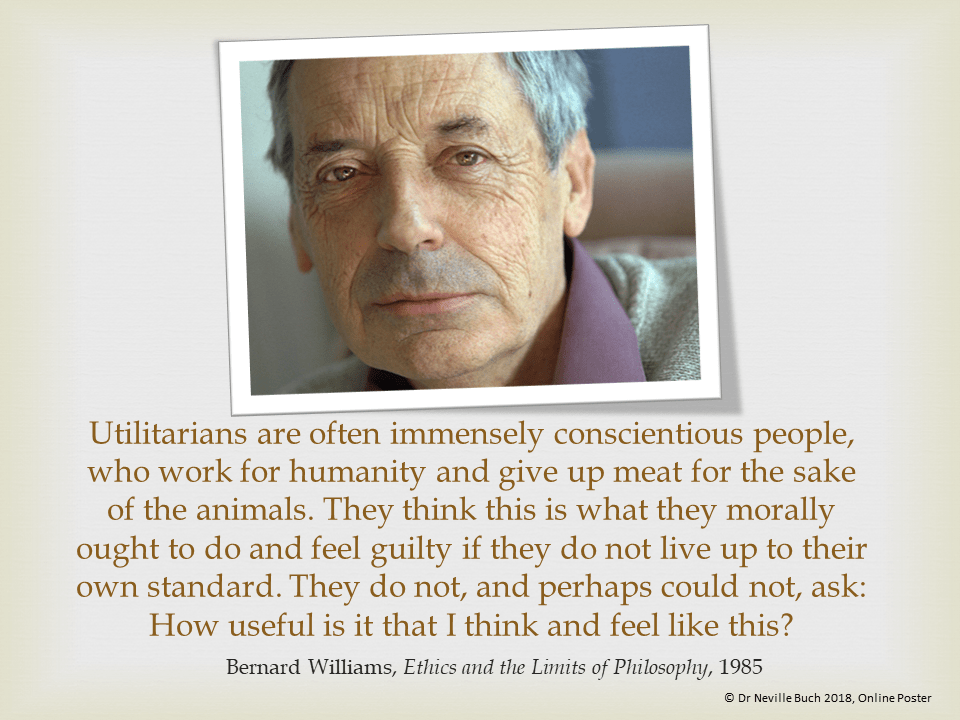
Featured Image: Sir Bernard Arthur Owen Williams FBA (21 September 1929 – 10 June 2003) was an English moral philosopher. His publications include Problems of the Self (1973), Ethics and the Limits of Philosophy (1985), Shame and Necessity (1993), and Truth and Truthfulness (2002). He was knighted in 1999.


Neville Buch
Latest posts by Neville Buch (see all)
- The Unbound Mind: Independent Scholarship, Institutional Isolation, and the Restoration of Human Authorship – October 20, 2026
- The Road to Geelong: A Re-Narrativization of The Story of Resilience Part 1 – October 20, 2026
- The Human Being Above the Transaction and Why Markets Cannot Measure Human Worth – October 15, 2026