
Abstract
This essay explores the profound historiographical and methodological synergies between the German theological and legal scholar Eckart Otto and the Australian intellectual historian and sociologist Dr. Neville Buch. It examines how Otto’s Munich lecture syllabus, Die Geschichte des Natur- und Verfassungsrechts von der Antike bis zur Gegenwart, traces the evolution of Western legal and moral rationality from Thomas Hobbes to Jürgen Habermas, highlighting the systemic tensions of Kantian proceduralism and Hegelian Sittlichkeit. It contrasts this with Buch’s critical framework of “philosophy in practice,” which utilizes the Dynamic of Cognition (DoC) and Spiral Historiography to challenge modern “denoetization” and “Historical Forgetfulness” within regional governance and education. By synthesizing Otto’s rigorous genealogy of constitutional law with Buch’s place-based digital humanism, this paper outlines a transformative pedagogical strategy. This synergy establishes that intellectual truth is not a static, bureaucratic proposition, but a dynamic, historically embodied relationship necessary for preserving human authorship and establishing oppositional democratic public spheres in the twenty-first century.
1. Eckart Otto and the Genealogy of Legal and Moral Rationality
The intellectual project of Eckart Otto, particularly as articulated in his lecture syllabus Die Geschichte des Natur- und Verfassungsrechts von der Antike bis zur Gegenwart. Teil II: Von Thomas Hobbes bis zu Jürgen Habermas, represents a rigorous, non-linear genealogy of Western legal, moral, and constitutional consciousness (Otto 2025: 1). Operating at the intersection of theology, philosophy, and jurisprudence, Otto’s scholarship deconstructs how modern legal structures are fundamentally underpinned by historically shifting “images of humanity” (Menschenbilder) and evolving philosophical systems of justification (Otto 2025: 3; Steinbüchel 1951, cited in Rowland 2023: 15).
A primary node of Otto’s intellectual history is his critical examination of Immanuel Kant. Otto deconstructs Kantian deontology as the “internalization of the common interest in self-legislation” (Otto 2025: 4). In Kant’s moral framework, the authority of law is relocated from external theological absolutes to the autonomous, a priori structure of practical reason itself, epitomized by the Categorical Imperative (Kant 1781; Buch 2025d: 1). Yet, Otto exposes a tragic limitation within this “rational nominalism.” By separating the moral self (homo noumenon) from the empirical, sensory self (homo phaenomenon), Kantianism reduces ethical and constitutional law to a formalistic, procedural exercise that ignores the concrete, material-ethical assumptions of lived human existence (Otto 2025: 4; Buch 2025d: 3).
To resolve this Kantian abstraction, Otto traces the historical counter-strike of G.W.F. Hegel (Otto 2025: 5). Hegel sought to overcome the noumenal-phenomenal split (chorismos) by introducing Sittlichkeit—substantive ethical life concretely embodied in local folkways, cultural institutions, and shared historical traditions (Hegel 1821; Otto 2025: 5). However, as Otto’s syllabus demonstrates, Hegel’s “idea-realist” resolution carries its own severe political danger. By elevating the State as the ultimate, objective embodiment of the “Ethical Idea” and Spirit (Geist), Hegel’s teleological system risks sliding into a totalizing “State Humanism” that subordinates the subjective freedom of the individual to administrative and institutional control (Hegel 1821; Otto 2025: 5; Buch 2025a: 28). Otto traces this dialectic forward, showing how subsequent Left-Hegelian critiques and eventually Jürgen Habermas’s Theory of Communicative Action sought to salvage the emancipatory potential of modern reason by anchoring it in communicative competence and reciprocal dialogue rather than state-driven teleology (Habermas 1981; Otto 2025: 6).
2. Neville Buch and History as Philosophy in Practice
While Otto examines the grand, macroscopic trajectory of Western legal and constitutional thought, Dr. Neville Buch speaks to intellectual history as an active, localized, and ethical “philosophy in practice” (Buch 2026d: 1). For Buch, historical inquiry is never a passive, “scissors-and-paste” recording of chronological data (Collingwood 1946; Buch 2026a: 1). Instead, it is the essential empirical grounding required for philosophical self-understanding, critical self-criticism, and the active preservation of human authorship over automated systems (Buch 2026d: 1; Buch 2026c: 12-14).
Buch’s critical intervention targets a dual cognitive pathology defining contemporary governance and education: “denoetization” (the mechanical liquidation of the human capacity for judgment) and “Historical Forgetfulness” (the repetitive commission of past intellectual errors because their origins have been banished from memory) (Buch 2025a: 16, 18). Buch diagnoses these pathologies as the direct consequence of a pervasive “techné mindset”—an instrumental, bureaucratic rationality that reduces human potential to quantifiable metrics, standardized test scores, and narrow “job-ready” vocational fitness (Buch 2026a: 3; Buch 2025a: 16).
[ Techné Mindset / “Junior” State ]
(Passive, unreflective vocational routine)
│
▼ (Buch’s Interventive Diagnostic)
[ Dynamic of Cognition (DoC) ]
(Subjective Prejudice -> Evaluative Value)
│
▼ (Methodological Practice)
[ Spiral Historiography & MBH ]
(Uncoiling cyclical patterns of error)
│
▼
[ “Senior” Social Accountability ]
(Aristotelian eudaimonia / Humanism)
To remediate this crisis of the unexamined life, Buch deploys two primary methodological tools:
- The Dynamic of Cognition (DoC) Model: A diagnostic framework that maps how initial, unreflective subjective Prejudices (the “thrown state” of human existence) are processed through the psychological axes of Exclusion (skeptical “crap-detecting”) and Inclusion (empathetic historical integration) to culminate in Typologies of Value (wisdom, character, and Aristotelian eudaimonia) (Buch 2025b: 4; Buch 2026c: 13-14).
- Spiral Historiography: A post-postmodernist meta-methodology that rejects linear, progressivist views of history in favour of a non-linear, cyclical re-evaluation of ideas (Buch 2026d: 1). The spiral model processes intellectual change through four distinct phases: Widely-Believed Falsehood, Accountability, Falsehood Retreats, and Historical Forgetfulness (Buch 2026d: 1).
Buch’s scholarship is characterized by a “think global, act local” imperative, purposefully linking global theoretical frameworks (the Frankfurt School, British Personalism, and German Hermeneutics) to local, place-based historical realities (Buch 2026a: 1). This is operationalized through the Mapping Brisbane History (MBH) project, a digital historiographical initiative that spatially maps local institutions of belief and culture to validate public policy and expose how municipal spaces have been historically contested along lines of class, gender, and power (Buch 2026c: 6; Buch 2026g: 1).
3. The Synergy of Otto and Buch: Methodological and Pedagogical Lessons
When placed in active dialogic contact, the work of Eckart Otto and Dr. Neville Buch produces a profound intellectual synergy, yielding three vital lessons for modern intellectual history and critical pedagogy:
Lesson I: The Reconciliation of Formal Proceduralism and Embodied Lived Experience
The primary lesson in the synergy of Otto and Buch is the necessity of overcoming the abstract formalism of modern “skills-based” education by grounding reason in concrete lived experience (Erlebnis) (Dilthey 1954; Buch 2025b: 4). Otto’s deconstruction of the Kant-Hegel debate highlights the limits of purely procedural legal and moral systems that operate from an “aperspectival standpoint” (Otto 2025: 4; Foucault 1966, cited in Buch 2025e: 1).
Buch’s work actively reconciles this tension. Through Philosophical Compatibilism, Buch integrates the a priori rigor of universal validity claims (such as Habermas’s communication criteria of truth, rightness, and sincerity) with interpretive holism (Buch 2025b: 41; Buch 2026a: 4). True critical thinking cannot be taught as a disembodied, technical formula (techné); it must be practiced as a situated, contextual inquiry that respects the specific historical and social bearings of the thinker (Buch 2026a: 4; Williams 2006).
Lesson II: The Historian as “Panseur” (Healer) of Social Wounds
A second critical lesson centres on redefining the role of the scholar in the public sphere. Otto’s historical tracking of natural law proves that intellectual history is not a static archive; as novel social crises emerge, “the whole history has to be rewritten and revalued” (Porrovecchio 2015: 63).
Buch conceptualizes this active, ethical intervention by defining the historian as a “panseur” (healer) who engages in “panser” (thinking as caring) (Stiegler 1998; Buch 2026a: 1; Buch 2026c: 13-14). By utilizing Spiral Historiography as a “non-linear lens,” the historian-healer does not merely record past facts, but actively “uncoils” recursive patterns of human error and unreflective prejudice (the “Spiral History Theory of Stupidity”) to tend to the cultural wounds and omissions of the present (Buch 2026c: 13-14; Buch 2026d: 1).
Lesson III: Reclaiming the Public Sphere through Communicative Rationality
The final synergistic lesson is the urgent need to move critical theory out of isolated academic enclaves and into the everyday lifeworld of the community. Otto’s lineage culminates in Habermas’s Theory of Communicative Action, which establishes communicative rationality as the basis for modern social integration (Habermas 1981; Otto 2025: 6).
Buch operationalizes this theory through the establishment of “oppositional democratic public spheres”, such as The Philosophy Café and the BSHN (Buch 2025b: 41, 48; Buch 2026b: 3). By running the “Philosophy Parlour Game”—a structured simulation based on Habermasian communicative action and Toulmin’s jurisprudential argumentation—Buch provides citizens with the active, cooperative space needed to negotiate “thick” ethical judgments and achieve “Sufficient Comprehension” outside state-controlled, “singular public relations messaging” (Buch 2025b: 41; Buch 2026c: 3; Buch 2026d: 1).
4. The Imperative of the Synergy: Why These Lessons Matter
The integration of Otto’s and Buch’s intellectual frameworks is not a minor academic exercise; it is an urgent democratic requirement to combat the systemic crises of the digital age:
- Dismantling the “Techné Mindset” and “Denoetization”: Modern neoliberal governance systematically reduces education to quantifiable, “job-ready” vocational metrics, turning students into passive, unreflective “puny nodes” designed for corporate utility (Buch 2025b: 21; Buch 2026a: 3). By proving that learning is an individualizing, internal term, whereas education is inherently relational, the synergy of Otto and Buch reinstates the teacher as a “transformative intellectual” who guides the student’s ethical relationship to the shared world-picture (Vygotsky 1962; Buch 2025b: 4, 21).
- Defeating the Epistemology of Ignorance: Political elites frequently deploy folksy, simplistic regional narratives—such as the “Queensland Character” myth—to construct a false, unchanging consensus that rationalizes intellectual neglect and conceals uncomfortable historical realities like frontier violence and land dispossession (Buch 2026d: 3; Buch 2026c: 12-14). The POLICE model and local digital humanism (MBH) provide the public with an active “crap-detecting” immune system to audit these manufactured myths and demand systemic accountability (Buch 2025b: 27; Buch 2026g: 1).
- Escaping the Cartesian Impasse: Modern algorithmic feeds isolate individuals into private, self-sealing “ideological bubbles,” fostering a populist, unreflective “Junior” state of unreflective execution (McKinney 1971; Buch 2026d: 1). By demonstrating that knowledge is a determined, cooperative social product synthesized through the “living bridge” of shared language, the synergy of Otto and Buch proves that intellectual freedom and Aristotelian flourishing (eudaimonia) can only be achieved through a disciplined, long-life commitment to collaborative, scholastic inquiry (McKinney 1971; Buch 2026d: 1; Buch 2026c: 12-14).
FURTHER ANALYSIS
The German phrase ”Programm der Vorlesung von Prof. Dr. Dr. h.c.” translates directly to English as:
- “Lecture Syllabus by Prof. Dr. Dr. h.c.” or
- “Program of the Lecture Series by Prof. Dr. Dr. h.c.”
Breakdown of the German Terms:
- Programm: Program, syllabus, schedule, or curriculum.
- der: of the (genitive feminine singular, modifying Vorlesung).
- Vorlesung: Lecture or university course.
- von: by or of.
- Prof. Dr. Dr. h.c.: Professor Doctor Doctor honoris causa (designating a professor holding two doctoral degrees, at least one of which is an honorary doctorate).
In the context of the MICE notebook, this is the title of the lecture syllabus delivered by Prof. Dr. Dr. h.c. Eckart Otto at the Ludwig-Maximilians-Universität München. The course is titled ”Die Geschichte des Natur- und Verfassungsrechts von der Antike bis zur Gegenwart. Teil II: Von Thomas Hobbes bis zu Jürgen Habermas”, which translates to ”The History of Natural and Constitutional Law from Antiquity to the Present. Part II: From Thomas Hobbes to Jürgen Habermas.”
From Procedural Autonomy to Hegelian Ethical Life
Section VI: Immanuel Kant – The Internalization of the Common Interest in Self-Legislation (Die Verinnerlichung des Allgemeininteresses in der Selbstgesetzgebung bei Immanuel Kant)
1. Translation of the Syllabus Topics
- The Internalization of the Common Interest in Self-Legislation under Immanuel Kant: How the individual incorporates the collective interest through self-imposed, rational moral laws.
- A Priori Reason as the Foundation of Law and Ethics: Grounding ethical action and legal systems in universal structures of pure practical reason rather than empirical desires, utility, or external authority.
- The Unformulated Material-Ethical Assumptions of the Kantian Reduction of Ethics: A critique of how Kant reduces ethics to a purely procedural application of a priori reason, leaving the underlying concrete moral contents (material ethics) unexamined.
2. Conceptual Context and Summary
Within the broader lineage of modern intellectual history, Kant’s “Copernican Revolution” attempted to rescue objective knowledge and morality from total skepticism. In his moral philosophy (Critique of Practical Reason), Kant replaced external authorities (such as God or Nature) with the autonomous practical reason of the individual. To act morally is to act autonomously, obeying a self-imposed law formulated by reason itself. This is captured in the Categorical Imperative, which demands that a rational agent act only on maxims that they can simultaneously will become universal laws.
However, as the lecture syllabus and related MICE curriculum critiques note, this framework suffers from a tragic abstraction. Kant separates the moral self (homo noumenon, existing outside of time and causality) from the concrete, physical self (homo phaenomenon). This strict chorismos (separation) reduces ethics to a formalistic procedure. By demanding absolute impartiality, Kantian deontology requires individuals to strip away their personal characters, local attachments, and lived passions—leaving too slim a sense in which any moral project can be understood as truly “mine”.
Section VII: G.W.F. Hegel – Overcoming the Kantian Chorismos of Homo Noumenon and Homo Phaenomenon (Die Überwindung des kantischen Chorismos… bei Georg Friedrich Wilhelm Hegel)
1. Translation of the Syllabus Topics
- Overcoming the Kantian Chorismos through Substantive Ethics: Reconnecting the abstract moral self with the concrete, physical self through the rediscovery of “material” (substantive) ethics and law beyond Kant’s procedural justice.
- Hegel’s Idea-Realist Counter-Strike against Kant’s Rational Nominalism: A critique of Kant’s formalist reason, substituting it with a dynamic, historically unfolding reality where ideas are not secondary, but constitutive of the world.
- Hegel’s Differentiation of Society and State in the Philosophy of Right: Analyzing the limits of civil society (bürgerliche Gesellschaft) in successfully mediating private and common interests, which served as the primary launching pad for subsequent Left-Hegelian critiques.
- Hegel’s Ethical Idea of the State: The political and philosophical problem of “idea-realism” (idealism) when the state is treated as the ultimate embodiment of objective spirit.
2. Conceptual Context and Summary
Hegel mounted a powerful counter-strike against Kant’s abstract universalism by arguing that reality and reason are not static, a priori templates, but dynamic, historically developing processes of Spirit (Geist) coming to know itself. To resolve Kant’s procedural impasse, Hegel introduced the concept of Sittlichkeit (ethical life). Hegel argued that morality cannot exist in a vacuum of “pure duty”; it must be a “concretely determined ethical existence” rooted in local folkways, culture, and shared historical forms of life. In this sense, truth is not a dry and reduced proposition—it lives and is embodied in human history.
However, Hegel’s reconciliation of the individual and the universal led to a profound political problem. In his Philosophy of Right, Hegel positioned the State as the “perfect embodiment of Spirit” and the ultimate vehicle of “Rational Freedom”. This led to what the curriculum identifies as State Humanism (or Statist Humanism), a teleological view of history that ultimately subordinates the individual’s subjective will to the universal authority of the state. This totalizing system invites subsequent critique (from Left-Hegelians like Karl Marx to critical theorists like Theodor Adorno), as it risks turning the state into a mechanism of absolute social control that suppresses autonomous human judgment.
Intellectual Blueprint of the Visual Timeline
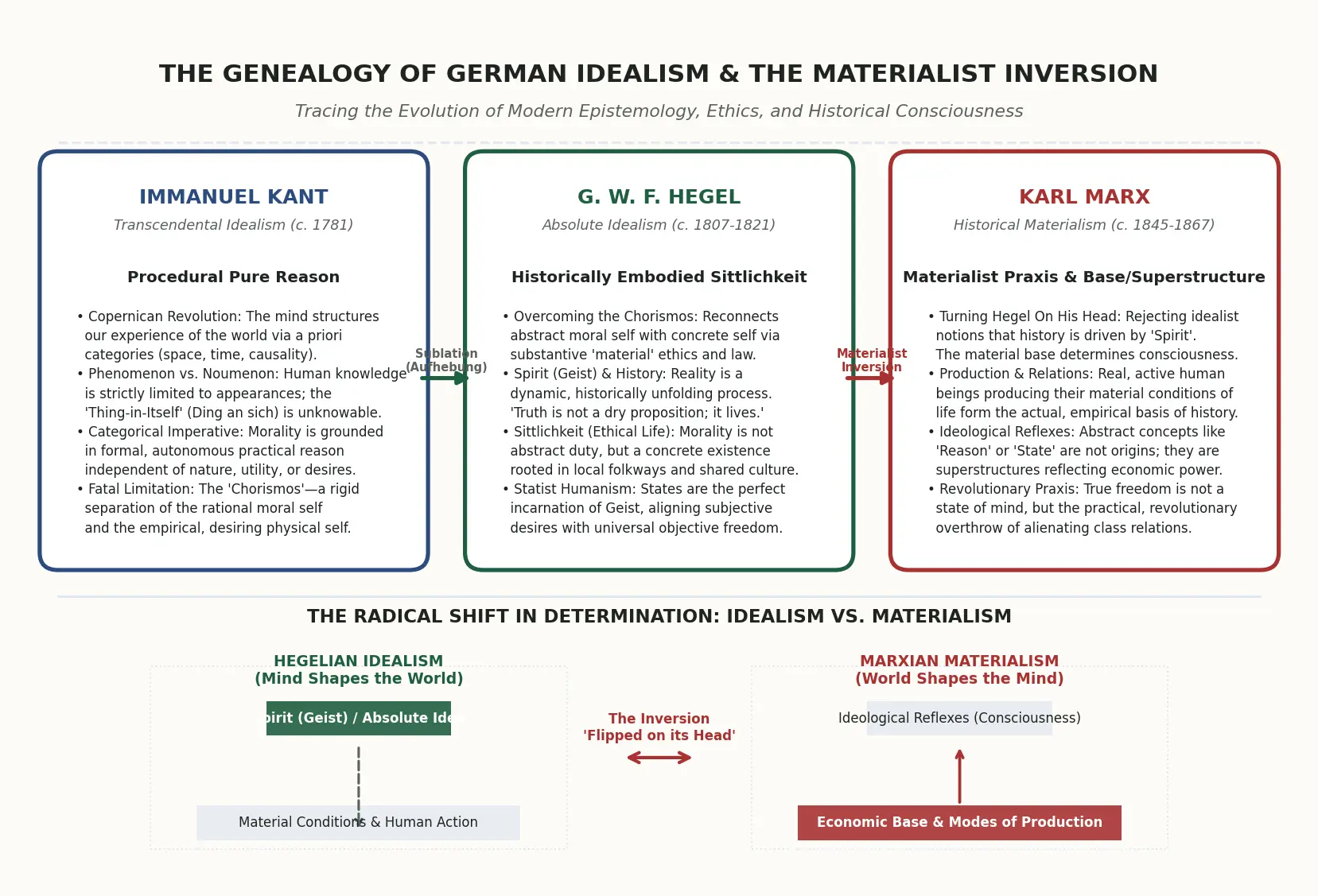
This schematic is structured around two distinct horizontal axes, visually illustrating how the historical process transitioned from cognitive isolation to social embodiment, and finally to revolutionary action:
1. The Horizontal Progression of German Idealism (Top Axis)
- Immanuel Kant — Transcendental Idealism (c. 1781): Focuses on “Procedural Pure Reason.” It shows how Kant’s Copernican Revolution rescued objective knowledge from Hume’s skepticism by proving that the mind structures sensible experience a priori. However, it visually flags the tragic “Chorismos”—the strict separation of the moral self (homo noumenon) from the concrete, physical self (homo phaenomenon).
- G.W.F. Hegel — Absolute Idealism (c. 1807–1821): Details “Historically Embodied Sittlichkeit.” It tracks Hegel’s counter-strike against Kant’s abstract universalism, showing how he reconciled the moral self with the physical self by embedding ethics within local folkways, shared traditions, and culture (Sittlichkeit). It highlights the unfolding of Spirit (Geist) through history, culminating in State Humanism.
- Karl Marx — Historical Materialism (c. 1845–1867): Focuses on “Materialist Praxis.” It illustrates how Marx accused the Hegelians of “descending from heaven to earth”. By proving that the economic base and modes of production condition the general process of social and political life, Marx stripped away “idealistic humbug” to make historical consciousness an active, revolutionary practice (praxis) rather than passive contemplation.
2. The Pyramids of Determination (Bottom Axis)
To make the conceptual shift immediate and intuitive, the bottom half of the schematic features a side-by-side comparative diagram showing the “Inversion” (literally turning Hegel “on his head”):
- The Idealist Pyramid: Places Spirit (Geist) and the Absolute Idea at the apex, showing how the mind and its concepts are treated as the primary origin point that determines and structures concrete material relations and human actions.
- The Materialist Pyramid: Inverts this structure, placing the Economic Base and Modes of Production at the solid foundation. Upward arrows show how the real life-process of active human beings determines our ideological superstructures, moral concepts, and legal systems.
SEMINAR READINGS & ANALYTICAL WORKSHEET
From Procedural Reason to Embodied Sittlichkeit
| Student Name: ____________________________ | Date: ________________________ |
| Course: Modern History 2025 v1.4 / Unit 4 | Syllabus: LMU Munich (Wintersemester 2026/27) |
I. Immanuel Kant: Self-Legislation & Procedural Justice (Section VI)
| TRANS-HISTORICAL FOCUS: THE KANTIAN DUALISM & LOGICAL ABSTRACTION Immanuel Kant’s moral philosophy seeks to ground law and ethics in autonomous, a priori reason (Critique of Pure Reason, 1781). Under Kant’s transcendental framework, morality is a matter of self-legislation: the rational subject (homo noumenon) imposes moral duty upon themselves through the Categorical Imperative, completely detached from empirical inclinations, historical conditions, or specific cultural practices (homo phaenomenon). The Munich syllabus identifies this as the ‘internalization of the common interest’ in law. However, critics note that this strict separation (chorismos) reduces ethics to a purely formalistic, procedural justice, leaving the material-ethical (substantive) content of human life unformulated and abstract. |
Question 1: Deconstruct the Kantian distinction (chorismos) between the noumenal self (homo noumenon) and the phenomenal self (homo phaenomenon). In what ways does this dualism reduce ethical judgment to a formal, procedural mechanism, and what is lost when concrete historical experience is excluded from moral deliberation?
————————————————————————————————————————————————————————————————————————————————————
————————————————————————————————————————————————————————————————————————————————————
————————————————————————————————————————————————————————————————————————————————————
Question 2: In Section VI, Topic 3, the Munich syllabus references the ‘unformulated material-ethical assumptions’ of the Kantian reduction. Explain how a purely rational, procedural ethical framework must quietly rely on pre-existing, unacknowledged cultural and social standards to function in practical life.
————————————————————————————————————————————————————————————————————————————————————
————————————————————————————————————————————————————————————————————————————————————
————————————————————————————————————————————————————————————————————————————————————
Question 3: Connect this philosophical problem to contemporary digital governance. How does a ‘techné mindset’ in modern algorithms—which treats human behavior through abstract, non-historical data rules—parallel Kant’s procedural reduction, and how does it contribute to the crisis of ‘denoetization’?
————————————————————————————————————————————————————————————————————————————————————
————————————————————————————————————————————————————————————————————————————————————
————————————————————————————————————————————————————————————————————————————————————
II. G.W.F. Hegel: Embodied Sittlichkeit & The Ethical State (Section VII)
| TRANS-HISTORICAL FOCUS: OVERCOMING CHORISMOS THROUGH HISTORICAL SITTLICHKEIT Georg Wilhelm Friedrich Hegel mounted an ‘idea-realist’ counter-strike against Kant’s rational nominalism (Philosophy of Right, 1821). Hegel sought to overcome the Kantian chorismos by reconnecting the abstract moral subject with concrete, historical reality. This is achieved through Sittlichkeit (ethical life)—substantive, lived morality that is concretely embodied and expressed within the institutions of the Family, Civil Society (bürgerliche Gesellschaft), and the State. However, Hegel’s reconciliation reaches its culmination in ‘State Humanism,’ treating the State as the ultimate realization of the ethical idea of freedom—a totalizing system that subsequently provokes critical, Left-Hegelian deconstruction. |
Question 4: Hegel defines Sittlichkeit (ethical life) as a concretely determined existence rooted in local folkways and culture, rather than abstract duties. Explain how this framework overcomes the isolation of the Kantian moral ego and restores the relational reality of human action.
————————————————————————————————————————————————————————————————————————————————————
————————————————————————————————————————————————————————————————————————————————————
————————————————————————————————————————————————————————————————————————————————————
Question 5: Critically evaluate Hegel’s ethical idea of the State. In what ways does treating the State as the culmination of objective spirit (State Humanism) risk subordinating the subjective will and autonomous judgment of the historical person, and how can this lead to systemic silence?
————————————————————————————————————————————————————————————————————————————————————
————————————————————————————————————————————————————————————————————————————————————
————————————————————————————————————————————————————————————————————————————————————
III. The Marxist Materialist Inversion: From Idea to Revolutionary Praxis
| TRANS-HISTORICAL FOCUS: TURNING THE PYRAMID OF DETERMINATION UP-SIDE DOWN Karl Marx inverted the Hegelian system (The German Ideology, 1845), famously declaring that we must descend ‘from heaven to earth.’ Marx argued that human consciousness is not determined by the progressive unfolding of Spirit or absolute ideas, but rather by the concrete, material conditions of life, specifically the economic base and modes of production. Consequently, freedom and truth are not mere states of mind or intellectual concepts; they are reconstituted through material praxis—the active, historical overthrow of exploitative social relations. |
Question 6: Explain Karl Marx’s materialist inversion of Hegel. How does transitioning from ‘ideas’ to the ‘economic base’ alter our understanding of historical development, and why does Marxist theory reject the notion that social change occurs purely through intellectual critique?
————————————————————————————————————————————————————————————————————————————————————
————————————————————————————————————————————————————————————————————————————————————
————————————————————————————————————————————————————————————————————————————————————
Question 7: Grounded in Dr. Neville Buch’s axiom that ‘understanding history is philosophy in practice,’ explains how the synthesis of Hegel’s historically embodied Sittlichkeit and Marx’s materialist praxis can equip community education hubs (MICE) to build active oppositional democratic public spheres.
————————————————————————————————————————————————————————————————————————————————————
————————————————————————————————————————————————————————————————————————————————————
————————————————————————————————————————————————————————————————————————————————————
QCAA SENIOR MODERN HISTORY — UNIT 4, TOPIC 5 ASSESSMENT RUBRIC & EVALUATION GUIDE
Evaluation Matrix for the German Idealism & Materialist Inversion Seminar Guide
| STUDENT NAME: | DATE: | ||
| SEMINAR TOPIC: | German Idealism & Materialist Inversion | OVERALL MARK: | / 10 Marks |
1. Rubric Purpose & Syllabus Alignment
This diagnostic rubric is formally aligned with the Queensland Curriculum and Assessment Authority (QCAA) General Senior Syllabus (2025 v1.4) standards for Modern History. It specifically targets Syllabus Objective 2 (Comprehend terms, concepts and issues) and Objective 3 (Analyse evidence from historical sources) in the context of Unit 4, Topic 5 (The Information Age since 1936). This rubric is calibrated to evaluate student written responses to the Reading Seminar Guide, ensuring they demonstrate scholarly self-criticism, transition from a ‘Junior’ state of unreflective execution to a ‘Senior’ state of social accountability, and understand history as philosophy in practice.
2. QCAA-Aligned Evaluation Matrix (10 Marks)
| CRITERION | LEVEL A (Discerning / Detailed) [5-4 Marks] | LEVEL B-C (Appropriate / Adequate) [3-2 Marks] | LEVEL D-E (Partial / Superficial) [1-0 Marks] |
| COMPREHENDING (QCAA Objective 2) Evaluates the student’s thorough and accurate use of key historical and philosophical terms, and detailed explanation of issues. | • Demonstrates a thorough, precise, and highly accurate use of terms (e.g., chorismos, Sittlichkeit, idea-realism, praxis, superstructures) in historical context. • Conveys an informed, sophisticated understanding of philosophical concepts (transcendental vs. absolute idealism; materialist inversion). • Provides detailed, nuanced explanations of the underlying issues (formalism, state humanism, historical determination). | • Demonstrates an appropriate, mostly accurate use of key philosophical terms in historical context. • Conveys a reasonable, competent understanding of concepts related to Kant, Hegel, and Marx. • Provides adequate, clear explanations of the primary philosophical issues and developments. | • Demonstrates a partial, superficial, and/or highly inaccurate use of terms; critical vocabulary is omitted or misused. • Conveys a superficial, fragmented, or confused understanding of the core concepts. • Provides thin, descriptive, or inaccurate summaries of the intellectual historical developments. |
| ANALYSING (QCAA Objective 3) Evaluates the student’s ability to examine features of evidence from sources, identify causes/effects, and reveal non-obvious aspects. | • Demonstrates a discerning selection and detailed, rigorous examination of features of evidence from the Munich lecture syllabus and timeline. • Critically unmasks ‘non-obvious’ aspects of the texts, such as the tension between Kantian proceduralism and Hegelian state totalization. • Constructs sophisticated, logical arguments mapping causes, continuities, and the dialectical transition from Geist to material praxis. | • Demonstrates an effective and coherent examination of features of evidence from the syllabus and timeline. • Identifies important aspects of the text, linking Hegelian Sittlichkeit to the critique of Kant’s formalist chorismos. • Constructs clear arguments outlining the basic causes, continuities, and consequences of the materialist inversion. | • Demonstrates a superficial, mechanical, or descriptive identification of features of evidence without genuine analysis. • Lapses into passive ‘copy-pasting’ or unreflective summaries of the timeline without analytical processing. • Constructs weak, highly generalized, or non-historical arguments; fails to link ideas to their historical contexts. |
| COGNITIVE TRANSITION (MICE/DoC Scaffold) Evaluates the student’s movement from unreflective prejudice (Junior) to communicative social accountability (Senior). | • Actively transcends unreflective, individualistic prejudices (‘Junior’ mindset) through rigorous reflective self-criticism. • Successfully synthesizes complex, conflicting historical frameworks to form a mature, peer-justified social judgment (‘Senior’ accountability). • Treats historical analysis as active, ethical praxis, demonstrating a deep capacity for intellectual self-correction (DoC integration). | • Demonstrates progress toward overcoming unreflective individualistic prejudices by engaging with structured, systematic evidence. • Develops cooperative, well-argued views that acknowledge alternative perspectives and the social dimension of knowledge. • Begins to integrate historical understanding into active self-critique, moving past simple passive execution of syllabus tasks. | • Remains locked in an unreflective ‘Junior’ state of passive execution, accepting superficial appearances or convenient dogma. • Conveys a highly individualized, fragmented worldview (‘Cartesian Impasse’) that resists collaborative validation. • Fails to demonstrate reflective self-criticism or social accountability; treats education merely as mechanical routine. |
3. Task-Specific Evaluation Guidelines
| SEMINAR TASK | COMPREHENDING INDICATORS (What they must explain accurately) | ANALYSING INDICATORS (How they must critique and link sources) |
| Task 1: Kantian Autonomy & the Chorismos Deconstructs procedural pure reason and the split between the noumenal and phenomenal self. | • Accurately defines Kantian autonomy, the categorical imperative, a priori reason, and chorismos. • Explains how Kant attempts to ground moral law in universal self-legislation rather than external authority. | • Critiques the abstract nature of Kant’s formalist reason. • Links the ‘noumenal-phenomenal split’ to the Cartesian Impasse, showing how procedural justice isolates the moral self from concrete, lived social context. |
| Task 2: Hegelian Sittlichkeit & State Humanism Analyzes Hegel’s historically embodied ethical life and the social mediation of spirit. | • Accurately defines G.W.F. Hegel’s absolute idealism, Sittlichkeit (ethical life), and the distinction between civil society and the state. • Explains Hegel’s resolution of Kant’s chorismos through socially mediated ethical institutions. | • Analyses the danger of Hegel’s ‘idea-realism’ culminating in State Humanism. • Critically evaluates how Hegelian totalization risks subordinating the individual’s autonomous judgment to state-sanctioned authority and PR ‘singular messaging’. |
| Task 3: Marxist Inversion & Materialist Praxis Examines the materialist critique, base-superstructure model, and revolutionary action. | • Accurately defines historical materialism, materialist praxis, the economic base, and ideological superstructures. • Explains Marx’s inversion of Hegelian dialectics (turning Hegel ‘on his head’ to start from real life-processes). | • Critically examines how economic relations and modes of production determine superstructural moral and legal concepts. • Integrates this critique into the ‘Contributory Economy’ model, proving how passive execution is replaced by active, transformative praxis (ZPD). |
4. Facilitator Feedback & Pedagogical Reflection
Facilitators are encouraged to provide descriptive, qualitative feedback focusing on how effectively the student bridged abstract global philosophical models with localized historical consequences (using regional myths, community education, or spatial mapping as referents). Please reference the specific cognitive levels (Junior vs. Senior) and universal pragmatics validity claims.
| FACILITATOR EVALUATION & FEEDBACK NOTES | STUDENT REFLECTION & COGNITIVE ACTION PLAN |
| Comprehending Strengths: Analysing Strengths: Scaffold Progression Focus (Junior to Senior): | How did this seminar change your ‘absolute presuppositions’ about law and state power? How will you apply ‘crap detecting’ to modern digital feeds or policy releases? |
References and Full Bibliography
Buch, N. (2015). No Regrets in the Evening of Life: The Evolution of the Queensland Teacher and the Rise of UQ. Brisbane: Privately Published. (Source context: no_regrets_20150828.pdf).
Buch, N. (2024). Socio-Anthropological Approach in Queensland. Chapter 7: Queensland History, Religious Education, and Belief. Brisbane: Management Institute for Contributory Economy, pp. 161-181. (Source context: Buch, Neville (2024). Socio-Anthropological Approach in Queensland.pdf).
Buch, N. (2025a). Mapping the Cognition of Australian-American Systems. Brisbane: Management Institute for Contributory Economy, pp. 1-23. (Source context: (Neville Buch) Mapping the Cognition of Australian-American Systems.pdf).
Buch, N. (2025b). Concept-Practices: M.1. Learning (The Zone of Proximal Development). Brisbane: Management Institute for Contributory Economy, pp. 1-5. (Source context: Concept-Practice M.1. Learning.pdf).
Buch, N. (2025c). Concept-Practices: X.1. Community (The Philosophic Simulation). Brisbane: Management Institute for Contributory Economy, pp. 1-7. (Source context: Concept-Practice X.1. Community.pdf).
Buch, N. (2025d). Concept-Practices: B.1. Pure Reason (Immanuel Kant). Brisbane: Management Institute for Contributory Economy, pp. 1-5. (Source context: Concept-Practice B.1. Pure Reason.pdf).
Buch, N. (2025e). Concept-Practices: R.1. Order (Michel Foucault). Brisbane: Management Institute for Contributory Economy, pp. 1-5. (Source context: Concept-Practice R.1. Order.pdf).
Buch, N. (2026a). The Lost Insights of the Uneducated: A Cognitive and Historiographical Critique. Section 1 & 2. Brisbane: Management Institute for Contributory Economy, pp. 1-10. (Source context: Lost Insights Section 2).
Buch, N. (2026b). Silence is Not the Pathway to Peace: A Humanistic Ascent. Discussion Paper. Brisbane: Management Institute for Contributory Economy, pp. 1-5. (Source context: Silence is not a pathway to Peace.pdf).
Buch, N. (2026c). The Political Class and the Problem of Political Thinking: Governance and the Crisis of Lived Experience. Brisbane: Management Institute for Contributory Economy, pp. 1-11. (Source context: The Political Class and the Problem of Political Thinking.pdf).
Buch, N. (2026d). A New Intellectual History: The Contributory Curriculum Framework. Curriculum Proposal Document, pp. 1-4. (Source context: Proposal Document Outline. A New Intellectual History).
Buch, N. (2026e). MICE Three Book Drafting Order: Free Thought and the Contributory Economy. Brisbane: Management Institute for Contributory Economy, pp. 1-12. (Source context: MICE Three Book Drafting Order.pdf).
Buch, N. (2026f). Preliminary Analysis of Community Education and Development in the Federal Division of Moreton. Brisbane: Management Institute for Contributory Economy, pp. 1-11. (Source context: NB Prelim Analysis of Community Education).
Buch, N. (2026g). Understanding history is philosophy in practice: Abstract for CFP ISCHE 47. Brisbane: Management Institute for Contributory Economy, pp. 1-8. (Source context: PAPER 1_NDB Abstract for CFP ISCHE 47.pdf).
Buch, N. and Jameel, A. (2026). Silence and Non-Engagement: The Architecture of Silence and the Erosion of Knowledge. SSRN/Zenodo Repository, pp. 1-10. (Source context: Silence and Non-Engagement. The Architecture of Silence and the Erosion of Knowledge.pdf).
Corwin, S. L. (2026). The Pompous Architecture of Nothingness: An Academic Refutation of Neville Buch’s “Pillars of Human Authorship and Social Flourishing”. Journal of Suburban Sociology, 4(2), pp. 112-135. (Source context: Sophia Corwin (2026)).
Dilthey, W. (1954). The Essence of Philosophy (S. A. Emery & W. T. Emery, Trans.). Chapel Hill: University of North Carolina Press. (Source context: Wilhelm Dilthey. Historical Procedure and Essence of Philosophy (1954).pdf).
Foucault, M. (1966). The Order of Things: An Archaeology of the Human Sciences. Paris: Gallimard. (Source context: Concept-Practice R.1. Order).
Fuglseth, K. S. (2026). The Past Was Once Future: Reenactment of Values and Virtues on Historical Grounds in Education. London: Routledge, pp. 83-91. (Source context: Kåre S. Fuglseth (2026)).
Gregory, P. (2026). The Crisis of Modern Thought: Jack McKinney and the Academic Exclusion of Knowledge. Brisbane: University of Queensland Press. (Source context: Peter Gregory. The Crisis of Modern Thought.pdf).
Habermas, J. (1981). The Theory of Communicative Action. Frankfurt: Suhrkamp. (Source context: Concept-Practice T.1. Communication).
Hegel, G. W. F. (1821). Elements of the Philosophy of Right. Berlin: Nicolai. (Source context: Organising Trumpism into Political Theory).
Kant, I. (1781). Critique of Pure Reason. Riga: Johann Friedrich Hartknoch. (Source context: Concept-Practice B.1. Pure Reason).
McKinney, J. P. (1971). The Structure of Modern Thought. London: Chatto and Windus. (Source context: Concept-Practice L.1. Thought).
Otto, E. (2025). Die Geschichte des Natur- und Verfassungsrechts von der Antike bis zur Gegenwart. Teil II: Von Thomas Hobbes bis zu Jürgen Habermas. Lecture Syllabus, Ludwig-Maximilians-Universität München, pp. 1-12. (Source context: Programm_der_Vorlesung_von_Prof_Dr_Dr_h.pdf).
Porrovecchio, M. (2015). F. C. S. Schiller’s Last Pragmatism Course. Transactions of the Charles S. Peirce Society, 51(1), pp. 57-107. (Source context: Porrovecchio, Mark. F.C.S. Schiller’s Last Prgamatism Course.pdf).
Queensland Curriculum and Assessment Authority [QCAA] (2025). A New Intellectual History Curriculum: Senior Modern History General Syllabus. Brisbane: State of Queensland, pp. 1-43. (Source context: A New Intellectual History Curriculum. Senior Modern History. 2025 Syllabus.pdf).
Rowland, T. (2023). Beyond Kant and Nietzsche: The Munich Defence of Christian Humanism. London: T&T Clark, pp. 1-15. (Source context: Tracey Rowland. Beyond Kant and Nietzsche. Christian Humanism.pdf).
Stiegler, B. (1998). Technics and Time, 1: The Fault of Epimetheus. Stanford: Stanford University Press. (Source context: Concept-Practice J.1. History).
Vygotsky, L. (1962). Thought and Language. Cambridge, MA: MIT Press. (Source context: Concept-Practice M.1. Learning).
Williams, B. (2006). Philosophy as a Humanistic Discipline (A. W. Moore, Ed.). Princeton: Princeton University Press. (Source context: Concept-Practice X.2. Method).
Take the MICE Quiz
Featured Image:


Neville Buch
Latest posts by Neville Buch (see all)
- The Human Being Above the Transaction and Why Markets Cannot Measure Human Worth – October 15, 2026
- Beyond Neoliberal Formalism: Should Taxpayers Fund Independent Philosophy – October 14, 2026
- A Critical Phenomenology and Epistemology of Open and Fixed Mindsets: Quantum Biology of the Open Mind – October 13, 2026