
Abstract
This critical reply essay deconstructs Bevin Luchel’s The Subsidised Imagination: A Critique of Rent-Seeking Epistemology in Buch’s The Crucible of Consciousness (2026). It demonstrates that Luchel’s deployment of public choice theory and subjective value theory constitutes a profound category error and a form of “vulgar pragmatism.” By reducing the value of intellectual labour to subjective market preferences, Luchel becomes captured by a neoliberal populist mindset that treats public taste and technocratic utility as the sole arbiters of truth and value.
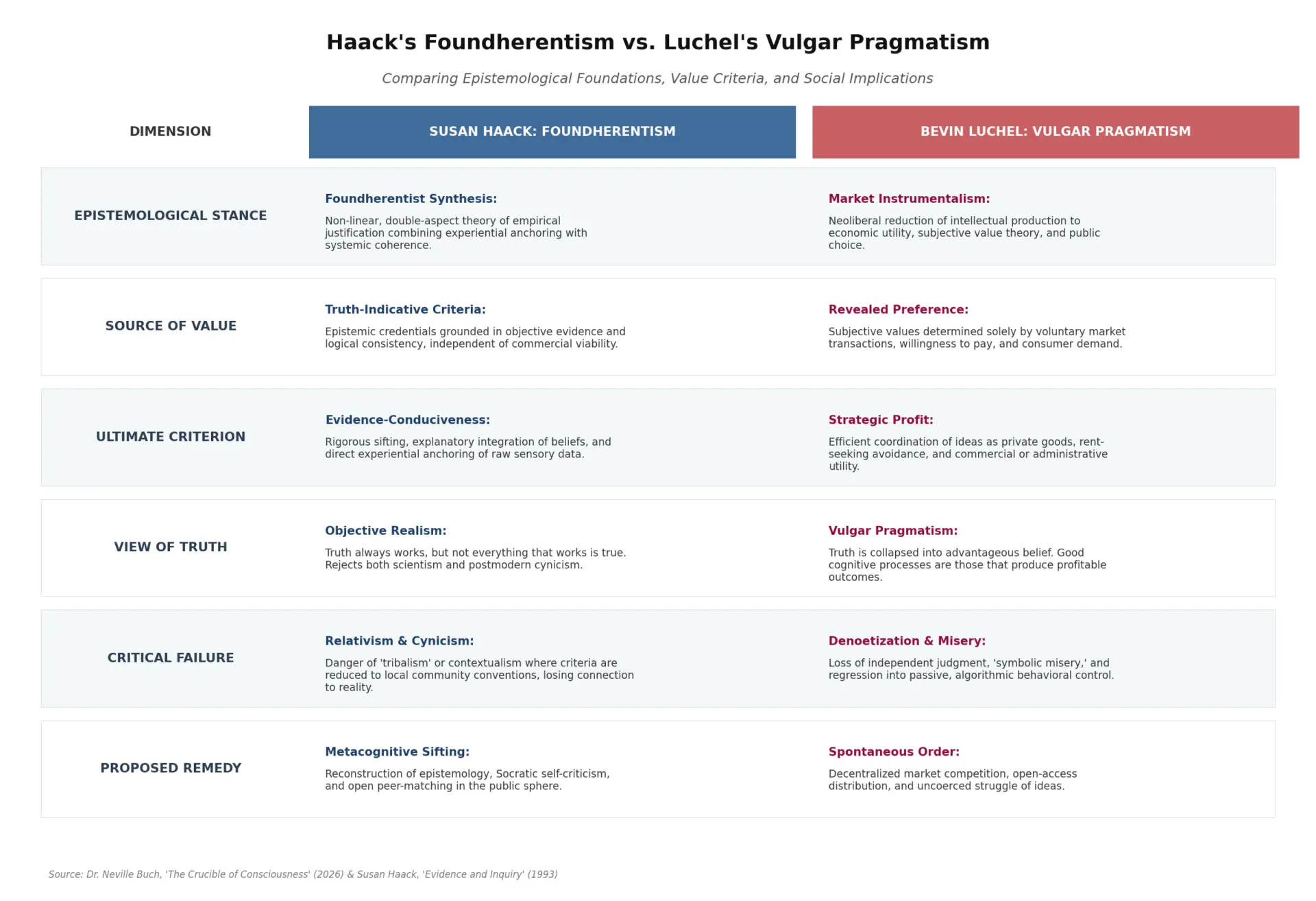
Through the lens of Susan Haack’s foundherentist epistemology (Evidence and Inquiry, 1993), this study subverts Luchel’s market-based epistemology. It demonstrates that truth-conducive inquiry has objective standards independent of consumer demand or bureaucratic efficiency. It contrasts Luchel’s decentralized market utopia with Dr. Neville Buch’s dual and devastating critique of both populist “folklore epistemology” and narrow, over-specialized “academicism.”
Finally, it outlines the MICE (Management Institute for Contributory Economy) solutions to these late-modern “stupidities” including professional contractualism, the POLICE model, and spiral historiography and explains why academics must accept these challenges to overcome their “short” and “reactionary” institutional thinking, thereby reclaiming human authorship and fostering Aristotelian flourishing.
—
Introduction: The Forensic Battleground of Late Modernity
In The Subsidised Imagination (2026), Bevin Luchel launches a spirited defence of the neoliberal “spontaneous order of intellectual exchange,” arguing that Dr. Neville Buch’s proposal for “professional contractualism” for intellectual labour is a rent-seeking category error (Luchel 2026, p. 1). Luchel contends that intellectual work has no intrinsic economic value independent of its capacity to satisfy the subjective preferences of voluntary consumers in the market of ideas (Luchel 2026, p. 3). To support this, he marshals Carl Menger’s marginal utility, Friedrich Hayek’s critique of the “fatal conceit,” and James Buchanan’s public choice theory, concluding that state-backed funding of scholarship inevitably generates administrative bloat, ideological conformity, and “systemic stagnation” (Luchel 2026, pp. 4, 5).
However, a close examination of Luchel’s text reveals that his critique is not a triumph of economic realism, but is instead a profound symptom of what Bernard Stiegler and Dr. Neville Buch call “denoetization” the systematic liquidation of the human capacity to reflect, evaluate, and judge (Stiegler 2025, p. 1; Buch 2025b, p. 12). By reducing the value of the logos to immediate market preferences and “measurable utility,” Luchel adopts a form of “vulgar pragmatism” that undermines the very possibility of objective inquiry (Haack 1993, p. 199; Buch 2026a, p. 5). This essay provides a critical reply to Luchel, utilizing Susan Haack’s foundherentist epistemology to expose the fallacies of his market-driven model and defending the critical necessity of Dr. Buch’s contributory economy.
—
1. Bevin Luchel as an Example of Academic Capture to Populist Thinking
Luchel’s essay serves as an archetypal case study of an academic who has become captured by populist thinking disguised as sophisticated economic theory (Buch 2023b, p. 17). Populism is characterized by a deep suspicion of institutional authority, professional expertise, and complex theoretical structures, often elevating the unreflective “common sense” of the multitude as the ultimate standard of truth (Hofstadter 1963; Buch 2025c, p. 1).
In the economic sphere, this populist impulse manifests as a blind faith in “market democracy” the belief that consumer demand and “revealed preferences” in voluntary exchange are the only authentic and democratic measures of a service’s value (Luchel 2026, p. 3).
[Populist Neoliberal Capture]
– Intellectual value = Market price.
– Reject public funding as “rent-seeking.”
– Deify unreflective consumer preferences.
(The Cognitive Fallacy)
[The Vulgar Pragmatist Collapse]
– Truth subordinated to subjective utility.
– Inquiry reduced to “retail governance.”
– Elimination of objective epistemic standards.
Luchel falls directly into this trap. He argues that because certain historians, philosophers, and sociologists cannot find paid employment in their fields, the public “does not subjectively value that production as highly as its producers believe it deserves” (Luchel 2026, p. 3). He presents this as an “accurate assessment of revealed preference” and a “description of consumer choice” (Luchel 2026, pp. 3, 4).
But as John Dewey and Richard Hofstadter warn, this deification of the market is a form of anti-intellectualism that cedes the critical space of reason to “ignorant habit” and unreflective public taste (Dewey 1922; Hofstadter 1963; Buch 2025c, p. 1). It forces the scholar to become a producer of “intellectual junk food” and “sociological propaganda,” adapting to the drive-based reflexes of computational capitalism rather than standing as a “just and candid critic” of society (Stiegler 2014; Buch 2026a, p. 4; Beyond Williams 2006, p. 220).
By claiming that the “spontaneous order” of the market has “generated unprecedented human flourishing and cognitive agency,” Luchel ignores the structural violence of the “neoliberal iron cage” (Luchel 2026, p. 2; Collins 1998, p. 572). He fails to realize that the market is not a neutral, democratic public sphere, but is a highly engineered technical-administrative system that standardizes human desire, induces “symbolic misery,” and systematically marginalizes “uncomfortable” histories, such as frontier violence and indigenous dispossession (Stiegler 2014; Buch 2026a, p. 4; Buch 2026b, p. 12).
—
2. Dr. Buch’s Double Critique: Populism vs. Academicism
To understand why Luchel’s position is so flawed, one must examine Dr. Neville Buch’s equal and devastating critique of both populism and academicism (Buch 2025a, p. 1). Dr. Buch’s “Synoptic Vision” rejects the false binaries of our modern “culture-history wars,” refusing to choose between the unreflective prejudices of the public and the insular stagnation of the university (Buch 2023b, p. 17; Buch 2025a, p. 4).
[Dr. Buch’s Synoptic Vision]
[The Populist Error] [The Academicist Error]
– “Folklore Epistemology.” – “Specialized Ignorance.”
– Hostility to professional critique. – Disengagement from local reality.
– Repeating “Widely-Believed Falsehoods.” – Cynical relativism; “puzzle-making.”
[The Interdisciplinary Fit]
– Standard-bearing scholarship.
– Grounded in local communities.
– Communicative action & truth.
I. The Critique of Populism
Dr. Buch argues that populism leads a population into the “spiral history theory of stupidity” and “historical forgetfulness” (Buch 2025d, p. 1; Buch 2026a, p. 3). Populist discourse is dominated by “folklore epistemology” and uncritical “faith in appearance,” repeating myths that “the more you use them, the more you believe them” (Buch 2026a, p. 3).
Populists treat serious, interdisciplinary scholarship as a “personal grievance” or a “rent-seeking” conspiracy of the elite (Buch 2026a, p. 3; Luchel 2026, p. 1). This hostility to professional critique prevents an authentic political and ethical reckoning with the past, leaving the public trapped in unreflective prejudice and vulnerable to the deceptions of “nasty politicians” (Buch 2026a, p. 4; Local and Global Social Harm, p. 1).
II. The Critique of Academicism
Conversely, Dr. Buch launch an equally devastating attack on “academicism” the narrow, hyper-specialized “wooden epistemology” of professional university gatekeepers (Buch 2024c, p. 12; Buch 2026a, p. 2). He notes that sandstone universities have increasingly abandoned local and regional factors, failing to engage in sufficient interdisciplinary scoping (Buch 2023b, p. 13).
Under the pressure of neoliberal “retail governance,” academics have become “near-automatons,” focused on “measurable utility,” alumni fundraising, and narrow, easily quantifiable techniques (Mills 1951; Collins 1998, p. 521; Buch 2026a, p. 1). Worse, many contemporary humanists “collude” with this technocratic reduction by refusing to call their own conclusions “true,” retreating into a privileged postmodern ambivalence and treating knowledge as a mere “specialist discourse” (Hayot 2021; Buch 2025a, p. 4; de la Bellacasa 2012, p. 435).
III. The Synoptic Resolution
Dr. Buch’s framework resolves this impasse by asserting that “understanding history is philosophy in practice” (Buch 2025d, p. 1). True scholarship must not remain locked behind the ivory tower’s expensive paywalls, nor should it surrender to the volatile, emotional forces of the crowd (Collins 1998, p. 521; de la Bellacasa 2012, p. 435). Instead, it must serve as an “oppositional democratic public sphere” where local micro-histories inform global theoretical frameworks, restoring intersubjective mutuality and social justice (Buch 2026a, p. 2; Habermas 1989).
—
3. Susan Haack’s Foundherentist Subversion of Luchel’s Epistemology
The core epistemological failure of Luchel’s critique can be systematically unmasked by applying the philosophy of the American epistemologist Susan Haack (1945, ), specifically her landmark work Evidence and Inquiry (1993) (Buch 2024c, p. 14; Three Umbrella Systems, p. 38). Haack’s project is dedicated to reconstructing a non-reductive epistemology that avoids the “faulty extremes” of both dogmatic foundationalism and cynical coherentism/contextualism (Haack 1993, p. 2) (referred to as “Foundherentism”).
[Susan Haack’s Epistemological Map]
[The Faulty Extremes] [Foundherentism]
– Dogmatic Foundationalism. – Combines empirical grounding
– Cynical Coherentism/Contextualism. with systemic coherence.
– Stich’s “Vulgar Pragmatism.” – Rejects “Scientism” and “Cynicism.”
[Subversion of Luchel’s Model]
– Truth is not a product of popularity.
– “Advantageous belief” is self-defeating.
– Objectivity is ratifiable and necessary.
I. Foundherentism vs. Relativistic Pragmatism
In chapter 8 of Evidence and Inquiry, Haack launches a devastating subversion of the “revolutionary scientistic naturalism” of Stephen Stich and Paul Churchland, who claim that because the brain operates through connectionist neural networks, human “beliefs” do not exist and traditional epistemological questions are superstitious nonsense (Haack 1993, p. 199). Haack demonstrates that their “no-belief” thesis is not only scientifically ill-motivated, but is profoundly self-defeating (Haack 1993, p. 199). Stich and Churchland must write books, utter sentences, and make logical arguments all of which require the active existence of beliefs, intent, and cognitive monitoring while simultaneously denying that beliefs exist (Haack 1993, p. 202).
In chapter 9, Haack targets Stich’s shift to “vulgar pragmatism” in The Fragmentation of Reason (1990) (Haack 1993, p. 229). Stich argues that we should abandon any concern with whether our beliefs are “true” (critiquing this as “epistemic chauvinism”) and focus instead on “cognitive improvement” defined purely as the search for more efficient cognitive techniques to achieve whatever the subject subjectively values, such as “survival, fame, fortune, power” (Stich 1990, cited in Haack 1993, p. 229).
Haack subverts this relativistic pragmatism through a brilliant, logical critique:
1. To believe that $p$ is to accept $p$ as true (Haack 1993, p. 229). One cannot simply choose to believe advantageous falsehoods because they are convenient.
2. Any non-trivial assessment of “cognitive improvement” (in Stich’s sense) requires detailed, truth-indicative knowledge of the actual circumstances in which a belief will conduce to what the subject values (Haack 1993, p. 231).
3. If one must know the actual circumstances, the traditional, truth-oriented epistemological questions about evidence, justification, and correctness inevitably arise again (Haack 1993, p. 231). Thus, Stich’s attempt to escape truth is logically impossible.
II. The Epistemological Category Error of Bevin Luchel
When we apply Haack’s critique of Stich to Bevin Luchel, the latter’s “spontaneous market order” collapses. Luchel is committing the exact same vulgar pragmatist error. He argues that the value of intellectual labour is equivalent to its economic price in voluntary exchange (Luchel 2026, p. 3). Under this view, a historical or philosophical inquiry is “good” or “valuable” only if it sells; if it fails to attract voluntary funding, it lacks value (Luchel 2026, p. 3).
But this is a massive category error that confuses economic price with epistemic value. Truth is not a commodity whose validity can be calculated by marginal utility or consumer “revealed preferences” (Menger 1871; Luchel 2026, p. 3). As Dr. Buch argues, “truths cannot be calculated” (Buch 2025a, p. 10). A historical analysis of frontier violence in Queensland is not “untrue” or “valueless” because the local, conservative public prefers to purchase cozy, patriotic myths (Buch 2026a, p. 4; Buch 2026b, p. 12).
To assess whether a historical narrative is truthful, we must use rigorous, truth-conducive, and interdisciplinary standards of evidence not market demand (Haack 1993, p. 231). By subordinating epistemic justification to market utility, Luchel provides a philosophical license for “artificial stupidity” and “sociological propaganda,” replacing honest, rational-critical inquiry with the profitable deceptions of public relations (Stiegler 2025, p. 1; Buch 2026a, p. 3).
—
4. Solutions to these “Stupidities”
Dr. Neville Buch and Dr. Neil Peach’s collaborative framework provides concrete, therapeutic solutions to the cognitive and social “stupidities” of our hyper-automated post-truth era (Correcting Thought, p. 1). These solutions are designed to unmask “institutional bullshit” and restore the active agency of the “historical person” (Frankfurt 2005; Lonergan 1962, p. 74; Buch 2026a, p. 2):
[The MICE Therapeutic Toolkit]
[Professional] [The POLICE] [Spiral]
[Contractualism] [Framework] [Historiography]
[Philosophy Café & Panser]
The Principle of Professional Contractualism over Voluntarism: Dr. Buch’s contemporary project asserts a crucial reality: “in the twenty-first century, voluntarism does not work” (Comprehension: Solutions and The Plan, Mind Map). Leaving intellectual labour in the history, philosophy, sociology, and education industries to unpaid, “pro bono” charity or the “spontaneous order” of the market systematically marginalizes critical thinkers, leading to a “technical abyss” of absolute non-knowledge (Buch 2026a, p. 2; Buch 2026b, p. 7). To break this political resistance, society must contract or employ the best global minds, releasing public funds from “twisted-thinking priorities” to support the “Synoptic Vision” of interdisciplinary scholarship (Comprehension, Mind Map; Buch 2026b, p. 12).
The POLICE Model: A rigorous diagnostic and self-regulatory tool designed to “police our own thoughts” across six key dimensions: Philosophically, Ontologically, Logically, and through the Intersection, Compatibility, and Education of ideas (Buch and Peach 2024; Correcting Thought, p. 3). By analysing the underlying structures of being and reason, the subject can move beyond unreflective, automated patterns of thought and deconstruct manufactured institutional myths (Buch 2026b, p. 10).
Spiral Historiography: This “non-linear lens” rejects both naive linear Whig progress and cynical postmodern fragmentation (Bebbington 1979, p. 11; Buch 2026b, p. 10). By recursively returning to past intellectual struggles, societies can learn from previous errors to avoid repeating them in the present, uncoiling from the “Spiral History Theory of Stupidity” (Buch 2025d, p. 1).
The Philosophy Café and Convivial Learning Webs: Rebuilding the public sphere through informal, non-technical forums like The Philosophy Café Brisbane, where independent scholars, professional teachers, and intellectually curious citizens can engage in active, democratic debates to bridge abstract theory with practical reality (The Philosophy Café Brisbane Flyer; NDB Full CV April 2026, p. 5).
Reinventing Penser (Thinking) as Panser (Caring): Moving from pure technical calculation (techné) to thinking as caring (panser) the procedural necessity of tending to the deep wounds of social fragmentation with empathy, compassion, and historical truthfulness (Stiegler 2025, p. 1; Buch 2026b, p. 4).
—
5. Why Academics and Scholars Must Accept these Challenges
Academics and other public intellectuals can no longer afford to retreat into their “short,” over-specialized, and “reactionary” bubble thinking (Collins 1998, p. 521; Three Umbrella Systems, p. 38). They must accept the challenges of Dr. Buch’s synoptic critique for three essential reasons:
I. Overcoming “Status Inconsistency” and Administrative Servility
Many contemporary academics suffer from “status inconsistency” possessing high cultural capital and educational credentials but lacking corresponding economic rewards or public prestige (Lenski 1954, cited in Luchel 2026, p. 7). In their desperation for institutional survival, university managers and scholars frequently capitulate to the “Job-Ready” technocratic priorities of their employers, transforming themselves into compliance-oriented “near-automatons” (Mills 1951; Buch 2026a, p. 1; Buch 2026b, p. 4).
By accepting Dr. Buch’s critique, they can break out of their “managerial bubble” and “folklore epistemology,” reclaiming their status as independent public intellectuals who are accountable to truth, rather than to administrative efficiency (Buch 2026a, p. 3; Williams 2006, p. 220).
II. Dismantling “Historical Forgetfulness” in Curriculum and Policy
Late-modern higher education has systematically banished the history of education and deep philosophy from its curriculum, replacing them with a “new language of learning” that focus solely on process, quantifiable metrics, and short-term vocational readiness (Buch 2024c, p. 12; Buch 2026a, p. 1). This “civilizational amnesia” leaves graduates and public policy completely detached from their ethical and historical foundations (Buch 2026a, p. 2).
Scholars must accept the challenge of Spiral Historiography to “uncoil” from these comfortable, reactionary habits, actively restoring the “long circuits of individuation” (such as deep reading, writing, and interdisciplinary analysis) to protect human judgment against mechanical liquidation (Stiegler 1998; Buch 2026b, p. 6).
III. Restoring the Integrity of the “Historical Person”
Ultimately, the battle is over Human Authorship ensuring that the “who” (the concrete human being) remains the proactive operator of the “what” (the technical, legal, and social systems) of our future (Stiegler 1998; Buch 2026b, p. 6).
If scholars continue to practice their “wooden epistemology” or adopt the cynical market-servility of Bevin Luchel, they remain complicit in the “immense regression” that reduces the human subject to a “puny human node” in an automated network (Stiegler 2025, p. 1; Correcting Thought, p. 1).
They must accept Dr. Buch’s challenge to integrate feelings, moral sense, and intention into our cognitive frameworks, steering our collective future away from the “technical abyss” toward genuine Aristotelian flourishing (Comprehension, Venn Diagram; Correcting Thought, p. 3).
—
Conclusion: The Choice Before Us
Bevin Luchel’s The Subsidised Imagination (2026) is a powerful, yet deeply cynical, manifesto for the status quo. By hiding behind the “theological mask” of the free-market “spontaneous order,” Luchel seeks to justify the systematic underfunding of the humanities and the liquidation of professional critique (Buch 2025a, p. 10; Luchel 2026, p. 3).
His market-based epistemology is a form of “vulgar pragmatism” that cannot withstand Susan Haack’s foundherentist subversion: truth-conducive inquiry is logically and practically indispensable, and its validity cannot be reduced to subjective price or popular demand (Haack 1993, p. 231).
The choice before the contemporary scholar is clear. We can follow Luchel down the slippery slope of “retail governance,” continuing to live as passive, automated consumers of algorithmic “autocomplete” within a “soulless,” contested institution (Stiegler 2025, p. 1; Buch 2026a, p. 1; Buch 2026b, p. 4).
Or we can join Dr. Neville Buch’s millennium-long chain of reform, adopting Spiral Historiography, implementing professional contractualism, and practicing the POLICE framework to “police our own thoughts” (Buch 2025d, p. 1; Buch 2026b, p. 12). By doing so, we refuse to live as “puny human nodes,” choosing instead to act as panseurs healing our fractured collective memory and reclaiming active human authorship over our technical and social systems to build a mature, democratic society (Stiegler 2025, p. 1; Buch 2026b, p. 6).
—
References / Bibliography
Arendt, H., 1958. The Human Condition. Chicago: University of Chicago Press. [Beyond Literalism: A Critique, p. 11]
Arendt, H., 1977. The Life of the Mind. Edited by M. McCarthy. New York: Harcourt Brace Jovanovich. [Segment 002 of Hannah Arendt. The Life of the Mind (1977).pdf, p. 16]
Bebbington, D.W., 1979. Patterns in History: A Christian Perspective on Historical Thought. Leicester: Inter-Varsity Press. [Bebbington, David (2025). Patterns in History.pdf, pp. 5-13]
Buch, N., 1995. American Influence on Protestantism in Queensland since 1945. Ph.D. thesis. University of Queensland. [NDB Full CV April 2026.pdf, p. 5]
Buch, N., 2017. Communities of Compassion and Social Change: Brisbane from the mid-1960s to the Present. Brisbane: Dr Neville Buch ABN: 86703686642. [Buch, N. (2017). Communities of Compassion and Social Change.pdf, pp. 1-6]
Buch, N., 2023a. “Evangelicals and Nation-Building Part 1”. Lucas: An Evangelical History Review, 3(1), pp. 44-70. [Beyond Literalism: A Critique, p. 26]
Buch, N., 2023b. Emotion-Caring-Convivial Urban Sociology. Brisbane: Dr Neville Buch ABN: 86703686642. [Buch, Neville (2023). Emotion-Caring-Convivial Urban Sociology.pdf, pp. 6-7, 12, 17]
Buch, N., 2024a. When Humanists Get Humanism Incorrectly. Brisbane: Humanists Brisbane. [(Neville Buch)When Humanists Get Humanism Incorrectly.pdf, pp. 4, 7, 8, 10-15]
Buch, N., 2024b. Rethinking school: Historical forgetfulness and educationalist theory 1971-1989. Brisbane: Management Institute for Contributory Economy. [Spiral Historiography and the Pedagogy of Consciousness in Australia.pdf, p. 12]
Buch, N., 2024c. When Humanists Know Nothing of Humanism: Contrast to the Comprehensive History. Brisbane: Humanists Brisbane. [(Neville Buch)When Humanists Know Nothing of Humanism.pdf, pp. 1-2, 5, 8, 9-12]
Buch, N., 2025a. Comprehensive Understanding of Humanism Today. Brisbane: Dr Neville Buch Blog. [(Neville Buch)Comprehensive Understanding of Humanism Today.pdf, pp. 1-2, 4, 10]
Buch, N., 2025b. The Dynamic of Cognition. Brisbane: Academia.edu. [(Neville Buch)The Dynamic of Cognition.pdf, p. 12]
Buch, N., 2025c. Humanism, Free Thought, and Our Conflicted Times. Brisbane: Dr Neville Buch Blog. [Humanism, Free Thought, and Our Conflicted Times.pdf, pp. 1-4]
Buch, N., 2025d. Historiography and Humanism. Brisbane: Dr Neville Buch Blog. [(Neville Buch)Historiography and Humanism.pdf, pp. 1, 4]
Buch, N., 2025e. Understanding Communication in the 2nd Quarter of the 21st Century. Brisbane: Dr Neville Buch Blog. [(Neville Buch)Understanding Communication in the 2nd Quarter of the 21st Century.pdf, pp. 38, 43]
Buch, N., 2026a. The Critique of The University of Queensland Social Impact Report. Brisbane: Management Institute for Contributory Economy. [Buch, N. (2026). The Critique of The University of Queensland Social Impact Report.pdf, pp. 1-5]
Buch, N., 2026b. A Matrix of Sociology. Brisbane: Management Institute for Contributory Economy. [A Matrix of Sociology.pdf, p. 6; p. 12]
Buch, N. and Peach, N., 2024. Philosophically Ontology Logic Intersect Compatibility Education (POLICE). Brisbane: Dr Neville Buch ABN: 86703686642. [Correcting Thought: The Reclamation of Human Authorship, p. 3]
Buchanan, J.M. and Tullock, G., 1962. The Calculus of Consent: Logical Foundations of Constitutional Democracy. Ann Arbor: University of Michigan Press. [Luchel 2026, p. 14]
Collins, R., 1998. The Sociology of Philosophies: A Global Theory of Intellectual Change. Cambridge: Belknap Press of Harvard University Press. [Collins, Randell (1998). The Sociology of Philosophies.pdf, pp. 56, 77, 91, 521, 572, 792]
Corwin, S.L., 2026. The Altar of Autocomplete and Buch’s Synthetic Historiography. Seattle: Sardonic Review Press. [Spiral Historiography and the Pedagogy of Consciousness in Australia.pdf, p. 12]
de la Bellacasa, M., 2012. “Thinking with Care”. Senses and Society, 7(1), pp. 435-457. [de la Bellacasa, Maria (2012). Thinking with Care.pdf, pp. 435-437]
Dewey, J., 1922. Human Nature and Conduct: An Introduction to Social Psychology. New York: Henry Holt & Co. [Comprehension: Solutions and The Plan, p. 6]
Frankfurt, H.G., 2005. On Bullshit. Princeton: Princeton University Press. [(Neville Buch)AI and the Quest for Wisdom Essay.pdf, p. 2]
Haack, S., 1993. Evidence and Inquiry: Towards Reconstruction in Epistemology. Oxford: Blackwell. [Haack, Susan (1993).pdf, pp. 2, 199, 229, 231, 309]
Haack, S., 1997. Manifesto of a Passionate Moderate: Unfashionable Essays. Chicago: University of Chicago Press. [Haack, Susan (1993).pdf, p. 357]
Haack, S., 2003. Defending Science – Within Reason: Between Scientism and Cynicism. New York: Prometheus Books. [PAPER 2. Abstract for the Pre-Conference Seminar.pdf, p. 2]
Habermas, J., 1979. Communication and the Evolution of Society. Translated by T. McCarthy. Boston: Beacon Press. [(Jurgen Habermas)Communication-and-the-Evolution-of-Society.pdf, pp. 6, 8]
Habermas, J., 1981. The Theory of Communicative Action (Vol. 1). Boston: Beacon Press. [Historiography: Interpretation, Patterns, and Spirals.pdf, p. 17]
Habermas, J., 1989. The Structural Transformation of the Public Sphere. Translated by T. Burger. Cambridge: MIT Press. [The Critique of The University of Queensland Social Impact Report, p. 5]
Hayek, F.A., 1988. The Fatal Conceit: The Errors of Socialism. Chicago: University of Chicago Press. [Luchel 2026, p. 15]
Hayot, E., 2021. Humanist Reason: A History, An Argument, A Plan. New York: Columbia University Press. [Comprehensive Understanding of Humanism Today.pdf, p. 1]
Hofstadter, R., 1963. Anti-Intellectualism in American Life. New York: Alfred A. Knopf. [Mapping the Cognition of Australian-American Systems.pdf, p. 3]
Lenski, G.E., 1954. “Status Crystallization: A Non-Vertical Dimension of Social Status”. American Sociological Review, 19(4), pp. 405-413. [Luchel 2026, p. 15]
Lonergan, B.J.F., 1962. Regis College Lectures: Operations, the Subject, Objects, Method. Edited by F. E. Crowe and R. M. Doran. Toronto: University of Toronto Press (CWL 22). [Collected Works of Bernard Lonergan Volume 22.pdf, pp. 68, 74, 141, 183, 210, 241, 285, 335, 354, 360]
Luchel, B., 2026. The Subsidised Imagination: A Critique of Rent-Seeking Epistemology in Buch’s The Crucible of Consciousness. Brisbane: Management Institute for Contributory Economy. [Luchel, Bevin (2026). The Subsidised Imagination.pdf, pp. 1-14]
Menger, C., 1871. Grunstein der Volkswirtschaftslehre (Principles of Economics). Vienna: Wilhelm Braumüller. [Luchel 2026, p. 15]
Mills, C.W., 1951. White Collar: The American Middle Classes. New York: Oxford University Press. [C. Wright Mills and the Matrix of Sociology, p. 13]
Stich, S.P., 1990. The Fragmentation of Reason: Preface to a Pragmatic Theory of Cognitive Evaluation. Cambridge: MIT Press. [Haack 1993, p. 356]
Stiegler, B., 1998. Technics and Time, 1: The Fault of Epimetheus. Translated by R. Beardsworth and G. Collins. Stanford: Stanford University Press. [Bernard Stiegler. Technics and Time.pdf, pp. 104, 140]
Stiegler, B., 2014. Symbolic Misery, 1: The Hyperindustrial Epoch. Translated by D. Ross. Cambridge: Polity. [The Hegemonic Domain: Power and Identity, p. 1]
Stiegler, B., 2025. The Immense Regression: What is Called Caring? (Vol. 1). Berlin: K. Verlag. [The Immense Regression: Denoetization and the Crisis of Social Harm, p. 1]
Williams, B., 1985. Ethics and the Limits of Philosophy. Cambridge: Harvard University Press. [(Bernard Williams)Ethics and the Limits of Philosophy.pdf, p. 162]
Williams, B., 1995. Making Sense of Humanity. Cambridge: Cambridge University Press. [Williams, Bernard (1995). Making Sense of Humanity. Pt1.pdf, p. 87]
Williams, B., 2006. Philosophy as a Humanistic Discipline. Edited by A. W. Moore. Princeton: Princeton University Press. [(Bernard Williams)Philosophy as a Humanistic Discipline.pdf, pp. 220-223]
*****
Take the MICE Quiz
Featured Image: Susan Haack



Neville Buch
Latest posts by Neville Buch (see all)
- The Human Being Above the Transaction and Why Markets Cannot Measure Human Worth – October 15, 2026
- Beyond Neoliberal Formalism: Should Taxpayers Fund Independent Philosophy – October 14, 2026
- A Critical Phenomenology and Epistemology of Open and Fixed Mindsets: Quantum Biology of the Open Mind – October 13, 2026