

This essay provides a rigorous sociological and epistemological investigation into the Dunning–Kruger Effect and its systemic manifestations in public governance and higher education. Moving beyond superficial pop-psychology, this paper establishes four central arguments: (1) the popular misapplication and rhetorical evasion surrounding the Dunning–Kruger Effect—where individuals mistake an illusion of knowledge for genuine insight, engage in confabulation, and resort to disingenuous backpedaling or equivocation (“claiming to have known a fact in the past” or shifting goalposts) when confronted with unmasked ignorance; (2) how major institutional actors in Queensland—specifically the Queensland Government, the Brisbane City Council, and The University of Queensland—have manifested severe institutional Dunning–Kruger Effect by enforcing technocratic “retail governance,” managerial “satisficing,” “job-ready” vocational reductionism, and the active abandonment of deep historical and humanistic inquiry; (3) the operational reforms required to transform decision-making, which demand deploying the Management Institute for Contributory Economy (MICE) POLICE diagnostic engine, driving a cognitional ascent from unreflective “Junior” execution to “Senior” social accountability, and embedding Habermasian Universal Pragmatics in public policy audits; and (4) why this message is of critical civilisational importance to halt automated denoetization, halt downward responsibility burden-shifting, preserve noodiversity, and secure Aristotelian flourishing (eudaimonia) in a flourishing City of Intellect.
1. The Anatomy of Epistemic Evasion: Deconstructing the Dunning–Kruger Effect and Cognitive Bias
In contemporary public discourse, the Dunning–Kruger Effect —originally formulated by social psychologists David Dunning and Justin Kruger (1999)—is frequently cited yet widely misunderstood. At its core, the Dunning–Kruger Effect describes a cognitive bias wherein individuals with low expertise, ability, or domain knowledge in a specific subject overestimate their own understanding or competence (Dunning & Kruger 1999, p. 1121; Key Concepts 2026, p. 1). Because these individuals lack the metacognitive capacity required to evaluate competence, they are doubly burdened: not only do they reach erroneous conclusions and make unfortunate choices, but their incompetence robs them of the cognitive tools necessary to realize their errors (Dunning & Kruger 1999, p. 1122; Buch 2026e, p. 33).
A. The Illusion of Knowledge vs. Confabulation
The Dunning–Kruger Effect operates in tandem with the Illusion of Knowledge (False Sense of Knowing) , a cognitive state in which an agent feels supreme subjective certainty about a fact or system despite being completely mistaken (Key Concepts 2026, p. 1). When this false certainty is disrupted by empirical reality or expert scrutiny, the unreflective mind often resorts to confabulation —an unconscious memory error where the brain fabricates, distorts, or misremembers details to fill cognitive gaps, which the individual genuinely believes to be true (Key Concepts 2026, p. 1; Buch 2025d, p. 14).
As Dr Neville Buch demonstrates in his Dynamic of Cognition (DoC) framework, this reliance on surface appearances creates an “illusory certainty” that saves the individual from the actual labour of critical thought, leaving them intellectually vulnerable to propaganda and institutional dogma (Stebbing 1939; Buch 2026a, p. 10; Buch 2026e, p. 31).
B. The Rhetorical Quip: Disingenuous Backpedaling and Equivocation
A critical element of epistemic evasion occurs when the incompetent agent is directly challenged by superior evidence or rigorous inquiry. Rather than undergoing Socratic self-critique or admitting ignorance, the agent frequently deploys disingenuous backpedaling and equivocation (Key Concepts 2026, p. 1).
In practice, this manifests as:
- The “I Knew That Past” Fallacy: Pretending that one previously possessed the correct information and was merely misquoted or misunderstood, attempting to convert present ignorance into past insight.
- Shifting Goalposts: Redefining the terms of discussion mid-argument so that the original erroneous claim appears retroactively valid.
- Dismissive Quips: Reducing profound methodological critiques to minor technicalities or “weak quips,” thereby evading the obligation to provide substantive justification.
In his analysis of “institutional bullshit” and pseudo-inquiry, Buch notes that bureaucratic gatekeepers frequently use these rhetorical dodges to insulate themselves from accountability, transforming dialogue into a “theatre of the deaf” where power replaces truth (Frankfurt 2005; Stiegler 2020, p. 18; Buch 2026e, p. 38; Buch 2026g, p. 2).
2. Institutional Dunning–Kruger: Case Studies of Cognitive Regression in Queensland Governance and Education
While the Dunning–Kruger Effect is typically analysed at the individual level, Dr Neville Buch’s sociological scholarship reveals that entire organizations can succumb to an Institutional Dunning–Kruger Effect . When governing bodies operate under bounded rationality and managerial “satisficing,” they develop an unreflective arrogance, measuring their success by internal administrative metrics while remaining blind to their systemic policy failures (Simon 1957; Buch 2026a, p. 37; Buch 2026e, p. 42). Three major institutions in Queensland illustrate this systemic cognitive regression.
A. The Queensland Government: The “Techné Mindset” and Historical Forgetfulness
The Queensland Government has historically exhibited a pronounced Dunning–Kruger Effect through its commitment to a “techné mindset” —an instrumental rationality that reduces multi-textured social realities to quantifiable, administrative data sets and “singular messaging” (Buch 2024, p. 164; Buch 2026e, p. 33).
As Dr Neville Buch documents in his cognition history of Queensland:
- The “Queensland Character” Myth: Political elites historically cultivated the folkish myth of the “Queensland character”—portraying citizens as rough, unreflective, pragmatic anti-intellectuals who have no need for philosophy or deep history (Buch 2021c, p. 2; Buch 2026f, p. 16; Buch 2026c, p. 4). This manufactured myth was weaponized to mask state-level policy blunders and isolate the population from critical scholarship.
- Educational Robbery (“Peter vs. Paul”): State policy historically robbed the “Paul” of intellectual education (wisdom, humanities, and critical thought) to pay the “Peter” of technical education (narrow vocational fitness), fostering a state of Specialized Ignorance across the public sector (Buch 2024, p. 164; Buch 2026e, p. 33).
- Historical Forgetfulness: By sanitizing colonial history (such as framing the 1828 Coopers Plains convict outstation as heroic road-clearing), state administration induced a systemic “Historical Forgetfulness,” leaving society trapped in a “vicious circle of stupidity” where past policy errors are endlessly repeated (Buch 2026c, p. 2; Buch 2026e, p. 146).
B. The Brisbane City Council: “Retail Governance” and Burden-Shifting
The Brisbane City Council (BCC) demonstrates the Dunning–Kruger Effect by reducing complex urban stewardship to “retail governance” and a “rates, roads, and rubbish” utility model (Buch 2016, p. 2; Buch 2026e, p. 143; Buch 2026g, p. 5).
Municipal administration routinely operates under the illusion that short-term physical infrastructure, real estate overdevelopment (“boomers of property”), and marketing spin constitute comprehensive city planning (Buch 2016, p. 5; Buch 2026e, p. 150). When municipal authorities deploy automated AI portals and digital self-service platforms under the guise of “smart city innovation,” they trigger Arif Jameel’s Economic Law of Responsibility Burden : centralizing administrative power while shifting unpriced cognitive, temporal, and operational liabilities downward onto citizens (Jameel 2026b, p. 1; Buch 2026g, p. 4). When challenged on urban heritage destruction or infrastructure failure, council leadership frequently retreats to PR equivocation, dismissing community opposition as “anti-development quips” (Buch 2016, p. 2; Buch 2026e, p. 144).
C. The University of Queensland: Credentialism and the Abandonment of Local History
Perhaps the most alarming manifestation of the Dunning–Kruger Effect occurs within higher education leadership, exemplified by The University of Queensland (UQ) . Despite possessing vast institutional resources, UQ administration has repeatedly succumbed to managerial credentialism and specialized ignorance (Buch 2016, p. 1; Buch 2020, p. 4; Buch 2026g, p. 4).
- Abandonment of Applied Local History: In his review of Brisbane historiography, Buch highlights UQ’s decision to dismantle the Centre for Applied History, transmuting it into a “nebulously titled Centre for the Government of Queensland” (Buch 2016, p. 1). This abandonment of rigorous local historical research created a profound vacuum of intellectual depth in public policy, replacing sharp empirical inquiry with vague administrative chatter (Buch 2016, p. 1; Buch 2026e, p. 33).
- The “Job-Ready” Credential Society: UQ leadership embraced the “job-ready” degree model, reducing higher education to a credentialing factory for corporate workforce entry (Collins 1979; Buch 2020, p. 4; Buch 2026a, p. 37). Degrees were converted into transactional commodities, while scholars in the humanities were marginalized as “unemployable” (Buch 2020, p. 4; Buch 2026e, p. 37).
- Marginalization of Independent Inquiry: UQ’s academic guild historically shielded itself from outside critique by labelling paradigm-shifting independent thinkers—such as Jack McKinney in the 1930s–50s and Dr Neville Buch in the contemporary era—as “amateurs” (Buch 2026f, p. 16; Buch 2026c, p. 7). This gatekeeping exemplifies the classic Dunning–Kruger pattern: institutional actors with low conceptual vision dismissing high-level heterodox scholarship to maintain administrative control (Haack 2018; Buch 2026g, p. 4).
3. Reforming Decision-Making: The MICE Diagnostic and Operational Architecture
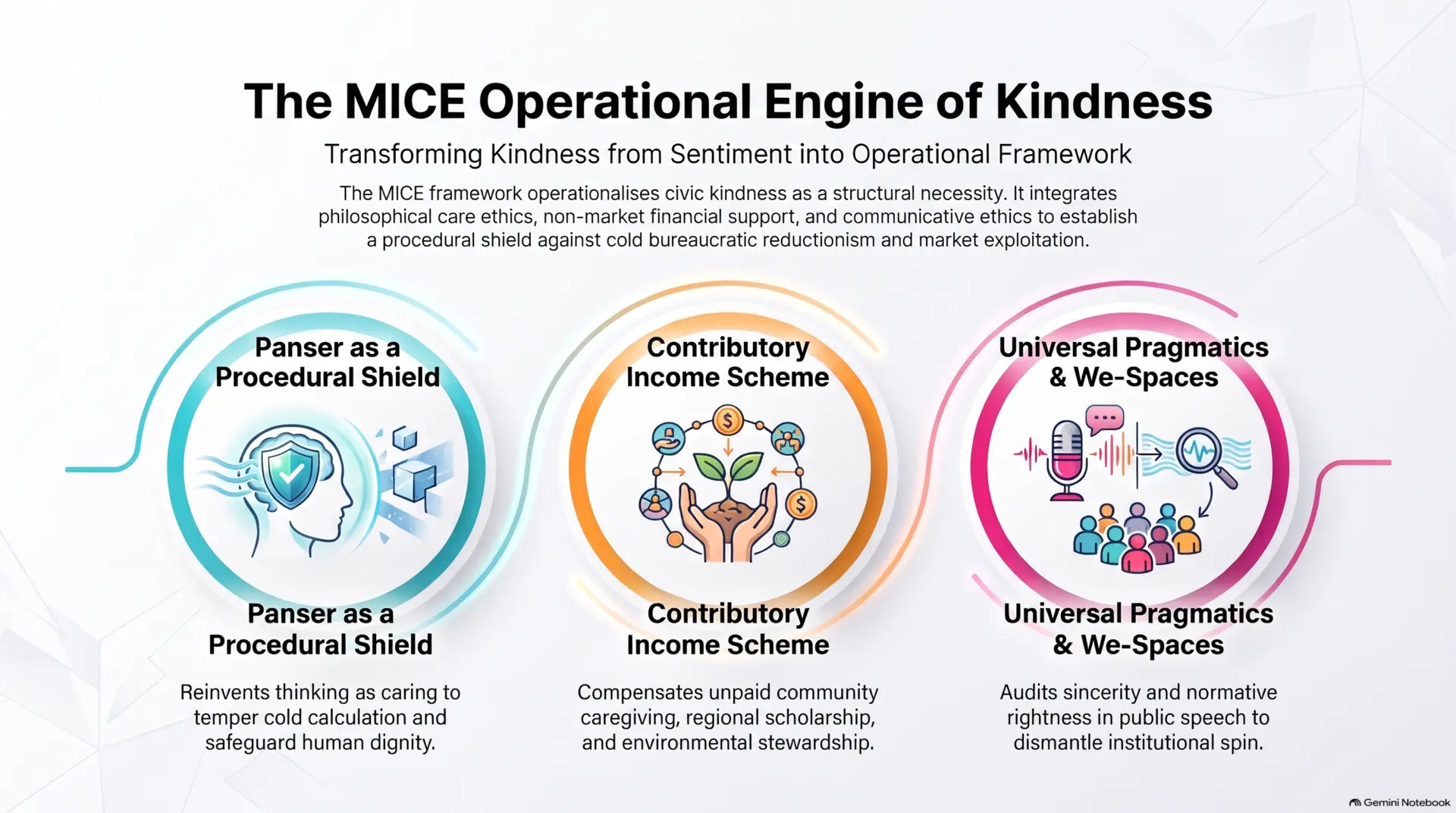
Overcoming the individual and institutional Dunning–Kruger Effect requires a fundamental reconstruction of public rationality. The Management Institute for Contributory Economy (MICE) provides the precise diagnostic and operational toolkit needed to replace unearned confidence with Sufficient Comprehension and Senior Social Accountability (Buch 2026a, p. 46; Buch 2026e, p. 74).
To reform institutional decision-making, governance must implement four core operational changes:
A. Deploy the POLICE Diagnostic Engine as an “Intellectual Immune System”
Institutions must subject all masterplans, policy statements, and AI implementations to the POLICE model ( P hilosophically, O ntology, L ogic, I ntersect, C ompatibility, E ducation) developed by Dr Neville Buch and Dr Neil Peach (Buch & Peach 2024; Buch 2026e, p. 74). The POLICE engine operates as a rigorous “crap-detector,” testing ontological premises (ensuring human agency is not replaced by automated algorithms), exposing internal logical contradictions, and filtering out PR spin and “institutional bullshit” (Frankfurt 2005; Buch & Peach 2024; Buch 2026g, p. 5).
B. Drive the Developmental Ascent from “Junior” to “Senior” Cognition
Decision-makers must undergo a developmental ascent away from the “Junior” mindset —characterized by docile execution, unreflective automaticity, and passive compliance with system metrics—toward a “Senior” state of social accountability (Buch 2026a, p. 46; Buch 2026e, p. 173). In the Senior state, public administrators achieve “conscious competence,” taking explicit moral responsibility for the social and ecological consequences of their decisions, ensuring that the human person ( “the who” ) masters the technical apparatus ( “the what” ) (Buch 2026e, p. 174).
C. Institutionalise Habermasian Universal Pragmatics in Communicative “We-Spaces”
Public sector decisions must be removed from secret enclaves and subjected to Habermas’s Universal Pragmatics in public “we-spaces” (Habermas 1979; Buch 2026e, p. 74). Decision-makers must reciprocally prove four universal validity claims:
- Comprehensibility: Communicating in clear, un-jargoned language.
- Factual Truth: Grounding claims in verified empirical evidence and historical context.
- Normative Rightness: Aligning policies with established social ethics and human dignity.
- Internal Sincerity (Truthfulness): Ensuring public statements match private intentions, eliminating deceptive PR manipulation.
D. Activate the Triadic Governance Engine for Civilisational Balance
Finally, decision-making must adopt MICE’s triadic motto: “Radical enough to shift the agenda, liberal enough to allow everyone a decent place, and conservative enough to preserve the legacy of good value” (Buch 2026b, p. 2; Buch 2026e, p. 7). This engine balances Conservative preservation of historical memory, Liberal guarantees of inclusive public participation, and Radical shifts away from GDP fundamentalism toward Aristotelian eudaimonia (Buch 2026b, p. 2; Buch 2026e, p. 7).
4. The Civilisational Imperative: Why Defeating Epistemic Evasion Matters
The message articulated by MICE is not merely a theoretical critique of Queensland administration; it is of vital civilisational importance for the survival of democratic lifeworlds in the twenty-first century (Stiegler 2018, p. 3; Buch 2026e, p. 12; Buch 2026g, p. 5).
- Halting Automated Denoetization and Symbolic Misery: As generative AI and automated platform capitalism accelerate, society faces what Bernard Stiegler terms denoetization —the mechanical liquidation of the collective capacity to think, judge, and care (Stiegler 2018, p. 2; Buch 2026e, p. 33). Defeating the Dunning–Kruger Effect is essential to ensure that human beings do not surrender their noetic agency to automated algorithms, preserving the human person as the author of meaning (Buch 2026e, p. 174).
- Enforcing the Law of Responsibility Burden: Without rigorous diagnostic audits, centralist bureaucracies will continue to offload unpriced operational risks and cognitive friction downward onto frontline workers and citizens (Jameel 2026b, p. 1). MICE equips public sector auditors with the tools required to enforce administrative answerability and substantial fairness (Jameel & Buch 2026, p. 2; Buch 2026g, p. 4).
- Preserving Noodiversity and Human Authorship: A society dominated by institutional Dunning–Kruger inevitably homogenizes culture into flat market metrics. MICE safeguards noodiversity —the preservation of epistemological pluralism, local historical memory, and First Nations custodianship—ensuring that regional identity is protected against centralized technocratic erasure (Stiegler 2020, p. 33; Buch 2026e, p. 100).
- Achieving Aristotelian Eudaimonia in the City of Intellect: Ultimately, democracy cannot survive as a cold, transactional market game. Defeating epistemic evasion enables society to transition into a Contributory City of Intellect , where public policy is guided by panser (thinking as caring), mutual trust, and the pursuit of genuine human flourishing ( eudaimonia ) (Stiegler 2018, p. 4; Buch 2026e, p. 174; Buch 2026g, p. 6).
5. Conclusion
The Dunning–Kruger Effect is far more than an individual cognitive quirk; when entrenched in public administration and higher education, it becomes a systemic pathology that degrades democratic governance. As demonstrated in Queensland, when state departments, municipal councils, and university leaders succumb to unearned confidence, they hide their failures behind technocratic PR spin, vocational reductionism, and disingenuous equivocation.
The Management Institute for Contributory Economy (MICE) offers the necessary operational antidote. By deploying the POLICE diagnostic engine, driving an ascent from Junior execution to Senior social accountability, embedding Universal Pragmatics in public policy, and operationalising the Triadic Governance Engine, MICE replaces institutional arrogance with Socratic humility and empirical rigor.
In an era threatened by automated denoetization and administrative regression, defeating epistemic evasion is an urgent civilisational task. By embracing MICE’s contributory vision, we can reclaim human authorship, protect our shared intellectual commons, and build a flourishing City of Intellect dedicated to truth, substantial fairness, and universal eudaimonia .
Harvard Bibliography
Aristotle. (c. 350 BC). Nicomachean Ethics (W. D. Ross, Trans.). Oxford: Clarendon Press.
Buch, N. (2016). Review of Bygone Brisbane . Brisbane: Mapping Brisbane History Project, pp. 1–4.
Buch, N. (2020). Economic rationalism and university course pricing 1989-2020. Australian Policy and History , 3 August 2020, pp. 1–16.
Buch, N. (2021c). Finding peace from the culture-history war . Open Access Monograph. Brisbane: Professional Historians Association (Queensland), pp. 1–12.
Buch, N. (2024). Queensland history, religious education, and belief. In D. W. Kim & D. Wright (Eds.), Socio-anthropological approaches to religion: Environmental hope (pp. 161–190). London: Lexington Books.
Buch, N. (2025d). Mind/body cognition with ideology: Cognition histories and public sociology . Brisbane: Management Institute for Contributory Economy, 12 June 2025, pp. 1–38.
Buch, N. (2026a). MICE. Limited thinking and the contributory economy (Book 1 of MICE). Brisbane: Management Institute for Contributory Economy, 6 April 2026, pp. 1–74.
Buch, N. (2026b). The new-old MICE ingredients: Vision and operation . Brisbane: Management Institute for Contributory Economy, 28 October 2026, pp. 1–12.
Buch, N. (2026c). Understanding history is philosophy in practice: A cognition history of Queensland . Brisbane: Management Institute for Contributory Economy, 10 April 2026, pp. 1–18.
Buch, N. (2026e). MICE intellectual handbook . Brisbane: Management Institute for Contributory Economy, 28 May 2026, pp. 1–175.
Buch, N. (2026f). Intellectual sovereignty and the sociological legacy of Jack McKinney . Brisbane: Management Institute for Contributory Economy, 15 June 2026, pp. 1–12.
Buch, N. (2026g). Susan Haack and social economy. Expediting inquiry in the contributory City of Intellect . Brisbane: Management Institute for Contributory Economy, 4 November 2026, pp. 1–12.
Buch, N., & Peach, N. (2024). Philosophically ontology logic intersect compatibility education (POLICE) . Brisbane: Management Institute for Contributory Economy.
Collins, R. (1979). The credential society: An historical sociology of education and stratification . New York: Academic Press.
Dunning, D., & Kruger, J. (1999). Unskilled and unaware of it: How difficulties in recognizing one’s own incompetence lead to inflated self-assessments. Journal of Personality and Social Psychology , 77(6), 1121–1134.
Frankfurt, H. G. (2005). On bullshit . Princeton: Princeton University Press.
Haack, S. (2018). Expediting inquiry: Peirce’s social economy of research. Cognitio: Revista de Filosofia , 19(2), 208–223.
Habermas, J. (1979). Communication and the evolution of society (T. McCarthy, Trans.). Boston: Beacon Press.
Jameel, A. (2026b). Jameel’s economic law of responsibility burden: A Coasean extension from external costs to decentralized reliability responsibility . SSRN Research Paper, 8 October 2026, pp. 1–18.
Jameel, A., & Buch, N. (2026). Moral architecture vs. technical guardrails: A synthesis of Arif Jameel and Neville Buch on AI existential risk and human agency . Brisbane: Management Institute for Contributory Economy, 14 September 2026, pp. 1–12.
Key Concepts: Illusion of Knowledge & Cognitive Biases. (2026). Notebook Text Source, Management Institute for Contributory Economy, 17 November 2026, p. 1.
Simon, H. A. (1957). Models of man, social and rational: Mathematical essays on rational human behavior in a social setting . New York: John Wiley & Sons.
Stebbing, L. S. (1939). Thinking to some purpose . Harmondsworth: Penguin Books.
Stiegler, B. (2018). New urban engineering, new urban genius . Keynote Address, Shanghai, 22 November 2018, pp. 1–6.
Stiegler, B. (2020). Excess, promises, compromise . In General Organology , Paris: Les Liens qui Libèrent, pp. 1–35.
Another Featured Image:


Neville Buch
Latest posts by Neville Buch (see all)
- The Pathology of Unearned Confidence: Deconstructing the Dunning–Kruger Effect, Epistemic Evasion, and Institutional Regression in Queensland Governance – November 17, 2026
- The Global Horizon of Contributory Thought – November 17, 2026
- Can you adequately think for the task or do you have the capacity to think deeper for the task? – November 17, 2026