
The “Reclaiming Human Authorship on Australian Highways” audio commentary on MICE’s Contributory Economy and Human Authorship at: https://drnevillebuch.com/2016-future-public-cognition/audio-commentary-discussion-no-debate-a-conversation-on-5th-australian-east-coast-trip-powerpoint-story-of-resilience-presentation-5th-australian-east-coast-trip-brisbane-to-geelong-and-back-vi/
Abstract
This concluding paper in the Lebensphilosophie series presents a comprehensive metacognitive framework—the Dynamic of Cognition (DoC)—designed to systematically counteract technological denoetization, institutional “potted thinking,” and the mechanical liquidation of human judgment[1]. Diagnosing the contemporary crisis of inquiry, the paper demonstrates how corporate managerialism, vocational reductionism, and automated predictive algorithms enforce a “Junior state of cognition,” reducing human subjects to unreflective “puny human nodes” within centralized administrative apparatuses[4]. Grounded in Maurice Merleau-Ponty’s foundational thesis that “perception is not representation”, the paper refutes both empiricist tabula rasa models and “wooden epistemology,” establishing that human cognition begins within an embodied, historically situated horizon (Prejudice) that must be consciously cultivated rather than naively denied [50–53].
To navigate the developmental ascent toward intellectual sovereignty, the paper operationalizes a four-stage cognitive trajectory [46–49, 87–90]:
- Prejudice (The Embodied Center): Re-anchoring thought in the lived body’s authentic engagement with the world (in rebus), transforming unexamined prejudgments into a provisional “forestructure” for genuine experience [50–53].
- Attitudes (The Thinking Axis): Deploying C. Wright Mills’s “sociological imagination” and Ivan Illich’s critique of manipulative institutions to bridge personal biography with public history, cultivating the “craftsmanship of the reflexive insider” [58–61].
- Exclusion (The Diagnostic Shield): Practicing systematic “crap detecting” to filter out “theological masks,” institutional mythologies, and administrative propaganda, thereby protecting the mind from algorithmic passivity[3].
- Inclusion (The Synthetic Horizon): Reaching a holistic synthesis through Jürgen Habermas’s theory of the Lifeworld and Randall Collins’s global sociology of philosophy, ensuring that cross-disciplinary networks illuminate the “whole of the matter” [83–89].
At its socioeconomic and civilizational nexus, the paper integrates Arif Jameel’s Quantum-Biological Financial Structure and Michael Macklin’s Lifelong Educational Entitlement model [7–9, 78–82]. By replacing fiat debt traps with a dual baseline of physical thermodynamic energy (Joules/Kilowatts) and unalterable human “Free Time,” the MICE framework decouples cognitive development from extractive wage-labour markets [8–9, 36]. It protects the Architect Generation (the 15-to-25-year-old biological design window) from digital serfdom, directing public funding to decentralized, convivial “learning webs” rather than bureaucratic institutional monopolies [12, 78–80].
Ultimately, this synthesis establishes the “Liberal (Post) Christian Horizon” and the “Sea of Faith” philosophy as noetic tools that dissolve rigid secularist-religious binaries [91–95]. By recognizing sacred and secular symbols as human cultural constructions aimed at mutual understanding (Verständigung), society reclaims Human Authorship over its technical and financial apparatuses [10–11, 86, 91]. Protecting localized noodiversity (diversity of knowledge and faith) ensures that human dignity, character, and Aristotelian flourishing (eudaimonia) guide 21st-century civilizational governance toward enduring Planetary Wisdom [92, 101–103].

Image: 2026-10-22 (35) Leaving Geelong, 6.00 a.m.
Early mornings or late mornings, it is just about a personal disposition and habit and yet there are nasty persons who will use the binary to judge ill another person. Many persons come to judgement in an unfortunate egoism.
In cognitive sociology, moral psychology, and philosophical anthropology, this statement diagnoses the mechanism through which superficial personal habits are arbitrarily weaponized into moralizing binaries [28, 44, 145–148]. The tendency to convert neutral individual variations—such as circadian chronotypes (“early mornings vs. late mornings”)—into benchmarks of character represents a reification of personal habit into moral virtue[1]. This reflects what C. Wright Mills and Richard Hofstadter identify as “potted thinking” and “popular pragmatism,” where individuals avoid deep ethical evaluation by relying on simplified dualisms to establish petty moral hierarchies[2]. Rather than assessing human worth through Bernard Williams’s “thick ethical concepts” (such as integrity, courage, and truthfulness), the egoistic observer operates from a Fixed Mindset (Dweck 2006)[7][8]. By converting personal preference into a normative rule, the judger projects their own lifestyle as a universal standard while dismissing differing human temperaments as moral failings [18–19, 145–148].
From a phenomenological and Levinasian perspective, “coming to judgment in an unfortunate egoism” marks an ontological failure to acknowledge the irreducible alterity of **”the Other”**[9][10]. As Emmanuel Levinas demonstrates, genuine ethical responsibility precedes objective categorization; reducing a human subject to a binary label based on trivial routines assimilates the Other into one’s own self-serving mental schema[9][10]. Within Dr. Neville Buch’s Dynamic of Cognition (DoC) framework, this represents a regressive state of Prejudice operating without Reflective Self-Criticism [27–28, 33]. Trapped inside an individual or institutional “bubble,” the egoistic judger relies on “blunt binaries” (virtuous early riser vs. suspect late riser) as a psychological defence mechanism, shielding their own identity from the vulnerability of genuine intersubjective encounter [81, 83, 178–180].
Within the framework of the Management Institute for Contributory Economy (MICE), overcoming this petty moralizing requires replacing transactional judgment with panser (thinking as caring) and Open Constitutionalism [15–16, 122, 127]. By deploying the POLICE diagnostic filter (Philosophically Ontology, Logic, Intersect, Compatibility, Education), thinkers can unmask how arbitrary social biases are manufactured to justify interpersonal aggression and status exclusion[11]. MICE re-centres the “historical person” as an evaluating, willing subject whose human dignity is grounded in Aristotelian flourishing (eudaimonia) and non-rivalrous contribution, rather than conformity to superficial behavioural metrics[14]. Replacing egoistic judgment with “good-tempered thinking” ensures that human diversity is protected as an essential element of noodiversity and democratic social peace[17][18].
Landscapes of Memory are the most powerful when they evoke the memories of loved one. Families gather for events in landscapes. The memories are powerful comforts even when shadowed by great sorrow.

Image: 2026-10-22 (36) Mill Park Hungry Jacks, a Family Gathering Place
In philosophical anthropology, environmental phenomenology, and cognitive sociology, this statement illuminates how “Landscapes of Memory” function as intersubjective, affective anchors for human kinship and collective identity [35–36, 52–54, 438–440]. Rather than serving as passive geographical backdrops, physical environments become imbued with narrative density through the embodied rituals of family gatherings—reunions, celebrations, and commemorative rites [35–38, 182–187]. Drawing on Maurice Merleau-Ponty’s thesis that perception is the lived body’s authentic engagement with the world rather than an abstract representation, the landscape operates as a spatialized archive where personal biography and generational memory intersect [35–38, 52–54]. When families gather in specific topographies—whether coastal reaches, regional homesteads, or urban parks—physical space is transformed into a shared lifeworld ( Lebenswelt ), anchoring human relationships in rebus (in the thing itself) [40–43, 79–80].
The paradox that these spatialized memories provide “powerful comforts even when shadowed by great sorrow” speaks directly to the classical structure of tragic knowledge and existential catharsis [107–108, 166–169]. As demonstrated in Dr. Neville Buch’s autoethnographic travel accounts, traversing landscapes associated with loved ones—such as family gathering sites in Mill Park, the Kinglake range, or coastal locations along the Australian east coast—evokes a “haunting presence” that triggers both deep grief and profound solace [168–169, 182–187, 438–440]. In accordance with Emmanuel Levinas’s ethics of alterity and Nel Noddings’s ethics of care, the memory of lost family members within a physical environment functions as a memento mori [208–210, 255]. Rather than leading to melancholic paralysis, this emotional resonance purges unexamined superficialities, allowing the individual to “think so as to feel life intensely” and discover that suffering can teach society “to want the right things” [8, 166–169, 298].

Image: 2026-10-22 (37) On the Way to Whittlesea
From the perspective of the Management Institute for Contributory Economy (MICE), recognizing the emotional power of familial landscapes provides an essential counter-weight to technocratic “historical forgetfulness” and corporate audit culture [28, 118–119, 125]. When modern managerialism reduces human existence to quantifiable throughput, it induces denoetization—the mechanical liquidation of memory, empathy, and judgment[1]. Cultivating awareness of “Landscapes of Memory” through family history and communal reflection activates panser (thinking as caring), allowing thinkers and communities to safeguard their noodiversity (diversity of knowledge and lived experience) [35, 63–65, 85, 116]. By honouring the shared memories embedded in physical places, the individual transcends the “altar of autocomplete,” re-emerging as an autonomous author of their own story and restoring human dignity (eudaimonia) within a flourishing public sphere[5].

Image: 2026-10-22 (39) Casula, Ibis Budget
The better scholars struggle with financial poverty, being rich in comprehensive cognition. However, hope is that a day will come when market fundamentalists will be ethically removed from decision making, and society will fund adequately the better scholars.
In cognitive sociology and the political economy of higher education, this statement captures the core structural paradox of modern intellectual life: the inverse relationship between material security and comprehensive cognition [100, 105–106]. Within corporate academia and marketized research regimes, institutional funding is heavily directed toward narrow, metric-driven outputs that satisfy administrative audit culture and commercial priorities [21–22, 32–33, 98–100]. Scholars who cultivate “360-degree vision” and Sufficient Comprehension—seeking the “whole of the matter” across transdisciplinary horizons—frequently refuse to constrain their research to short-term market clearance or corporate agendas [30, 99–100, 105–106]. As sociologist Randall Collins demonstrates, formal academic institutions often operate as gatekeeping networks that reward compliance over genuine paradigm shifts, leaving autonomous scholars who generate deep civilizational capital to navigate extreme precarity and live near the poverty line while preserving their intellectual sovereignty [60–61, 74, 98–100].
The hope for “ethically removing market fundamentalists from decision-making” aligns directly with the diagnostic and reformative architecture of the Management Institute for Contributory Economy (MICE) [20–28, 107]. Market fundamentalism commits a decisive category error by conflating short-term transactional price with long-term civilizational value, assuming that unfunded truths possess no social utility [21–22, 30–31]. Through the POLICE diagnostic filter (Philosophically Ontology, Logic, Intersect, Compatibility, Education) and Open Constitutionalism, MICE unmasks this marketized decision-making as an outdated “wooden epistemology” that reduces evaluating, willing human persons to atomized utility-maximizing nodes [20–22, 26–28, 49]. Drawing on Susan Haack’s epistemological foundherentism, MICE demonstrates that the explanatory power and truthfulness of comprehensive scholarship exist independently of consumer market demand, establishing a moral and rational framework to replace administrative gatekeepers with peer-reviewed, transparent public criteria [26–28, 30–31].

Image: 2026-10-22 (38) Casula, Dinner
Ultimately, transitioning toward “adequately funding the better scholars” requires operationalizing “professional contractualism” and the Contributory Income Scheme [27, 34–36, 108]. Following Bernard Stiegler’s macroeconomic proposals and Michael Macklin’s decentralized educational funding models, MICE asserts that high-level humanistic scholarship and historical synthesis must be publicly underwritten as vital cognitive scaffolding—analogous to civil engineering or public health infrastructure [25, 34–36, 66–68]. By decoupling human livelihood from extractive wage-labour markets, society compensates non-rivalrous contributions that protect the democratic sphere from demagoguery, “denoetization,” and cultural amnesia [25, 34–35, 64, 100]. Adequate public funding for comprehensive thinkers restores Aristotelian flourishing (eudaimonia) and substantial fairness, ensuring that human authors—rather than market algorithms or corporate audit metrics—remain the proactive masters of civilizational wisdom [11–13, 38–41, 102, 108].
Featured Image: Neville performing his TASA-ASSR Presentation (4), Friday 23 October 2026
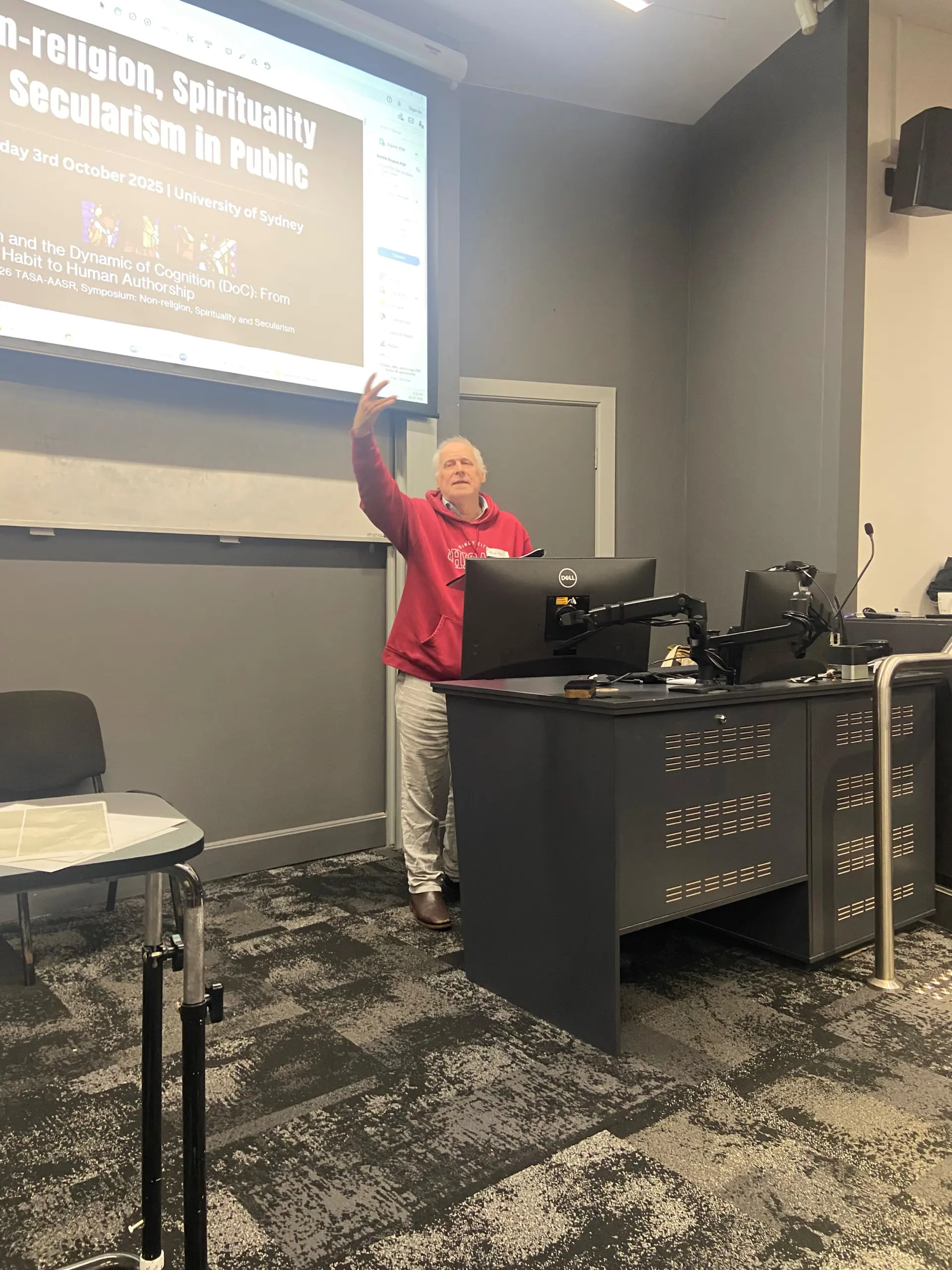
Here is a comprehensive, structured bibliography for The Story of Resilience series (documenting Dr. Neville Buch’s 5th Australian East Coast Trip and the accompanying intellectual synthesis) grounded in the source records[1].
1. Series Context & Overview
The Story of Resilience series details Dr. Neville Buch’s travel from Brisbane through regional New South Wales to Geelong and Melbourne, returning via Sydney[1][3]. The series synthesizes the physical trials of the journey (roadside breakdowns, financial strain, and community kindness) with deep historical research, featuring an extended collaborative research residency with leading Australian Islamic historian Dr. Dzavid Haveric in Geelong and a presentation on the Dynamic of Cognition (DoC) at the University of Sydney[1].
2. Primary Works by Dr. Neville Buch & MICE Publications
The core theoretical, methodological, and diagnostic foundation of the series is established across Dr. Buch’s publications for the Management Institute for Contributory Economy (MICE) [16–17, 130–131, 159, 203–204, 279–280]:
- Buch, N. (2015). Process of Learning (Principles) & The Dynamic of Cognition. Brisbane: Dr Neville Buch Publications[4].
- Buch, N. (2024). The Spiral History Theory of Stupidity: Getting Stuck in Time-Space, and Personal Breakout of Historical Cognition Patterns. Brisbane: Management Institute for Contributory Economy[5][6].
- Buch, N. (2025). MICE Principles and Philosophy (First Development). Working Paper. Brisbane: Management Institute for Contributory Economy[5].
- Buch, N. (2026a). MICE: Limited Thinking and the Contributory Economy (Book 1 of MICE). Brisbane: Management Institute for Contributory Economy[5].
- Buch, N. (2026b). Dr Buch in Intellectual Community: Reclaiming Authorship in the City of Intellect. Brisbane: Management Institute for Contributory Economy[5][8].
- Buch, N. (2026c). Understanding History is Philosophy in Practice: A Cognition History of Queensland. Brisbane: Management Institute for Contributory Economy[5][8].
- Buch, N. (2026d). Academic Rigour, Epistemic Renewal, and the Crisis of Inquiry: A Scholarly Review of the Vanderbilt Commission Report on the State of Scholarship. Brisbane: Management Institute for Contributory Economy[9].
- Buch, N. (2026e). Spiral Historiography and the Pedagogy of Consciousness in Australia. Academic Synthesis[10].
- Buch, N. (2026f). The Idea of Religion Today. Brisbane: Management Institute for Contributory Economy[10].
- Buch, N. (2026g). Thinking Religion in Place: Religion Is Not What It Was. Brisbane: Management Institute for Contributory Economy[10].
- Buch, N., & Peach, N. (2024). Philosophically Ontology Logic Intersect Compatibility Education (POLICE). Brisbane: Management Institute for Contributory Economy[7].
- Buch, N., Macklin, M., & Peach, N. (2026). MICE Intellectual Handbook: Limited Thinking and the Contributory Economy. Brisbane: Management Institute for Contributory Economy[8].
3. Foundational Theoretical, Epistemological & Sociological Literature
The series draws on key works in phenomenology, cognitive sociology, critical theory, and educational philosophy to articulate the Dynamic of Cognition, panser (thinking as caring), and the critique of neoliberal formalisms [16–18, 44–47, 106–110, 132, 185–186, 281–286]:
- Arendt, H. (1977). The Life of the Mind (M. McCarthy, Ed.). New York: Harcourt Brace Jovanovich[13].
- Aristotle. (c. 350 BC). Nicomachean Ethics (W. D. Ross, Trans.). Oxford: Clarendon Press[6].
- Cavanaugh, W. (2008). Being Consumed: Economics and Christian Desire. Grand Rapids: William B. Eerdmans Publishing[11].
- Coase, R. H. (1960). The Problem of Social Cost. Journal of Law and Economics, 3(1), 1–44[11].
- Collins, R. (1998). The Sociology of Philosophies: A Global Theory of Intellectual Change. Cambridge, MA: Belknap Press of Harvard University Press[14].
- Collins, R. (2019). The Credential Society: An Historical Sociology of Education and Stratification. New York: Columbia University Press[11][14].
- Cupitt, D. (2008). The Meaning of the West: An Apologia for Secular Christianity. London: SCM Press[14].
- Dweck, C. S. (2006). Mindset: The New Psychology of Success. New York: Random House[9].
- Ellul, J. (1973). Propaganda: The Formation of Men’s Attitudes. New York: Vintage Books / Octagon Books [223–224].
- Gadamer, H.-G. (1989). Truth and Method (2nd rev. edn.). New York: Crossroad[9].
- Haack, S. (1993). Evidence and Inquiry: Towards Reconstruction in Epistemology. Oxford: Blackwell [204–205].
- Habermas, J. (1979). Communication and the Evolution of Society (T. McCarthy, Trans.). Boston: Beacon Press[15].
- Habermas, J. (1984). The Theory of Communicative Action. Boston: Beacon Press[16].
- Habermas, J. (1991). Knowledge and Human Interests. Cambridge: Polity Press[14][16].
- Hofstadter, R. (1963). Anti-Intellectualism in American Life. New York: Random House USA Inc. [214–215].
- Illich, I. (1971). Deschooling Society. London: Calder & Boyars[17].
- Illich, I. (1973). Tools for Conviviality. New York: Harper & Row[17].
- Ingold, T. (2011). Being Alive: Essays on Movement, Knowledge and Description. London: Routledge[16].
- Macklin, M. (1967). Analogy, Analysis and God (Philosophical Thesis). Brisbane: University of Queensland[18].
- Macklin, M. (1976). When Schools Are Gone: A Projection of the Thought of Ivan Illich. Brisbane: University of Queensland Press[18].
- McKinney, J. P. (1971). The Structure of Modern Thought. London: Chatto & Windus[19].
- Merleau-Ponty, M. (1945/1962). Phenomenology of Perception (C. Smith, Trans.). London: Routledge & Kegan Paul [50, 210–211].
- Mills, C. W. (1959). The Sociological Imagination. New York: Oxford University Press[17][20].
- Noddings, N. (1984). Caring: A Feminine Approach to Ethics and Moral Education. Berkeley: University of California Press[19][21].
- Postman, N., & Weingartner, C. (1969). Teaching as a Subversive Activity. New York: Delacorte Press[22].
- Stiegler, B. (1998). Technics and Time, 1: The Fault of Epimetheus. Stanford: Stanford University Press [206–207, 228, 282].
- Stiegler, B. (2014). Symbolic Misery, Vol. 1: The Hyper-Industrial Epoch. Cambridge: Polity Press [207, 228–229, 282].
- Stiegler, B. (2018). Qu’appelle-t-on panser?: 1. L’immense régression. Paris: Les Liens qui Libèrent[21].
- Williams, B. (1985). Ethics and the Limits of Philosophy. Cambridge, MA: Harvard University Press[23].
4. Historical & Collaborative Research Literature
Literature documenting Australian history, Islamic historical encounters, regional geography, and social development synthesized during the Geelong research residency and road trip [1, 132, 315–318]:
- Haveric, D. (2006). Australia in Muslim Discovery: Historical Rediscovering of Australia by Non-Muslims and Muslims. Geelong: Deakin University Print Services[15].
- Haveric, D. (2012). History of the Muslim Discovery of the World: Islamic Civilisation Within the Plurality of Civilisations. Geelong: Deakin University Print Services[15].
- Haveric, D. (2016). History of the Bosnian Muslim Community in Australia: Settlement Experience in Victoria. Saarbrücken: Lambert Academic Publishing [315–316].
- Haveric, D. (2017). Muslim Memories in Victoria: Building Communities and Interfaith Relations from the 1950s to the 1980s. Australian Journal of Islamic Studies, 2(3), 134–162[24].
- Haveric, D. (2018). ANZAC Muslims: An Untold Story. Australian Journal of Islamic Studies, 3(3), 78–102[24].
- Haveric, D. (2023). A History of Muslims in the Australian Military: Loyalty, Patriotism, Contribution from 1885 to 1945. London: Cambridge Scholars Publishing[25].
- Haveric, D. (2026a). Macassan Muslims and Aboriginal Australians: Cultural and Spiritual Encounters. Religions, 17(2), 1–18[25].
- Haveric, D. (2026b). Reconsidering Possible Macassan Prayer Structures in Northern Australia: Port Essington and Raffles Bay. Australian Journal of Islamic Studies, 11(1), 45–68 [132, 317–318].


Neville Buch
Latest posts by Neville Buch (see all)
- The Road to Home. A Re-Narrativization of The Story of Resilience Part 7 – October 26, 2026
- The Road to Home. A Re-Narrativization of The Story of Resilience Part 6 – October 26, 2026
- The Road to Home. A Re-Narrativization of The Story of Resilience Part 5 – October 26, 2026