
Dr Neville Buch re-producing this extract (an article at the end in PDF format):
Georgios Tsagdis and Bart Buseyne (2024). Introduction. The Invitation of Memory in Bernard Stiegler: Memories of the Future, 1-2, accessed at
https://www.academia.edu/128247562/Introduction_The_Invitation_of_Memory_2024_?sm=a&rhid=37704816009
In the thick of yet another of the century’s crises, bio-technological as much as bio-political, the passing of Bernard Stiegler clouded into a darker shade of grey our overcast skies. As an intellectual, Stiegler had never been more present in the agora. His contributions were felt increasingly stronger among non-specialist circles, beginning to influence domains far beyond the academic, artistic and experimental techno-scientific enclaves where he had been originally received. At the moment of his passing, Stiegler represented for many of us a hope.
His sharp sensibility for signs of change in the public sphere, this seismographic acuteness to register and to elucidate the symptomatic significance of events that for most of us passed as anecdotal, lent particular gravity to the interventions he initiated. We recall, for instance, his interpretation of the Nanterre massacre in 2002, in which Richard Durn was led to the murder of eight councillors and the injury of nineteen others, before taking his own life. Stiegler saw in Durn’s explicit cry for existence, a ‘structural privation of his primordial narcissistic capacities’, loss of ‘the power to signify’ and an extreme expression of the evermore common loss of individuation. Similarly, Stiegler was deeply affected by and subsequently drew attention to the testimony of the fifteen year old Florian, who in 2015 spoke of his generation’s complete loss of dreams and ideals, paralysed by the fear of being the last, or among the last of generations.
In all this, Stiegler was personally implicated. Philosophy was not for him a profession, an exercise, mere intellectual curiosity. As he confessed in ‘How I became a philosopher’, he found himself in a singular relationship to the practice of philosophy, a relationship informed by the gravity of the accident and the import of agency: the necessity of the latter proceeding upon the default of the former. His theorisation of the accidental formed a vantage point to access the historical foreclosed in Heidegger’s notion of the ‘world-historical’ (das Weltgeschichtliche), as much as in Frankfurt School’s critique of capitalism. Such access enabled him to pass into act. Among numerous interventions, his address to the Secretary-General of the United Nations in November 2019, formed a high point, as he urged for action in the name of life and in the spirit of the young generation, set in sharp relief by the movement Youth for Climate.
His suicide only a few months later came thus as an abrupt anti-climax of a verdict on older generations that seemed to be gaining traction. As the call for accountability, if not responsibility, addressed by the youth to the generations that precipitated the environmental catastrophe was growing louder, the world at large and Stiegler’s life in specific, came simultaneously to a halt. His failing health was refracted into the ailing of the globe and amplified by the violent idiocy of bio- techno-political apparatuses, who summed up their responses in a series of prohibitions, controls and mandates, barely capable of fathoming the complexity of the crisis they had engendered, a crisis long foreseen and foretold.
His loss of hope is our loss. But this loss marks also a crossroad; Stiegler’s passing is a passage. Under the sign of this suicide we find the call of continuing his work, which is not only inscribed in countless tertiary retentions, but which also inhabits a great host of thinkers and practitioners across the globe…
PDF Files:
What is Happening in Our Intellectual Environment
Bernard_Stiegler_Memories_of_the_Future
Introduction_The_Invitation_of_Memory_20
Three Ways of Thinking Through Senses
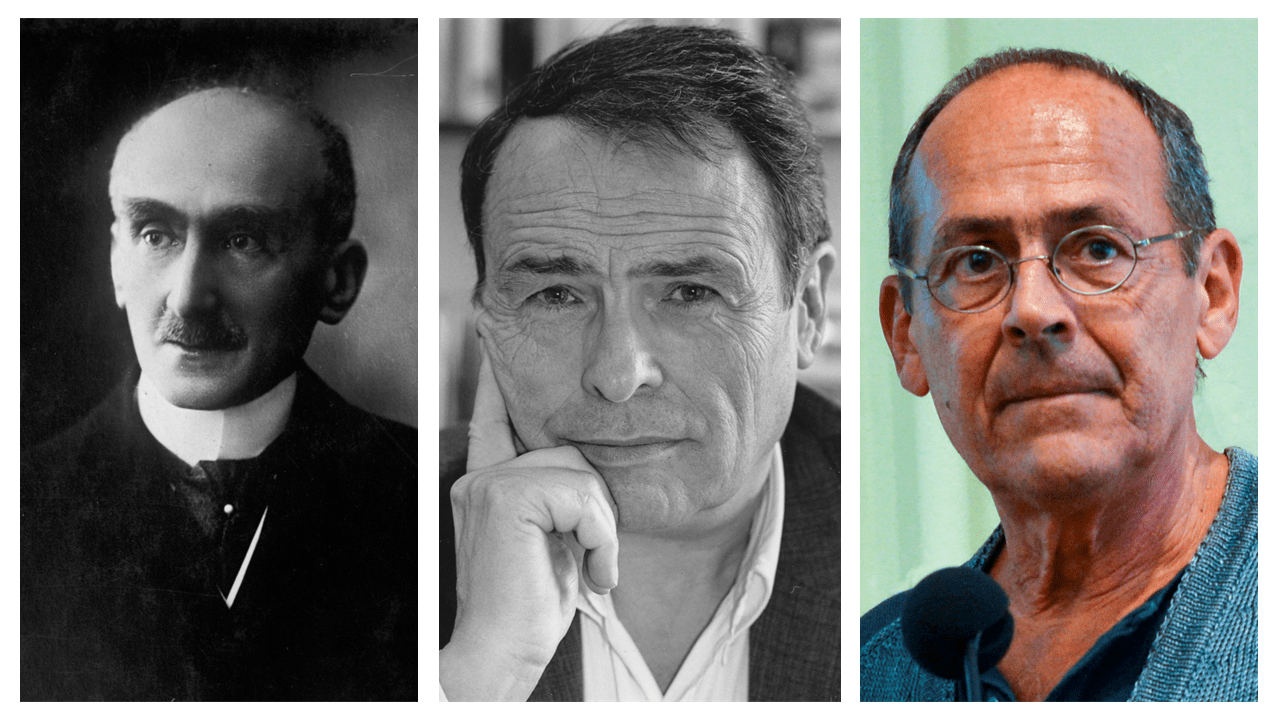
Featured Image: Henri Bergson, Pierre Bourdieu, Bernard Stiegler


Neville Buch
Latest posts by Neville Buch (see all)
- Death in Life and Life in Death: Affective, Intellectual, and Ontological Dimensions of Human Mortality – October 2, 2026
- Psychological Symbol Cards – October 2, 2026
- The Washington Post Impact Report and American Studies – October 1, 2026