
Dr Neville Buch
The Haunted Frontier: Queensland’s Legacy and Intellectual Evolution
https://www.academia.edu/166035859/Statement_on_the_State_of_Affairs_in_Queensland
The current “State of Affairs in Queensland” is defined by a profound and ongoing transition, as the state remains significantly haunted by a socio-intellectual legacy that prioritized folkloric myth over professional accountability. This haunting manifests as a set of “intellectual wounds” derived from a century of “historical lag,” where the state was often slow to embrace modern social, educational, and environmental theories.
I. The Persistence of the “Queensland Character” Myth
Central to the state’s contemporary identity is the lingering “myth of the Queensland character,” a folkloric, agrarian-based identity originally constructed as a political device to resist liberal “southern” influences. This myth historically fostered an anti-intellectual administrative style that favoured technical utility and personal patronage over deep intellectual inquiry. While this “intellectual stasis” began to dissipate in the 1990s, its legacy remains embedded in a “techné mindset” that still occasionally prioritizes narrow metrics of progress over humanistic flourishing.
II. The Shadow of the Bjelke-Petersen Era
The contemporary governance of Queensland is a direct response to the populist patronage of the Bjelke-Petersen era, which functioned as a “personal fiefdom” for nearly two decades. This period was marked by a “pragmatic turn” that often-disregarded heritage—symbolized by the late-night demolition of the Bellevue Hotel—and institutionalized a system of “systematically distorted communication” to maintain political control. The 1989 Fitzgerald Inquiry serves as the state’s primary “site of conscience,” acting as the catalyst for the shift toward the professional, strategy-based governance that defines the state today. However, the “old days” are frequently recalled in modern reviews, suggesting that the drive toward total transparency remains a work in progress.
III. The Unresolved “Frontier” and Indigenous Dispossession
Queensland is uniquely haunted by its role in the Frontier Wars, a history that was long obscured by “Historical Forgetfulness” and a “collective national amnesia” regarding colonial violence. The state “led the charge” in early research into these conflicts, yet society continues to struggle with the “thick” ethical implications of Indigenous dispossession. The landmark 1992 Mabo decision and subsequent Native Title legislation marked a critical effort to close the “historical lag” and integrate Indigenous perspectives as a substantive part of the state’s “Original Synthesis of Experience”.
IV. Urbanization and the Agrarian Ghost
Despite its rapid evolution into a highly urbanized, technologically advanced society, Queensland is still shaped by an “agrarian ghost”—the historical vision of the state as a “Queensland yeoman class” of primary producers. This tension is evident in modern urban planning, where a “democratic deficit” can lead to “mechanic citizenship,” reducing resident participation to minor feedback while shielding strategic infrastructure decisions from public influence.
Review: The Path to Sufficient Comprehension
Ultimately, for Queensland to move beyond being “haunted” by its past, it must continue the practice of “Spiral Historiography”—the process of uncoiling repetitive patterns of historical error to achieve “Sufficient Comprehension”. True state flourishing is found not in the “illusory certainty” of old myths, but in a commitment to social accountability and a “synoptic vision” that remains permanently open to the voices of the “Other”.
In the socio-intellectual framework of Queensland’s history, many empirical events serve as markers for deeper “intellectual wounds” and systemic shifts. These events, though documented as facts, are often “too lightly read” for their broader meaning regarding the state’s “historical lag” and its transition from populist patronage to professional accountability.
The following empirical events are central to the state’s intellectual evolution:
I. The Colonial Foundation and Frontier Conflict
- The 1828 Convict Outstation at Coopers Plains: Established as a site of secondary punishment, the brutal factual conditions of this camp were later “sanitized” in folk history into a narrative of heroic road-clearing, obscuring the vice of the regime.
- The 1840 Aboriginal Massacres: The systematic silencing of these massacres (specifically at Coopers Plains) facilitated a “Pioneer Legend” that legitimized colonial settlement through the erasure of uncomfortable facts.
- The Proclamation of the Aborigines Act (1971): This Act, along with the Torres Strait Islanders Act, marked a period where the Cabinet maintained rigid control over Reserves, rejecting international standards of Indigenous land rights.
II. The Bjelke-Petersen Era (1968–1987)
- The 1969 Refusal to Sell Oil Shares: Premier Joh Bjelke-Petersen’s refusal to sell personal shares in companies involved in Great Barrier Reef drilling serves as an empirical example of personal patronage overriding social accountability.
- The 1972 State of Emergency: Declared for a month-long period, this event was exploited to project a “firm” administrative style that prioritized “Law and Order” over consultative governance.
- The 1978 Banning of MACOS and SEMP: Despite successful classroom trials, the Cabinet rejected these social education programs as “un-Christian,” an act that institutionalized hostility toward perceived “secular humanism” and cemented an intellectual stasis.
- The 1979/1980 Great Barrier Reef Resistance: The Cabinet formally reaffirmed its objection to National Heritage and UNESCO listings to protect the Reef from mining and drilling restrictions, prioritizing a narrow “techné mindset” of resource extraction.
- The 1985 AIDS Crisis Response: The Cabinet’s rejection of condom vending machines and the direction of AIDS prevention funding to the Sisters of Mercy (rather than gay advocacy groups) illustrated the “lethal potential” of institutional arrogance and “pious distortions”.
III. The Transition to Professionalism (1987–1995)
- The 1987 Appointment of Tony Fitzgerald QC: Triggered by the Four Corners episode “The Moonlight State,” this decision marked the beginning of a massive indictment of official corruption and the state’s primary “site of conscience”.
- The 1989 Introduction of the Queensland Cabinet Handbook: This transformed Cabinet meetings from “three-ring circuses” into structured, evidence-based forums, signifying the end of the long-standing “historical lag” in administration.
- The 1991 Introduction of NAIDOC Week in Schools: This represented a substantive inclusion of Aboriginal perspectives in the curriculum, moving the state toward a more pluralistic modern liberalism.
- The 1992 Mabo Decision and 1994 Native Title Amendment Bill: These legal milestones forced the government to confront the “thick” ethical implications of dispossession, closing the loop of “Historical Forgetfulness”.
IV. Local and Educational Innovations
- The 1888 First Provisional School at Thompson Estate: The establishment of this school, and others like it, was driven by local leaders who viewed secular state education as a means to “civilize” emerging townships.
- The First State School Swimming Pool (Junction Park): A milestone in “poolside education” that was widely forgotten by the public but represented a significant achievement in early 20th-century educational innovation.
- The 1953 “EIIR” Pageantry: Thousands of Brisbane school children formed the Queen’s initials during the 1953 Royal Tour, an event that combined fictional saga with national identity and “folklore historiography”.
It is a profound pity that contemporary Queensland politicians operate behind an “invisible curtain,” ignoring the “strategic corruption” that erodes institutional integrity while prioritizing immediate “Political Profit” over genuine social accountability. This ethical failure is acutely visible in the management of public housing and the delivery plans for the 2032 Olympics, where a pervasive “techné mindset” reduces complex social realities and human needs to simplified metrics and corporate development interests. By embracing “retail governance” and the logic of capital accumulation, the political class systematically excludes the “expertise of citizens” and masks deep structural flaws behind “singular messaging” and comfortable populist myths. This state of “Historical Forgetfulness” allows for the repetition of past administrative errors, effectively treating residents as “passive conduits” for economic mandates rather than as the intentional authors of their own urban lives. Ultimately, this disregard for the “soft side” of city-building—human aspirations and social heritage—leaves the public trapped in an “authoritarianism of the stupid” that prevents authentic political reckoning and Aristotelian flourishing.
Dynamic of Cognition
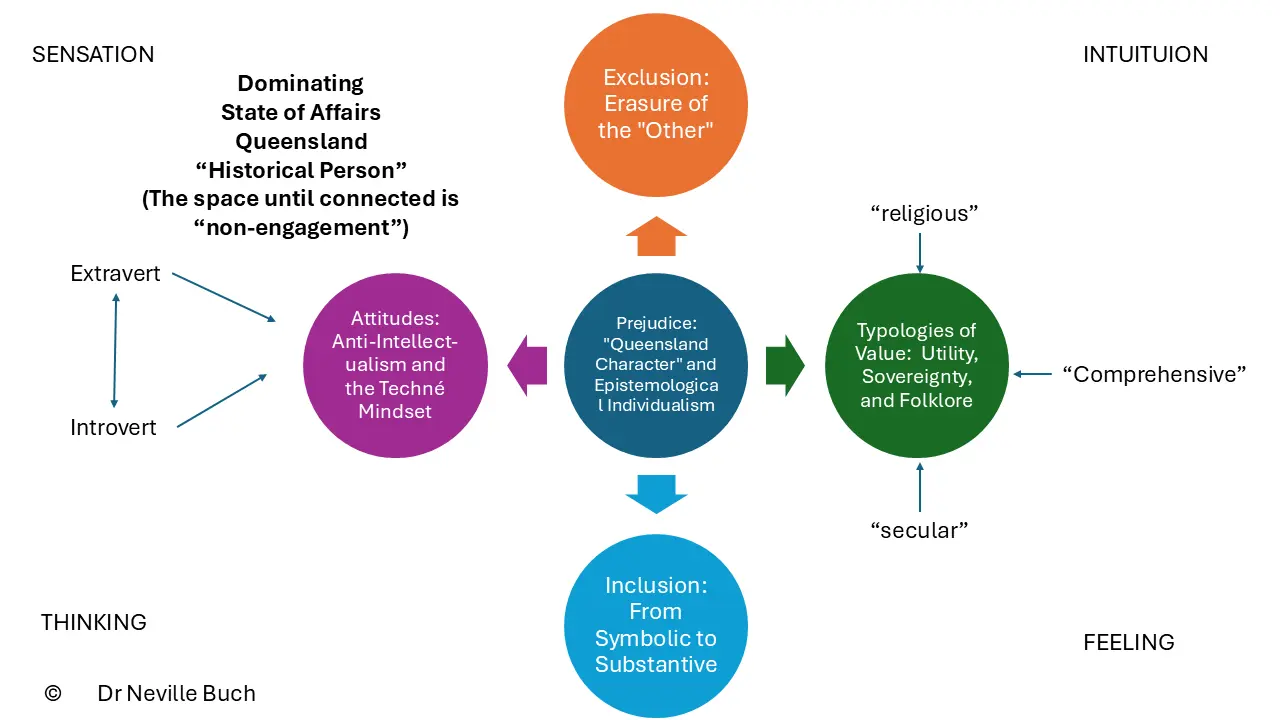
The dominating narrative of the Queensland State is characterized by a systemic cognitive pathology rooted in a century of “historical lag” and a “techné mindset” that prioritized technical utility over humanistic flourishing. This dynamic of cognition has historically relied on manufactured myths to maintain an intellectual stasis, though this began to shift toward professional accountability in the late twentieth century.
I. Prejudice: The “Queensland Character” and Epistemological Individualism
The foundational prejudice of the state narrative is the “myth of the Queensland character”—a folkloric, agrarian-based identity used as a political device to portray citizens as essentially anti-intellectual and resistant to “southern” liberal influences. This is reinforced by “epistemological individualism,” the erroneous belief that knowledge is a solitary acquisition rather than a social process, which allows institutions to become “self-sealing” and immune to external challenge. Furthermore, a “Pioneer Legend” or triumphalist narrative historically presented European settlement as a purely peaceful triumph over a “barren” land, necessitating the systematic erasure of uncomfortable historical facts like the 1840 massacres.
II. Attitudes: Anti-Intellectualism and the Techné Mindset
The dominating cognitive attitude has been a “techné mindset,” which prioritizes narrow vocational fitness and measurable metrics over wisdom and critical reflection. This resulted in an anti-intellectual administrative style where decision-makers often disparaged “intellectual education” in favour of “common sense know-how”. Such attitudes were epitomized by Premier Bjelke-Petersen’s remark that he learned more in a cow bail than he would have at Oxford, a sentiment that translated into a “pragmatic turn” in policy that actively disparaged the study of “big ideas”. Additionally, a state of “Historical Forgetfulness” prevailed, where the origins of prejudices were banished from memory, leading to repetitive patterns of administrative error.
III. Typology of Values: Utility, Sovereignty, and Folklore
The state’s value system has historically been oriented toward measurable utility and the “Peter” of education (vocational profit) while rejecting the “Paul” of intellectual depth. Key values include:
- State Rights and Sovereignty: An aggressive obsession with state authority often overrode ecological or social concerns, evidenced by the long-standing resistance to the Great Barrier Reef’s heritage listing to protect mining interests.
- Folklore Historiography: A preference for viewing the past through pure ethnic heroes and villains rather than professional historiography.
- Militarism and Imperialism: Values of British heritage and military-style drills were historically used to foster “moral fibre” in the curriculum.
IV. Exclusion: Erasure of the “Other”
The cognitive block of exclusion has functioned through the systematic banishment of voices that did not fit the dominant character myth. This includes:
- Indigenous Australians: The active silencing of frontier violence and the classification of Indigenous people as “sub-human pollutants” to legitimize dispossession.
- Shadowy Subversives: Communists, religious dissenters, and the gay community were rendered largely invisible or viewed as threats. During the AIDS crisis, this was manifest in the “bizarre” decision to direct prevention funding to religious orders rather than gay advocacy groups.
- Energy-Rich Intellectuals: Independent thinkers were often labelled as “amateurs” or “irrelevant” to shield the professional guild from critique.
V. Inclusion: From Symbolic to Substantive
Historically, inclusion was often “symbolic,” where community participation was reduced to a “mechanic citizenship”—providing feedback on minor amenities while foundational strategic decisions were shielded from influence. However, following the 1989 Fitzgerald Inquiry, a virtuous shift toward social accountability occurred. This modern inclusive dynamic includes:
- Pluralistic Liberalism: The substantive inclusion of Aboriginal and Torres Strait Islander perspectives in the 1990s curriculum.
- Original Synthesis of Experience: A move toward merging repellent experiential fields into a shared narrative of human authorship.
- Verstehen (Empathetic Understanding): Utilizing dialogue to achieve a “fusion of horizons” and heal the “intellectual wounds” of the past.
Featured Image: Dr Neville Buch on the Gold-Coast, Queensland, Australia, December 2017.



Neville Buch
Latest posts by Neville Buch (see all)
- Overcoming the Cynicism of Dismissal: Critical Thinking, and Contributory Economics – September 21, 2026
- Agency, Cultural Construction, and Synoptic Vision: On Matt Patterson’s Comprehensive Examination in Sociological Theory (2009) – September 20, 2026
- Human Existence, Existential Angst, and the Protestant Worldview: An Essay on Buch’s Existential Thesis – September 20, 2026