
The “Why Accepting Death Givers Life Meaning” audio commentary on MICE’s Contributory Economy and Human Authorship at this page:
Dr Neville Buch and MICE[1]
The “Why Accepting Death Givers Life Meaning” audio commentary on MICE’s Contributory Economy and Human Authorship at:
Abstract
This essay explores the dialectical relationship between “Death in Life” and “Life in Death” across historical, psychological, philosophical, and sociological perspectives[1]. “Death in Life” describes the psychological, affective, and bodily states in which mortality, loss, melancholy, or medicalized disconnection interpenetrate everyday human existence[1]. Conversely, “Life in Death” signifies the creative, spiritual, or authentic transformation through which confronting finitude becomes the primary catalyst for life affirmation, artistic inspiration, and human agency[5]. The essay examines how the affective dimension operates through states such as Enlightenment melancholy (leucocholy and black bile), existential dread (Angst), and terror management[1], and how the intellectual dimension functions through Cartesian versus relational ontologies, Heideggerian being-towards-death (Sein-zum-Tode), and Nietzschean embodied convalescence[2]. Ultimately, understanding this dual condition is vital for dismantling contemporary death denial, restoring social connection, and achieving authentic human flourishing[2].
1. Introduction: Conceptualizing “Death in Life and Life in Death”
The pairing of “Death in Life” and “Life in Death” represents one of the most enduring paradoxes in European literature, continental philosophy, and medical humanities[1]. Rather than viewing life and death as strictly sequential biological events—where life abruptly ends and death begins—this paradox conceptualizes mortality as a continuous, ambient presence operating within living consciousness[1].
As historian Philippe Ariès and philosopher Martin Heidegger observe, human culture historically recognized that as soon as a human being comes to life, they are immediately old enough to inhabit a constant relation to their death (Ariès 1974 cited in Runstrom 2015, p. 7; Heidegger 1927 cited in Runstrom 2015, p. 66)[12][17]. In modern secular society, however, material reductionism and medicalization have attempted to sanitize death, reducing human existence to mere vegetative growth and biological decay (Buch 2026, p. 3; Macdonald 2018, p. 290; Runstrom 2015, pp. 10–13)[2]. Examining the interplay between “Death in Life” and “Life in Death” exposes the limitations of this reductionism and recovers the transformative potential of human finitude[6].
2. What is “Death in Life” and “Life in Death”?
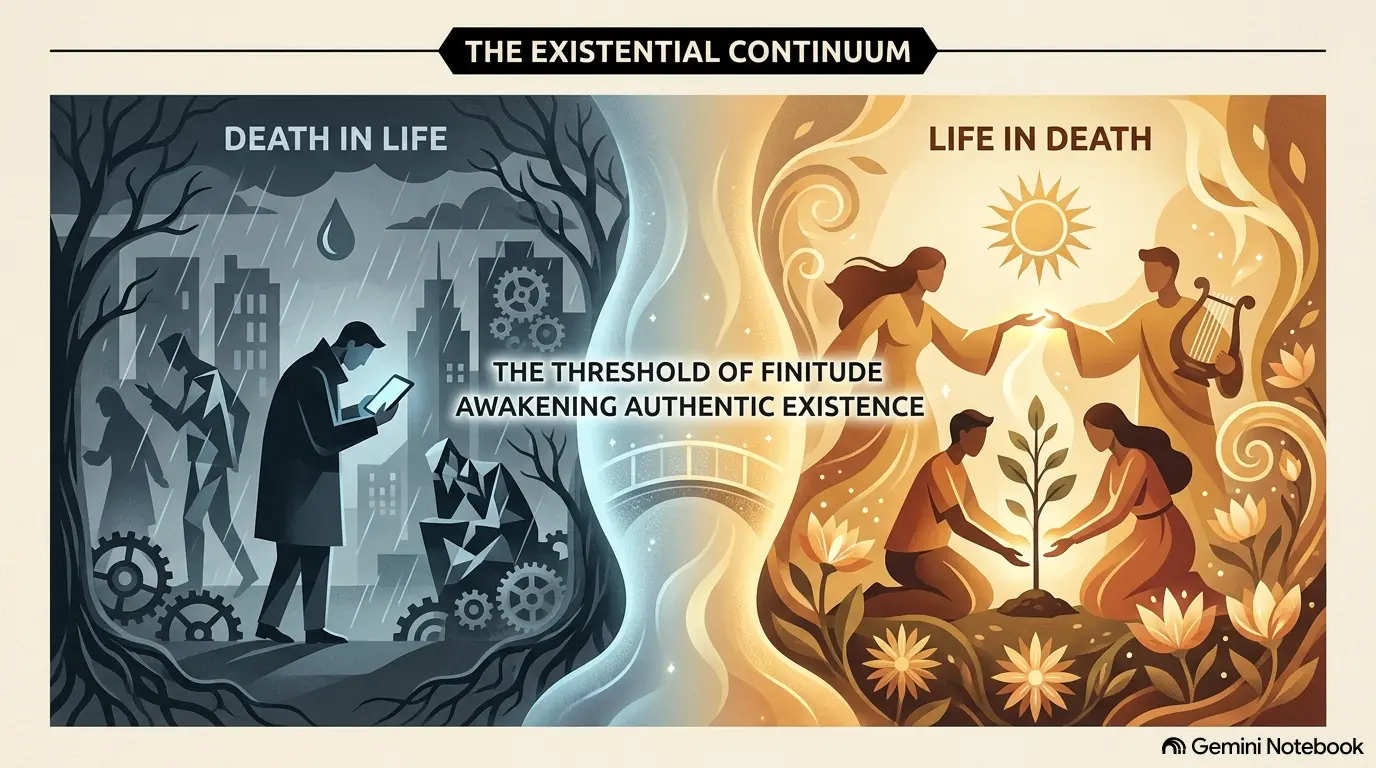
The terms “Death in Life” and “Life in Death” represent two complementary poles of a single existential continuum:
THE EXISTENTIAL CONTINUUM
- Death in Life: Refers to the phenomenological state wherein living individuals experience the weight, terror, or presence of mortality within their daily lives (Ingram 2006, p. 90; Runstrom 2015, p. 4)[1][20]. Historically, this manifested in the 18th-century melancholiac who inhabited a “no-man’s-land between life and death,” feeling dead from within despite physical vitality (Ingram 2006, pp. 90, 96)[1][21]. In contemporary medical contexts, “Death in Life” appears in Cartesian medical paradigms that view progressive neurodegenerative conditions (such as dementia) or chronic illness as “death brought into life,” isolating sufferers into social disconnection (Macdonald 2018, pp. 290–291)[2][22]. In existential philosophy, it represents the passive, automated existence of the “automatic cultural person” who sinks into vegetative routine without authentic choice (Becker 1973 cited in Runstrom 2015, p. 25; Buch 2026, p. 3)[14][23].
- Life in Death: Refers to the paradoxical realization of truth, creative energy, or spiritual vitality attained precisely through confronting and enduring dissolution (Corby 2007, pp. 3, 5; Runstrom 2015, p. 42)[5]. Drawing on Hegel’s assertion in the Phenomenology of Spirit that the spirit wins its truth only when it “finds itself in absolute dismemberment” and can “endure death and maintain itself in it,” Romantic writers like W.B. Yeats sought a state of visionary inspiration—a “life-in-death” reached through solitary creative labour (Hegel 1807 cited in Corby 2007, p. 3; Corby 2007, p. 6)[5][24]. Philosophically, “Life in Death” occurs when an individual embraces finitude as a meaning-giving element, transforming mortality into an active affirmation of possibility and vitality (Heidegger 1927 cited in Runstrom 2015, pp. 86–87; Nietzsche 1887 cited in Runstrom 2015, pp. 126, 134)[8].
3. How the Affective Side Works in Death in Life and Life in Death
The affective dimension encompasses the emotional, visceral, and psychological energies generated by the awareness of mortality:
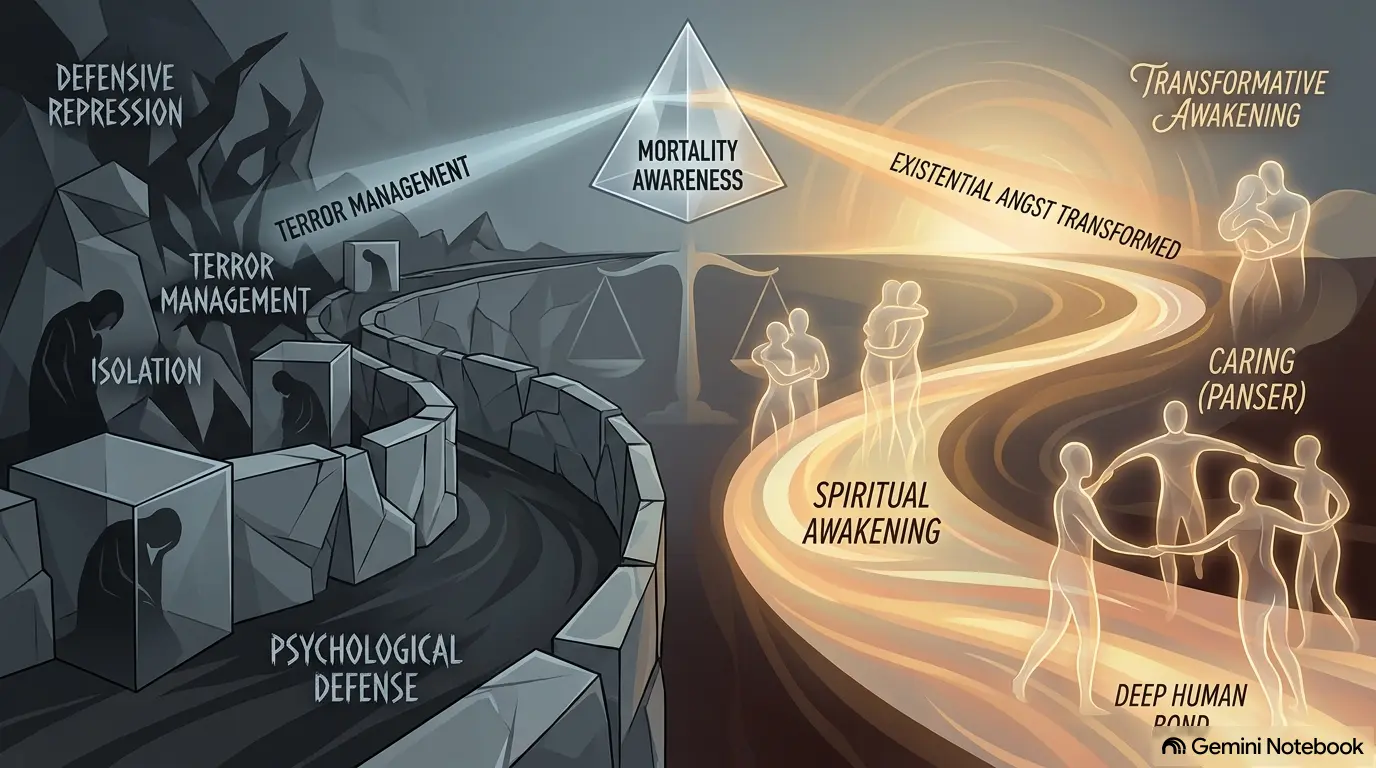
A. Melancholy, Dread, and Terror
In 18th-century medical and self-narrative literature, melancholy was described as an affective state that cast the shadow of death over all experience (Ingram 2006, p. 95)[4]. Sufferers experienced what Thomas Gray categorized as “black melancholy,” characterized by unremitting dread, terrifying visions, and a feeling of being among the damned (Gray 1742 cited in Ingram 2006, pp. 91–92)[4][9]. Modern Terror Management Theory (TMT) confirms that when human beings are exposed to subliminal reminders of mortality (“Mortality Salience”), they experience non-conscious existential dread, which frequently triggers aggressive defensiveness, xenophobia, and rigid adherence to cultural worldviews (Greenberg et al. 1997 cited in Runstrom 2015, pp. 47, 53)[27][28].
B. Existential Angst as a Transformative Catalyst
While acute dread can lead to psychological paralysis or hostility toward others, existential philosophy reframes existential angst ( Angst ) as an essential affective mechanism (Buch 2026, p. 3; Heidegger 1927 cited in Runstrom 2015, p. 84)[11][14]. Angst differs from specific fear; while fear is directed at an objective threat in the world, angst is an objectless mood that reveals the sheer precariousness of existence (Heidegger 1927 cited in Runstrom 2015, p. 84)[11]. In Buch’s thesis, existential angst is the vital spiritual mechanism required to “save our human soul” from collapsing into mechanical, vegetative reductionism (Buch 2026, p. 3)[14]. When sustained rather than chemically or culturally suppressed, angst changes into “unshakable joy”—the affective breakthrough that accompanies authentic freedom (Dastur 1996 cited in Runstrom 2015, p. 84; Heidegger 1927 cited in Runstrom 2015, p. 84)[11].
C. Spiritual Coping and “Panser” (Thinking as Caring)
In clinical and religious settings, confronting death in life triggers profound spiritual re-evaluations (Bousso et al. 2010, pp. 522–523)[29]. Individuals facing terminal illness or loss reinterpret cultural and religious symbols to maintain hope, finding that spirituality increases their capacity for emotional coping (Bousso et al. 2010, p. 522)[29]. Similarly, in educational and philosophical frameworks, affective engagement with mortality fosters panser—”thinking as caring”—an emotional shield that protects human particularity and empathy against automated, cold calculations (Buch 2026, p. 224; Macdonald 2018, p. 295)[30].
4. How the Intellectual Side Works in Death in Life and Life in Death
The intellectual and ontological dimension examines how cognitive structures, philosophical systems, and social ontologies define and navigate the boundary between life and death:
A. Cartesian Reductionism vs. Relational Ontology
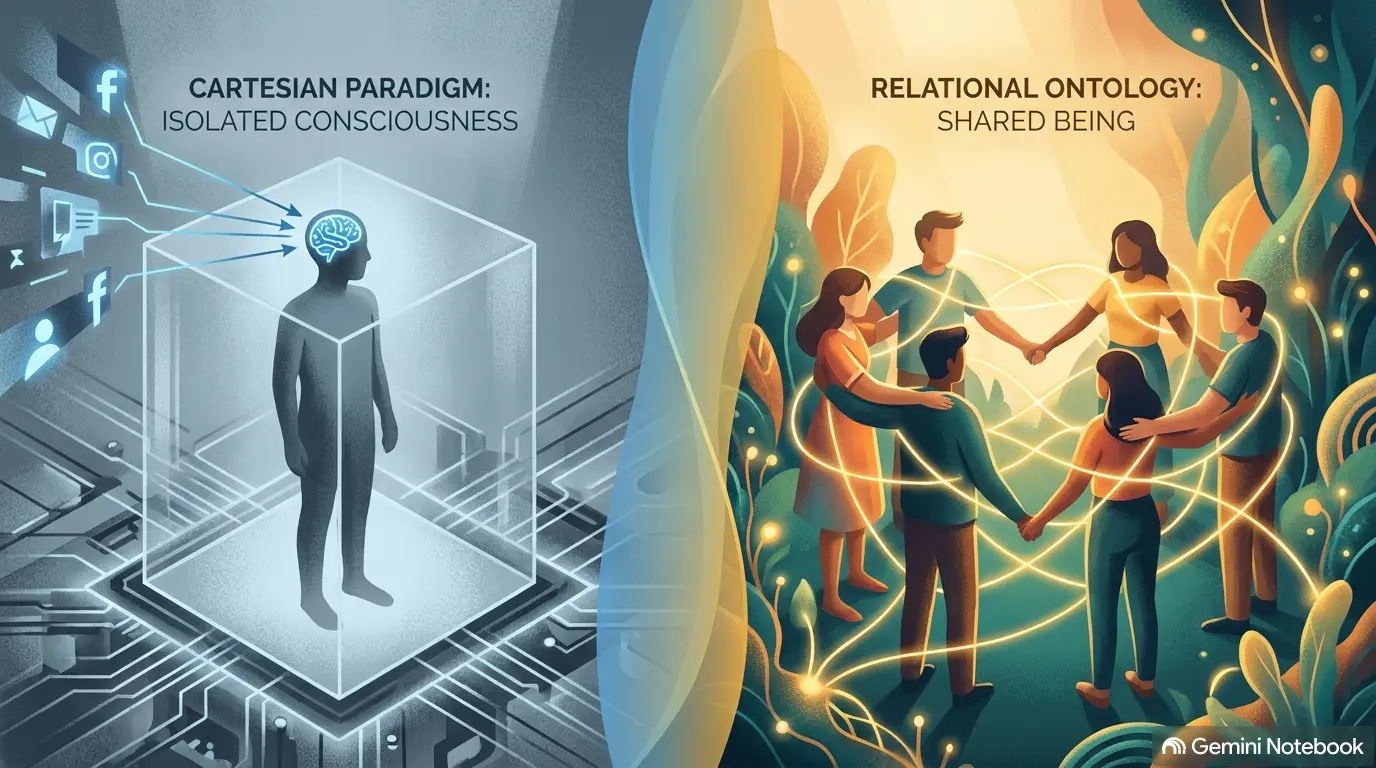
Modern Western medicine and physicalism operate largely under a Cartesian paradigm, which locates human identity strictly within individual brain function and physical mechanisms (Macdonald 2018, p. 290; Wikipedia 2026d)[2]. Under this Cartesian intellect, severe cognitive decline (such as dementia) or physical degeneration is classified as an objective “failure” or “loss of personhood,” producing a social death long before somatic death occurs (Ariès 1974 cited in Runstrom 2015, p. 14; Macdonald 2018, pp. 290, 294)[2].
In contrast, a relational ontology redefines life and death socially: human life is held in intersubjective connection with others (Macdonald 2018, pp. 290, 295)[2][32]. Death is not an isolated mechanical failure within a brain, but the severance of relational holding (Macdonald 2018, p. 295)[32]. When society maintains intellectual and emotional connection with vulnerable individuals, authentic human life persists despite physical disease (Macdonald 2018, p. 295)[30][32].
B. Heidegger’s Sein-zum-Tode (Being-Towards-Death)
In Being and Time, Martin Heidegger provides a rigorous ontological critique of how the intellect understands mortality (Heidegger 1927 cited in Runstrom 2015, pp. 65–86)[12][33]. Heidegger distinguishes between mere “demise” (Ableben—biological stopping) and authentic being-towards-death ( Sein-zum-Tode ) (Heidegger 1927 cited in Runstrom 2015, p. 67)[34][35].
Intellectually, everyday human thought operates in inauthenticity: society distracts itself through “idle talk” (Gerede), framing death as an anonymous event that happens to “others” (“one dies, but not right now”) (Heidegger 1927 cited in Runstrom 2015, pp. 76–77)[36][37]. Authentic being-towards-death, achieved through “anticipatory resoluteness” (vorlaufende Entschlossenheit), requires the mind to intellectually grasp death as its ownmost, non-relational, certain, and insuperable possibility (Heidegger 1927 cited in Runstrom 2015, pp. 71, 86)[38][39]. By running ahead into the certainty of finitude, the intellect clears away social illusions and takes full ownership of life’s genuine possibilities (Heidegger 1927 cited in Runstrom 2015, p. 86)[25].
C. Nietzschean Convalescence and Embodied Intellect
Friedrich Nietzsche approaches the intellectual problem of mortality through the lens of a “cultural physician,” focusing on sickness and convalescence (Nietzsche 1887 cited in Runstrom 2015, pp. 102, 114, 126)[42]. Nietzsche rejects abstract metaphysics that seeks an afterlife, demanding that the intellect embrace bodily vulnerability (Runstrom 2015, p. 126)[45][46]. For Nietzsche, physical sickness is a literal experience of “death within life” (Runstrom 2015, p. 114)[43]. The noble intellect does not resent or deny this suffering; rather, it uses sickness as a necessary condition to “convalesce” into an elevated, exuberant state of health, affirming the whole of life through active self-determination (Nietzsche 1887 cited in Runstrom 2015, pp. 126, 133–134)[8].
5. Why It Is Important to Understand “Death in Life and Life in Death”
Understanding the dynamic between Death in Life and Life in Death is of critical importance for contemporary culture, ethics, and healthcare:
- Dismantling the Unhealthy Denial of Death: Modern Western society has enforced a severe taboo around mortality, hiding dying individuals in sanitized institutions and sedating awareness to protect public comfort (Ariès 1974 cited in Runstrom 2015, pp. 10–13)[18]. Historians and psychologists warn that this total suppression is dangerous: it deprives individuals of grief rituals, creates psychological neurosis, and leads to a “recoil from the desire to exist” (Ariès 1974 cited in Runstrom 2015, p. 14; Runstrom 2015, p. 2)[51].
- Preventing Ideological Aggression: As experimental Terror Management Theory demonstrates, unexamined, repressed death anxiety directly fuels intergroup hostility, racism, and war, as societies lash out against differing worldviews to protect their unconscious immortality illusions (Greenberg et al. 1997 cited in Runstrom 2015, pp. 28, 53)[28][54]. Recognizing finitude consciously enables individuals to pursue intrinsic, compassionate goals rather than defensive aggression (Vail et al. 2012 cited in Runstrom 2015, pp. 54–56)[55].
- Resisting Material Reductionism and Automated Control: In an era increasingly governed by algorithmic throughput and technocratic efficiency, human life is frequently reduced to a biological commodity (Buch 2026, p. 3)[14]. Understanding “Death in Life” empowers individuals to protest against rigid temporal boundaries and reclaim their agency as conscious authors of reality (Buch 2026, p. 3)[14].
- Fostering a Caring Society and Eudaimonia : Re-conceptualizing death through a relational framework restores dignity to aging, illness, and dying (Macdonald 2018, p. 295)[30][32]. It establishes that human flourishing (eudaimonia) depends not on perpetual physical perfection, but on social connection, empathy, and mutual responsibility (Macdonald 2018, p. 295; Buch 2026, p. 237)[30][32].
6. Conclusion
The interplay of Death in Life and Life in Death reveals that human mortality is not an external accident or a mere biological boundary, but the fundamental horizon against which human meaning, love, and creative freedom are defined[1]. While modern Cartesian reductionism seeks to deny death—thereby reducing human existence to a vegetative “Death in Life”—philosophical, psychological, and relational inquiries demonstrate that confronting finitude authentically awakens the individual[2]. By integrating affective dread into transformative angst and intellectualizing death as a shared, relational condition, human society can move past the denial of death and reclaim a life of authentic connection, courage, and exuberant affirmation[2].
Endnotes
- Historical Shifts in Death Denial and Tame Death: French historian Philippe Ariès outlines four distinct historical periods in the Western conception of mortality[1][2]. In the early Middle Ages (“tame death”), death was familiar, public, and accepted as a natural condition of human life rather than a sudden accident[2][3]. By the twentieth century (“forbidden death”), mortality was removed from the control of the dying individual and handed over to medical institutions, where death became sanitized, sedated, and treated as an unnatural failure or taboo[4]. See Ariès (1974), cited in Runstrom (2015, pp. 7–14)[2][6].
- Material Reductionism and “Mechanical Death”: Dr. Neville Buch argues that material reductionism and technocratic determinism reduce human existence to a deterministic machine[7]. Under this paradigm, individuals do not authentically exist; rather, they merely “be” in a vegetative state characterized by physical growth and biological decay (“Growth and Death, but not human life”)[7]. Authentic human existence requires protesting against self-imposed temporal boundaries[7]. See Buch (2026, p. 3)[7].
- Cartesian Medicalization and Sickness as Death in Life: Anthropologist Gaynor Macdonald examines how modern biomedicine’s Cartesian paradigm treats human identity as an isolated, brain-bound mechanism[8]. In conditions such as dementia or progressive neurodegeneration, the absence of a somatic cure causes medical and social institutions to view the individual as “lost to life” or experiencing “death brought into life,” producing social death long before biological demise[8]. See Macdonald (2018, pp. 290–291)[8].
- Enlightenment Melancholy and Internal Putrefaction: Literary historian Allan Ingram documents how seventeenth- and eighteenth-century melancholiacs occupied a distinct “no-man’s-land between life and death”[15]. Sufferers experienced acute depressive delusions wherein their very understanding, beliefs, and identity felt “dead from within,” illustrated by extreme clinical cases where patients perceived putrefying corpses beside them or believed their bodies were made of fragile glass[16]. See Ingram (2006, pp. 90, 95–96)[15].
- The “Automatic Cultural Person” and Repressed Finitude: Anthropologist Ernest Becker posits that modern individuals build elaborated cultural “hero systems” and character armors to deny their animal creatureliness and mortal vulnerability[20][21]. Those who unthinkingly conform to routine without confronting finitude become “automatic cultural people,” living in a state of tranquilized, partial depression[21]. See Becker (1973), cited in Runstrom (2015, p. 25, pp. 149–150)[21][22].
- Romantic Vision Poetry and Hegel’s Dialectic of Dismemberment: James Corby analyzes how Romantic poets like W.B. Yeats engineered an “aesthetics of failure,” where well-ordered prosaic verse is violently interrupted by chaotic vision poetry[23]. Drawing on G.W.F. Hegel’s Phenomenology of Spirit, this visionary state requires the artistic self to endure absolute dismemberment and “maintain itself in death” in order to achieve true creative inspiration (“life-in-death”)[26]. See Hegel (1807), cited in Corby (2007, p. 6, p. 16)[26][27], and Corby (2007, pp. 3–6)[23].
- The Orphic Archetype and Nocturnal Death-in-Life: Drawing on Neo-Platonic motifs, Samuel Taylor Coleridge, and John Milton’s Il Penseroso, Yeats conceptualizes the writer’s solitary, night-bound labour in the tower as a form of “death-in-life”[29]. Like Orpheus peering into Hades, the artist submits to incessant solitude to bring the visionary “other night” into the light of day[31]. See Coleridge (1833), cited in Corby (2007, p. 12)[31], and Corby (2007, pp. 11–13, 18)[29].
- Black Melancholy and the Memento Mori Voice: Eighteenth-century poet Thomas Gray categorized severe depression as “black melancholy,” marked by unremitting horror and visions of damnation[34]. In Elegy Written in a Country Churchyard (1751), Gray assumes the role of an intermediary between the living and the unhonored dead, utilizing his melancholy sensitivity to remind society of their shared mortality through classic memento mori reflections[35]. See Ingram (2006, pp. 91–92, 100–101)[34].
- Mortality Salience and Terror Management Theory: Experimental psychologists in Terror Management Theory (TMT) demonstrate that priming individuals with subtle death reminders (“Mortality Salience”) triggers non-conscious existential dread[38][39]. To buffer this anxiety, participants defensively bolster their cultural worldviews, resulting in increased preference for in-group members and heightened aggression, prejudice, and hostility toward out-groups[39][40]. See Greenberg et al. (1997), cited in Runstrom (2015, pp. 47, 53)[39][40].
- Existential Angst as the Soul-Saving Mechanism: Unlike specific fear directed at an objective threat in the world, existential angst (Angst) is an objectless mood that reveals Dasein’s precariousness and fundamental relation to death[41]. Dr. Neville Buch asserts that retaining this existential angst is the vital mechanism needed to “save our human soul” from collapsing into mechanistic reductionism[7]. See Buch (2026, p. 3)[7] and Heidegger (1927), cited in Runstrom (2015, p. 84)[43].
- Transfiguration of Dread into Unshakable Joy: Continental philosopher Françoise Dastur explains that authentic engagement with mortality does not involve resisting anxiety, but allowing oneself to be borne by it until dread transfigures into “unshakable joy”[44]. This joy stems from recognizing that finitude is the very foundation of human possibility and freedom[44][45]. See Dastur (1996), cited in Runstrom (2015, p. 84)[44][45].
- Spiritual Coping and Meaning-Making in Sickness: Clinical studies by Regina Szylit Bousso et al. demonstrate that patients and families confronting life-threatening illness utilize religious and spiritual frameworks to reframe suffering, locate hope, and maintain emotional coherence when living in the shadow of death[46]. See Bousso et al. (2010, pp. 522–523)[46].
- Panser (Thinking as Caring) and Empathy: In Buch’s cognitive framework, panser—”thinking as caring”—serves as an emotional and ethical shield[47]. It protects individual human particularity, dignity, and subjective experience against cold, calculating, automated logic[47]. See Buch (2026, p. 224).
- Relational Ontology vs. Individualist Personhood: Anthropologist Gaynor Macdonald contrasts the individualist “personhood” model—which ties human value strictly to cognitive performance and memory—with a relational ontology[8]. A relational ontology asserts that human life is inherently social and precarious; to live is to be held in connection with others[8]. Disconnection, rather than biological disease, constitutes true social death[8][51]. See Macdonald (2018, pp. 290, 294–295)[8].
- Ontological Distinction: Demise vs. Being-Towards-Death: Martin Heidegger’s Being and Time (1927) separates physical biological stopping (Ableben / demise) from being-towards-death ( Sein-zum-Tode **)**[52][53]. Death is not an event at the end of life, but an ontological constitution of human existence: “As soon as man comes to life, he is at once old enough to die”[52][54]. See Heidegger (1927), cited in Runstrom (2015, pp. 66–67)[52][53].
- Idle Talk ( Gerede ) and the They-Self ( Das Man ): In everyday inauthentic existence, individuals disown their mortality by absorbing themselves in public “idle talk”[55][56]. The public authority (“The They”) trivializes death into an anonymous, distant event (“one dies, but not right now”), shielding the individual from grasping death as their ownmost possibility[55]. See Heidegger (1927), cited in Runstrom (2015, pp. 76–78)[55].
- Anticipatory Resoluteness ( Vorlaufende Entschlossenheit ): Authentic being-towards-death occurs through “running ahead” (Vorlaufen) into the certainty and indefiniteness of finitude[44][59]. By anticipating death as its ownmost, non-relational, insuperable possibility, Dasein is liberated from public conformity and empowered to make resolute, self-determined choices[42]. See Heidegger (1927), cited in Runstrom (2015, pp. 81–86, 91)[42].
- Nietzsche’s Cultural Physician and Convalescence: Friedrich Nietzsche approaches mortality through the lens of embodiment, physical sickness, and convalescence[61]. Viewing sickness as a direct physical experience of “death within life,” Nietzsche argues that the noble spirit does not resent suffering, but uses illness as a necessary stimulus to convalesce into an exuberant, life-affirming state of health[62]. See Nietzsche (1887), cited in Runstrom (2015, pp. 102, 114, 126–134)[61].
- Prosocial Shifts from Mortality Reminders: While early TMT research focused on defensive aggression, subsequent experiments by Vail et al. show that when mortality salience is paired with broad humanistic framing (such as global climate threats or childhood memories), death awareness fosters compassion, international peacemaking, and prosocial behavior[40][65]. See Vail et al. (2012), cited in Runstrom (2015, pp. 54–56)[40][65].
- Protesting Temporal Boundaries for Eudaimonia : Confronting death in life demands a shift away from neoliberal market efficiency toward Aristotelian flourishing (eudaimonia)[7][66]. By rejecting rigid temporal mechanics and committing to relational care, society ensures that individuals are held in connection throughout life, aging, and death[67]. See Buch (2026, pp. 3, 237)[7] and Macdonald (2018, pp. 295, 297)[67][69].
Bibliography
- Bousso, R. S., Serafim, T. S. and Misko, M. D. (2010) ‘The Relationship Between Religion, Illness and Death in Life’, Revista da Escola de Enfermagem da USP, 44(2), pp. 522–527.
- Buch, N. (2026) Buch’s Existential Thesis. Unpublished manuscript, Dr Neville Buch, pp. 1–3.
- Corby, J. (2007) ‘Death in life and life in death. Yeats’s Romanticism’, Grotte de Nymphai, pp. 1–12.
- Ingram, A. (2006) ‘Death in Life and Life in Death: Melancholy and the Enlightenment’, Gesnerus, 63(1–2), pp. 90–102.
- Macdonald, G. (2018) ‘Death in life or life in death? Dementia’s ontological challenge’, Death Studies, 42(5), pp. 290–297.
- Runstrom, M. R. (2015) Death in Life: Approaches to the Contemporary Denial of Death in Theoretical & Experimental Psychology and Continental Philosophy. Master’s Thesis, DePaul University, Chicago, Illinois, pp. 1–158.
- Wikipedia (2026d) Materialism.pdf. Wikipedia, The Free Encyclopedia.
- Wikipedia (2026e) Mind.pdf. Wikipedia, The Free Encyclopedia.
Take the MICE Quiz
[1] Artificial Intelligence (A.I.) has been fairly used in the production of this work. The tool used is Google NotebookLM (recently rebranded as Gemini Notebook). It is an AI-powered virtual research assistant and thinking partner designed to help a person interact deeply with their own documents. Unlike general chatbots, it is source-grounded, meaning it only generates answers based on the specific PDFs, documents, or links uploaded. The A.I. process in the production of this work has been limited to the attached (prompts) on each of the questions in turn. This ensures an accurate reading of each source. The author then rearranged and re-edited the answers the A.I. provided. The human author publishes this work. A.I. is never an author when used properly. This assistance is not qualitatively different from a human research assistant when that assistance is deemed to have no authorial status but is acknowledged.
*****


Neville Buch
Latest posts by Neville Buch (see all)
- Death in Life and Life in Death: Affective, Intellectual, and Ontological Dimensions of Human Mortality – October 2, 2026
- Psychological Symbol Cards – October 2, 2026
- The Washington Post Impact Report and American Studies – October 1, 2026