
Dr Neville Buch and MICE[1]
Abstract
This essay provides a sociological, historiographical, and epistemological critique of the “political backend” governing the local history industry in Queensland and Brisbane. Operating beneath the surface of community heritage and local historical societies is a complex structure of institutional power, technocratic management, and ideological manipulation. The essay establishes four central arguments: (1) how state, municipal, and academic institutions deploy hidden political strategies—specifically an instrumental “techné mindset,” managerial “satisficing,” “rates, roads, and rubbish” retail governance, and downstream responsibility burden-shifting—to marginalize critical scholarship and sanitize historical memory; (2) how these institutional actors rely on and exploit the political naivety and “naïve empiricism” of a significant portion (though notably not all) of local history group members who remain trapped in antiquarian “pioneer mythologies” and the “Nostalgia Trap”; (3) the urgent reformative message that Queensland and Brisbane history organisations must embrace, which requires conceptualizing local history as “philosophy in practice,” adopting the Local Study Area (LSA) framework to transcend parochialism, enforcing professional accreditation through the Professional Historians Association (Queensland), utilizing GIS spatial mapping, integrating interdisciplinary research, and fearlessly confronting “uncomfortable histories”; and (4) why this message is of vital civilisational importance to secure truth and social justice, cultivate active democratic citizenship, halt automated “denoetization” and cognitive regression, and foster Aristotelian eudaimonia (human flourishing) within a Contributory City of Intellect.
1. Institutional Governance and the Mechanics of Hidden Political Strategies
The public presentation of local history is rarely a neutral, unmediated reflection of community memory. Rather, it is shaped by what can be termed the “political backend” of the local history industry—a subtle network of administrative mechanisms, fiscal priorities, and institutional agendas designed to govern what is remembered, how it is interpreted, and who is granted the authority to speak (Buch 2026b, p. 154). In Queensland, major institutional actors—including the State Government, the Brisbane City Council (BCC), and tertiary institutions such as The University of Queensland (UQ)—have historically executed hidden political strategies that constrain the intellectual scope of local history while shielding institutional power from critical scrutiny (Buch 2026b, pp. 154–159).
1.1 The Techné Mindset and Educational Robbery in Queensland Governance
At the state level, Queensland governance has long been dominated by what Dr Neville Buch terms the “techné mindset”—an instrumental rationality that reduces multi-textured social realities to quantifiable, administrative data sets and singular political messaging (Buch 2024, p. 164; Buch 2026b, p. 155). This administrative posture is historically rooted in a state-sponsored populism that cultivated the folkish myth of the “Queensland character” (Buch 2021, p. 2; Buch 2026b, p. 156). Political elites portrayed Queensland citizens as rough, pragmatic anti-intellectuals who had no need for deep philosophy or rigorous historical analysis (Buch 2026b, p. 156).
This manufactured myth served as ideological cover for a systemic policy of educational reductionism—a process of “robbing Peter to pay Paul,” wherein public policy consistently starved the “Paul” of humanistic wisdom, ethics, and historical scholarship in order to fund the “Peter” of narrow, vocational technical fitness (Buch 2024, p. 164; Buch 2026b, p. 156). By enforcing specialized ignorance across the public sector, state institutions induced a systemic “Historical Forgetfulness” (Buch 2026b, p. 156). Complex colonial realities—such as the brutal convict penal outpost at Cowper’s Plains (1826–1842) or frontier violence against First Nations peoples—were sanitized into heroic narratives of diligent road-clearing and pastoral expansion, trapping society in a cycle of unexamined policy errors (Buch 2026b, p. 156; Buch 2026c, p. 171).
1.2 Retail Governance, Real Estate Overdevelopment, and Downstream Burden-Shifting
At the municipal level, the Brisbane City Council exemplifies institutional regression through its commitment to “retail governance” and a narrow “rates, roads, and rubbish” utility model (Buch 2016, p. 2; Buch 2026b, p. 157). Municipal administration routinely operates under the illusion that short-term physical infrastructure, real estate density (“boomers of property”), and marketing spin constitute comprehensive urban planning (Buch 2016, p. 5; Buch 2026b, p. 157). Examination of Council minutes from the post-1925 Greater Brisbane era reveals a progressive thinning out of municipal concerns regarding the cultural and intellectual life of the city (Buch 2022b, pp. 87–88). While pre-1925 local authorities actively supported local schools of arts and cultural assemblies, modern municipal governance treats urban heritage as a decorative backdrop for commercial property development (Buch 2022b, p. 87; Buch 2026b, p. 157).
Furthermore, as municipal authorities deploy automated digital portals and self-service platforms under the banner of “smart city innovation,” they trigger Arif Jameel’s Economic Law of Responsibility Burden (Jameel 2026, p. 1; Buch 2026b, p. 157; Buch 2026d, p. 188). By centralizing administrative authority while shifting unpriced temporal, operational, and cognitive liabilities downward onto citizens and community groups, municipal institutions force local history societies to navigate bureaucratic friction without providing structural funding or research support (Jameel 2026, p. 1; Buch 2026b, p. 157). When local historians challenge urban heritage destruction or suburban overdevelopment, council leadership frequently retreats to PR equivocation, dismissing critical community inquiry as “anti-development quips” (Buch 2016, p. 2; Buch 2026b, p. 157).
1.3 Higher Education Credentialism and the Abandonment of Applied Local History
Perhaps the most damaging institutional strategy has occurred within higher education. Despite possessing vast intellectual resources, university leadership—most visibly at The University of Queensland—has succumbed to managerial credentialism and academic isolation (Collins 1979; Buch 2020, p. 4; Buch 2026b, p. 158). In the late 1990s, UQ dismantled its ground-breaking Centre for Applied History, transmuting it into a “nebulously titled Centre for the Government of Queensland” following a major state grant (Buch 2016, p. 1; Buch 2022a, p. 64; Buch 2026b, p. 159). This decision severed the vital working relationship between university scholars and community organisations like the Brisbane History Group Inc. and the Royal Historical Society of Queensland (RHSQ) (Buch 2022a, p. 64).
Under the “job-ready” degree model, higher education was reduced to a credentialing factory for corporate workforce entry, marginalizing humanities scholars and abandoning local studies units (Collins 1979; Buch 2020, p. 4; Buch 2022a, p. 64). To maintain their professional guild status, university administrators engaged in aggressive boundary-work, shielding themselves from external critique by labelling independent scholars and community researchers as “amateurs” (Gieryn 1983; Buch 2026b, p. 159; Buch 2026d, p. 191). This institutional gatekeeping created a profound vacuum in public policy, replacing sharp empirical inquiry into local urban growth with superficial administrative rhetoric (Buch 2016, p. 1; Buch 2026b, p. 159).
1.4 Historical Precedents and the Commercialisation of Heritage (“Historyland”)
These institutional strategies are not recent anomalies; they reflect a long-standing historical template in Queensland. A landmark precedent occurred during the 1959 Queensland Centenary of Self-Government (Buch 2026c, p. 169). The official historical agenda was captured by conservative political figures Sir Raphael Cilento (President of the RHSQ) and government public relations officer Clem Lack, who sidelined the rigorous, peer-reviewed academic history prepared by Professor Gordon Greenwood’s team at UQ (Ginn 2009; Buch 2015, p. 14; Buch 2026c, p. 169). Instead, Cilento and Lack published Triumph in the Tropics (1959), a triumphalist, white-settler saga that presented colonial development as a romantic conquest while systematically denigrating or erasing Indigenous, Melanesian, and Asian populations (Cilento & Lack 1959; Buch 2026c, p. 169).
In contemporary times, this political strategy manifests as the commercialisation of heritage tourism (Baumann et al. 2011, pp. 37–40; Buch 2026c, p. 171). Because the financial viability of heritage venues depends on maintaining a steady flow of diverse, paying visitors, institutions face immense pressure to present an inoffensive, sanitized version of the past (Baumann et al. 2011, p. 38). As public historian David Lowenthal observed, when local history is reduced to a “Historyland”—a sentimental, static relic to be visited on weekends—it severs the vital evolutionary connection between past social struggles and modern civic responsibilities (Lowenthal 1996; Buch 2026c, p. 171).
2. The Political Naivety of Local History Group Members and Institutional Exploitation
The success of these hidden institutional strategies relies heavily on the internal dynamics and political posture of local history organisations. Across Queensland, local and family history operates as an unregulated “cottage industry”—a complex, fluid space where voluntary hobbyists, amateur enthusiasts, and accredited professional historians intersect (Buch 2015, p. 15; Buch 2026c, p. 171).
2.1 Naïve Empiricism, Pioneer Mythology, and the Nostalgia Trap
A significant proportion of local history group members operate under what Dr Neville Buch diagnoses as “naïve empiricism” or “naïve imperialism” (Buch 2019c, p. 59). Unversed in historiographical methodology, these members reduce the study of the past to the uncritical collection of material relics, family genealogies, and localized anecdotes (Buch 2019c, p. 59; Buch 2026c, p. 171). At the suburb level—in areas such as Coopers Plains, Sunnybank, Annerley, and Stephens Shire—local historical accounts have historically been dominated by “pioneer mythology,” romanticizing 19th-century white agriculturalists as unblemished, heroic founders (Buch 2019b, pp. 49–51; Buch 2026c, p. 170).
This uncritical posture creates the “Nostalgia Trap” (Buch 2026c, pp. 167–175). Nostalgia in local history functions as a bittersweet emotional buffer against rapid social and technological change (Batcho 2026, pp. 169–172; Pickering & Keightley 2006, pp. 920–924; Buch 2026c, p. 172). However, when retrospective nostalgia becomes the dominant framework, it promotes severe social amnesia (Pickering & Keightley 2006, p. 921; Buch 2026c, p. 174). Unreflective local history groups rely on selective memory, gossip, and unverified oral traditions, producing “urban myths and legend, built upon gossip, innuendo, and rumour” rather than evidence-based scholarship (Buch 2015, p. 16; Buch 2026c, p. 173).
2.2 Institutional Exploitation of Political Naivety
State and municipal institutions actively capitalize on this political naivety. Because naive group members view local history as a harmless, non-political hobby or an exercise in nostalgic civic pride, they remain blind to how their voluntary labour is weaponized (Buch 2015, p. 16; Buch 2026c, p. 174). Institutions exploit this naivety in three distinct ways:
- Erasure of Uncomfortable Truths : By encouraging local societies to focus on antiquarian “attic exploring” and static museum displays, institutions ensure that uncomfortable historical realities—such as colonial land dispossession, Southeast Queensland frontier massacres, convict exploitation, and working-class labour strikes—are kept out of public discourse (Baumann et al. 2011, p. 38; Buch 2026c, p. 171, 174).
- Extraction of Unpaid Labour : Municipal councils routinely praise local historical societies for “preserving community spirit” while withholding meaningful financial grants, effectively using voluntary labour to fulfill statutory heritage obligations without funding professional research (Buch 2015, p. 15; Buch 2022a, p. 72; Jameel 2026, p. 1).
- Depoliticization of Class and Power : As sociologist Lucy Taksa demonstrates, conservative local narratives frequently invoke a false, nostalgic concept of “community” to obscure genuine historical dynamics of class conflict, gender inequality, and socio-economic exploitation (Taksa 2000, pp. 7–10; Buch 2015, pp. 30–31; Buch 2026c, p. 174).
2.3 Clarification: Not All Local History Members are Naïve
It is crucial to state explicitly that political naivety does not characterize all members of local history groups. As historian Lee A. Dew pointed out, and as Buch affirms in the Queensland context, many local history volunteers possess sophisticated, professional skill-sets derived from careers in education, law, engineering, and the social sciences (Dew 1971, pp. 167–170; Buch 2015, p. 25; Buch 2022a, p. 76). Increasing numbers of retiree hobbyists are former academic researchers or senior public servants who are highly read in critical literature (Dew 1971, p. 170; Buch 2015, p. 25).
Furthermore, accredited professional historians working within local communities—such as members of the Professional Historians Association (Queensland)—actively fight against parochialism and pioneer myth-making (Buch 2015, p. 42; Buch 2026c, p. 175). The problem of political naivety is not an inherent trait of all local historians, but rather a structural vulnerability present in a number of unaccredited, unregulated group members whose unreflective enthusiasm is manipulated by institutional actors (Buch 2015, p. 16; Buch 2026c, p. 173).
2.4 The Dunning-Kruger Effect and Epistemic Evasion
This structural vulnerability is exacerbated by the Dunning-Kruger Effect —a cognitive bias wherein individuals with low domain expertise in historical methodology overestimate their competence, lacking the metacognitive capacity to recognize their errors (Dunning & Kruger 1999, p. 1121; Buch 2026b, p. 151). Operating alongside the Illusion of Knowledge , unreflective hobbyists achieve subjective certainty about local origins based on surface appearances (Buch 2026b, p. 152). When confronted with rigorous archival evidence that contradicts cherished local legends, the unreflective mind resorts to confabulation —fabricating or misremembering details to fill cognitive gaps—and defensive backpedaling (Buch 2026b, pp. 152–153; Buch 2026d, p. 188). Institutions leverage this cognitive state, using PR quips and superficial awards to validate amateur myth-making while sidelining peer-reviewed historical scholarship (Buch 2026b, p. 154, 159).
3. The Reform Imperative: Core Message for Queensland and Brisbane History Organisations
To break free from institutional manipulation and overcome internal cognitive limitations, Queensland and Brisbane history organisations must undergo a profound historiographical and operational reform.
3.1 Understanding History as “Philosophy in Practice”
The fundamental message that local history organisations must understand is that history is not an antiquarian hobby, a collection of static facts, or a vehicle for nostalgic sentimentality (Kammen 2011, p. 4; Buch 2025a, p. 120; Buch 2026c, p. 180). Understanding history is philosophy in practice (Buch 2025a, p. 120, 133). Local history is a humanistic, ethical discipline that grounds abstract philosophical questions regarding justice, citizenship, and human agency in the concrete particulars of specific places and communities (Williams 1985; Buch 2025a, pp. 120–125; Buch 2026c, p. 180). Local historical research provides the essential empirical counterweight to abstract dogma, testing universal claims against the complex, contingent realities of lived experience (Buch 2025a, pp. 121–123).
3.2 Scaling Beyond Parochialism: The Local Study Area (LSA) Framework
Local history organisations must urgently reject single-suburb isolationism, “bubble thinking,” and parochial boundaries (Buch 2019a, p. 46; Buch 2022a, p. 83; Buch 2026a, p. 145). Most local historical societies in Brisbane still operate conceptually as if they were living in the pre-1925 era of isolated shires and municipal boards (Buch 2019a, p. 46). To achieve scholarly validity, organisations must adopt the Local-Regional-Global Dynamic —summarized by the classic maxim, “Think Globally, Act Locally” (Fridley 1968, p. 172; Buch 2015, p. 12; Buch 2025a, p. 117, 123).
The operational model for this transition is the Local Study Area (LSA) framework developed in the Mapping Brisbane History (MBH) project (Buch 2026a, pp. 144–148). Rather than adhering to fluctuating political ward boundaries or narrow suburb names, the LSA framework clusters historical data into 67 distinct study areas across Greater Brisbane (Buch 2026a, p. 144). LSAs function as “laboratories of thought” where local events are mapped against broader economic, environmental, and intellectual schemas (Buch 2026a, p. 145). By connecting localized sites to regional and global historical patterns, the LSA framework allows local historians to overcome parochialism and present a balanced, comprehensive worldview (Buch 2026a, p. 145).
3.3 Prospective Nostalgia and the Four Pillars of Historiographical Reform
Organisations must shift from regressive, retrospective nostalgia (which encourages a defeatist retreat into an idealized past) to prospective or progressive nostalgia (Pickering & Keightley 2006, pp. 920–924; Buch 2026c, p. 175). Prospective nostalgia uses past human experiences and struggles as an active navigational compass to inform present decisions and orient future possibilities (Pickering & Keightley 2006, p. 922; Buch 2026c, p. 175).
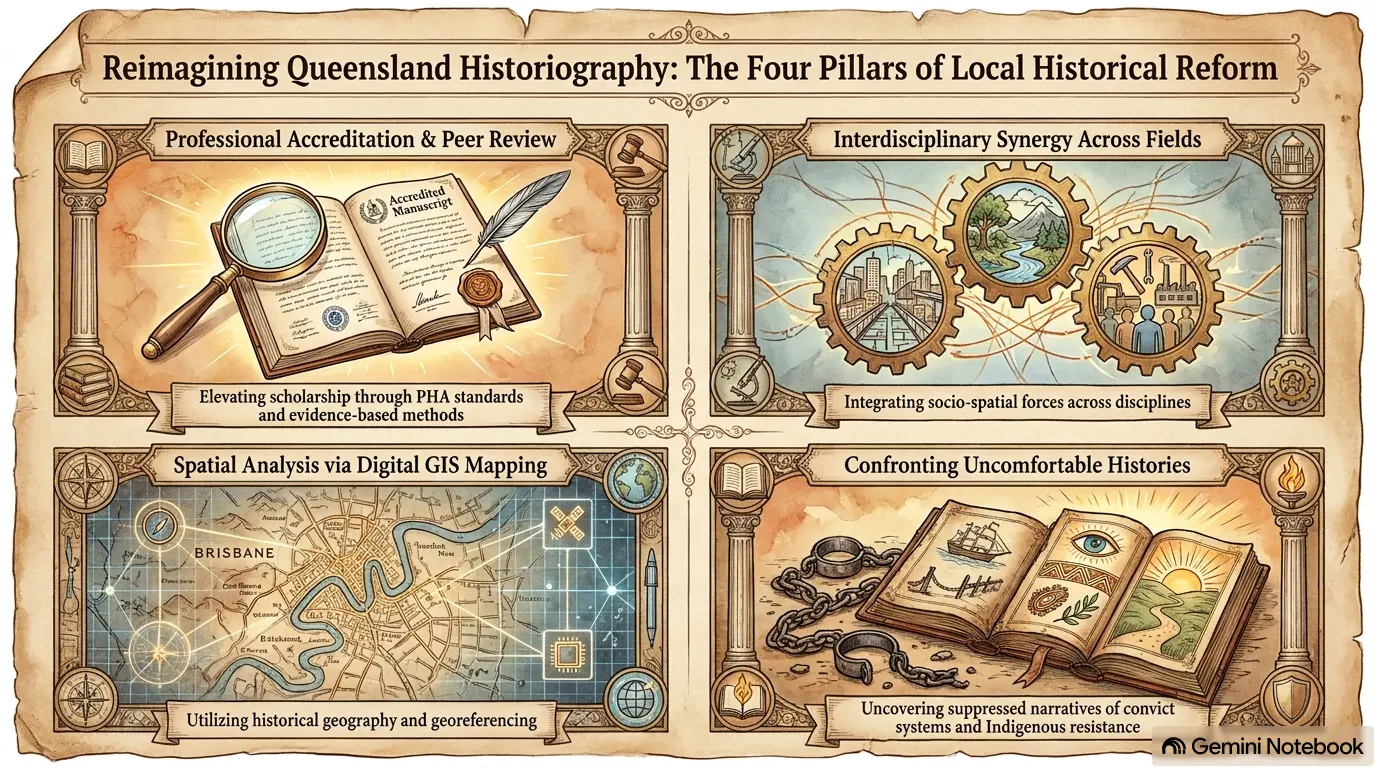
To operationalize prospective nostalgia, organisations must adopt the Four Pillars of Local Historical Reform (Buch 2026c, p. 175):
Professional Standards and Collaborative Accreditation : Leadership in local history must involve historians trained in critical research methodologies (Buch 2015, p. 15; Buch 2026c, p. 175). Peak accreditation bodies like the Professional Historians Association (Queensland) PHA Qld provide nationally recognized standards that enforce peer review, ethical practice, and rigorous source criticism (Dew 1971; Buch 2015, p. 42; Buch 2026c, p. 175). Professional historians must actively collaborate with community volunteers, bridging the gap between academic rigour and local passion (Dew 1971, p. 170; Buch 2026c, p. 175).
- Spatial Analysis via Digital GIS Mapping : Modern digital tools offer a direct antidote to unverified folk memory (Buch 2015, p. 10; Buch 2026c, p. 176). Projects like MBH and the Brisbane Southside History Network (BSHN) utilize GIS software to georeference early colonial survey maps—such as Stapylton’s 1839 survey and Dixon’s 1842 Moreton Bay map (Buch 2026c, p. 176). By overlaying archival records onto modern spatial geography, researchers can empirically verify or refute local legends, pinpointing exact historical structures rather than relying on inaccurate 20th-century suburban folklore (Buch & O’Connor 2024; Buch 2026c, p. 176).
- Interdisciplinary Frameworks : Local history must integrate insights from environmental history (examining land clearing, flood dynamics, and urban ecology; Rothman 1993, pp. 8–9; Mosley 2006, pp. 915–920; Buch 2026c, p. 177), urban history (analysing municipal governance and suburbanization; Mooney-Melvin 1996, pp. 18–21), and social history (examining labour movements and demographic shifts; Goubert 1971, pp. 116–117; Taksa 2000; Buch 2026c, p. 177).
- Interpreting Uncomfortable and Marginalized Histories : Local history venues must directly confront “uncomfortable history” (Baumann et al. 2011, pp. 37–40; Weyeneth 2014, pp. 9–12; Buch 2026c, p. 178). In Queensland, this requires incorporating frontier violence, convict penal regimes, institutional asylum histories (such as Goodna), working-class strikes, and multicultural experiences (e.g., Chinese, Pacific Islander, and European migrant histories) into permanent interpretive exhibits (Fisher 1990; Baumann et al. 2011; Buch 2026c, p. 178).
3.4 Operationalizing MICE Diagnostics and Triadic Governance
Finally, history organisations must deploy the diagnostic toolkits developed by the Management Institute for Contributory Economy (MICE) (Buch 2026b, pp. 160–161). Organisations should implement the POLICE framework ( Philosophically Ontology Logic Intersect Compatibility Education ) to audit local historical claims, detecting and filtering out manufactured myths, institutional PR spin, and epistemic evasion (Buch & Peach 2024; Buch 2026b, p. 160).
Furthermore, decision-making should adopt MICE’s triadic motto: “Radical enough to shift the agenda, liberal enough to allow everyone a decent place, and conservative enough to preserve the legacy of good value” (Buch 2026b, p. 161, 164). This triadic balance ensures that local history remains Conservative in preserving authentic historical evidence, Liberal in guaranteeing inclusive public participation, and Radical in shifting community focus away from market metrics toward genuine human flourishing (Buch 2026b, p. 161).
4. Civilisational Importance: Social Justice, Critical Citizenship, and Human Authorship
The message to reform the local history industry is not a mere academic exercise; it is of vital civilisational importance for the survival of democratic lifeworlds in the 21st century (Stiegler 2018; Buch 2026b, p. 162).
4.1 Truth, Accuracy, and the Non-Negotiable Prerequisite of Social Justice
Truth and accuracy in historical representation are non-negotiable prerequisites for social justice (Buch 2015, p. 16; Buch 2026c, p. 179). Sanitizing the past through nostalgic pioneer myths or institutional PR spin actively perpetuates historical violence and cultural erasure (Buch 2026c, p. 179). A society that refuses to confront its history—including First Nations land dispossession, colonial massacres, and systemic class inequality—cannot achieve genuine reconciliation, equity, or social cohesion (Buch 2015, p. 16; Buch 2026c, p. 179). Rigorous, evidence-based local history provides the necessary truth-telling foundation upon which meaningful social justice must be built (Buch 2015, p. 16; Buch 2026c, p. 179).
4.2 Local History as a Laboratory for Democratic Citizenship
As American historian Don McNeil established in his classic 1955 treatise, The Why of Local History , local history serves as an indispensable, small-scale laboratory for political and civic understanding (McNeil 1955, pp. 245–247; Buch 2015, pp. 4–6; Buch 2026c, p. 179). While broad national or international politics often seem distant and abstract, the local arena presents political, economic, and social forces at first hand (McNeil 1955, p. 246; Buch 2015, p. 5). By studying local municipal decisions, zoning conflicts, school board developments, and historical community struggles, citizens gain the analytical perspective required to judge contemporary political issues honestly and intelligently (McNeil 1955, p. 246; Buch 2026c, p. 179). Local history transforms passive residents into active, informed “citizen scholars” who understand the democratic process, respect minority rights, and possess the critical tools to resist bureaucratic manipulation (McNeil 1955, p. 246; Buch 2025a, p. 130; Buch 2026c, p. 179).
4.3 Halting Automated Denoetization and Preserving Noodiversity
In the contemporary era of generative AI, automated digital platforms, and technocratic algorithmification, society faces what philosopher Bernard Stiegler diagnoses as denoetization —the mechanical liquidation of the collective human capacity to think, judge, and care (Stiegler 2018, pp. 2–4; Buch 2026b, p. 162). When local history is surrendered to automated algorithms, superficial web summaries, or institutional PR portals, human beings lose their noetic agency, becoming passive consumers of manufactured content (Stiegler 2018, p. 3; Buch 2026b, p. 162).
Defeating institutional epistemic evasion and reforming local history is essential to preserve noodiversity —the preservation of epistemological pluralism, local historical memory, First Nations custodianship, and heterodox independent inquiry against centralist technocratic erasure (Stiegler 2020, p. 33; Buch 2026b, p. 162). Rigorous spatial and historiographical research restores “human authorship,” ensuring that human beings remain the conscious masters of their technology and the authors of their shared social existence (Buch 2026a, p. 144; Buch 2026b, p. 162).
4.4 Transitioning to the Contributory City of Intellect ( Eudaimonia )
Ultimately, democracy cannot survive as a cold, transactional market game governed by “rates, roads, and rubbish” (Buch 2026b, p. 157, 162). Defeating epistemic evasion enables society to transition into a Contributory City of Intellect —a urban community guided by panser (thinking as caring), mutual trust, and the pursuit of genuine human flourishing ( eudaimonia ) (Stiegler 2018, p. 4; Buch 2026b, p. 162). By transforming local history from a sentimental antiquarian pastime into a rigorous, inclusive, and critical discipline, we equip communities with the intellectual tools needed to navigate contemporary crises—such as urban gentrification, environmental degradation, and social inequality—and secure a truthful, democratic, and flourishing future for all (McNeil 1955, p. 247; Buch 2026c, p. 180).
5. Bibliography
- Abbott, L. & Grayson, R.S. (2011) ‘Community engagement in local history: a report on the Hemel at War project’, Teaching History , 145, pp. 4–12.
- Batcho, K.I. (2026) ‘NOSTALGIA: The Bittersweet History of a Psychological Concept’, in History of Nostalgia , pp. 169–176.
- Baumann, T., Galloy, J.M., Hurley, A. & Wolford, J.B. (2011) ‘Interpreting Uncomfortable History at the Scott Joplin House State Historic Site in St. Louis, Missouri’, The Public Historian , 33(2), pp. 37–66.
- Buch, N. (2015) Local History and Value – An Annotated Bibliography , Brisbane Southside History Network, Working Draft 3, 1 May 2015, pp. 1–45.
- Buch, N. (2016) The Brisbane History Governance Review , Working Paper, Brisbane Southside History Network, pp. 1–12.
- Buch, N. (2019a) Greater Brisbane and Our Local History Approach , Brisbane Southside History Network, pp. 1–3.
- Buch, N. (2019b) Local History Beyond Appearance, Stephens Shire Study , Data Handout, Brisbane Southside History Network, pp. 1–6.
- Buch, N. (2019c) Professional History for The local Philosophy Cafe , Working Paper, pp. 1–8.
- Buch, N. (2020) Higher Education and the Credential Society in Queensland , Working Paper, Management Institute for Contributory Economy, pp. 1–10.
- Buch, N. (2021) The Manufactured Myth of the Queensland Character , Working Paper, Management Institute for Contributory Economy, pp. 1–8.
- Buch, N. (2022a) Wither Local History in the Academy? The shifting historiography in Local Studies and Local History in Australian Universities and among Independent Researchers , AHA Conference Paper, 28 June 2022, pp. 1–24.
- Buch, N. (2022b) Wither Local History in the Academy , PowerPoint Presentation, AHA Conference, 28 June 2022, slides 1–28.
- Buch, N. (2024) The Techné Mindset and Vocational Reductionism in Queensland Education , Working Paper, Management Institute for Contributory Economy, pp. 150–175.
- Buch, N. (2025a) Local History Cognition , Working Paper, Sunnybank Hills, Brisbane, pp. 1–25.
- Buch, N. (2025b) Local History Cognition – Bibliography , Working Paper, Sunnybank Hills, Brisbane, pp. 1–15.
- Buch, N. (2026a) New MBH Program. Mapping Brisbane History. The Local Study Area Framework , Management Institute for Contributory Economy (MICE), pp. 1–12.
- Buch, N. (2026b) The Dunning–Kruger Effect. The Pathology of Unearned Confidence: Deconstructing the Dunning–Kruger Effect, Epistemic Evasion, and Institutional Regression in Queensland Governance , Management Institute for Contributory Economy (MICE), 28 May 2026, pp. 1–283.
- Buch, N. (2026c) The Nostalgia Trap. Historiography, Pioneer Mythology, and the Intellectual Reform of Queensland Local History , Management Institute for Contributory Economy (MICE), pp. 1–25.
- Buch, N. (2026d) The Perennial Struggle to Defeat Nonsense. The Anatomy of Bureaucratic Denial , Management Institute for Contributory Economy (MICE), 4 November 2026, pp. 1–20.
- Buch, N. & O’Connor, A. (2024) The Big Mapping Picture of Coopers Plains , Submission to the Royal Geographical Society of Queensland (RGSQ), Coopers Plains History Group, 27 February, pp. 1–12.
- Buch, N. & Peach, N. (2024) Philosophically Ontology Logic Intersect Compatibility Education (POLICE) , Brisbane: Management Institute for Contributory Economy (MICE).
- Cilento, R. & Lack, C. (eds) (1959) Triumph in the Tropics: An Historical Sketch of Queensland , Brisbane: Smith and Paterson.
- Collins, R. (1979/2019) The Credential Society: An Historical Sociology of Education and Stratification , New York: Academic Press / Columbia University Press.
- Dew, L.A. (1971) ‘The “Professional” Historian and Local History’, Louisiana History: The Journal of the Louisiana Historical Association , 12(2), pp. 167–175.
- Dunning, D. & Kruger, J. (1999) ‘Unskilled and unaware of it: How difficulties in recognizing one’s own incompetence lead to inflated self-assessments’, Journal of Personality and Social Psychology , 77(6), pp. 1121–1134.
- Finberg, H.P.R. (1952) The Local Historian and His Theme , Leicester: University College of Leicester Occasional Papers.
- Fisher, R. (1990) ‘Roots of Racism: The Chinese Experience in Early Brisbane, 1848-1860’, Labour History , 59, pp. 73–86.
- Fridley, R.W. (1968) ‘Local History and World Upheaval’, Minnesota History , 41(4), pp. 171–177.
- Ginn, G. (2009) ‘Cilento’s Centenary: The Triumph of His Topics’, Queensland Review , 16(2), pp. 57–85.
- Gieryn, T.F. (1983) ‘Boundary-work and the demarcation of science from non-science’, American Sociological Review , 48(6), pp. 781–795.
- Goubert, P. (1971) ‘Local History’, Daedalus , 100(1), pp. 113–127.
- Huang, P. (1982) ‘County Archives and the Study of Local Social History: Report on a Year’s Research in China’, Modern China , 8(1), pp. 133–143.
- Jameel, A. (2026) The Lifestyle State: “Needs become luxuries. Welfare becomes lifestyle” , Lahore: Zenodo. DOI: 10.5281/zenodo.20824313.
- Kammen, C. (2011) ‘On Doing Local History: In Memoriam: Quite a Decade’, History News , 66(4), pp. 3–4.
- Lowenthal, D. (1996) The Heritage Crusade and the Spoils of History , London: Viking.
- McNeil, D. (1955) ‘The Why of Local History’, The Wisconsin Magazine of History , 38(4), pp. 245–247.
- Mooney-Melvin, P. (1996) ‘Urban History, Local History and Public History’, History News , 51(2), pp. 18–23.
- Mosley, S. (2006) ‘Common Ground: Integrating Social and Environmental History’, Journal of Social History , 39(3), pp. 915–933.
- Palmowski, J. (2002) ‘Liberalism and Local Government in Late Nineteenth-Century Germany and England’, The Historical Journal , 45(2), pp. 381–409.
- Pickering, M. & Keightley, E. (2006) ‘The Modalities of Nostalgia’, Current Sociology , 54(6), pp. 919–941.
- Rothman, H.K. (1993) ‘Environmental History and Local History’, History News , 48(6), pp. 8–9.
- Simon, H.A. (1957) Models of Man, Social and Rational , New York: John Wiley & Sons.
- Stiegler, B. (2018) New Urban Engineering, New Urban Genius , Keynote Address, Shanghai, 22 November 2018, pp. 1–6.
- Stiegler, B. (2020) Excess, Promises, Compromise , in General Organology , Paris: Les Liens qui Libèrent, pp. 1–35.
- Taksa, L. (2000) ‘Like a Bicycle, Forever Teetering between Individualism and Collectivism: Considering Community in Relation to Labour History’, Labour History , 78, pp. 7–32.
- Weyeneth, R.R. (2014) ‘What I’ve Learned Along the Way: A Public Historian’s Intellectual Odyssey’, The Public Historian , 36(2), pp. 9–25.
- Williams, B. (1985) Ethics and the Limits of Philosophy , Cambridge, MA: Harvard University Press.
Take the MICE Quiz
[1] Artificial Intelligence (A.I.) has been fairly used in the production of this work. The tool used is Google NotebookLM (recently rebranded as Gemini Notebook). It is an AI-powered virtual research assistant and thinking partner designed to help a person interact deeply with their own documents. Unlike general chatbots, it is source-grounded, meaning it only generates answers based on the specific PDFs, documents, or links uploaded. The A.I. process in the production of this work has been limited to the attached (prompts) on each of the questions in turn. This ensures an accurate reading of each source. The author then rearranged and re-edited the answers the A.I. provided. The human author publishes this work. A.I. is never an author when used properly. This assistance is not qualitatively different from a human research assistant when that assistance is deemed to have no authorial status but is acknowledged.


Neville Buch
Latest posts by Neville Buch (see all)
- University interdisciplinary rankings 2027: The Illusion of Metrics and the Hollowing Out of Australian Higher Education – November 18, 2026
- The Political Backend of the Local History Industry – November 18, 2026
- The Perennial Struggle to Defeat Nonsense: The Anatomy of Bureaucratic Denial – November 18, 2026