
The “Should Taxpayers Fund Independent Philosophy” audio commentary on MICE’s Contributory Economy and Human Authorship:

The “Who Is the Real Academic Rent Seeker” audio commentary on MICE’s Contributory Economy and Human Authorship:
Abstract
This essay presents a critical interrogation of Bevin Luchel’s monograph, Fixed Mindsets, Fixed Incomes: What Beyond the Binary Is Really Asking For (2026), evaluating its arguments through the twin lenses of comprehensive philosophical anthropology and contributory political economy. Luchel mounts an orthodox neoliberal critique of Dr. Neville Buch’s proposal for “professional contractualism” and the institutional framework of the Management Institute for Contributory Economy (MICE), framing them through public choice theory as rent-seeking special pleading, bureaucratic capture, and a “sinecure complex” rooted in status inconsistency.
This essay demonstrates that Luchel’s critique collapses because it commits two foundational category errors: anthropologically, it reduces the evaluating, willing “historical person” to an atomized, utility-maximizing homo economicus, mistaking the procedural strictures of corporate managerialism for objective inquiry; economically, it conflates price with value and short-term transactional market clearance with long-term civilizational capital. By contrasting Luchel’s narrow market fundamentalism with MICE’s synthesis of Bernard Stiegler’s organology, Jürgen Habermas’s communicative action, and Bernard Williams’s thick ethical concepts, this essay demonstrates why the Contributory Economy represents a rigorous, practical, and vital alternative to the epistemic degradation of the contemporary knowledge commons.
1. How MICE Principles and Philosophy Actually Work
To understand where Luchel’s critique falters, one must first accurately articulate what the Management Institute for Contributory Economy (MICE) is and how its philosophical architecture operates[1]. Luchel reduces MICE to an administrative vehicle designed to extract state retainers for independent scholars[4][5]. In reality, MICE is an interdisciplinary research and governance framework grounded in what Buch terms “Spiral Historiography”—reading foundational and ancient insights with modern inclusivity to navigate contemporary structural crises[3].
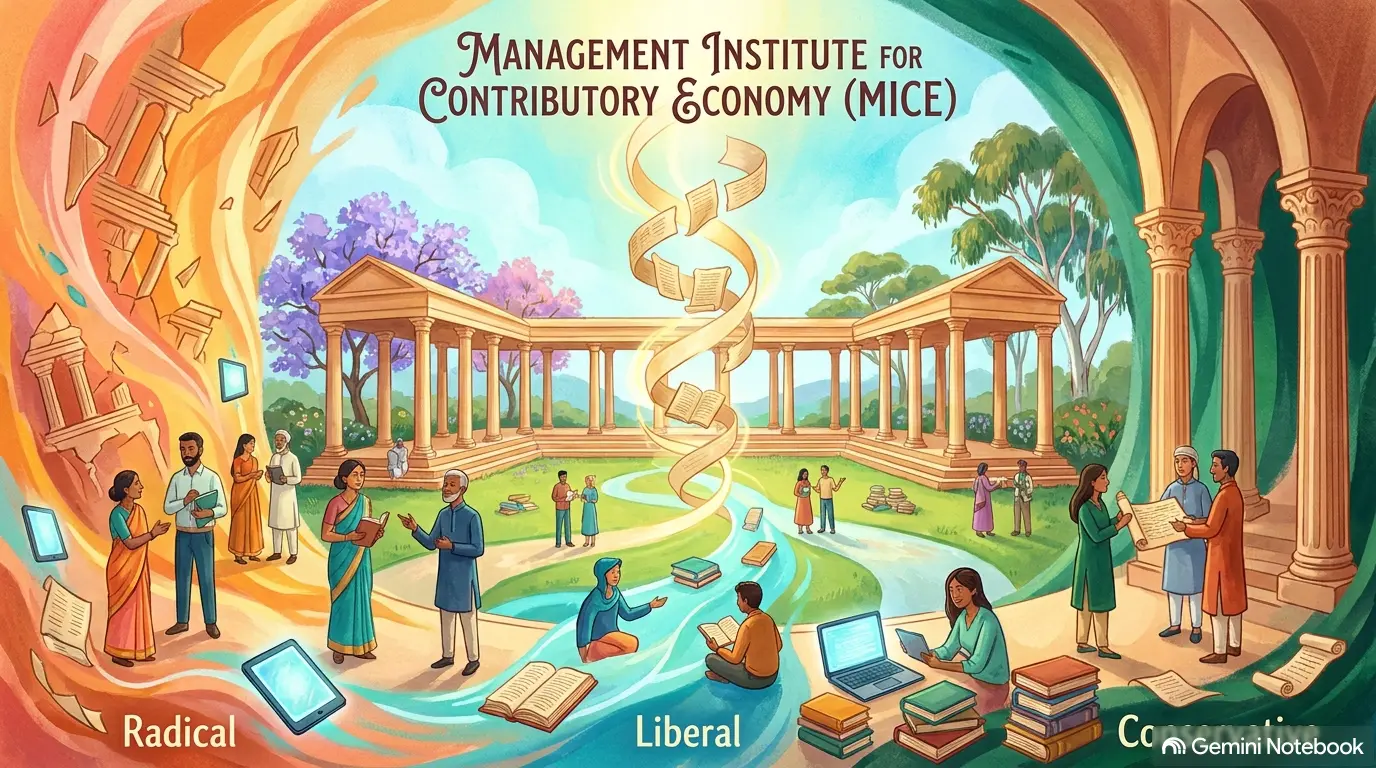
As articulated in its foundational charter, MICE functions across eight integrated principles synthesized from European continental philosophy, Anglo-American epistemology, and cognitive sociology[3]:
- The Organological Dimension (Stiegler): Drawing upon Bernard Stiegler’s Technics and Time, MICE recognizes that human memory, cognition, and culture are intrinsically coupled with technical artifacts (epiphylogenesis)[12][13]. In an unregulated digital economy dominated by algorithmic predictive text and speculative platforms, the uncritical mechanization of thought induces “denoetization”—the systematic liquidation of human cognitive faculties, deep memory, and contemplative judgment[12]. MICE operates to restore “long circuits of attention,” ensuring that technical implements serve humanization rather than reducing the thinker to a passive node in a feedback loop[9][15].
- The Communicative Dimension (Habermas): MICE operationalizes Jürgen Habermas’s theory of communicative competence and communicative action[9]. Rather than accepting transactional bargaining where power and money dictate outcomes, MICE provides an institutional model for **”Open Constitutionalism”**[16][20]. This framework establishes a transparent “level playing field” where action conflicts are resolved through unforced, reasoned consensus rather than administrative decree[16].
- The Ethical Dimension (Williams): Following Bernard Williams’s critique of empty utilitarian formalism, MICE anchors socio-economic assessment in “thick ethical concepts” (such as truthfulness, courage, and integrity)[8]. These concepts inherently integrate factual description with evaluative meaning, preventing economic policy from degenerating into the thin, statistical abstractions of audit culture[21][22].
- The Operational Method (The POLICE Framework): MICE operationalizes its inquiry through the five-stage POLICE filter (Philosophically Ontology, Logic, Intersect, Compatibility, Education)[16]. This systematic diagnostic tests whether any theoretical model corresponds to actual states of affairs (Ontology), maintains deductive coherence (Logic), integrates cross-disciplinary datasets without disciplinary imperialisms (Intersect), aligns with empirical and historical baselines (Compatibility), and translates into socially accountable public pedagogy (Education)[23].
Far from being an insular guild or an entitlement vehicle, MICE is a structured methodology designed to cultivate human capability and preserve civilizational knowledge against systemic market short-termism[5][8].
2. How Luchel’s Critique Goes Wrong: Anthropological and Economic Flaws
Bevin Luchel’s Fixed Mindsets, Fixed Incomes organizes its attack around eight formal charges, accusing Buch of rent-seeking, shifting intellectual ground, misapplying epistemology, and evading public choice economics[15]. However, when subjected to comprehensive examination, Luchel’s polemic reveals profound conceptual failures:

A. The Anthropological Collapse: Eliminating the “Historical Person”
The primary defect of Luchel’s essay lies in its impoverished philosophical anthropology. Luchel unreservedly adopts the neoclassical ontology of the sovereign consumer and the utility-maximizing contractor[31][32]. In doing so, he reduces the human thinker to what Arpad Szakolczai and Tim Ingold identify as the central pathology of modern rationalism: an abstract entity detached from lifeworld immersion, environment-coupling, and lived history[33].
In Buch’s philosophical anthropology, the primary analytical category is the “historical person”—the human being as an evaluating, willing subject and proactive author of their own existence, who is “context-embedded but not context-determined”[36]. Luchel’s thesis that a scholar’s intellectual output must be judged by its marketability (“the choice of readers to attend or look elsewhere”) ignores how corporate capitalism actively manipulates desire and commodifies attention[39]. As Shoshana Zuboff’s research on surveillance capitalism demonstrates, contemporary market platforms do not neutrally aggregate consumer choice; they trade in behavioural surplus, engineering automated feedback loops that erode human agency and speculative depth[41][42].
By treating the market as a neutral, objective arbiter of intellectual worth, Luchel confuses the transactional apparatus of modern “schooling” and digital distribution with genuine epistemic authority[43]. As Szakolczai demonstrates, the mechanical imitation of market metrics in academic disciplines functions like an alchemical delusion—a “magic wand” that replaces deep participatory understanding with superficial administrative productivity[45].
B. The Epistemic Error: Conflating Warrant with Market Clearance
Luchel repeatedly charges Buch with committing a category error by invoking Susan Haack’s foundherentism, asserting that Haack’s crossword-puzzle model of warrant provides no mandate for municipal budgets or state retainers[29]. Here, it is Luchel who commits the decisive category error.
Buch’s deployment of Haack is directed against Luchel’s own market fundamentalism: the neoliberal claim that if an idea cannot achieve self-sustaining commercial monetization, its production represents an inefficient misallocation of scarce resources[32]. By decoupling epistemic warrant from consumer demand, foundherentism establishes that the truthfulness, historical coherence, and explanatory power of historical analysis exist entirely independent of whether a market willing to purchase it exists[32][52].
When Luchel retorts that unfunded truths can simply survive on volunteer labour, independent presses, or personal wealth, he ignores the material reality of knowledge production[53][54]. Complex historical synthesis—such as the reconstruction of Queensland’s legal, institutional, and frontier history—requires extensive archival excavation, specialized paleographic skills, and years of dedicated labour[55][56]. To demand that this work submit to the instant profitability of the marketplace or be consigned to extinction is not a defence of an “open society”; it is a recipe for cultural denoetization and historical forgetfulness[14].
C. The Flaw of Public Choice Reductionism
Luchel’s reliance on James Buchanan, Gordon Tullock, and William Niskanen is dogmatic and one-dimensional[31]. While public choice theory accurately identifies the rent-seeking tendencies of self-aggrandizing bureaucracies, Luchel elevates it to a metaphysical absolute: any public underwriting of intellectual labour must inevitably devolve into administrative capture, conformity, and corrupt gatekeeping[31][62].
This creates a false binary: either intellectual life is abandoned to the hyper-commodified Darwinism of market platforms, or it is trapped in Soviet-style bureaucratic monopoly[63]. Luchel completely ignores MICE’s explicit constitutional alternative: Open Constitutionalism mediated by the POLICE framework[16][20]. Under open constitutionalism, funding panels are not static bureaucratic monopolies; they are periodically renegotiated, publicly accountable councils governed by transparent procedural criteria, strict peer-reviewed falsification, and cross-disciplinary verification[16].
D. The False Equivalence of Digital Voluntarism
Luchel points to Wikipedia, Linux, arXiv, and open-source software as empirical proof that high-level intellectual commons require no structural economic underwriting[64]. This comparison fails under institutional scrutiny.
First, as Yochai Benkler’s own research reveals, open-source infrastructure such as Linux and Apache is heavily subsidized by major corporate capital (IBM, Google, Red Hat) that extracts downstream commercial value from shared standards[67]. Second, Wikipedia functions as a tertiary aggregator of already-published literature; it does not, by its own foundational policies, generate original primary research or archival historical synthesis. Third, while preprint servers like arXiv and PhilArchive circulate papers, the scholars writing those papers are overwhelmingly employed in salaried university positions or supported by institutional fellowships[65].
To cite digital preprint servers—populated by salaried researchers—as evidence that independent humanists need no income or economic infrastructure is a glaring empirical evasion[65][68].
E. Ad Hominem Diagnosis vs. Epistemic Critique
Finally, Luchel devotes extensive space to hypothesizing psychological motives, invoking Gerhard Lenski’s “status inconsistency” to dismiss Buch’s philosophy as the personal resentment of an academic outsider who owns property in Brisbane[5].
This move exemplifies what C. S. Lewis termed “Bulverism”—assuming a claim is false based on the alleged social or financial circumstances of the author rather than engaging the substantive truth of the argument[73][74]. Whether a scholar holds an endowed university chair or works as an independent researcher in Sunnybank Hills has zero bearing on the logical validity of the Dynamic of Cognition model or the empirical realities of academic casualization[6][70]. By focusing on personal circumstances, Luchel evades the structural crisis documented across higher education: the halving of academic departments, the exploitation of doctoral graduates, and the dismantling of humanities curricula[75].
3. Why MICE Is a Potential and Practical Solution to the Failing Economic Model
Contemporary society is grappling with the profound exhaustion of the neoliberal economic paradigm[76][77]. This failure manifests not only in widening wealth inequality and ecological degradation, but in an acute crisis of intellectual infrastructure[78][79]. Under corporate managerialism, universities have abandoned their civic and humanistic mandates, replacing collegial education with commercial “schooling,” casualized piecework, and audit-driven throughput[44].
Simultaneously, the broader digital economy has entered the era of surveillance capitalism, where human experience is mined as raw behavioural data and human cognition is outsourced to commercial predictive algorithms[41].
MICE offers a viable, grounded, and practical economic alternative through the framework of the Contributory Economy[8][84]:

- Decoupling Contribution from Extractive Labour: Following Bernard Stiegler’s macroeconomic proposals, the Contributory Economy recognizes that automation, artificial intelligence, and algorithmic systems are permanently eroding traditional wage-labour hours[9][12]. Attempting to force all human activity into conventional market employment produces underemployment, extreme precarity, and widespread “bullshit jobs.” MICE replaces this extractive paradigm with a model that remunerates citizens for contributory activities—activities that generate non-rivalrous social value, cultural knowledge, ecological care, and public education[8].
- Operationalizing “Professional Contractualism”: Contrary to Luchel’s assertion that professional contractualism is an unaccountable sinecure, MICE models it on established public-good frameworks[4][49]. Just as societies publicly finance municipal infrastructure, civil engineering codes, and public health officers because their failure endangers the physical community, societies must underwrite cognitive scaffolding and historical literacy to protect the democratic public sphere from demagoguery and epistemic collapse[4][15]. These contracts are governed by verifiable deliverables: public lectures, community archives, school curriculum support, and transparent peer review via the POLICE methodology[3].
- Restoring Local and Regional Economies: As demonstrated in Buch’s historical analyses of Queensland, local communities possess rich, diversified histories of belief, doubt, and social struggle that are systematically ignored by centralized corporate media and global university rankings[58][85]. MICE provides a decentralized structure that connects independent researchers with local historical societies, municipal councils, and community groups, fostering resilient networks of mutual support and civic regeneration[86][87].
- Reconciling the Political Dialectic: MICE operationalizes its distinctive motto: *”Radical enough to shift the agenda, liberal enough to allow everyone a decent place in the social environment, and conservative enough to preserve the legacy of good value”*[84][88]. This triadic balance prevents reform from collapsing into destructive radicalism or stagnant traditionalism, providing a practical, evolutionary pathway for institutional renewal[3][84].
4. Why MICE Is Important: Reclaiming Human Authorship
At its deepest philosophical core, MICE is not merely an alternative funding proposal; it is a vital defence of human authorship and noetic flourishing in an era of technological hyper-rationalization[12].
When society surrenders its intellectual life to market algorithms and corporate audit metrics, it accelerates what Stiegler calls symbolic misery—the loss of the capacity to feel, think, and author one’s own life[12]. In such a world, ideas are reduced to machine-optimized tokens, history is liquidated into an endless digital present, and the human being is relegated to an unreflective consumer of automated autocomplete[14].
MICE matters because it insists on the irreducibility of the human spirit:
- It Champions the “Historical Person”: MICE re-centres the individual as an active agent capable of reflection, moral courage, and compassionate intelligence, refusing to treat human beings as superfluous objects of bureaucratic systems[37].
- It Fosters “Horizon Fusion” and Social Peace: In an increasingly polarized society divided into rigid ideological silos, MICE deploys Gadamerian hermeneutics and Habermasian communicative action to build genuine bridges between conflicting worldviews, transforming destructive social anger into constructive, lasting resolution[16].
- It Protects the Intellectual Commons: By providing an epistemological and economic harbor for independent scholars, regional historians, and non-conforming thinkers, MICE ensures that truth-seeking remains pluralistic, rigorous, and free from the coercive pressures of both corporate capital and authoritarian administrative regimes[11].
Conclusion
Bevin Luchel’s Fixed Mindsets, Fixed Incomes is a textbook artifact of the very pathology it seeks to defend: a marketized mindset that knows the price of everything and the value of nothing[32][95]. By attempting to trap a profound philosophical proposal within the narrow cage of public choice incentives and personal status anxieties, Luchel misses the civilizational stakes of the debate[31][70].
The Management Institute for Contributory Economy is not asking for a sinecure; it is offering a disciplined, rigorous, and workable pathway out of the Analytical Abyss[4][94]. It calls for an economic order where the life of the mind is no longer treated as a market luxury, but cherished as the indispensable foundation of human freedom, democratic wisdom, and planetary hope[8][84].
References
Benkler, Y. (2006) The Wealth of Networks: How Social Production Transforms Markets and Freedom. New Haven, CT: Yale University Press[67][96].
Brueggemann, W. (2014) Sabbath as Resistance: Saying No to the Culture of Now. Louisville, KY: John Knox Press[97].
Buchanan, J.M. and Tullock, G. (1962) The Calculus of Consent: Logical Foundations of Constitutional Democracy. Ann Arbor: University of Michigan Press[60][61].
Buch, N. (2015) Process of Learning (Principles) & The Dynamic of Cognition. Brisbane: Dr Neville Buch Publications[98].
Buch, N. (2018) ‘Small is Big: Scaling the Map for Brisbane Persons and Institutions 1825–2000’. Paper presented at the Australian Historical Association Conference, Canberra[99][100].
Buch, N. (2024) ‘Philosophically Ontology Logic Intersect Compatibility Education (POLICE)’. Brisbane: Dr Neville Buch Publications[98].
Buch, N. (2024) ‘Queensland History, Religious Education, and Belief’, in D.W. Kim and D. Wright (eds) Environmental Hope: Socio-Anthropological Approaches to Religion. London: Lexington Books, pp. 175–192[101].
Buch, N. (2025) MICE Principles and Philosophy (First Development). Working Paper. Brisbane: Management Institute for Contributory Economy[3].
Buch, N. (2026) Academic Rigour, Epistemic Renewal, and the Crisis of Inquiry: A Scholarly Review of the Vanderbilt Commission Report on the State of Scholarship. Brisbane: MICE[1].
Buch, N. (2026) Yes, I want Anger Expressed But Then Resolved. Brisbane: MICE[117].
Dweck, C.S. (2006) Mindset: The New Psychology of Success. New York: Random House[28][121].
Gadamer, H.-G. (1989) Truth and Method. 2nd rev. edn. New York: Crossroad[122].
Haack, S. (1993) Evidence and Inquiry: Towards Reconstruction in Epistemology. Oxford: Blackwell[49][121].
Habermas, J. (1984) The Theory of Communicative Action. Boston: Beacon Press[122].
Habermas, J. (1991) Knowledge and Human Interests. Cambridge: Polity Press[123].
Ingold, T. (2011) Being Alive: Essays on Movement, Knowledge and Description. London: Routledge[34][124].
Lenski, G.E. (1954) ‘Status Crystallization: A Non-Vertical Dimension of Social Status’, American Sociological Review, 19(4), pp. 405–413[72][121].
Lewis, C.S. (1970) ‘Bulverism’, in God in the Dock: Essays on Theology and Ethics. Grand Rapids, MI: Eerdmans[68][74].
Luchel, B. (2026) Fixed Mindsets, Fixed Incomes: What Beyond the Binary Is Really Asking For. Brisbane: October 2026[4].
Niskanen, W.A. (1971) Bureaucracy and Representative Government. Chicago: Aldine-Atherton[60][155].
Postman, N. and Weingartner, C. (1969) Teaching as a Subversive Activity. New York: Delacorte Press[146].
Stiegler, B. (1998) Technics and Time, 1: The Fault of Epimetheus. Stanford: Stanford University Press[13][156].
Stiegler, B. (2014) Symbolic Misery, Vol. 1: The Hyper-industrial Epoch. Cambridge: Polity Press[51][155].
Szakolczai, A. (2023) Political Anthropology as Method. London and New York: Routledge[33].
Williams, B. (1985) Ethics and the Limits of Philosophy. Cambridge, MA: Harvard University Press[13][84].
Zuboff, S. (2019) The Age of Surveillance Capitalism: The Fight for a Human Future at the New Frontier of Power. New York: Public Affairs[41].


Neville Buch
Latest posts by Neville Buch (see all)
- Beyond Neoliberal Formalism: Should Taxpayers Fund Independent Philosophy – October 14, 2026
- A Critical Phenomenology and Epistemology of Open and Fixed Mindsets: Quantum Biology of the Open Mind – October 13, 2026
- The Spiral Historiography in the Techné Mindset – October 13, 2026