
Abstract
This essay is basically humanly-devised with A.I. assistance in re-drafting. The aim of the essay is to articulate “ingredients” which have always been the Management Institute for Contributory Economy (MICE) Motto but is still new for some persons. The MICE Motto in the details expresses the Vision and Operation.
1. Introduction and Methodological Foundations
The Management Institute for Contributory Economy (MICE) Motto is “Radical enough to shift the agenda, liberal enough to allow everyone a decent place in the social environment, and conservative enough to preserve the legacy of good value.”
This essay is basically humanly-devised and A.I. assisted message for governing decision-makers. The general public understands the messaging well. They have been harmed by bad decision-making due the failures in sufficient comprehension. The MICE Motto in the details expresses the Vision and Operation. The reverse order of the Motto is revealing for our purpose.
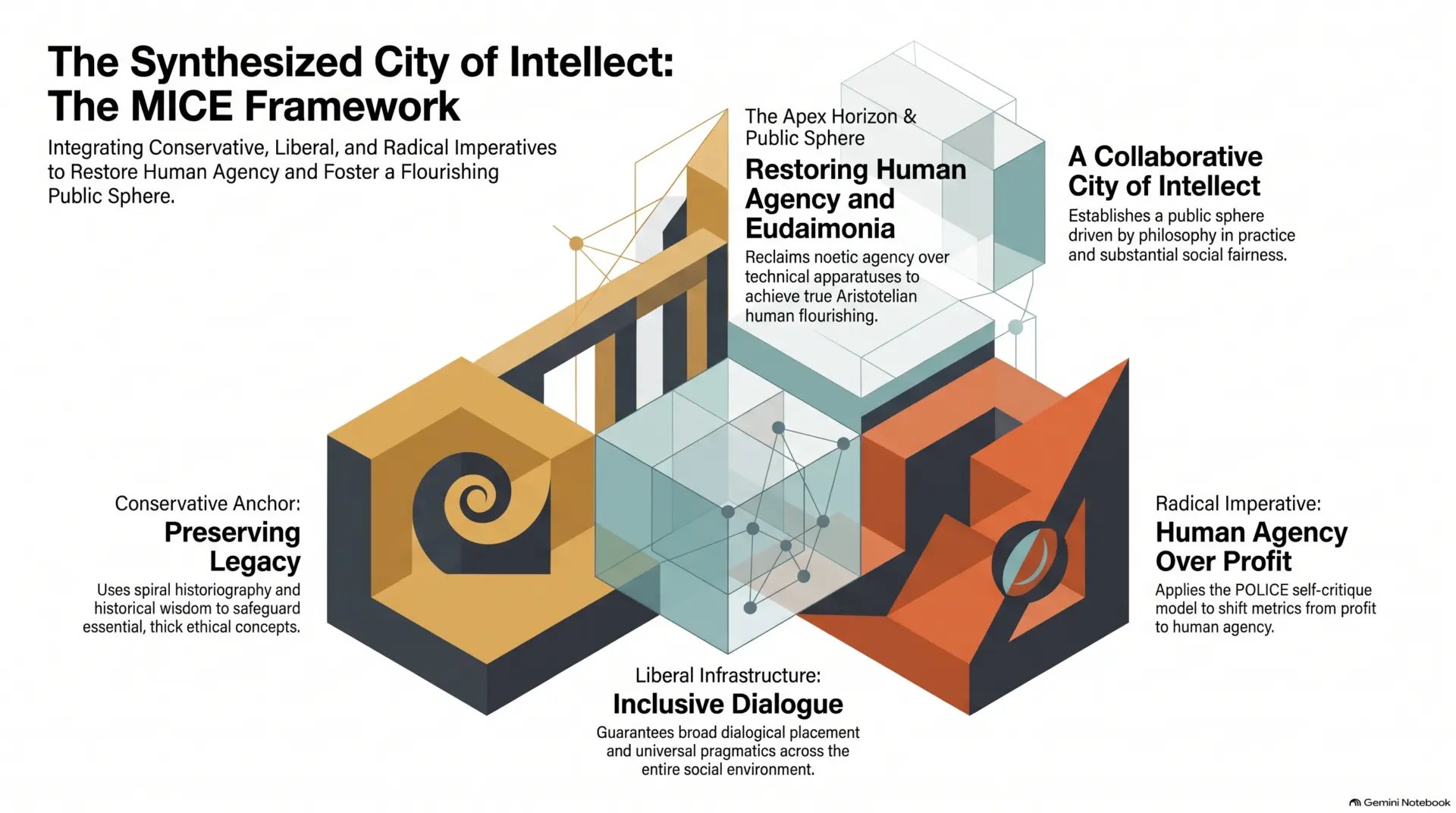
While these three ideological streams—conservatism, liberalism, and radicalism—are frequently presented in contemporary politics as mutually exclusive or adversarial, MICE synthesises them into a coherent epistemological discipline (A Different Radical Centre 2026, p. 1; Buch 2026a, p. 14). This synthesis is explicitly humanly devised with artificial intelligence assistance (Buch 2026b, p. 1). In accordance with MICE’s foundational principles of human authorship, generative AI tools (such as Google NotebookLM / Gemini Notebook) operate strictly as source-grounded research assistants without authorial status, ensuring that the human subject (“the who”) maintains conscious control over technological apparatuses (“the what”) (Buch 2026b, p. 1; Jameel & Buch 2026, p. 107; Reclaiming Human Authorship 2026, p. 3).
Crucially, MICE’s concept of the Radical Centre differs from the political “Third Way” championed by figures like Tony Blair and Anthony Giddens (Mouffe 2000, p. 1; A Different Radical Centre 2026, p. 1). Political theorist Chantal Mouffe rightly critiques the “Third Way” for promoting a dangerous “politics without adversary,” which creates a “democratic deficit” by falsely assuming that a “win-win” market consensus can eliminate structural power imbalances (Mouffe 2000, p. 2; A Different Radical Centre 2026, p. 1).
In contrast, Dr Neville Buch’s “accurate centralism” is not a political maneuver to erase conflict, but an intellectual discipline designed to navigate between the ideological extremes of hard materialism and vague spiritualism (Buch 2025b, p. 2; A Different Radical Centre 2026, p. 1). Rather than seeking a superficial compromise that surrenders to neoliberal market hegemony, MICE uses rigorous diagnostic tools—such as the POLICE model ( Philosophically Ontology Logic Intersect Compatibility Education )—to unmask “institutional bullshit,” test assumptions, and restore human agency (Buch & Peach 2024; A Different Radical Centre 2026, p. 2; Buch 2026a, p. 46).
Conservative enough to preserve the legacy of good value
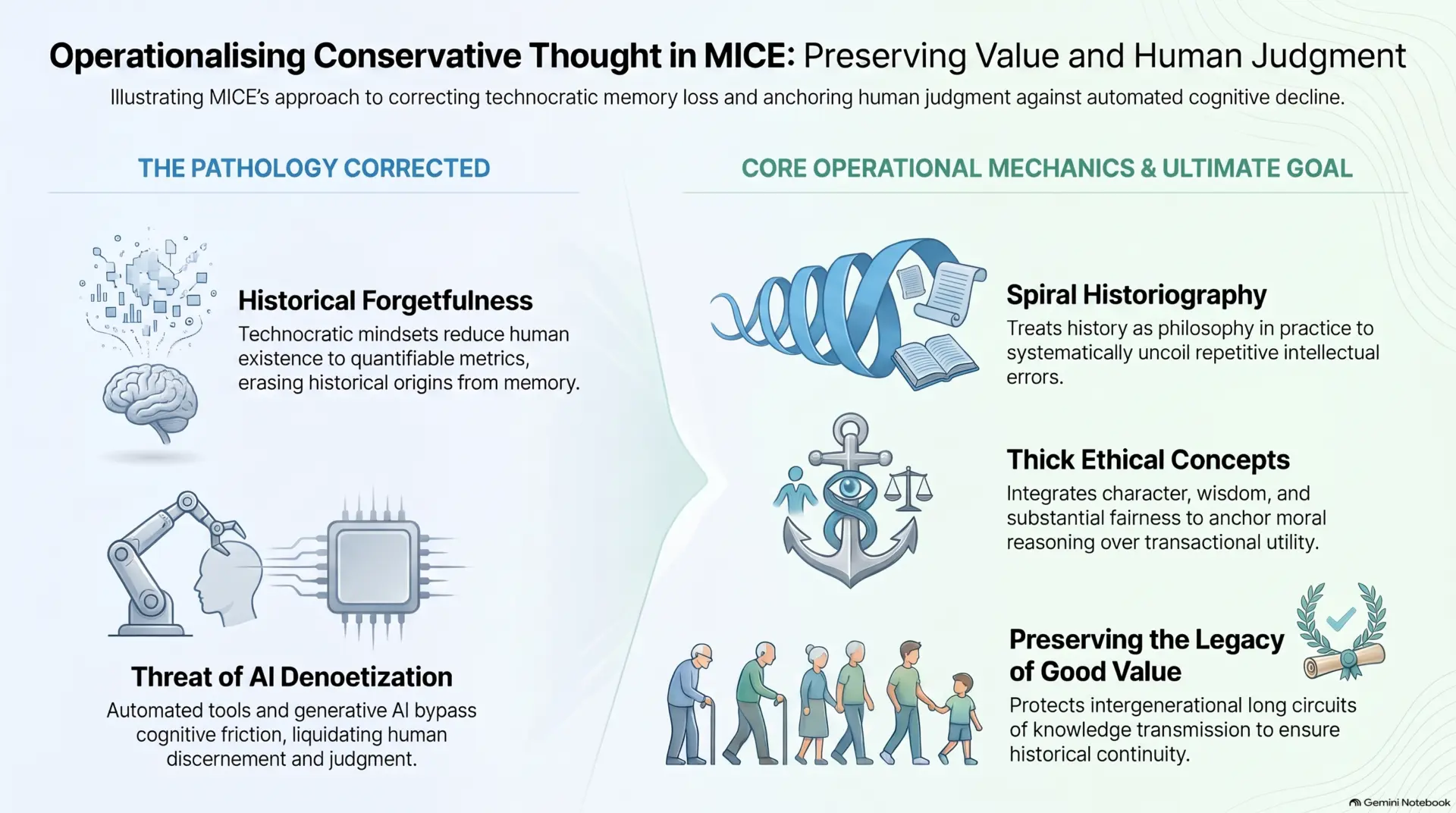
The first operational pillar of the MICE motto—analysed here in the revealing reverse order of practical implementation—focuses on conservative preservation (Buch 2026b, p. 2). In the MICE framework, conservatism is detached from reactionary party politics or market-fundamentalist “neoconservatism,” which often destroys traditional community bonds in pursuit of speculative financial gain (Buch 2024b, p. 177; Buch 2026a, p. 14). Instead, conservatism is operationalised as the deliberate preservation of historical wisdom, cultural legacy, and moral standards necessary to anchor human character (Buch 2025a, p. 1; Buch 2026a, p. 14).
A. Remediating “Historical Forgetfulness” via Spiral Historiography
MICE identifies “Historical Forgetfulness”—the systemic banishment of historical origins and regional intellectual legacies from public memory—as a primary cognitive pathology of contemporary governance (Buch 2024a, p. 2; Buch 2026a, p. 39). Technocratic management treats the social landscape as a static, flat plane to be re-engineered according to short-term economic metrics (Buch 2026a, p. 39; Buch 2026c, p. 4).
MICE operationalises conservative thought through Spiral Historiography, which treats history as “philosophy in practice” (Buch 2024a, p. 2; Buch 2026a, p. 39, 45). By “uncoiling” past intellectual struggles and unearthing forgotten historical contexts—such as Queensland’s hidden intellectual history or early multicultural contributions—MICE preserves the “historical a priori” that prevents society from repeating “vicious circles of stupidity” (Buch 2024a, p. 2; Buch 2026a, p. 39; Buch 2026c, p. 6).
B. Protecting “Thick Ethical Concepts” Against Market Reductionism
Modern bureaucratic systems rely heavily on “thin concepts”—abstract, superficial terms like “efficiency,” “utility,” and “job-readiness” stripped of moral texture (Buch 2026a, p. 33, 40). MICE operationalises conservative thought by safeguarding “thick ethical concepts” (such as character, courage, wisdom, and substantial fairness) rooted in local communities, historical practices, and shared cultural folkways (Buch 2026a, p. 40, 62). These thick anchors provide the stable moral foundation required for genuine ethical judgment, ensuring that human values remain resilient against market volatility (Buch 2026a, p. 40, 63).
C. Preserving Intergenerational “Long Circuits” of Knowledge
Drawing on continental philosophy and organology, MICE warns that automated platforms and generative AI induce denoetization—the mechanical liquidation of human memory and judgment (Stiegler 2018; Roe & Perkins 2026, p. 2; Buch 2026a, p. 11, 34). Conservative operationalisation within MICE acts as a protective shield, preserving the intergenerational “long circuits” of individuation, educational mentorship, and craftsmanship (Buch 2026a, p. 11, 45). It ensures that ancient wisdom, civilisational standards, and the legacy of good value are not erased by automated, short-term algorithmic routines (Buch 2026a, p. 14, 45; Buch 2026b, p. 2).
Liberal enough to allow everyone a decent place in the social environment
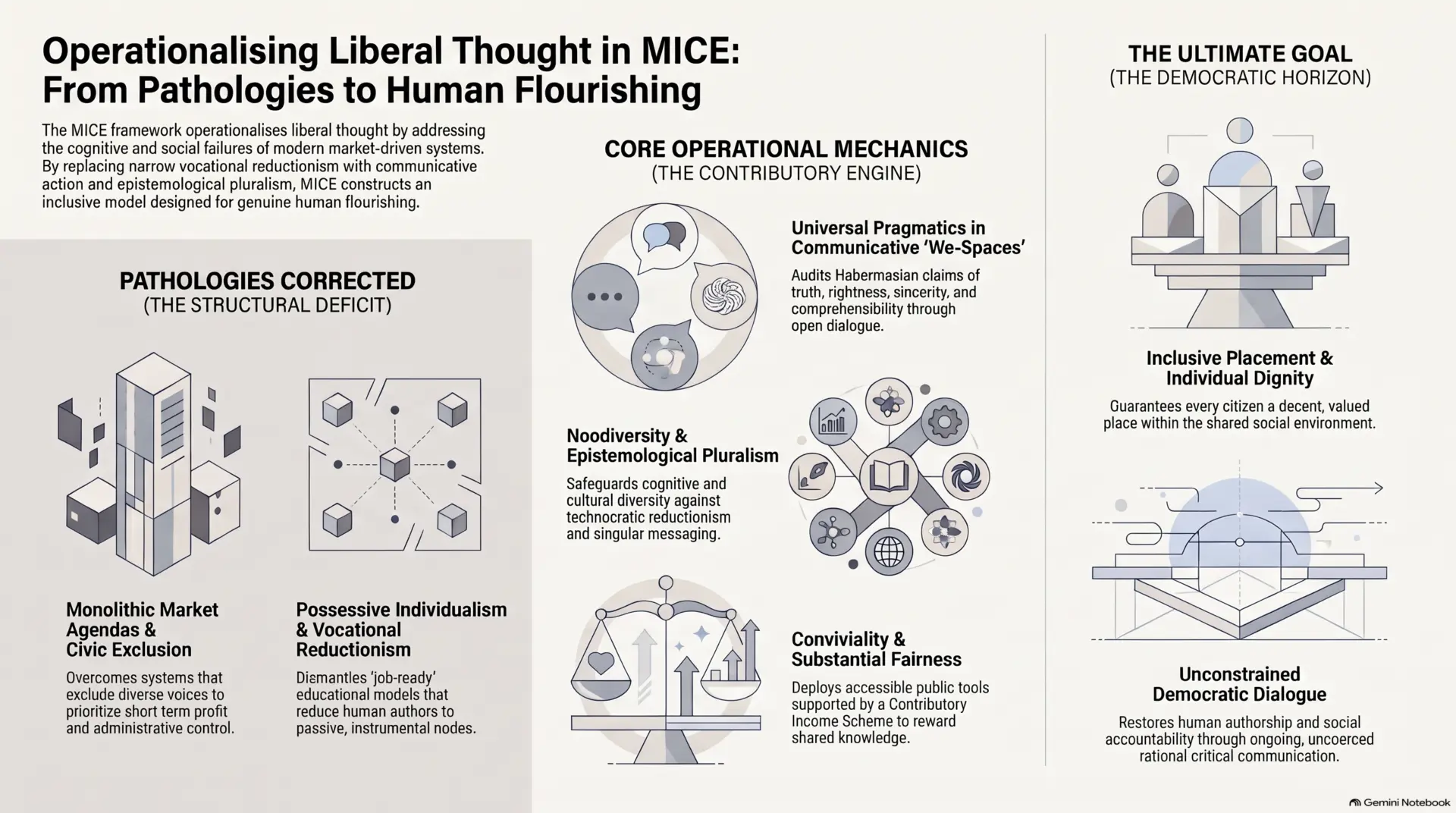
The second operational pillar of the motto focuses on liberal inclusion and civic placement (Buch 2026a, p. 14; Buch 2026b, p. 2). MICE rescues liberalism from its modern degradation into hyper-individualistic “possessive individualism” or predatory market deregulation (Buch 2026a, p. 30, 60). Instead, it operationalises classical and social liberalism as the institutional guarantee of broad social placement, individual dignity, epistemological pluralism, and unconstrained public dialogue (Buch 2026a, p. 14, 18, 49).
A. Universal Pragmatics and Communicative “We-Spaces”
MICE operationalises liberal thought by adopting Jürgen Habermas’s framework of Universal Pragmatics and communicative action ( Verständigung ) (Habermas 1979; Buch 2026a, p. 14, 49, 67). Rather than allowing communication to be reduced to strategic manipulation or PR messaging aimed at maximizing “Political Profit,” MICE establishes open, democratic “we-spaces” (Buch 2026a, p. 14, 30, 49). Within these spaces, every citizen has the equal right to raise and reciprocally evaluate four universal validity claims:
- Comprehensibility: Clear expression within a shared language (Buch 2026a, p. 24, 78).
- Truth: Factually accurate representation of the external world (Buch 2026a, p. 24, 78).
- Rightness: Conformity with legitimately established social norms (Buch 2026a, p. 24, 78).
- Truthfulness (Sincerity): Honest expression reflecting internal intent (Buch 2026a, p. 24, 78).
B. Protecting Noodiversity and Epistemological Pluralism
To ensure that everyone has a “decent place in the social environment,” MICE champions noodiversity—the preservation of diverse forms of knowledge, faith traditions, and local cultural perspectives against homogenizing corporate or state mandates (Buch 2026a, p. 11; Buch, Macklin & Peach 2026, p. 13). It operationalises liberal epistemological pluralism, insisting that truth is rarely a single, easily calculable metric, but the stable result of open, intersubjective inquiry (Buch 2026a, p. 18, 148). This prevents higher education and civic governance from treating citizens as a “meaningless checkerboard of parts” or narrowing education into mere vocational “job tickets” (Buch 2026a, p. 30, 38).
C. Conviviality, Access to Reality, and Substantial Fairness
Drawing on Ivan Illich, MICE operationalises liberal social placement through conviviality—designing institutions to be flexible, accessible tools that foster autonomous, creative intercourse among citizens rather than forcing unwilling consumption (Illich 1973; Buch 2026a, p. 60, 70). This is paired with Substantial Fairness and a Contributory Income Scheme (modeled on open-source collaboration and artistic intermittence) (Stiegler 2010; Buch 2026a, p. 56, 75). By compensating unpaid knowledge production, care work (panser), and historical preservation, MICE ensures that no individual is left behind due to market structural disadvantages (Buch 2026a, p. 43, 75, 81).
Radical enough to shift the agenda
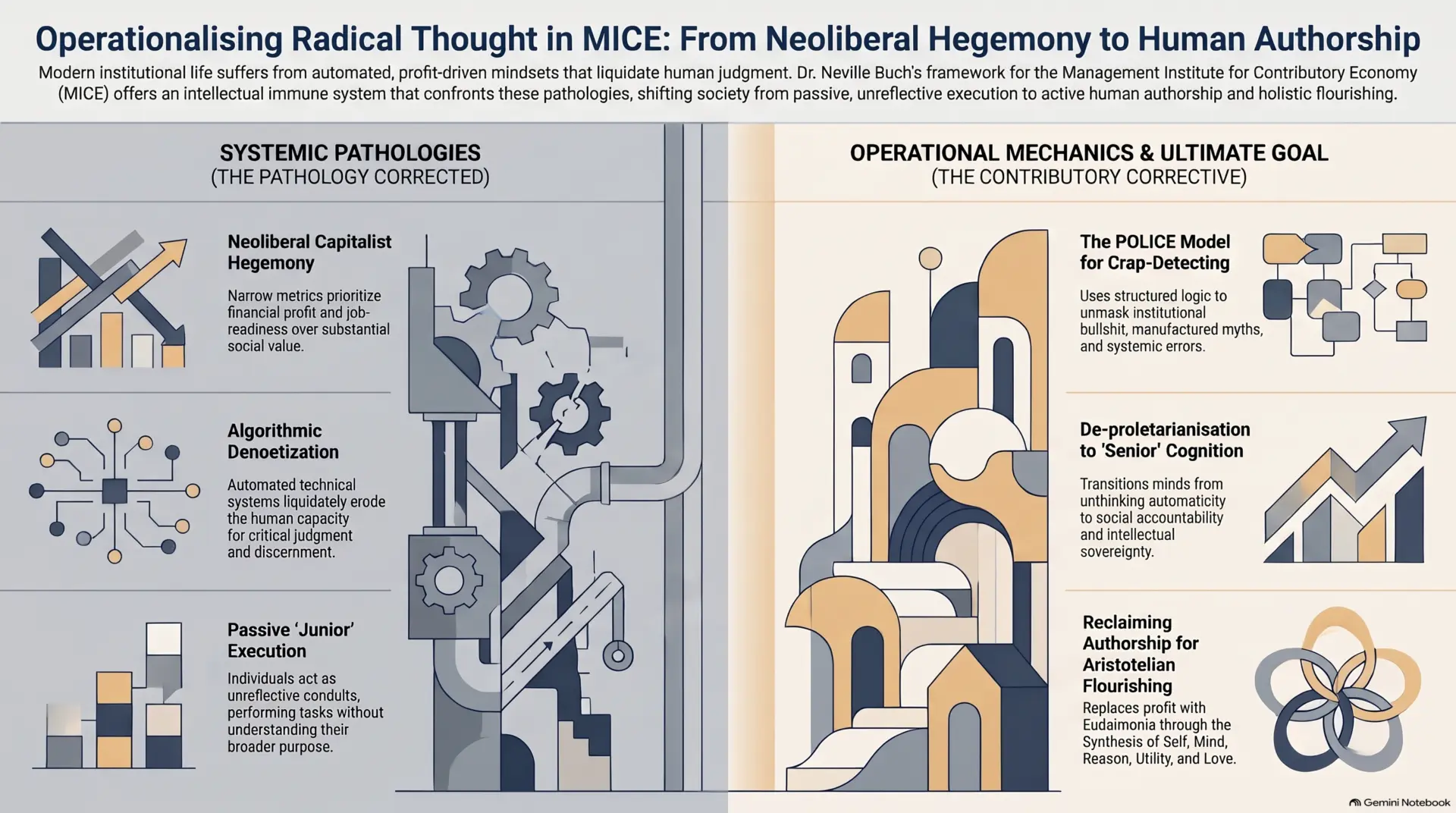
The third operational pillar represents the radical imperative of MICE: providing the critical force required to dismantle entrenched, extractive systems and shift society toward a new civilisational paradigm (Buch 2026a, p. 14; Buch 2026b, p. 2). Radicalism in MICE is not violent overthrow or lawless destruction, but a “radical breakout” from the cognitive and economic structures that trap humanity in systemic stupidity (Buch 2024a, p. 2; Buch 2026a, p. 14, 29).Top of Form
A. “Crap Detecting” and Active Nihilism via the POLICE Model
MICE operationalises radical thought through its primary analytical engine: the POLICE model ( Philosophically Ontology Logic Intersect Compatibility Education ) (Buch & Peach 2024; Buch 2026a, p. 34, 46). POLICE functions as an intellectual immune system and “crap-detecting” tool, training thinkers to practice Active Nihilism—the deliberate, systematic testing and negation of entrenched institutional myths, PR spin, and “theological masks” used to justify elite domination (Buch 2026a, p. 34, 38, 46; Buch 2026d, p. 2). This radical stance refuses to accept market-driven imperatives as natural or inevitable laws, exposing the political choices that underpin economic exploitation (Buch 2026a, p. 12, 38).
B. De-proletarianisation: From “Junior” Execution to “Senior” Authorship
Under digital platform capitalism and automated governance, human beings are reduced to “puny nodes” or passive conduits executing tasks without understanding their purpose (Stiegler 2016; Buch 2026a, p. 10, 37). MICE diagnoses this as a state of “Junior Cognition”—docile, unreflective execution (Buch 2026a, p. 37; Buch 2026c, p. 15). MICE operationalises radical thought by driving a developmental ascent to “Senior Cognition”—a state of conscious competence, intellectual sovereignty, and social accountability where the human person (“the who”) reclaims proactive authorship over automated technical and economic systems (“the what”) (Buch 2026a, p. 29, 37, 57; Buch 2026c, p. 15).
C. Shifting the Measure of Value: From Profit to Aristotelian Flourishing ( Eudaimonia )
The most radical agenda shift executed by MICE is the total replacement of GDP growth, credential inflation, and speculative capital accumulation with Aristotelian Flourishing ( Eudaimonia ) as the ultimate measure of societal success (Aristotle c. 350 BC; Buch 2026a, p. 28, 54, 84). MICE operationalises this through the Synthesis of the Five Intentions (The Synthesis of Being), integrating:
- Self: Internal agency and identity (Buch 2026a, p. 54, 83).
- Mind: Judgment and synoptic discernment against denoetization (Buch 2026a, p. 54, 83).
- Reason: Procedural logic functioning as a cognitive regulator (Buch 2026a, p. 54, 83).
- Utility: Socialized action promoting ecological balance and shared welfare (Buch 2026a, p. 55, 83).
- Love / Panser : Thinking as caring—a procedural shield protecting human dignity (Noddings 1984; Stiegler 2018; Buch 2026a, p. 43, 55, 74).
A Summative Conclusion
The re-drafted vision and operation of the Management Institute for Contributory Economy demonstrates that political and economic reform cannot succeed through one-sided, ideological extremism (Buch 2025b, p. 2; Buch 2026b, p. 2). A purely conservative approach risks stagnating in nostalgic, unreflective traditionalism; a purely liberal approach risks dissolving social cohesion into fragmented consumerism; and a purely radical approach risks destroying the valuable historical legacies that anchor human identity (Buch 2026a, p. 14; Buch 2026b, p. 2).
MICE’s triadic motto resolves these tensions by creating an integrated operational engine for applied thought (Buch 2026a, p. 14, 81; Buch 2026b, p. 2). By remaining conservative enough to preserve historical memory and thick ethical concepts, liberal enough to guarantee open communicative placement and noodiversity for all citizens, and radical enough to unmask institutional bullshit and replace profit-driven metrics with Aristotelian flourishing, MICE provides governing decision-makers with a practical roadmap out of the contemporary “immense regression” (Stiegler 2018; Buch 2026a, p. 10, 14, 81; Buch 2026b, p. 2).
Ultimately, MICE transforms political philosophy from an abstract, polarized battlefield into an active practice of “philosophy in practice,” building a collaborative, just, and flourishing “city of intellect” where every human being can act as a proactive author of a shared future (Buch 2026a, p. 45, 86; Buch 2026c, p. 4).
Harvard Bibliography
A Different Radical Centre: Buch and the Epistemology of the Radical Centre. (2026). Academic Position Monograph, Management Institute for Contributory Economy.
Aristotle. (c. 350 BC). Nicomachean Ethics (W. D. Ross, Trans.). Oxford: Clarendon Press.
Buch, N. (2024a). The spiral history theory of stupidity: Getting stuck in time-space, and personal breakout of historical cognition patterns. Brisbane: Management Institute for Contributory Economy.
Buch, N. (2024b). Queensland history, religious education, and belief. In D. W. Kim & D. Wright (Eds.), Socio-anthropological approaches to religion: Environmental hope (pp. 161–190). London: Lexington Books.
Buch, N. (2025a). Mind, body cognition with ideology: The fit of materialism, spiritualism, and accurate compatibility. Sunnybank Hills: Management Institute for Contributory Economy.
Buch, N. (2025b). MICE principles and philosophy (First development). Brisbane: Management Institute for Contributory Economy.
Buch, N. (2026a). MICE. Limited thinking and the contributory economy (Book 1 of MICE). Brisbane: Management Institute for Contributory Economy.
Buch, N. (2026b). DRAFT. The new-old MICE ingredients: Vision and operation. Brisbane: Management Institute for Contributory Economy.
Buch, N. (2026c). Understanding history is philosophy in practice: A cognition history of Queensland. Brisbane: Management Institute for Contributory Economy.
Buch, N. (2026d). Understanding history is philosophy in practice. Brisbane: Management Institute for Contributory Economy.
Buch, N., Macklin, M., & Peach, N. (2026). MICE intellectual handbook. Brisbane: Management Institute for Contributory Economy.
Buch, N., & Peach, N. (2024). Philosophically ontology logic intersect compatibility education (POLICE). Brisbane: Management Institute for Contributory Economy.
Collins, R. (2019). The credential society: An historical sociology of education and stratification. New York: Columbia University Press.
Habermas, J. (1979). Communication and the evolution of society (T. McCarthy, Trans.). Boston: Beacon Press.
Illich, I. (1973). Tools for conviviality. New York: Harper & Row.
Jameel, A., & Buch, N. (2026). Moral architecture vs. technical guardrails: A synthesis of Arif Jameel and Neville Buch on AI existential risk and human agency. Brisbane: Management Institute for Contributory Economy.
McKinney, J. P. (1971). The structure of modern thought. London: Chatto & Windus.
Mouffe, C. (2000). The democratic paradox. London: Verso.
Noddings, N. (1984). Caring: A feminine approach to ethics and moral education. Berkeley: University of California Press.
Reclaiming Human Authorship in the Age of Generative AI. (2026). Academic Research Essay, Management Institute for Contributory Economy.
Roe, J., & Perkins, M. (2026). Agency in the age of generative AI: A critical review of educational implications. Academia AI and Applications, 2(Art. 8422), 1–22.
Stiegler, B. (2010). For a new critique of political economy (D. Ross, Trans.). Cambridge: Polity Press.
Stiegler, B. (2016). Automatic society, volume 1: The future of work (D. Ross, Trans.). Cambridge: Polity Press.
Stiegler, B. (2018). Qu’appelle-t-on panser?: 1. L’immense régression. Paris: Les Liens qui Libèrent.


Neville Buch
Latest posts by Neville Buch (see all)
- Philosophy in Practice: Actual and Potential MICE Operational Spheres – October 28, 2026
- The New-Old MICE Ingredients: Vision and Operation – October 28, 2026
- The “Why Tech Makes Us Fear Forgetting” audio commentary and Comparative Analysis of Memory, Trauma, and Cultural Ideology in Unforgettable (2017), Unforgettable (US TV), and Unforgotten (UK TV): – October 27, 2026