
The “Why Tech Makes Us Fear Forgetting” audio commentary on MICE’s Contributory Economy and Human Authorship:
Abstract
This comparative essay examines how memory, forgetfulness, and “un-forgottenness” are conceptualized, dramatically operationalized, and culturally shaped across three distinct screen works: the 2017 American film Unforgettable, the American television series Unforgettable (2011–2016), and the British cold-case television series Unforgotten (2015–present). Grounded in the phenomenology of mental activity, psychological research on reconstructive memory, and screen historiography, this study demonstrates how screen drama frequently distorts cognitive reality by commodifying memory either as a hyper-retentive, photographic “recording device” or as a pathologized, vengeful obsession. Furthermore, the analysis reveals a stark transatlantic cultural divergence: American screen narratives overwhelmingly embrace a liberal-progressive “ameliorative” model where excavating the past resolves historical trauma, whereas British cold-case dramas emphasize ongoing, irremediable pain and structural complexity. Finally, the paper articulates how societies can move beyond “Historical Forgetfulness” to re-memorize forgotten cultural messages of human dignity, relational care (panser), and active human authorship.
Introduction: Screen Drama and the Memory Spectrum
In contemporary media culture, television and film serve as primary arenas where public discourse negotiates its relationship with the past (Warner 2017, p. 1)[1]. Crime procedurals and thrillers, in particular, function as cultural laboratories that explore anxieties surrounding memory loss, traumatic persistence, and archival preservation (Warner 2017, p. 3) [146–148]. By comparing the 2017 domestic thriller Unforgettable (dir. Denise Di Novi), the American police procedural Unforgettable (CBS/A&E, 2011–2016), and the acclaimed British cold-case drama Unforgotten (ITV, 2015–present), we observe how narrative screen choices reflect broader philosophical, psychological, and national orientations toward memory.
1. How Forgetfulness and Un-forgottenness Work: Phenomenology, Reconstructive Cognition, and Hypermnesia
To understand how memory operates in screen drama, we must first establish its philosophical and cognitive mechanics. Memory is not a passive, static storage vault or a magical “Pensieve” containing intact recordings of past events (Buch 2025, p. 2) [1–2]. Rather, human memory is an active, reconstructive process—a “memory of a memory”—subject to decay, emotional reshaping, and cognitive interpretation (Casey 1976, pp. 106–109; Buch 2025, p. 2) [1–2, 106–109].
I. The Phenomenology of Memory vs. Imagination
As Edward Casey notes in his comparative phenomenology of mental activity, memory differs fundamentally from imagination through its rootedness in prior perception, its temporal continuity with the past, and its element of existential familiarity (Casey 1976, pp. 110–122) [110–123]. Remembering involves “presentifying” an experience that possesses a factual, historical anchor, whereas imagination is free from corrigibility and historical continuity (Casey 1976, pp. 111–115) [111–115].
However, because both memory and imagination derive from fading sensory impressions, memory traces are inherently vulnerable to “compelling memory illusions,” misattributions, and post-event suggestions (Payne et al. 1997, pp. 58–59; Loftus 1997) [131–134, 135–137]. True human memory accepts uncertainty, decay, and the lack of precise detail as intrinsic features of honest recall (Buch 2025, p. 2)[2].
II. Hyperthymesia and Pathological Un-forgottenness
“Un-forgottenness” operates along two distinct axes:
- Hypermnesia / Hyperthymesia: The total inability to forget, where an individual visualizes every detail of their personal past with vivid, un-degraded intensity (Wikipedia 2026b) [220–221]. In the American TV series Unforgettable, Detective Carrie Wells exhibits hyperthymesia, allowing her to replay past scenes in her mind like a video recording (Wikipedia 2026b) [220–221].
- Traumatic Fixation / Psychological Un-forgottenness: The involuntary, intrusive persistence of unhealed historical or personal trauma (Warner 2017, p. 8; Huyssen 2003, p. 8)[3][4]. In the 2017 film Unforgettable, the antagonist Tessa Connover suffers from pathologized obsession, where childhood trauma and narcissistic injury prevent her from letting go of her past marriage, manifesting as gaslighting and violence (Wikipedia 2026a) [204–205].
2. How American and British Cultures Effect Different Understandings in Forgetfulness and Un-forgottenness
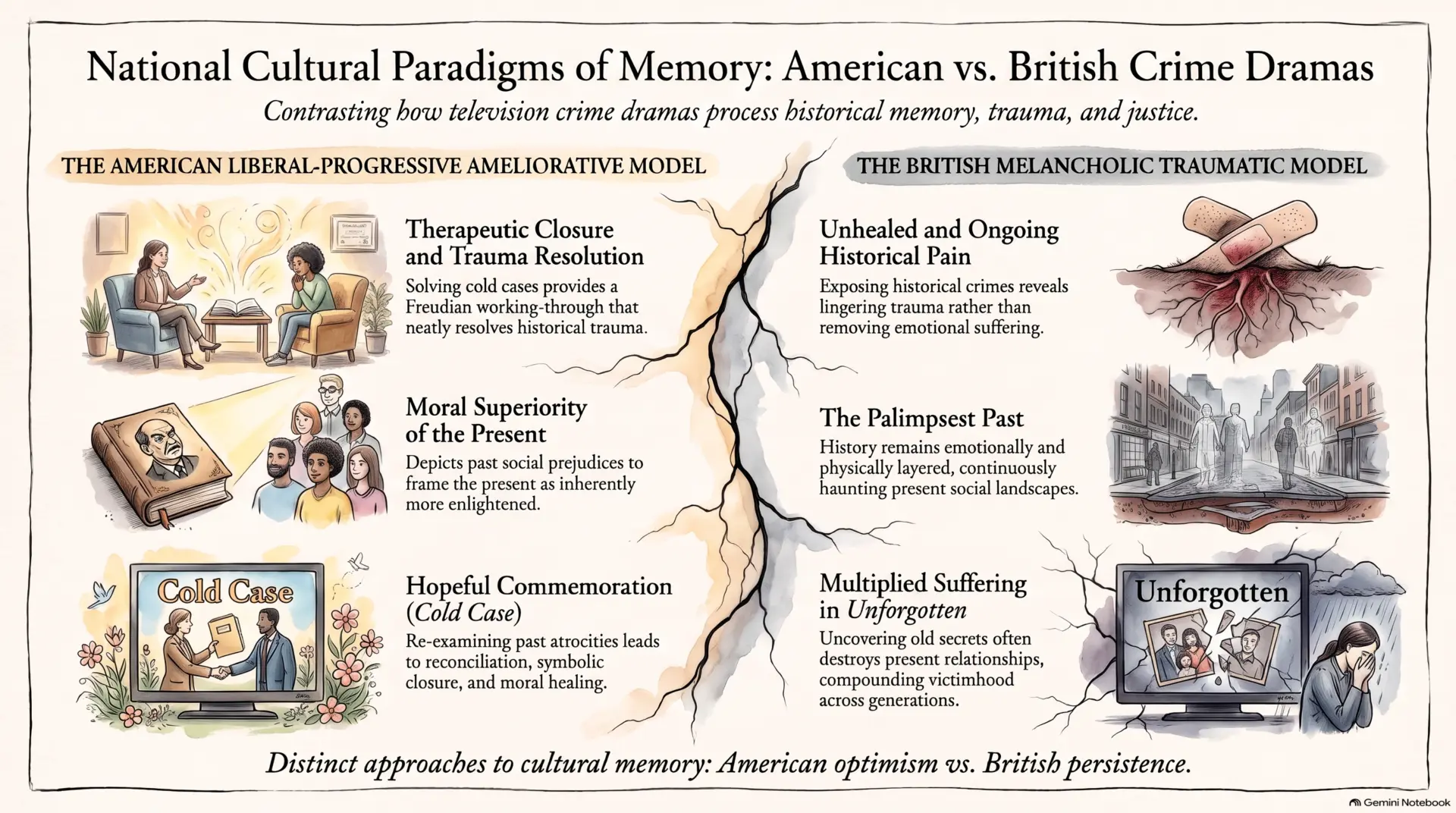
Screen representations of historical crimes and personal memories reflect deep-seated cultural differences between American and British societies regarding progress, justice, and historical trauma (Warner 2017, p. 11) [174–176, 194–195].
I. The American Ameliorative Paradigm: Closure and Presentist Superiority
American police procedurals—such as Cold Case and Unforgettable—are typically framed around a liberal-progressive ameliorative model (McFadden 2014, p. 147, cited in Warner 2017, p. 11) [174–175]. In these narratives:
- The past is represented as a site of dark trauma, prejudice, and police corruption, while the present is depicted as enlightened, technologically superior, and morally advanced (Warner 2017, p. 14) [186–189].
- Solving an unforgotten crime acts as a therapeutic “working through” (Ellis 2002, cited in Warner 2017, p. 15)[5]. Once the truth is uncovered, victims’ spirits find peace (often visually represented by ghosts appearing to detectives), justice is delivered, and social harmony is restored (Warner 2017, p. 15)[5][6].
- In the 2017 film Unforgettable, the narrative similarly relies on absolute moral resolution: the pathologized antagonist dies, allowing the heroic nuclear family to move forward into a sanitized future (Wikipedia 2026a)[7].
II. The British Melancholic Paradigm: Ongoing Pain and Unhealed Trauma
In contrast, British crime series like Unforgotten and Waking the Dead reject easy therapeutic closure, operating within a melancholic framework that highlights the ongoing, destructive presence of the past (Warner 2017, p. 11) [175–176, 195]. In Unforgotten:
- Uncovering a thirty- or forty-year-old murder does not automatically bring happiness or societal healing (Warner 2017, p. 11) [175–176]. Instead, as DCI Cassie Stuart and DI Sunny Khan unearth historical remains, the investigation unravels decades of built-up lives, destroying contemporary families, exposing systemic social prejudices (racism, homophobia, institutional cover-ups), and increasing the total volume of human pain (Warner 2017, pp. 11, 13–14) [175–176, 181–183].
- Rather than demonstrating presentist superiority, Unforgotten shows that the past remains an active, un-eliminated force (“palimpsest”) within contemporary British society (Warner 2017, p. 16; Huyssen 2003, p. 7) [179–180, 192–194].
3. How Screen Drama Distorts Understanding of Forgetfulness and Un-forgottenness
While television crime dramas raise public awareness regarding archival research and historical crimes, their structural conventions introduce severe epistemological distortions (Warner 2017, p. 5) [151–153].
I. Epistemological Distortion: Privileging Witness Memory Over Official Archives
In actual historical practice, historians rely primarily on formal, written archival documentation, treating individual witness memory with caution due to the natural degradation and self-serving nature of recall (Megill 1998, p. 47, cited in Warner 2017, p. 8) [150, 161–162]. Screen dramas reverse this hierarchy (Warner 2017, p. 5) [151–153]:
- Diegetically and extra-diegetically, television shows privilege personal memory and witness testimony over archival documents because living characters provide compelling dramatic narrative and emotional engagement (Warner 2017, p. 5) [151–153].
- Official institutional archives are visually depicted as vast, dusty, threatening, or sterile labyrinths, whereas human memory is framed as the ultimate, authentic key to truth (Warner 2017, p. 6) [154–155]. This creates a false cultural narrative that living memory is inherently superior to documentary evidence (Warner 2017, pp. 5–6)[8].
II. The Technocratic Camera Fallacy: Memory as “Pensieve”
In the American series Unforgettable, hyperthymesia is dramatized by having the lead character physically walk through holographic, frozen reconstructions of her past perceptions (Wikipedia 2026b) [220–221]. This reinforces the technocratic fallacy that memory functions like an uncorrupted digital video recorder (Buch 2025, p. 2)[2]. In reality, human recall is always an interpretive, reconstructive act influenced by current emotions, values, and narrative needs (Casey 1976, p. 111; Payne et al. 1997, p. 59) [2, 111, 133–134].
III. Pathologizing Ordinary Forgetting vs. Instrumentalizing Dementia
Screen dramas frequently exaggerate memory loss, portraying it either as pathological villainy (as in Unforgettable 2017) or using Alzheimer’s disease as a convenient script device (Warner 2017, p. 9) [165, 204–205]. In shows like Cold Case and Unforgotten, detectives frequently catch murderers because an aging suspect’s senile dementia causes them to lose restraint and blurt out confessions (Warner 2017, p. 9) [165–168]. This instrumentalizes neurodegenerative illness into a narrative trick rather than portraying the genuine human reality of cognitive decline (Warner 2017, p. 9) [165–168].
4. What Messages in Society Are Forgotten But Can Be Re-memorized?
Behind the dramatic tropes of crime television lies a deeper sociological reality: modern technocratic society suffers from “Historical Forgetfulness”—the systematic banishment of historical context, intellectual genealogies, and shared moral commitments (Buch 2026a, pp. 9, 23, 41, 113)[9].
I. Re-memorizing the Inviolable Dignity of the Human Person
Market fundamentalism and automated digital routines induce denoetization—the mechanical liquidation of the human capacity to reflect, evaluate, and care (Buch 2026a, pp. 8, 23, 113; Stiegler 2025)[13][14]. In screen dramas and wider society, individuals are frequently reduced to functional objects, case numbers, or consumer targets (Buch 2025; Vanlaere and Gastmans 2011, p. 165). The first forgotten message that must be re-memorized is the Personalist conviction that every human being is an incarnate spirit ( esprit incarné ) endowed with irreducible dignity, whose life story cannot be calculated or discarded (Vanlaere and Gastmans 2011, p. 165; Buch 2026a, p. 8)[13].
II. Re-memorizing Panser: Thinking as Caring
In series like Unforgotten, the detectives’ search for truth is driven by an underlying ethic of care—to find the remains of forgotten victims (like Jimmy Sullivan or Hayley Reid) and “bring them home” (Warner 2017, p. 12; Wikipedia 2026c) [179, 254–258]. This mirrors the Personalist call to act as a panseur —one who transforms thinking ( penser ) into active caring and dressing of wounds ( panser ) (Stiegler 2025, cited in Buch 2026a, pp. 10, 24)[15][16]. Society must re-memorize that intellectual and historical inquiry is not an extractive, adversarial exercise, but an act of communal healing and restorative justice (Buch 2026a, pp. 10, 24)[15][16].
III. Reclaiming Active Human Authorship
Finally, re-memorizing our historical roots frees society from the illusion that present social arrangements are fixed or unchangeable (Buch 2026a, pp. 10, 114)[17]. By engaging in Spiral Historiography—retrieving foundational insights from past reforming cohorts and reading them with modern, inclusive understanding—citizens reclaim their role as proactive authors of their shared destiny, steering culture toward genuine Aristotelian flourishing (eudaimonia) (Buch 2026a, pp. 8, 10, 114)[15].
References / Bibliography
Assmann, J. and Czaplicka, J., 1995. ‘Collective Memory and Cultural Identity’, New German Critique, (65), pp. 125–133. Cited in K. Warner, 2017. ‘History, Memory and Television Crime Drama’, Spiel: History as TV Series II, 3(1), p. 10.
Bebbington, D.W., 1979. Patterns in History: A Christian Perspective on Historical Thought. Leicester: Inter-Varsity Press.
Buch, N., 2025. 02. Personal History Workshop: Thinking Out Memory and the History of Ruth. Brisbane: Dr Neville Buch.
Buch, N., 2026a. The Crucible of Consciousness: Historiography and the Genesis of Reforming Thought. Brisbane: Neville Buch and Management Institute for Contributory Economy (MICE).
Buch, N., 2026b. Bibliography: Forgettable and Unforgotten. Brisbane: Dr Neville Buch.
Casey, E.S., 1976. ‘Comparative Phenomenology of Mental Activity’, The Philosophical Forum, 8(1), pp. 106–126.
Ellis, J., 2002. Seeing Things: Television in the Age of Uncertainty. London: I.B. Tauris. Cited in K. Warner, 2017, p. 15.
Eschrich, S., Münte, T.F. and Altenmüller, E.O., 2008. ‘Unforgettable Film Music: The Role of Emotion in Episodic Long-Term Memory for Music’, BMC Neuroscience, 9(48), pp. 1–9.
Huyssen, A., 2003. Present Pasts: Urban Palimpsests and the Politics of Memory. Stanford: Stanford University Press. Cited in K. Warner, 2017, p. 3.
Loftus, E.F., 1997. ‘Memory for a Past That Never Was’, Current Directions in Psychological Science, 6(3), pp. 60–65.
McFadden, M., 2014. ‘“People Shouldn’t Be Forgotten”: Cold Case’s Pursuit of History’s Ghosts’, Journal of Popular Film and Television, 42(3), pp. 139–149. Cited in K. Warner, 2017, p. 11.
Megill, A., 1998. ‘History, Memory, Identity’, History of the Human Sciences, 11(3), pp. 37–62. Cited in K. Warner, 2017, p. 8.
Payne, D.G., Elie, C.J., Blackwell, J.M. and Neuschatz, J.S., 1997. ‘Memory Illusions: Remembering Events That Never Occurred’, Current Directions in Psychological Science, 6(1), pp. 56–60.
Stiegler, B., 2025. The Immense Regression: What is Called Caring? (Vol. 1). Berlin: K. Verlag. Cited in N. Buch, 2026a, p. 10.
Vanlaere, L. and Gastmans, C., 2011. ‘A Personalist Approach to Care Ethics’, Nursing Ethics, 18(2), pp. 161–173.
Warner, K., 2017. ‘History, Memory and Television Crime Drama’, Spiel: History as TV Series II, 3(1), pp. 1–19.
Wikipedia, 2026a. Unforgettable (2017 film). Wikimedia Foundation. Available at: https://en.wikipedia.org/wiki/Unforgettable_(2017_film).
Wikipedia, 2026b. Unforgettable (American TV series). Wikimedia Foundation. Available at: https://en.wikipedia.org/wiki/Unforgettable_(American_TV_series).
Wikipedia, 2026c. Unforgotten. Wikimedia Foundation. Available at: https://en.wikipedia.org/wiki/Unforgotten.
Featured Image: Screenshot 2026-10-27 Notebook Work on Cultural Memory Models


Neville Buch
Latest posts by Neville Buch (see all)
- The “Why Tech Makes Us Fear Forgetting” audio commentary and Comparative Analysis of Memory, Trauma, and Cultural Ideology in Unforgettable (2017), Unforgettable (US TV), and Unforgotten (UK TV): – October 27, 2026
- Marketing Killed the Message: Reclaiming Relational Dignity in an Age of Transactional Utility – October 27, 2026
- The Road to Home. A Re-Narrativization of The Story of Resilience Part 7 – October 26, 2026