

Dr Neville Buch and MICE[1]
Abstract
This essay outlines the actual and potential operational activities of the Management Institute for Contributory Economy (MICE), founded by Dr. Neville Buch alongside colleagues Dr. Neil Peach and Dr. Michael Macklin. Moving beyond abstract academic critique, MICE functions as an operational infrastructure for applied social practice, human authorship, and civic renewal[1][2]*. Grounded in its foundational triadic motto—”Radical enough to shift the agenda, liberal enough to allow everyone a decent place in the social environment, and conservative enough to preserve the legacy of good value”[3][4]—the Institute executes its vision across six distinct operational domains: (1) individual and joint research and writing projects; (2) organizing and presenting academic and civic seminars; (3) delivering invited keynote addresses; (4) drafting policy statements and executive briefs; (5) providing expert consultations; and (6) presenting face-to-face proposals to governing decision-makers. This essay examines how these integrated activities operationalise “philosophy in practice”[5][6], equipping public managers, scholars, and citizens with diagnostic tools to overcome technocratic reductionism, counter algorithmic denoetization, and build a collaborative “City of Intellect” dedicated to Aristotelian flourishing (eudaimonia)[7][8].*
1. Introduction: The MICE Mandate and the Operational Engine
The contemporary socioeconomic landscape is increasingly defined by what philosopher Bernard Stiegler terms the “immense regression”—a state where automated algorithms, short-term market metrics, and technocratic management liquidate human judgment, critical discernment, and civic agency[9]. In response to this crisis of purpose, the Management Institute for Contributory Economy (MICE) was established to bridge the divide between theoretical philosophy and practical institutional reform[1][12].
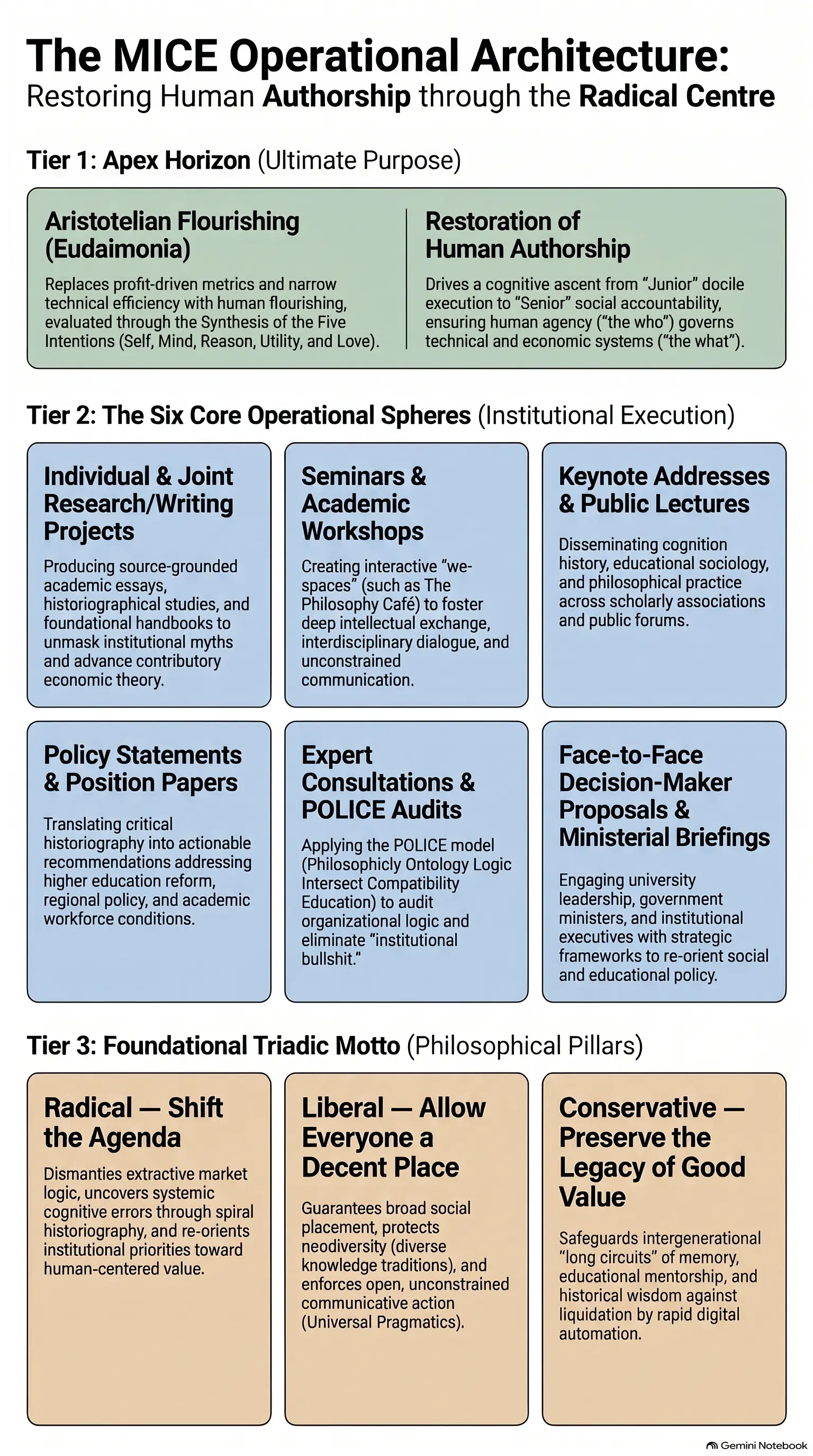
At the core of MICE operations is a triadic governing motto:
*”Radical enough to shift the agenda, liberal enough to allow everyone a decent place in the social environment, and conservative enough to preserve the legacy of good value”*[3][4].
Operationally, MICE operates as an independent research institute and public scholarship body[12][13]. Methodologically, MICE demonstrates human authorship in the digital age by utilizing generative AI tools (such as Google NotebookLM / Gemini Notebook) strictly as non-authorial research assistants, ensuring that the human subject (“the who”) maintains conscious control over technological tools (“the what”)[14][15]. The Institute translates its theoretical framework into concrete social interventions through six interconnected operational spheres[2][12].
2. Domain 1: Individual and Joint Research and Writing Projects
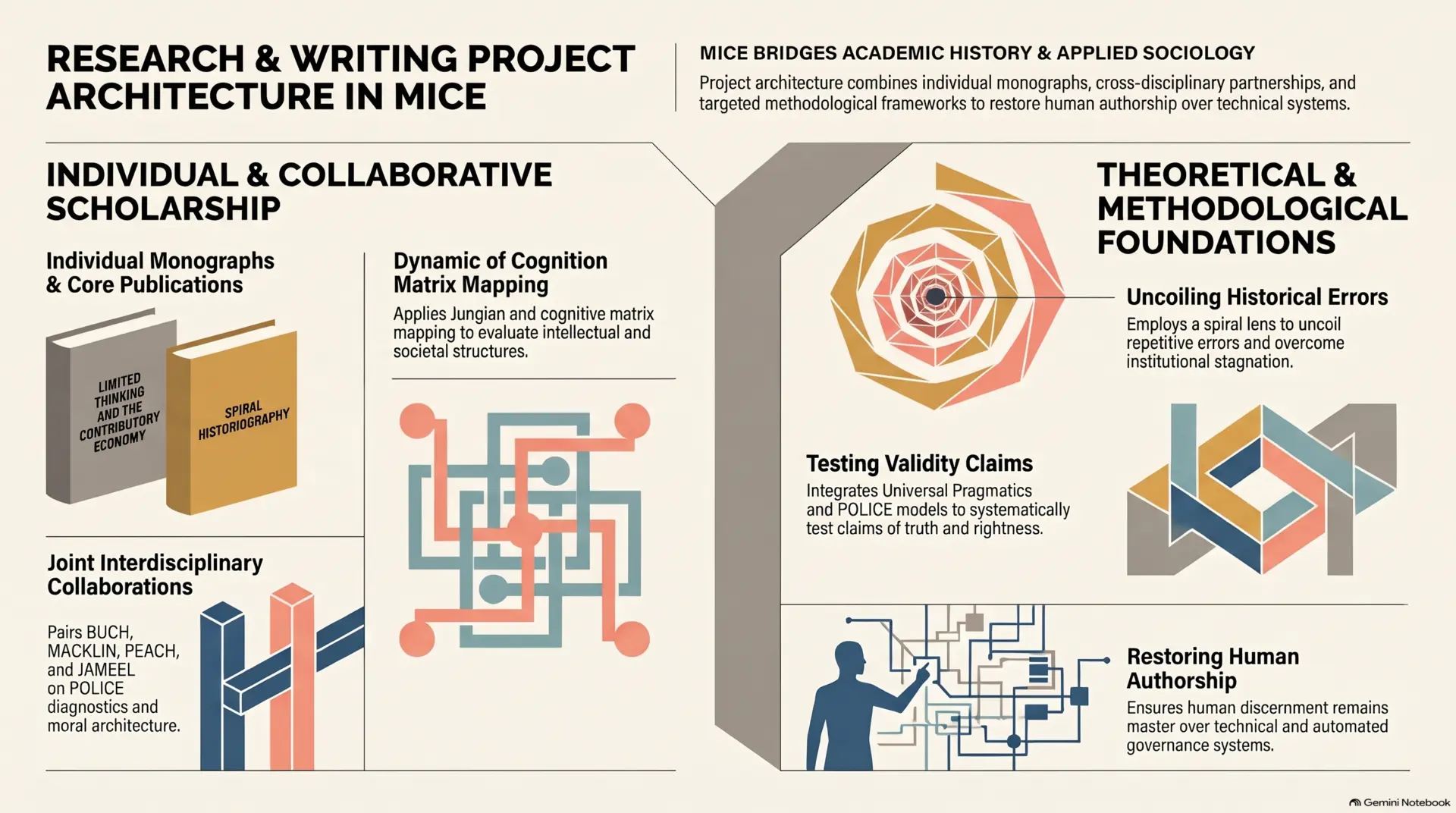
The intellectual bedrock of MICE consists of rigorous individual and collaborative research initiatives that span historiography, sociology, economics, and moral philosophy[12].
A. Monograph and Handbook Development
MICE produces foundational reference texts and analytical monographs designed to dismantle specialized ignorance[2][12]. Key individual works by Dr. Neville Buch include MICE: Limited Thinking and the Contributory Economy (2026a), Understanding History is Philosophy in Practice (2026c), and The New-Old MICE Ingredients: Vision and Operation (2026b)[4]. These projects develop core MICE methodologies, including Spiral Historiography (uncoiling repetitive historical errors) and the Dynamic of Cognition (DoC) matrix[14].
B. Collaborative and Cross-Institutional Syntheses
MICE actively fosters joint writing projects that bring disparate research fields into alignment[13]. Notable collaborative projects include:
- The POLICE Model ( Philosophically Ontology Logic Intersect Compatibility Education ): Developed jointly by Dr. Neville Buch and Dr. Neil Peach, this diagnostic framework provides a logical method to unmask “institutional bullshit” and test validity claims[20][21].
- The Jameel–MICE Synthesis: A joint project between Arif Jameel and Dr. Neville Buch (Moral Architecture vs. Technical Guardrails, 2026) that integrates Jameel’s global governance concepts (the Economic Law of Responsibility Burden and the Lifestyle State) with Buch’s meso-cognitive MICE framework[22][23].
- Independent Scholarship Studies: Joint research analysing the sociological legacy of thinkers like Jack McKinney and evaluating the common experience of independent scholars operating outside university bureaucracies[22][24].
3. Domain 2: Organising and Presenting Seminars and Academic Workshops
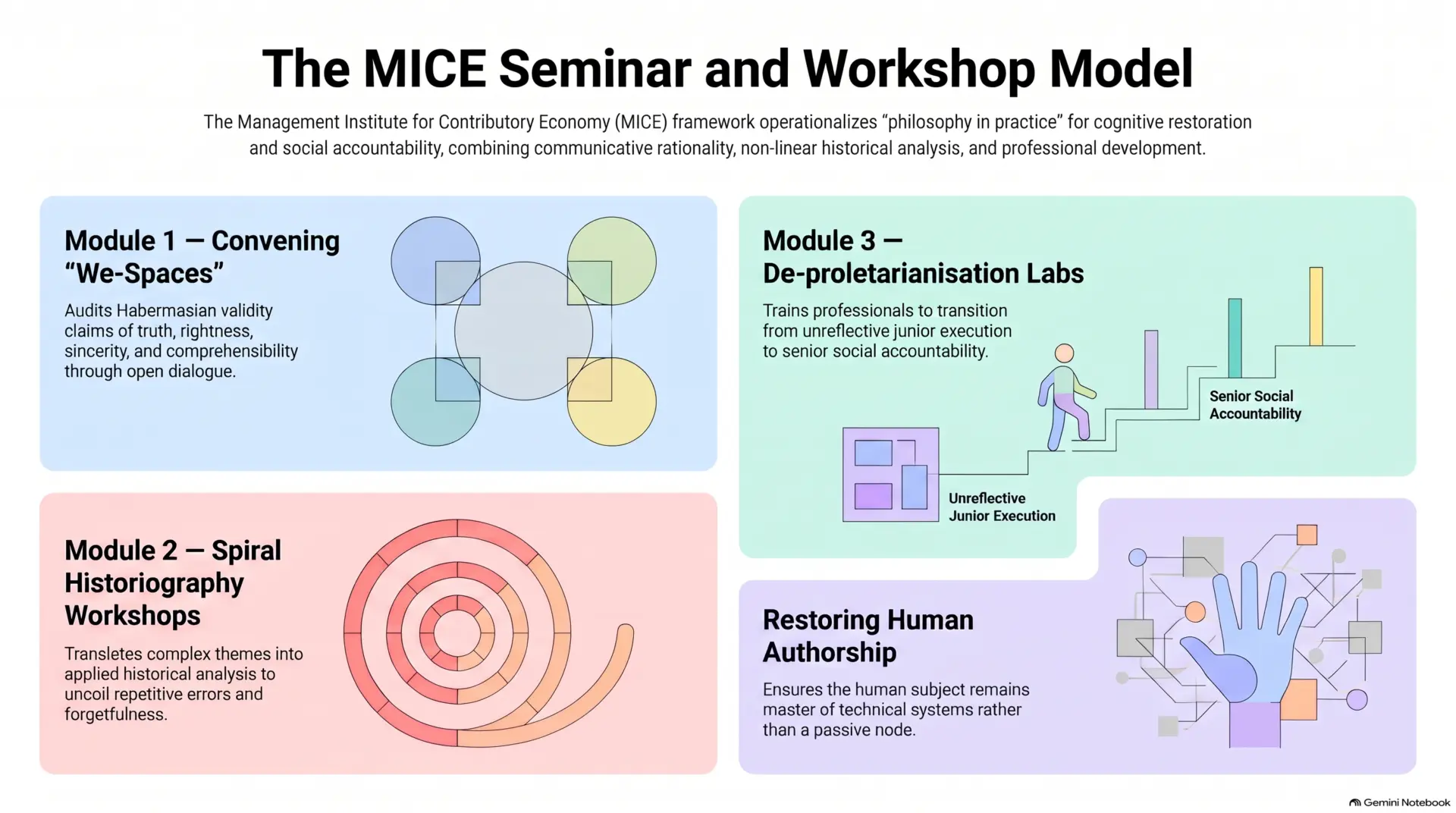
MICE translates research into active dialogue by organizing structured academic seminars, conference panels, and interactive workshops[5][25].
- Translating Conference Themes into Applied Analysis: MICE convenes specialized seminars surrounding major academic gatherings, such as translating the 2026 Australian Historical Association (AHA) conference theme (“Changing Minds”) into applied historical interventions for local governance[5].
- Creating Habermasian “We-Spaces”: Guided by Universal Pragmatics, MICE seminars reject one-way information dumping in favour of communicative action (Verständigung)[9]. Seminars operate as democratic “we-spaces” where participants audit four universal validity claims: comprehensibility, truth, rightness, and sincerity[16][27].
- Noodiversity Workshops: Seminars bring together independent researchers, municipal officers, and educators to cultivate noodiversity—protecting localized, diverse forms of knowledge against corporate and vocational reductionism[3][28].
4. Domain 3: Keynote Address, Invited Talks, and Public Lectures
To influence broader public discourse, MICE members regularly deliver invited talks, public lectures, and keynote presentations to academic societies, civic groups, and professional associations[3][13].
- Promoting “Thinking as Caring” ( Panser ): Invited lectures articulate Nel Noddings’s and Bernard Stiegler’s concept of panser (thinking as caring)—presenting care and moral empathy as an essential procedural shield against automated computational logic[29][30].
- Addressing AI Denoetization and Human Agency: Keynote talks address the risks of generative AI and automated decision-making, providing audiences with practical frameworks to protect human judgment and reclaim authorship over technological systems[9][11].
- Challenging Credentialism and Market Reductionism: Public lectures engage communities on topics such as credential inflation, the rise of the “techné mindset,” and the necessity of restoring thick ethical values to local education and social services[1][6].
5. Domain 4: Producing Policy Statements, Position Papers, and Executive Briefings
MICE operationalises its theoretical discoveries by producing formal policy statements, position papers, and executive briefing notes for public distribution[4][31].
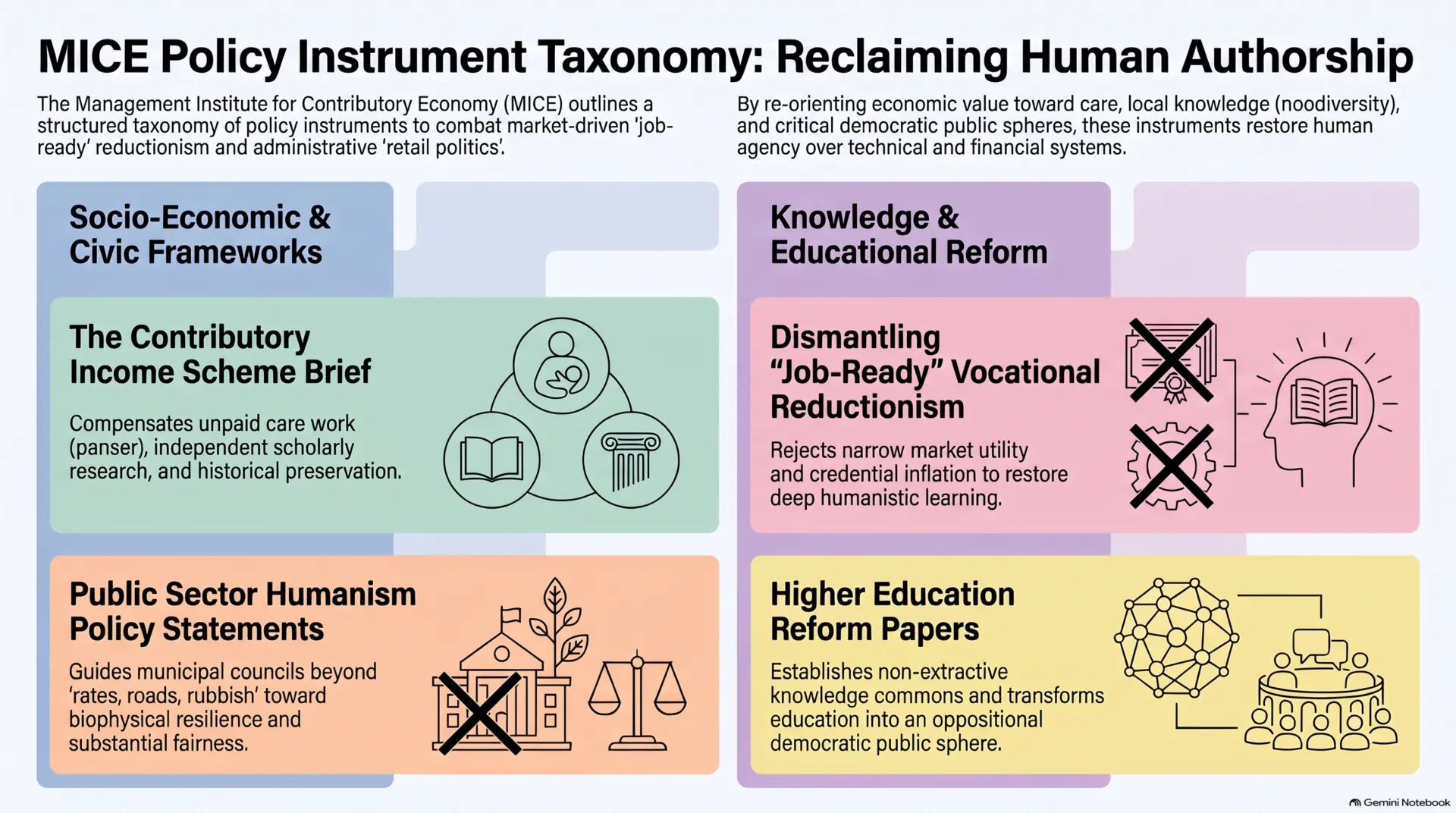
- The Contributory Income Scheme: Policy briefs formulate economic models for a Contributory Income Scheme (modelled on open-source intermittence and artistic support) to compensate unpaid care work (panser), independent research, and environmental stewardship[30][32].
- Public Sector Humanism Statements: MICE drafts policy guidelines for local governments, encouraging municipal leaders to expand their focus beyond narrow economic rationalism toward biophysical sustainability and Substantial Fairness[7][32].
- Position Papers on Educational Sovereignty: Statements critique “job-ready” vocational reductionism, presenting blueprints for higher education institutions to act as “oppositional democratic public spheres”[25][33].
6. Domain 5: Expert Consultations and POLICE Diagnostic Audits
MICE provides professional consultation services to public institutions, non-profit organizations, educational facilities, and community networks seeking to audit their operational structures[20][21].
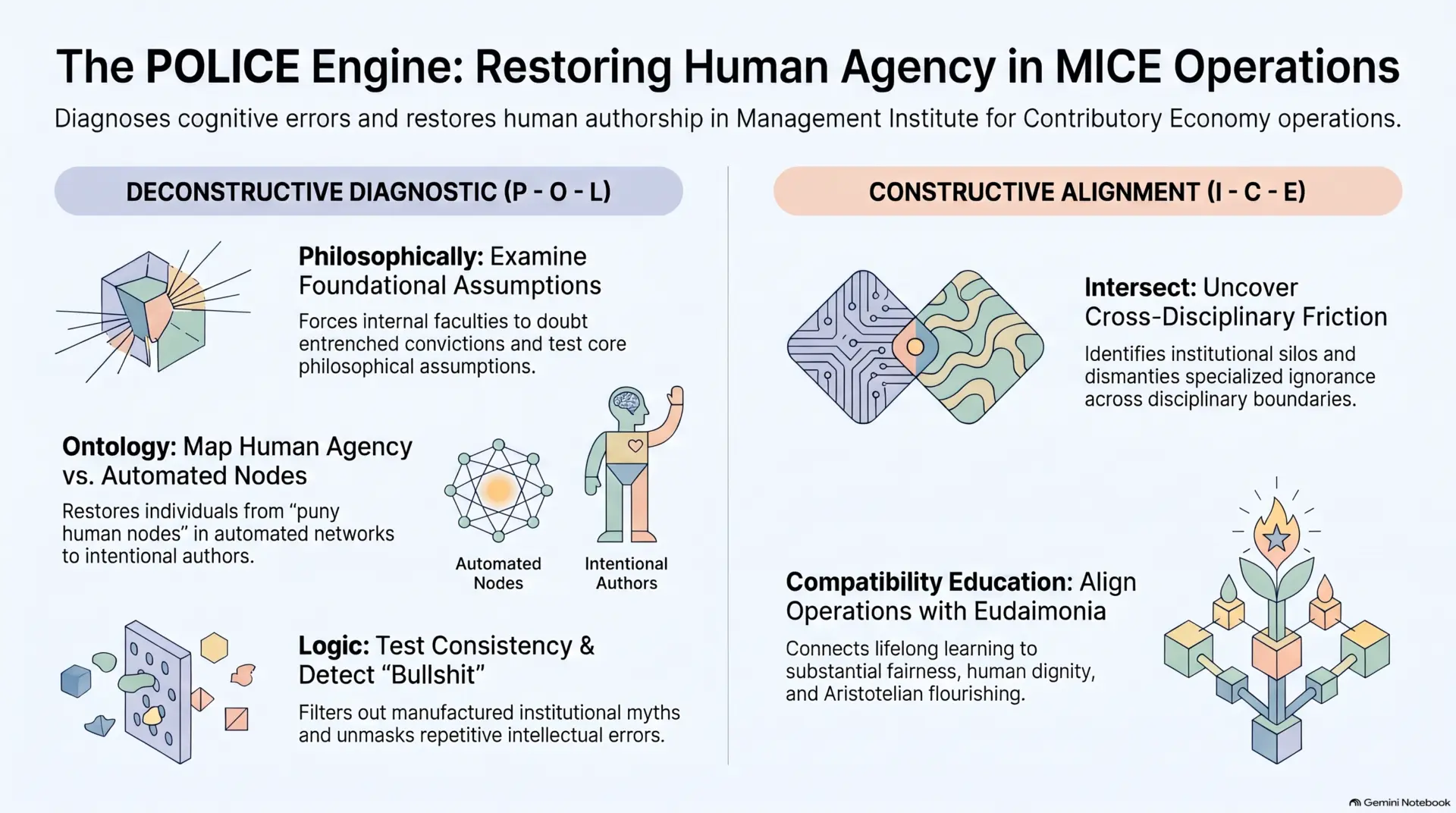
- Conducting POLICE Audits: Using the POLICE diagnostic tool, MICE consultants assist organizations in “crap detecting”—unmasking administrative jargon, inefficient satisficing, and “institutional bullshit” that drain human morale[20][34].
- Transitioning from “Junior” to “Senior” Organizational Cognition: Consultation programs guide management teams to transition employees from “Junior” unreflective execution (focusing narrowly on how without understanding why) to “Senior” social accountability, where workers exercise proactive authorship[14].
- Implementing Substantial Fairness: MICE consults with public service providers to replace purely transactional efficiency metrics with Substantial Fairness, ensuring that organizational success is evaluated through human dignity and community well-being[7][32].
7. Domain 6: Face-to-Face Strategic Proposals and Ministerial Briefings
The most direct operational activity of MICE involves presenting face-to-face proposals, slide presentations, and executive briefings to governing decision-makers, government ministers, and municipal leaders[4][8].
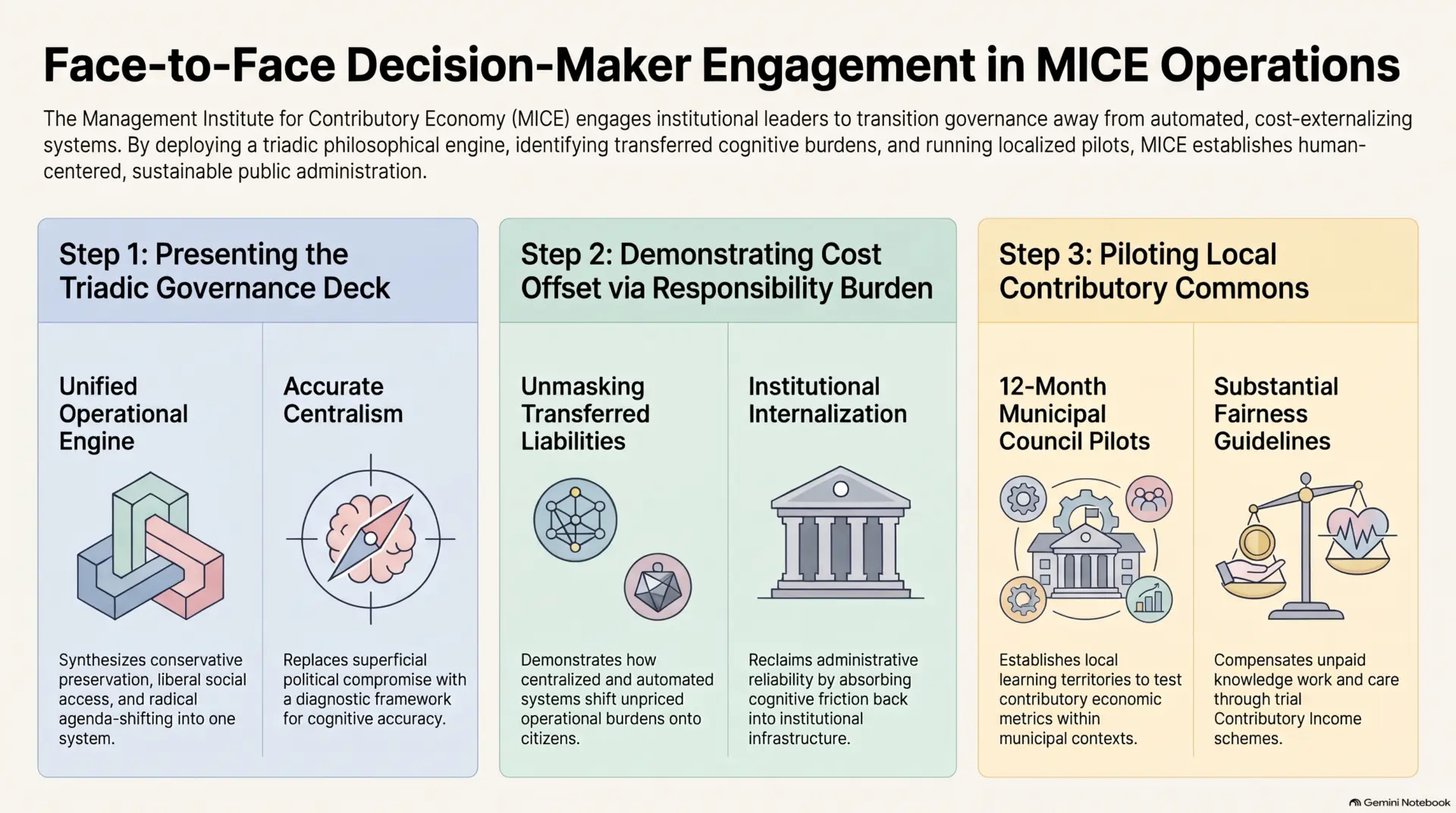
- Executive Slide Presentations: MICE representatives deliver structured, data-grounded slide decks (such as the MICE Triadic Governance Deck) in face-to-face meetings with executive boards and political leaders[4]. These briefings illustrate how the Conservative, Liberal, and Radical moments operate as an integrated governance engine[4][8].
- Mitigating the Downward “Responsibility Burden”: In face-to-face meetings, MICE presents economic proofs (drawing on Arif Jameel’s Law of Responsibility Burden) demonstrating how automated and centralized systems shift unpriced operational liabilities downward onto citizens and public workers[22][36].
- Establishing Municipal Pilot Frameworks: MICE pitches concrete pilot proposals to local councils, offering frameworks to test Contributory Economy principles within municipal health, social care, and urban planning departments[7][32].
8. Conclusion: The Synthesized Contributory City of Intellect
The actual and potential activities of the Management Institute for Contributory Economy demonstrate that political philosophy and economic critique attain their true fulfillment only when operationalised through applied social practice[8][12].
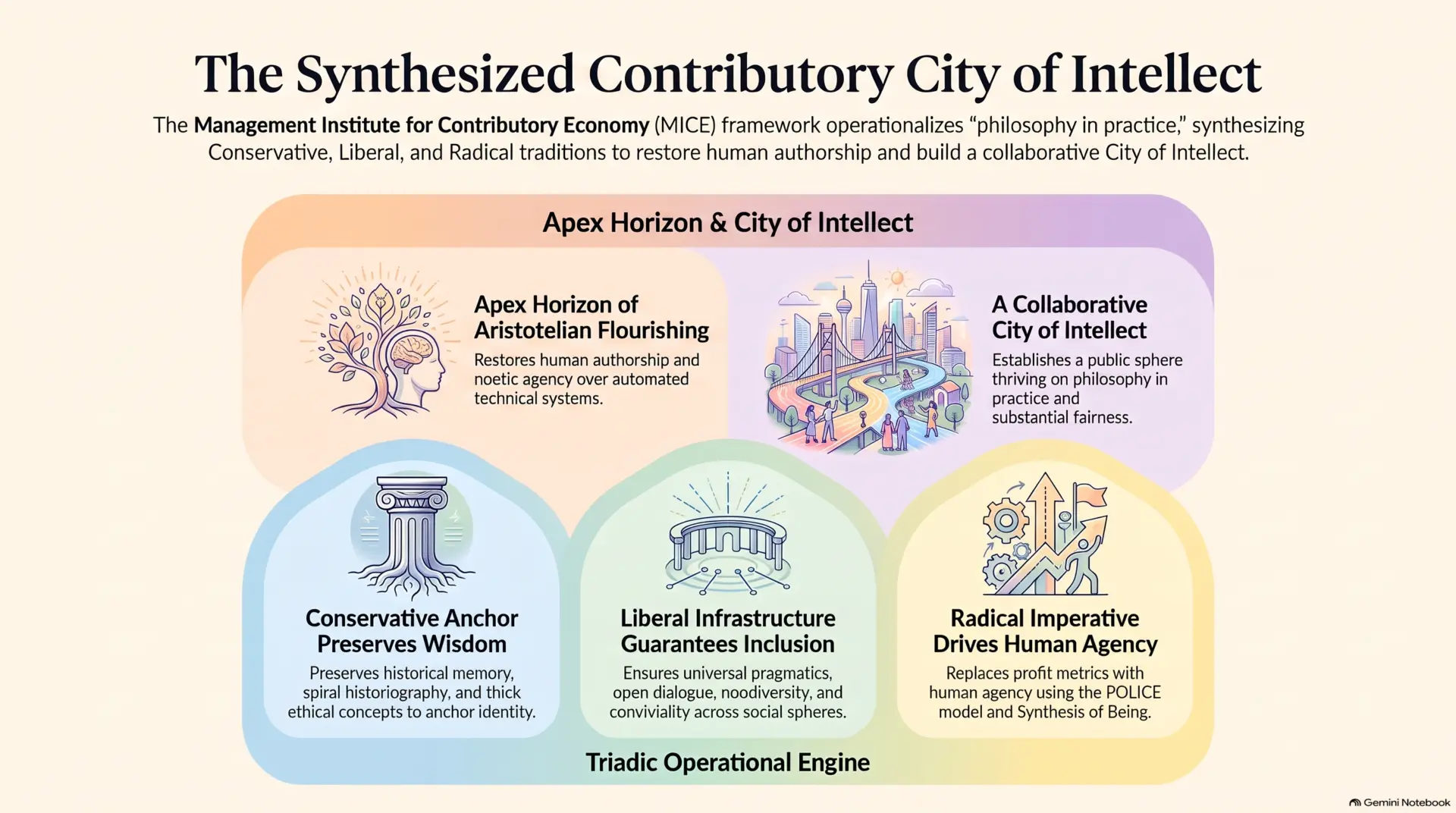
By connecting individual research projects, interactive seminars, public lectures, policy statements, expert consultations, and face-to-face decision-maker engagements, MICE provides a complete operational model for democratic renewal[4][12]. Through these integrated operations, MICE transforms abstract theory into an active practice of “philosophy in practice,” building a collaborative, resilient, and flourishing “City of Intellect” where every citizen reclaims their rightful status as an author of a shared future[7][8].
Harvard Bibliography
A Different Radical Centre: Buch and the Epistemology of the Radical Centre. (2026). Academic Position Monograph. Brisbane: Management Institute for Contributory Economy.
Aristotle. (c. 350 BC). Nicomachean Ethics (W. D. Ross, Trans.). Oxford: Clarendon Press.
Buch, N. (2024a). The spiral history theory of stupidity: Getting stuck in time-space, and personal breakout of historical cognition patterns. Brisbane: Management Institute for Contributory Economy.
Buch, N. (2025a). MICE principles and philosophy (First development). Brisbane: Management Institute for Contributory Economy.
Buch, N. (2026a). MICE. Limited thinking and the contributory economy (Book 1 of MICE). Brisbane: Management Institute for Contributory Economy.
Buch, N. (2026b). DRAFT. The new-old MICE ingredients: Vision and operation. Brisbane: Management Institute for Contributory Economy, 28 October 2026, pp. 1–12.
Buch, N. (2026c). Understanding history is philosophy in practice: A cognition history of Queensland. Brisbane: Management Institute for Contributory Economy.
Buch, N. (2026d). History as philosophy in a contributory economy. Brisbane: Management Institute for Contributory Economy, 4 July 2026, pp. 1–8.
Buch, N., Macklin, M., & Peach, N. (2026). MICE intellectual handbook. Brisbane: Management Institute for Contributory Economy.
Buch, N., & Peach, N. (2024). Philosophically ontology logic intersect compatibility education (POLICE). Brisbane: Management Institute for Contributory Economy.
Habermas, J. (1979). Communication and the evolution of society (T. McCarthy, Trans.). Boston: Beacon Press.
Illich, I. (1973). Tools for conviviality. New York: Harper & Row.
Jameel, A., & Buch, N. (2026). Moral architecture vs. technical guardrails: A synthesis of Arif Jameel and Neville Buch on AI existential risk and human agency. Brisbane: Management Institute for Contributory Economy.
Noddings, N. (1984). Caring: A feminine approach to ethics and moral education. Berkeley: University of California Press.
Roe, J., & Perkins, M. (2026). Agency in the age of generative AI: A critical review of educational implications. Academia AI and Applications, 2(Art. 8422), 1–22.
Stiegler, B. (2010). For a new critique of political economy (D. Ross, Trans.). Cambridge: Polity Press.
Stiegler, B. (2018). Qu’appelle-t-on panser?: 1. L’immense régression. Paris: Les Liens qui Libèrent.
Take the MICE Quiz
[1] Artificial Intelligence (A.I.) has been fairly used in the production of this work. The tool used is Google NotebookLM (recently rebranded as Gemini Notebook). It is an AI-powered virtual research assistant and thinking partner designed to help a person interact deeply with their own documents. Unlike general chatbots, it is source-grounded, meaning it only generates answers based on the specific PDFs, documents, or links uploaded. The A.I. process in the production of this work has been limited to the attached (prompts) on each of the questions in turn. This ensures an accurate reading of each source. The author then rearranged and re-edited the answers the A.I. provided. The human author publishes this work. A.I. is never an author when used properly. This assistance is not qualitatively different from a human research assistant when that assistance is deemed to have no authorial status but is acknowledged.


Neville Buch
Latest posts by Neville Buch (see all)
- Philosophy in Practice: Actual and Potential MICE Operational Spheres – October 28, 2026
- The New-Old MICE Ingredients: Vision and Operation – October 28, 2026
- The “Why Tech Makes Us Fear Forgetting” audio commentary and Comparative Analysis of Memory, Trauma, and Cultural Ideology in Unforgettable (2017), Unforgettable (US TV), and Unforgotten (UK TV): – October 27, 2026