
In late 2026, Australian education ministers announced the creation of an integrated national body—the proposed Australian Teaching and Learning Commission—combining ACARA, AITSL, AERO, and Education Services Australia (Frew 2026, p. 191). While aimed at streamlining curriculum, assessment, research, and teaching standards, this powerful institution risks establishing a narrow, technocratic orthodoxy that reduces learning to standardized test scores, explicit instruction metrics, and corporate “job-ready” credentialism (Frew 2026, p. 190; Buch 2024a, p. 14).
This essay outlines how the research, cognitive cartography, and social philosophy of the Management Institute for Contributory Economy (MICE)—led by Dr. Neville Buch, Dr. Neil Peach, and Dr. Michael Macklin—provide an indispensable framework to steer the new Commission. Grounded in Buch’s Dynamic of Cognition (DoC) four-stage model, Ivan Illich and Michael Macklin’s conformance-free learning webs and lifelong educational entitlements, and Paulo Freire’s problem-posing pedagogy, MICE offers vital policy lessons to prevent algorithmic formalization and digital denoetization.
The essay details:
- The core theoretical and practical MICE lessons for national education;
- How the proposed Commission can operationalize these lessons through multi-perspectival evidence standards, noetic impact statements, and decentralized funding;
- A practical roadmap for contracting MICE as an independent expert consultancy during the Commission’s pre-legislative design phase (2026–2027); and
- Why this humanistic model is essential for safeguarding democratic agency, social equity, and Planetary Wisdom in Australian society.
1. Introduction: The Proposed Education Commission and the Risk of Technocratic Reductionism
On 2 November 2026, Australian federal and state education ministers outlined a plan to amalgamate Australia’s primary national education architectures—the Australian Curriculum, Assessment and Reporting Authority (ACARA), the Australian Institute for Teaching and School Leadership (AITSL), the Australian Educational Research Organisation (AERO), and Education Services Australia (ESA)—into a singular Australian Teaching and Learning Commission (Frew 2026, p. 191). Capable of defining national curricula, prescribing teaching standards, commissioning research, and measuring educational success, this unified body will wield unprecedented authority over Australian primary, secondary, and tertiary learning environments (Frew 2026, p. 191).
  THE POLICY CHOICE FOR AUSTRALIA'S NEW COMMISSION
 ┌──────────────────────────────────┬──────────────────────────────────┐
 │ THE REACTIONARY ROUTE │ THE ENLARGING ROUTE │
 │ ("Straightening" Technocracy) │ (MICE & DoC Vision) │
 ├──────────────────────────────────┼──────────────────────────────────┤
 │ • Narrow "Science of Learning" │ • Pluralistic Evidence Standards │
 │ as sole national orthodoxy. │ (Cognitive, Relational, First │
 │ • Test-score & NAPLAN fetishism. │ Nations, Sociological). │
 │ • Mind as passive node for │ • Focus on conditions of learning│
 │ "job-ready" credentialism. │ (belonging, agency, purpose). │
 │ • Algorithmic "denoetization". │ • Restoring Human Authorship & │
 │ │ Planetary Wisdom. │
 └──────────────────────────────────┴──────────────────────────────────┘
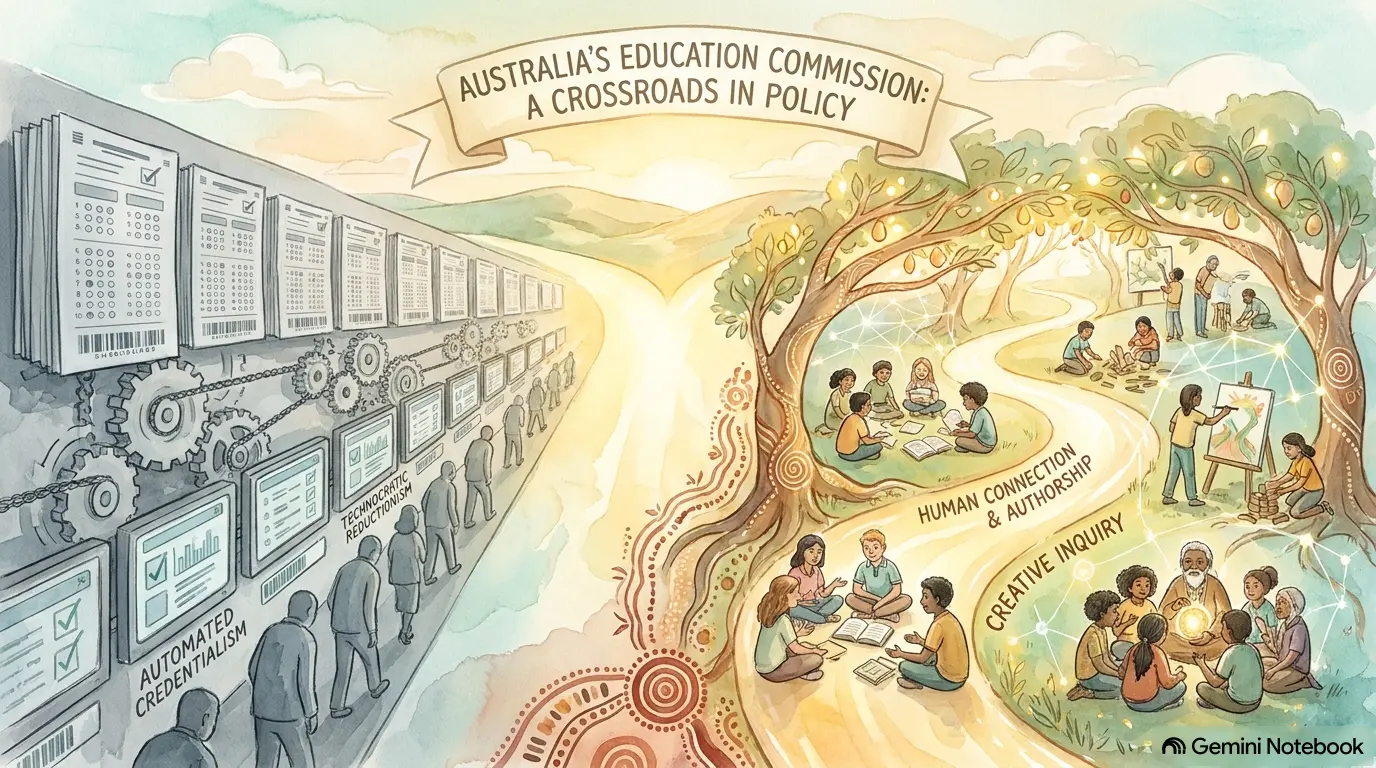
As educational commentator John Frew observes, such centralized reach presents a profound institutional fork in the road: the Commission could act as a life-enlarging institution that creates the holistic conditions for human learning, or it could operate as a reactionary “straightener,” reducing education to what is easiest to prescribe, observe, and count (Frew 2026, pp. 190, 195; Ashenden 2026, cited in Frew 2026, p. 190). When systems measure only what can be seen from the administrative center—attendance data, NAPLAN ranks, and standardized cognitive load metrics—they risk transforming a single branch of psychology into a rigid national doctrine, crowding out the relational, emotional, and social dimensions of learning (Frew 2026, p. 193).
To avoid repeating historical mistakes—such as Queensland’s political censorship of inquiry-based curricula in the 1970s or the reduction of TAFE and university courses to narrow “job tickets”—the nation requires a sophisticated, interdisciplinary policy framework (Buch 2024a, p. 14; Buch 2026a, p. 15). The Management Institute for Contributory Economy (MICE) provides precisely this baseline, offering decadal research in history of education, cognitive cartography, and non-creedal social philosophy (Buch 2025a, p. 1; NDB CV 2026, p. 1).
2. What Are the MICE Lessons for Australia’s New Education Commission?
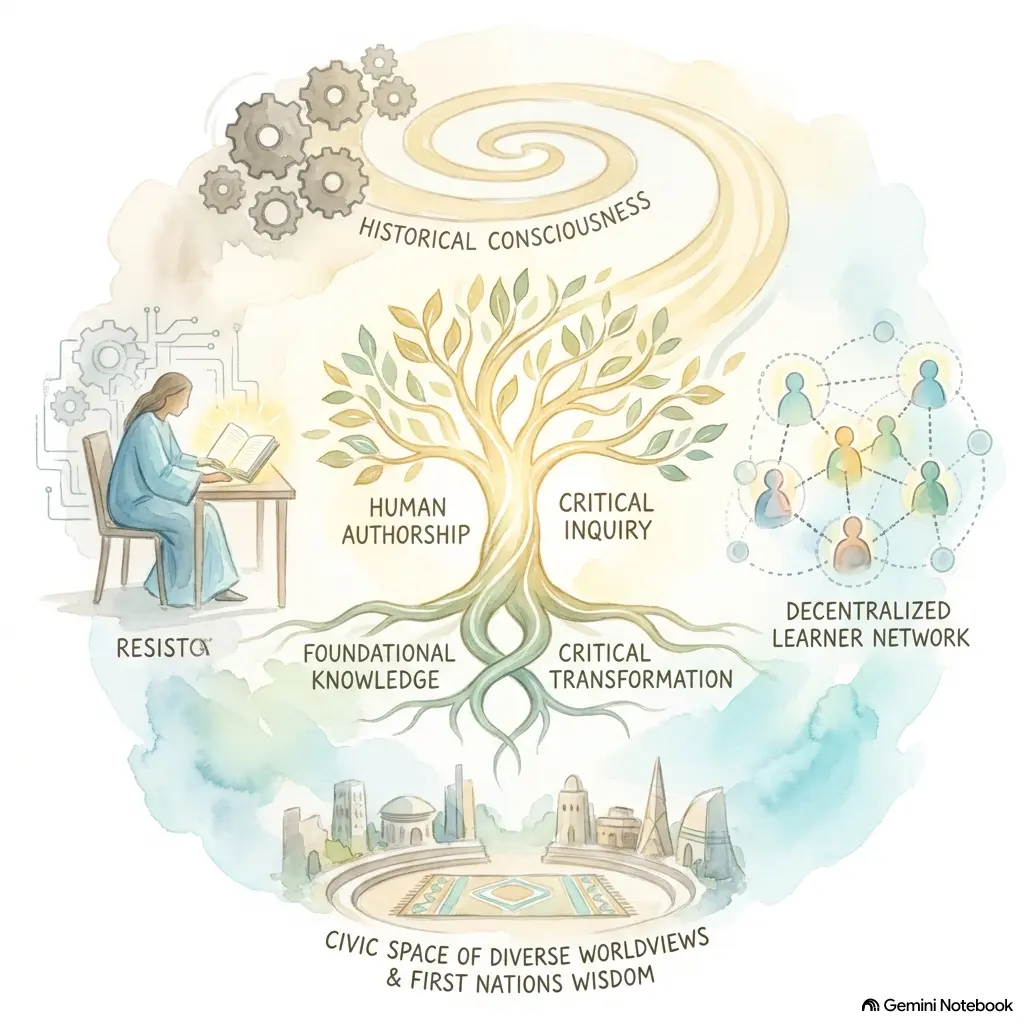
The research output of MICE—synthesizing the works of Dr. Neville Buch, Dr. Michael Macklin, Dr. Neil Peach, and global social theorists—provides five primary lessons for national education reform:
  CORE MICE LESSONS FOR THE COMMISSION
 ┌─────────────────────────────────────────────────────────────────────────┐
 │ 1. DYNAMIC OF COGNITION (DoC) & COUNTERING DENOETIZATION │
 │ Moving beyond unreflective habit to Human Authorship & Planetary │
 │ Wisdom; filtering out algorithmic "autocomplete" routines. │
 ├─────────────────────────────────────────────────────────────────────────┤
 │ 2. SYNTHESIZING EDUCARE AND EDUCERE │
 │ Reconnecting cultural training (educare) with critical leading-out │
 │ (educere) to overcome narrow "job-ready" credentialism. │
 ├─────────────────────────────────────────────────────────────────────────┤
 │ 3. CONVIVIAL LEARNING WEBS & LIFELONG EDUCATIONAL ENTITLEMENTS │
 │ Inverting manipulative school monopolies into decentralized skill │
 │ networks funded via per-capita student accounts (Macklin/Illich). │
 ├─────────────────────────────────────────────────────────────────────────┤
 │ 4. CIVIC SECULARITY VS. IDEOLOGICAL SECULARISM │
 │ Maintaining neutral, non-coercive spaces that foster post-secular │
 │ pluralism, interreligious literacy, and First Nations wisdom. │
 ├─────────────────────────────────────────────────────────────────────────┤
 │ 5. SPIRAL HISTORIOGRAPHY & "CRAP DETECTING" │
 │ Navigating past educational reforms to eliminate "historical │
 │ forgetfulness" and unmask bureaucratic propaganda. │
 └─────────────────────────────────────────────────────────────────────────┘
2.1 Lesson 1: The Dynamic of Cognition (DoC) and Resisting “Denoetization”
MICE’s core theoretical engine is Dr. Neville Buch’s Dynamic of Cognition (DoC) matrix, which maps human thought across four progressive stages: Stage 1 (Prejudice / Lived Embodiment), Stage 2 (Attitudes / Critical Thinking), Stage 3 (Exclusion / Procedural Filtering), and Stage 4 (Inclusion / Synthesis and Human Authorship) (Buch 2025a, p. 1; Buch 2026a, pp. 1–2).
MICE warns that modern education is suffering from acute denoetization—the mechanical liquidation of human judgment caused by hyper-formalized online environments, predictive algorithms, and test-driven instruction (Stiegler 2014 and Serdyukov 2021, cited in Buch 2026a, pp. 21–22). The new Commission must understand that treating students as passive receptacles to be filled with prepackaged content (Freire’s “banking model”) creates a dangerous cognitive “rift” between a creative, investigative mind and a passive, filled one (Freire 1970 and Serdyukov 2021, cited in Buch 2026a, p. 21).
2.2 Lesson 2: Synthesizing Educare and Educere Against Credential Inflation
MICE rejects the etymological and policy reductionism that separates training (educare) from critical leading-out (educere) (Buch 2026a, p. 21). In recent decades, Australian state and federal policies have excessively favored educare, degrading higher education and TAFE into mere “job-ticket” factories (Collins 2019 and Buch 2024a, pp. 13–14). Sociologist Randall Collins demonstrated that expanding education solely for market entry does not increase social mobility; it merely drives credential inflation, forcing students onto an endless, costly treadmill of formal qualifications without deepening their actual cognitive capacity (Collins 2019, cited in Buch 2024a, p. 15). The Commission must design policies that balance foundational cultural knowledge with autonomous critical inquiry (Buch 2026a, p. 21).
2.3 Lesson 3: Convivial Learning Webs and Lifelong Educational Entitlements
Drawing on Ivan Illich and Dr. Michael Macklin, MICE highlights that universal education cannot be delivered through manipulative institutional monopolies alone (Illich 1971; Macklin 1972, p. 197; Macklin 1976). Macklin’s landmark proposal for Funding Reformed School advocates dividing the national educational budget into direct, per-capita educational entitlements deposited at birth into personal educational accounts (Macklin 1976, p. 14; Buch 2026a, pp. 34–35). Individuals can draw from these funds throughout their lives to pay mentors, acquire specific vocational skills, or access learning resources when they are most motivated, transforming education from an obligatory consumer product into a decentralized learning web (Macklin 1976, p. 14; Illich 1973; Buch 2026a, p. 35).
2.4 Lesson 4: Policy Secularity vs. Secularism and Protecting Pluralism
MICE establishes an essential policy distinction between neutral civic secularity and aggressive political secularism (Buch 2024d, p. 1; Buch 2024e, p. 1). Secularity provides a neutral, non-coercive public space that protects religious freedom, non-religion, and philosophical diversity; secularism, when turned into a rigid ideology, attempts to sanitize public education of all worldview discussions (Buch 2024e, pp. 1–2). The Commission must preserve secularity to foster post-secular dialogue, interreligious literacy, and First Nations relational knowledge (“Country”) without imposing anti-religious or hyper-technocratic dogmas (Byrne 2014; Habermas 2006, cited in Buch 2025b, p. 14; Buch 2026b, p. 3).
2.5 Lesson 5: Spiral Historiography and “Crap Detecting”
To prevent “historical forgetfulness”—the condition wherein policy-makers repeatedly recycle failed educational panaceas because they have lost the historical context of their conceptual schemas—MICE advocates Spiral Historiography (Buch 2024a, p. 12; Buch 2026a, p. 41). The Commission must deploy “crap detecting” as a structural filter, systematically identifying and discarding bureaucratic propaganda, market-driven fads, and “theological/ideological masks” that conceal institutional failures (Postman and Weingartner 1969, cited in Buch 2026a, p. 24).
3. How the Proposed Commission Can Implement MICE Lessons
To translate these MICE lessons into concrete governance, the Australian Teaching and Learning Commission should implement four structural mechanisms during its legislative formulation:
  COMMISSION IMPLEMENTATION ARCHITECTURE
 ┌─────────────────────────────────────────────────────────────────────────┐
 │ 1. MULTI-PERSPECTIVAL EVIDENCE STANDARDS │
 │ Mandating that AERO and Commission research synthesize cognitive │
 │ science with developmental, sociological, and First Nations models. │
 ├─────────────────────────────────────────────────────────────────────────┤
 │ 2. MANDATORY "SCHOOL-ENVIRONMENT & NOETIC IMPACT STATEMENTS" │
 │ Evaluating all national policy proposals for workload cost, equity │
 │ in remote settings, and impacts on unmeasured human outcomes. │
 ├─────────────────────────────────────────────────────────────────────────┤
 │ 3. DECENTRALIZED LEARNING WEBS & PER-CAPITA LIFELONG ACCOUNTS │
 │ Operationalizing Macklin's entitlement model for post-secondary and │
 │ adult education via direct learning credits. │
 ├─────────────────────────────────────────────────────────────────────────┤
 │ 4. INDEPENDENT ASSESSMENT & REFLEXIVE INSIDER EVALUATION │
 │ Separating curriculum evaluation from reporting bodies to prevent │
 │ the Commission from becoming the sole judge of its own work. │
 └─────────────────────────────────────────────────────────────────────────┘
- Broaden the National Definition of “Evidence”: The Commission’s research arm (incorporating AERO) must be legally bound to protect pluralism in what counts as valid educational evidence (Frew 2026, p. 194). Cognitive load theory and explicit instruction—while valuable—must not be permitted to become a monistic “science of learning” (Frew 2026, p. 193). Evidence standards must explicitly incorporate developmental psychology, relational sociology, practitioner action research, and First Nations community-led literacy frameworks (such as the Literacy for Life Foundation model) (Boughton and Williamson 2015, pp. 294–295; Frew 2026, p. 194).
- Institute Mandatory “School-Environment and Noetic Impact Statements”: Every major curriculum change, assessment regime, or teaching standard proposed by the Commission should undergo a rigorous impact assessment prior to implementation (Frew 2026, p. 194). These statements must evaluate:
- Teacher workload costs and administrative friction;
- Efficacy and cultural safety in disadvantaged, rural, remote, and specialist school settings;
- What vital human outcomes (e.g., curiosity, moral agency, civic belonging) are displaced by the proposal; and
- Protection against algorithmic denoetization and automated “autocomplete” learning (Frew 2026, p. 194; Buch 2026a, p. 22).
- Establish Decentralized Educational Entitlement Accounts: The Commission should partner with federal treasury and state departments to pilot Michael Macklin’s lifelong educational entitlement model for post-secondary and adult learning (Macklin 1976, p. 14; Buch 2026a, p. 34). By providing school-leavers and mature-age citizens with direct, credit-bearing learning accounts, Australia can bypass institutional university monopolies, allowing citizens to fund mentors, TAFE modules, community workshops, and skill exchanges throughout their lives (Macklin 1976, p. 14; Boughton 2016).
- Ensure Independent Assessment and Practitioner Governance: To prevent the Commission from becoming the sole judge of its own performance, national assessment auditing (formerly ACARA’s testing arm) must maintain structural independence from curriculum drafting (Frew 2026, p. 194). Furthermore, governance boards must feature active classroom practitioners, professional historians, and community sociologists—embodying C. Wright Mills’ “craftsmanship of the reflexive insider”—rather than exclusively corporate CEOs and party-aligned bureaucrats (Mills 1959, cited in Buch 2026a, p. 17).
4. How MICE Could Be Contracted for Consultancy on These Questions
As education ministers prepare draft legislation for 2027, the Management Institute for Contributory Economy (MICE) is uniquely positioned to serve as an independent expert consultancy to guide the Commission’s foundational architecture (Frew 2026, p. 192; NDB CV 2026, p. 1).
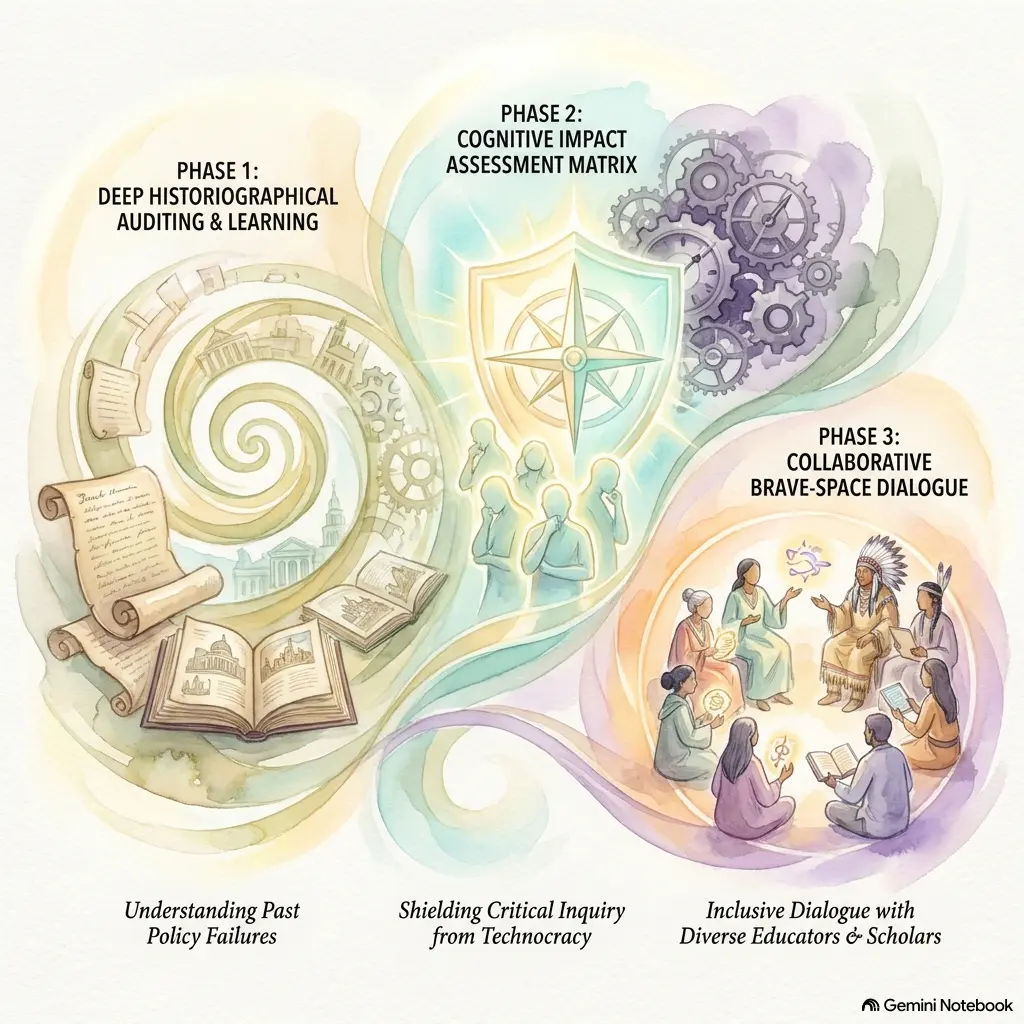
  MICE CONSULTANCY ENGAGEMENT ROADMAP
 ┌──────────────────────────────────┬──────────────────────────────────┐
 │ MICE CONSULTANCY DELIVERABLE │ POLICY IMPACT & UTILITY │
 ├──────────────────────────────────┼──────────────────────────────────┤
 │ Phase 1: Pre-Legislative │ Auditing ACARA, AITSL, and AERO │
 │ Historiographical Audit (2027) │ archives to identify recurring │
 │ │ failure modes & "historical delay".│
 ├──────────────────────────────────┼──────────────────────────────────┤
 │ Phase 2: Cognitive Impact │ Establishing the DoC evaluation │
 │ Framework & Matrix Design │ rubric to test national curriculum│
 │ │ against "denoetization" risks. │
 ├──────────────────────────────────┼──────────────────────────────────┤
 │ Phase 3: Reflexive Stakeholder │ Conducting "Brave Space" workshops│
 │ & Community Consultation │ with teachers, academics, and │
 │ │ First Nations educators. │
 └──────────────────────────────────┴──────────────────────────────────┘
4.1 Academic Authority and Professional Pedigree
MICE operates under the leadership of veteran Australian scholars whose combined expertise spans university executive management, state curriculum evaluation, and international philosophical history (NDB CV 2026, pp. 1, 4):
- Dr. Neville Buch: Professional Historian (MPHA), former Vice-Chancellors’ Research Officer at the University of Melbourne, Convenor of the TASA Sociology of Education Group, and leading authority on Queensland educational history and cognitive dynamics (Buch 1995; Buch 2024a; NDB CV 2026, pp. 1, 4).
- Dr. Neil Peach: Former Chief Operating Officer and Academic Registrar at the University of Southern Queensland, specializing in higher education governance, strategic planning, and work-based learning (Peach 2005; NDB CV 2026, p. 4).
- Dr. Michael Macklin: Former Senator for Queensland, Dean of Humanities and Social Sciences at the University of New England, and Australia’s premier authority on Ivan Illich and progressive educational philosophy (Macklin 1976; NDB CV 2026, p. 4).
4.2 Consultancy Scope and Engagement Packages
MICE can be formally contracted by the Department of Education or the Commission’s Implementation Taskforce under three targeted consultancy packages (Buch 2024v, cited in Buch 2024b, p. 46; NDB CV 2026, p. 1):
- Package A: Pre-Legislative Historiography and Audit (Phase 1): Conducting a comprehensive historiographical audit of Australia’s fifty-year history of curriculum and assessment reforms (from the 1970s Radford and ROSBA reviews to NAPLAN and Gonski). MICE will identify systemic failure modes, administrative overreach, and historical forgetfulness, ensuring the draft 2027 legislation avoids past traps (Buch 2024a, p. 12; Greenwell and Bonner 2022).
- Package B: Cognitive Impact & Noetic Rubric Formulation (Phase 2): Developing the formal evaluation matrix for the Commission’s “School-Environment and Noetic Impact Statements.” Utilizing the Dynamic of Cognition (DoC) framework, MICE will provide policy analysts with standardized diagnostic tools to screen national curriculum units for cognitive formalization, “de-reading” risks, and techno-bureaucratic bias (Buch 2025a; Buch 2026a, p. 21).
- Package C: Reflexive Stakeholder Consultation & “Brave Space” Facilitation (Phase 3): Designing and facilitating national consultation roundtables with teachers, educational researchers, First Nations community leaders, and nonreligious/religious representatives. Deploying Arao & Clemens’ “Brave Space” protocols, MICE will ensure public feedback is gathered without corporate manipulation or ideological coercion (Arao and Clemens 2013, cited in Peerenboom 2026; Buch 2026a, p. 17).
5. Why an Education Commission Along These Lines Is Important for Australian Society
Re-framing the proposed Australian Teaching and Learning Commission around MICE’s humanistic and cognitive principles is an existential necessity for Australian democracy in the mid-21st century for four compelling reasons:
  THE ASCENT TO PLANETARY WISDOM
┌───────────────────────────────────────────────────────────────────────────┐
│ STAGE 4: INCLUSION / SYNTHESIS │
│ - Human Authorship & Aristotelian Flourishing │
│ - Noodiversity & "Dialogue of Myths" │
│ - Planetary Wisdom & Public Orthopraxis │
├─────────────────────────────────────────────────────────────────────────┤
│ ▲ │
│ HUMANISTIC ASCENT (Care / Panser) │
│ │ │
├───────────────────────────────────────────────────────────────────────────┤
│ STAGE 3: EXCLUSION / REGRESSION │
│ - Algorithmic Formalization & Denoetization │
│ - "Potted Thinking" & "Historical Forgetfulness" │
│ - Technocratic Control & Corporate Credentialism │
└───────────────────────────────────────────────────────────────────────────┘

5.1 Reclaiming Human Authorship in the Age of Generative AI
As the Fourth Industrial Revolution inundates schools and workplaces with automated decision-making, predictive text, and generative AI algorithms, human cognition faces unprecedented pressures toward passivity (Serdyukov 2021 and Stiegler 2014, cited in Buch 2026a, p. 21). If national education policy merely reinforces algorithmic formalization, it will produce a generation of “puny human nodes” unable to exercise sovereign moral judgment (Buch 2026a, p. 22). Anchoring the Commission in MICE’s DoC framework restores Human Authorship, guaranteeing that the student remains the proactive, moral author of their own intellectual and civic life (Buch 2026a, pp. 1, 42).
5.2 Building an Intellectual Immune System Against “Potted Thinking”
Modern Australian public discourse is increasingly fragmented by sensationalist media, political polarization, and “potted thinking”—compressed, unexamined slogans that bypass critical reflection (Hofstadter 1963 and Ellul 1973, cited in Buch 2026a, pp. 10, 19). An Education Commission governed by MICE’s “crap detecting” methodology equips Australian citizens with an intellectual immune system, fostering the critical skills necessary to unmask corporate propaganda, resist political demagoguery, and maintain democratic oversight (Postman and Weingartner 1969, cited in Buch 2026a, p. 24).
5.3 Overcoming Educational Inequality Through Genuine Conviviality
Australia’s current school system remains deeply segregated by socio-economic status and geographic isolation, with traditional competitive schooling consistently reinforcing existing distributions of privilege (Macklin 1972, p. 209; Greenwell and Bonner 2022). By integrating Ivan Illich and Michael Macklin’s convivial learning webs and educational entitlements, the Commission can deliver true educational equity (Macklin 1976; Boughton 2013). Funding individuals directly empowers marginalized, adult, and remote First Nations learners to pursue self-initiated literacy and vocational goals without being stigmatized by institutional failure (Boughton and Williamson 2015, p. 294; Macklin 1976).
5.4 Guiding National Life Toward Planetary Wisdom
Finally, global crises such as climate change, ecological degradation, and geopolitical instability demand an education system that rises above parochialism and short-term market utility (Buch 2025c, p. 1; Buch 2026a, p. 45). By cultivating noodiversity (diversity of knowledge) and respecting the deep, relational wisdom of Indigenous connection to Country, a MICE-guided Commission elevates national education from routine administrative compliance to Planetary Wisdom—nurturing human flourishing (eudaimonia), biospheric care (panser), and public orthopraxis (Stiegler 2018 and Cupitt 2008, cited in Buch 2025b, p. 4; Buch 2026a, p. 45).
6. Conclusion
Australia stands at a critical juncture in the history of its national education policy. The creation of the proposed Australian Teaching and Learning Commission offers a rare opportunity to rebuild the nation’s educational infrastructure (Frew 2026, p. 191). If governed by narrow technocratic metrics, test-score fetishism, and market-driven credentialism, the Commission will solidify an automated orthodoxy that liquidates human judgment and alienates learners (Collins 2019; Frew 2026, p. 195; Buch 2026a, p. 21).
Conversely, by embracing the lessons of the Management Institute for Contributory Economy (MICE)—incorporating Dr. Neville Buch’s Dynamic of Cognition, Dr. Michael Macklin’s funding reform, Ivan Illich’s convivial learning webs, and Paulo Freire’s problem-posing dialogue—the Commission can become a life-enlarging institution. Contracting MICE during the Commission’s legislative design phase ensures that national policy is grounded in deep historical historiography and rigorous cognitive cartography. Ultimately, a MICE-guided Education Commission will dismantle the “altar of autocomplete,” safeguard democratic pluralism, and restore Human Authorship and Planetary Wisdom for generations to come.
Bibliography
- Arao, B. and Clemens, K. (2013). ‘From Safe Spaces to Brave Spaces: A New Way to Recognize Hope and Risk in Social Justice Education’. In L. M. Landreman (ed.) The Art of Effective Facilitation: Reflections on Social Justice Educators. Sterling, VA: Stylus Publishing, pp. 135–150.
- Ashenden, D. (2026). ‘Why Should an Economic Radical be an Educational Reactionary?’. Inside Story, October. [Cited in Frew 2026, p. 190].
- Biesta, G. (2022). World-Centred Education: A View for the Present. London: Routledge.
- Boughton, B. (2013). ‘Popular Education and the “Party Line”‘. Globalisation, Societies and Education, 11(2), pp. 239–257.
- Boughton, B. (2016). ‘Popular Education and Mass Literacy Campaigns in Australia’. Australian Journal of Adult Learning, 56(2), pp. 200–221.
- Boughton, B. and Williamson, F. (2015). ‘“A Strong Belief in the Possibility of a Better Life”: The Pedagogy of Contingency in North-Western New South Wales’. In Indigenous Education in Australia: Learning and Teaching for Deadly Futures. London: Routledge, pp. 294–312.
- Buch, N. (1995). American Influence on Protestantism in Queensland since 1945. Ph.D. thesis, Department of History, University of Queensland. [Awarded April 1995].
- Buch, N. (2024a). Rethinking School: Queensland Education 1971–1989. Brisbane: Management Institute for Contributory Economy.
- Buch, N. (2024b). School Thinkers and Cognition History in our Schools. Brisbane: Management Institute for Contributory Economy.
- Buch, N. (2024c). ‘Queensland History, Religious Education, and Belief’. In D. W. Kim and D. Wright (eds.) Socio-Anthropological Approaches to Religion: Environmental Hope. London: Lexington Books, pp. 157–172.
- Buch, N. (2024d). Secular, Secularity, and Secularism Policy Statement. Draft Policy Statement for Humanists Australia Limited.
- Buch, N. (2024e). Secularity is Not Secularism. Position Paper, Management Institute for Contributory Economy.
- Buch, N. (2025a). Non-Religion PowerPoint Framework and the Dynamic of Cognition (DoC) Model. Brisbane: Management Institute for Contributory Economy.
- Buch, N. (2025b). What Happened to Secular Theology? European (including UK) and American Contributions to Non-Religion 1967–2025. Paper presented at the TASA-AASR Non-Religion Symposium, University of Sydney, 3 October.
- Buch, N. (2025c). Comprehensive Background Today on so-called Religion and Secularity. Brisbane: Management Institute for Contributory Economy.
- Buch, N. (2026a). Non-Religion and Dynamic of Cognition. Draft Academic Article.
- Buch, N. (2026b). Thinking Religion in Place: Religion is Not What It Was. Brisbane: Management Institute for Contributory Economy.
- Byrne, C. (2014). Religion in Secular Education: What Everybody Needs to Know. Leiden: Brill.
- Collins, R. (1998). The Sociology of Philosophies: A Global Theory of Intellectual Change. Cambridge, MA: Harvard University Press.
- Collins, R. (2019). The Credential Society: An Historical Sociology of Education and Stratification. New York: Columbia University Press. [Cited in Buch 2024a, p. 15].
- Cupitt, D. (2008). The Meaning of the West: An Apologia for Secular Christianity. London: SCM Press. [Cited in Buch 2025b, p. 4].
- Ellul, J. (1973). Propaganda: The Formation of Men’s Attitudes. New York: Vintage Books. [Cited in Buch 2026a, p. 19].
- Freire, P. (1970). Pedagogy of the Oppressed. New York: Seabury Press. [Cited in Buch 2026a, p. 5].
- Frew, J. (2026). ‘Australia’s New Education Commission Must Measure What Matters’. Pearls and Irritations, 13 November, pp. 189–196.
- Fricker, M. (2007). Epistemic Injustice: Power and the Ethics of Knowing. Oxford: Oxford University Press.
- Greenwell, T. and Bonner, C. (2022). Waiting for Gonski: How Australia Failed Its Schools. Sydney: UNSW Press.
- Habermas, J. (2006). ‘On the Relations Between the Secular Liberal State and Religion’. In H. de Vries and L. E. Sullivan (eds.) Political Theologies: Public Religions in a Post-Secular World. New York: Fordham University Press, pp. 251–260. [Cited in Buch 2025b, p. 14].
- Hofstadter, R. (1963). Anti-Intellectualism in American Life. New York: Alfred A. Knopf. [Cited in Buch 2026a, pp. 9–10].
- Illich, I. (1971). Deschooling Society. London: Calder & Boyars. [Cited in Buch 2026a, p. 34].
- Illich, I. (1973). Tools for Conviviality. New York: Harper & Row. [Cited in Buch 2026a, p. 15].
- Macklin, M. (1972). When Schools Are Gone. Melbourne: Australian Union of Students / University of Queensland Press.
- Macklin, M. (1975). ‘Those Misconceptions Are Not Illich’s’. Educational Theory, 25(3), pp. 323–329.
- Macklin, M. (1976). When Schools Are Gone: A Projection of the Thought of Ivan Illich. St. Lucia: University of Queensland Press. [Cited in Buch 2026a, pp. 34–35].
- Mills, C. W. (1959). The Sociological Imagination. New York: Oxford University Press. [Cited in Buch 2026a, p. 17].
- NDB Full CV (2026). Dr Neville Douglas Buch Curriculum Vitae and Professional Record. Brisbane: MICE.
- Peach, N. (2005). ‘Academic Planning and Strategic Planning: Strangers in the Night or Potent Weapons for Strategic Competitive Advantage?’. Academia.edu Working Paper.
- Peerenboom, L. (2026). Ethical Research of Religious Trauma: Workshop Proceedings. 2nd Leaving Religion and Politics of Nonreligion Symposium, University of Sydney, 23 October.
- Postman, N. and Weingartner, C. (1969). Teaching as a Subversive Activity. New York: Delacorte Press. [Cited in Buch 2026a, p. 24].
- Serdyukov, P. (2021). ‘A Growing Formalization of Contemporary Online Education’. Academia Letters, Article 22396. [Cited in Buch 2026a, p. 21].
- Stiegler, B. (2014). Symbolic Misery, 1: The Hyperindustrial Epoch. Cambridge: Polity Press. [Cited in Buch 2026a, p. 22].
- Stiegler, B. (2018). Qu’appelle-t-on panser? 1. L’immense régression. Paris: Éditions Les Liens qui Libèrent. [Cited in Buch 2025c, p. 1].



Neville Buch
Latest posts by Neville Buch (see all)
- Australia’s New Education Commission and Lessons from MICE – November 14, 2026
- MICE and American-Australian Studies: Historiographical Foundations & Contributory Sociology – November 14, 2026
- Architects of Care: World Kindness Day, MICE, and the Contributory Re-Orientation of Society – November 13, 2026