
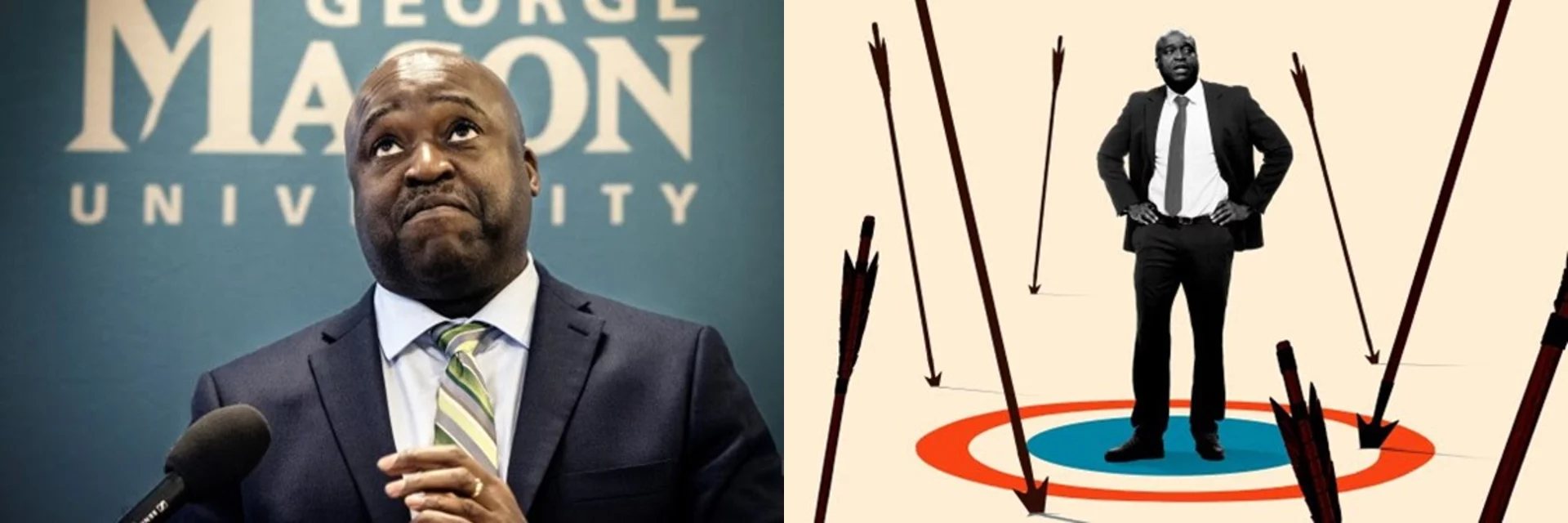
George Washington, President of George Mason University (GMU) has Defiance, taking a stand against what is wrong.
From The Chronicle of Higher Education, 26 August 2025:
GMU President Refuses to Apologize for Diversity Efforts, Lawyer Calls Ed. Dept. Claims ‘Absurd’ by Katherine Mangan and Jasper Smith. In a 10-page letter, Gregory Washington’s lawyer says the Trump administration conducted an incomplete and haphazard investigation full of “gross mischaracterizations.”
LEADERSHIP
Gregory Washington’s Gamble by Katherine Mangan and Jasper Smith. The president of George Mason — and faculty leaders — may be punished for defending university policies.
Dictionary
Definitions from Oxford Languages
defiance
/dɪˈfʌɪəns/
noun
open resistance; bold disobedience.
“an act of defiance”
The point being, as with warfare in live ammunition and physical explosions, our words, ideas, and beliefs have powerful impact. Defiance, taking a stand against what is wrong, has powerful meaning. It is a good choice when it appears as un-warfare like, because it is not warfare; it is speaking truth.
Siegfried Sassoon’s Public Statement of Defiance
“I am making this statement as an act of wilful defiance of military authority, because I believe the war is being deliberately prolonged by those who have the power to end it.
I am a soldier, convinced that I am acting on behalf of soldiers. I believe that this war, upon which I entered as a war of defence and liberation has now become a war of aggression and conquest. I believe that the purposes for which I and my fellow soldiers entered upon this war should have been so clearly stated as to have made it impossible to change them, and that, had this been done, the objects witch actuated us would now be attainable by negotiation.
I have seen and endured the suffering of the troops, and I can no longer be a party to prolong these sufferings for ends which I believe to be evil and unjust. I am not protesting against the conduct of the war, but against the political errors and insincerity’s for which the fighting men are being sacrificed.
On behalf of those who are suffering now I make this protest against the deception which is being practised on them; also I believe that I may help to destroy the callous complacence with which the majority of those at home regard the continuance of agonies which they do not share, and which they have not sufficient imagination to realise.”
Siegfried Sassoon was an English poet, writer, and soldier decorated for bravery in World War I. His war poems are characterized by their unflinching honesty and fierce denouncement of the political errors and patriotic rhetoric that perpetuated the conflict. Sassoon’s visceral depictions of trench warfare exposed the stark realities of the front lines, challenging the romanticized notions of heroism prevalent at the time. [see footnote]
Featured Image: George Washington, President of George Mason University (GMU) has Defiance.
FOOTNOTE
What has been reproduce is a copy of the open letter, published in The Times newspaper, 31 July 1917.
The letter published by a war hero (Sassoon won the Military Medal) caused a minor furore and questions were asked in the Houses of Parliament.
Jim Saville © by owner. provided at no charge for educational purposes.
Analysis (ai): This public statement by Sassoon is a powerful indictment of the war, demonstrating the disillusionment and anger felt by many soldiers. Sassoon’s critique of the war as “a war of aggression and conquest” aligns with the growing anti-war sentiment within the British public during the later stages of the war.
Unlike Sassoon’s earlier war poetry, which focused on the personal experiences and emotions of soldiers, this statement is more explicitly political. Sassoon directly challenges the government’s justification for the war and its conduct of the war, accusing them of “deception” and “callous complacence.”
The statement reflects the growing sense of disillusionment and frustration among soldiers and the public alike, and its publication was a significant event in the anti-war movement. Although Sassoon’s protest did not immediately lead to an end to the war, it helped to galvanize opposition to the government’s policies and contributed to the eventual decline in public support for the war.


Neville Buch
Latest posts by Neville Buch (see all)
- Volunteers Economically Abused: Neoliberal Formalism, MICE Philosophy, and the Capacity for Comprehensive Understanding – October 25, 2026
- University Academy Aggression: Corporate Managerialism, MICE Philosophy, and the Capacity for Comprehensive Understanding – October 25, 2026
- The Numbers Game Problem: Neoliberal Formalism, MICE Philosophy, and the Capacity for Comprehensive Understanding – October 25, 2026