
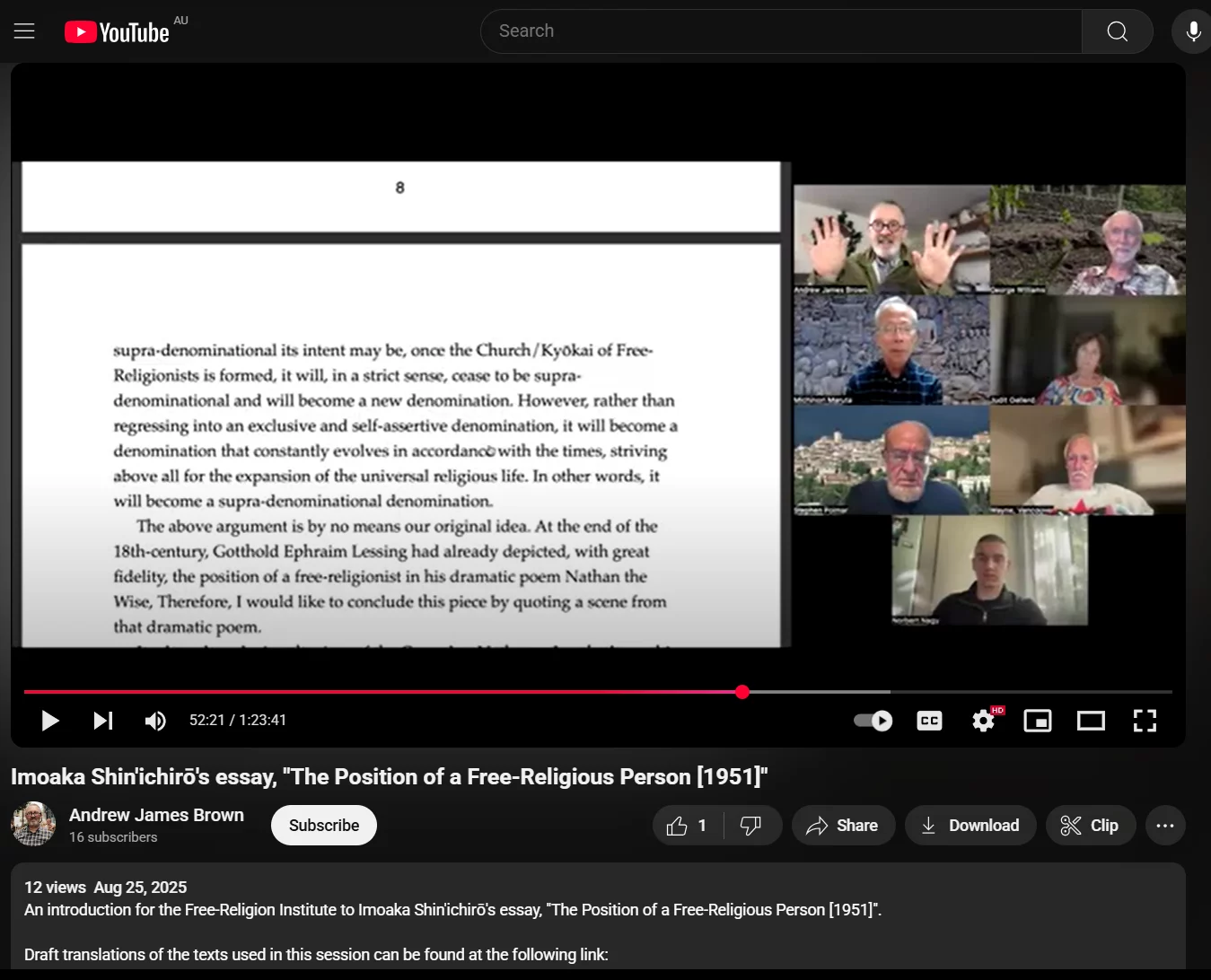
Andrew James Brown provides Open Education and an introduction to Imoaka Shin’ichirō’s essay, “The Position of a Free-Religious Person [1951]”.
I recommend listen to the YouTube video. Or read the transcription of Selected Essays by Imaoka Shin’ichiro [今岡信一良] (1881-1988).
School Education and Religion (2) [1956]
Shōwa 31 [1956] in “NHK New Books” [国際宗教研究所紀要]
137L – 139R
On the relationship between school education [学校教育] and religion [宗教], most general scholars [一般学者] and other educators [教育者] seem to conclude, firstly, that specific religions [特定宗教] should not be incorporated into school education [学校教育]; and secondly, that teaching religious knowledge [宗教の知識教育] and fostering religious sentiment [宗教の情操教育] are both acceptable — especially the latter, which should be actively encouraged. However, I have some doubts here. Can education in religious knowledge and sentiment really exist independently of an education of the religious will [宗教の意思教育]? Since knowledge [知識] and sentiment [情操] cannot operate separately from will within a person’s character [人格], I find it questionable to assume that religious education [知識教育] can safely be limited to knowledge and sentiment alone.
I find it puzzling why religious education [宗教教育] itself isn’t recognised — rather than being limited to teaching knowledge or cultivating sentiments about religion. This issue, I think, stems from the idea that specific religions must not be introduced into schools. The fear is that bringing a particular religion [特定の宗教] — that is, a sect [宗派] or organisations [教団] — into the classroom would disrupt the educational environment. I fully share that concern. However, the deeper question is whether religion as such can exist independently of sects or religious organisations. Must we assume that religion has no existence apart from specific forms? I do not think so. I believe that religion — apart from sects, denominations, or organised religious bodies — genuinely and properly exists.
The religion [宗教] of Jesus [イエス] was not, I believe, the established religion [既成宗教] of his time — namely Judaism [ユダヤ教] — nor the religion of the global Roman Church [ローマ教会] as it exists today, centred on the Pope [ローマ法皇]; rather, it was the personal religion of Jesus himself [イエス自身の宗教]. The same holds true for Master Shinran [親鸞上人]: he separated himself from the institutional religion [教団] of his day and followed a religion of his own [自分自身の宗教]. That this differs from the present-day Buddhism of the Honganji [本願寺仏教] is, of course, evident. I believe the same principle applies to the matter of school education [学校教育]. It is indeed possible to introduce into school education [学校教育] a religion [宗教] that is neither a sect [宗派] nor a formal religious institution [教団]; and in fact, I see such a religion — what I call pure religion [純粋宗教] — as already present and actively at work within school education [学校教育].
Take, for instance, subjects like natural science [理科] and mathematics [数学]. These fields are, at their heart, a search for eternal truth [永遠の真理] that lies within nature [自然] and human life [人生]. As such, they evoke a deep yearning [あこがれ] for truth [真理], and a sense of reverent devotion [帰依の念] rises up like a spring. There is a well-known story about Newton [ニュートン]: when calculating whether the 28-day orbit of the moon [お月様] around the earth matched his theoretical predictions, he found they did not align. After sixteen years of effort, he finally discovered a miscalculation. When the numbers at last began to match, he was so overwhelmed with emotion [感激] and spiritual intensity [興奮] that he could not complete the calculation himself and entrusted it to a friend. I would say that this, too, is a truly noble religious experience [宗教的な体験]. The same applies to the study of social studies [社会科]. When we discover the serene and majestic law [安厳なる道理] that governs human relationships [人間関係] in society [社会] and the rise and fall of all humanity [全人類の盛衰興亡], we cannot help but feel inwardly compelled to straighten our course [標を正さしめられます].
I believe the same can be said about the study of majority rule [多数決] in democracy [デモクラシー]. As Rousseau [ルソー] said, the general will [総意] — the unified will of the whole [全体の意思] — is always right. Democracy [デモクラシー], then, is the pursuit of this always-right general will [総意]. Accordingly, what we call majority rule [多数決] in real-world politics [現実政治] is, in fact, something profoundly supra-realistic [超現實的] and idealistic [理想主義的]; democracy [デモクラシー], in this light, emerges as a pursuit of what may rightly be called divine will [神意] — the very heart/mind of God [神の御心]. This is what we come to realise. The microscopic world revealed by the lens [顕微鏡] and the vast cosmos glimpsed through the telescope [望遠鏡] both belong to the realm of deep mystery [神秘]. The study of language [言葉の研究] is not just an exercise in memorisation — it is, in truth, a training in human love [人類愛], a way of coming to understand the inner world of one’s own people [民族] and of others [他の民族]. The same is true of the study of the performing arts [芸能]. Through a reality that is not necessarily beautiful [美しからぎる現実], we create and internalise a world of aesthetic experience [審美の世界] — a world that could be described as supra-real [超現実]. What is this, if not religious practice [宗教的実習]? Thus, learning in these various fields [諸学科] is not only academic study — it is also, at the same time, the purest kind of supra-denominational [超宗派的] religious practice [宗教的実習]. In this sense, religious education [宗教教育] is a kind of education [教育] that rightly belongs not only in private schools [私立学校], but also in national [国立] and public [公立] schools. In fact, I believe that even in such schools, without being fully conscious of it as education [教育], this kind of religious education [宗教教育] is already being practised.
School education [学校教育], moreover, does not consist solely in classroom learning [教科の学習]. Student council activities [生徒会活動], which fall under what we call special educational activities [特別教育活動], are no less important than formal study [学習活動]. And within such activities, a form of religious practice [宗教的実践] is present. Through their learning experiences [学習活動], students [生徒] receive inspiration [インスピレーション] from their teachers [教師] — inspiration they may carry with them for the rest of their lives. Yet they also receive stimulation [刺戟] and influence [影響] from their classmates [学友] — sometimes equal to, or even greater than, that received from teachers. There is perhaps no more beautiful sight than the sparks that fly when the soul [魂] of a teacher who has dedicated their life to education [教育] meets the pure and innocent souls [魂] of youth — or when young people encounter one another soul-to-soul. In such moments, one senses the stirring of something greater than either the teacher’s or the students’ souls. Something exists there which cannot be explained by saying that a teacher is merely carrying out education [教育]. One might call it sincerity [真心], or perhaps the heart/mind of God [神のこころ]. In short, it is my view that in those rare and true moments when education [教育] becomes authentic education [本当の教育], there already exists a form of religious practice or activity [宗教的な実践や活動] — something that can only be described with a term like pure religion [純粋宗教].
Featured Image: Screenshot 2025-08-26 Imoaka Shin’ichirō’s essay, The Position of a Free-Religious Person


Neville Buch
Latest posts by Neville Buch (see all)
- Death in Life and Life in Death: Affective, Intellectual, and Ontological Dimensions of Human Mortality – October 2, 2026
- Psychological Symbol Cards – October 2, 2026
- The Washington Post Impact Report and American Studies – October 1, 2026