
Abstract
Intelligent living is defined as the transformation of human existence from a series of passive, unreflective reactions into a deliberate act of “human authorship”. It requires the Original Synthesis of Experience, where an individual takes the disconnected data of their life—memories, sensory inputs, and cultural heritage—and weaves them into a coherent common world-picture. This process is anchored in Lebensphilosophie (Philosophy of Life), which posits that meaning is not found in abstract, eternal forms, but within the continuous flow of lived experience (Erlebnis). By integrating the Five Intentions—Self, Mind, Reason, Utility, and Love—individuals can rise above the “coldness of calculation” and the “analytical abyss” of modern technicity to achieve Aristotelian Flourishing. With an appendix of what an example of unintelligence looks like.
PDF File:
Applied Principles for Intelligent Living
Applied Principles for Intelligent Living
I. The Internal Foundation: Self and Mind
- Assert Human Authorship: Recognize that you are the primary agent of your own life; reject the “Junior” state of being a passive conduit for societal prejudices or mechanical drives.
- Cultivate Reflective Consciousness: Practice seeing the Self as the object of its own reflection, distinguishing your “inner theatre” from external stimuli to establish a secure sense of identity.
- Engage in Metacognitive Control: Move beyond merely noticing your thoughts (monitoring) to actively regulating your learning and behaviour (control).
II. The Cognitive Discipline: Reason and Truthfulness
- Adopt the Via Negativa: Systematically purge errors and “widely-believed falsehoods” from your understanding by subjecting every entrenched belief to persistent skeptical doubt.
- Commit to Historical Reason: Follow the axiom that “understanding history is philosophy in practice”; use your social and historical context as the empirical grounding for all ethical critique.
- Practice Perspective Integration: Abandon the search for a single “God’s-eye view” and instead achieve cognitive superiority by integrating multiple, competing interpretations of reality.
- Utilize Pragmatic Truth Tests: Define the value of a belief by its practical efficacy and consequences; if a concept has no “practical bearing on existence,” it is an abstract net that misses real life.
III. The Ethical Compass: Utility and Love
- Maximize Universal Happiness: Apply Utility as a public criterion, striving for actions that maximize the good for the community while minimizing harm.
- Deploy the Panser of Love: Temper the coldness of logical calculation with Thinking as Caring; prioritize the particularity of the person before you over universal rules.
- Bridge the Gap with “Thick Concepts”: Use ethical terms (like honesty or justice) that fuse factual description with evaluation, ensuring your moral judgments remain anchored in concrete social practice.
IV. The Social Engagement: Praxis and Communication
- Pursue Conscientisation: Link your critical thoughts (critique) directly to reflective intervention (action) to transform your social environment.
- Engage in Communicative Rationality: Prioritize rational-critical dialogue aimed at mutual understanding (Verständigung); avoid “strategic action” that treats others as tools for your own success.
- Restore the Public Sphere: View your community—churches, clubs, or neighbourhood groups—as oppositional democratic spaces where the discourse of possibility and democracy can flourish.
V. The Perpetual Cycle: Growth and Persistence
- Embrace Spiral Historiography: Accept that ideas and beliefs evolve cyclically; use the lessons of past struggles to avoid repeating errors in your current narrative.
- Operate in the Zone of Proximal Development (ZPD): Constantly seek the gap between your present performance and your potential competence, using social interaction and instruction as the engine for development.
- Practice Stoic Calmness: Maintain internal integrity amidst the “chaos” of existence, transforming even the most difficult “dreadful accidents” of life into a triumphant “Thus I willed it”.
——————————————————————————–
Analogy for Intelligent Living: Intelligent living is like navigating a ship through a vast, shifting archipelago. Most people are like passengers (the “Junior” state), accepting the ship’s route as predetermined fate. The intelligent liver, however, is the navigator who has found their rudder (the Self and Mind). They use Reason as their compass to filter out the “fog” of propaganda (via Negativa), and Utility to measure the distance to a safe harbor. Yet, the compass alone is not enough; they must use Love as their ballast, ensuring that in their quest for efficiency, they do not capsize the ship by ignoring the “weight” of human feeling. They do not follow a static map but engage in Spiral Navigation, constantly adjusting their course by looking back at the landmarks they’ve passed (history) to ensure they reach the “Universal Unfolding” of their destination with integrity.
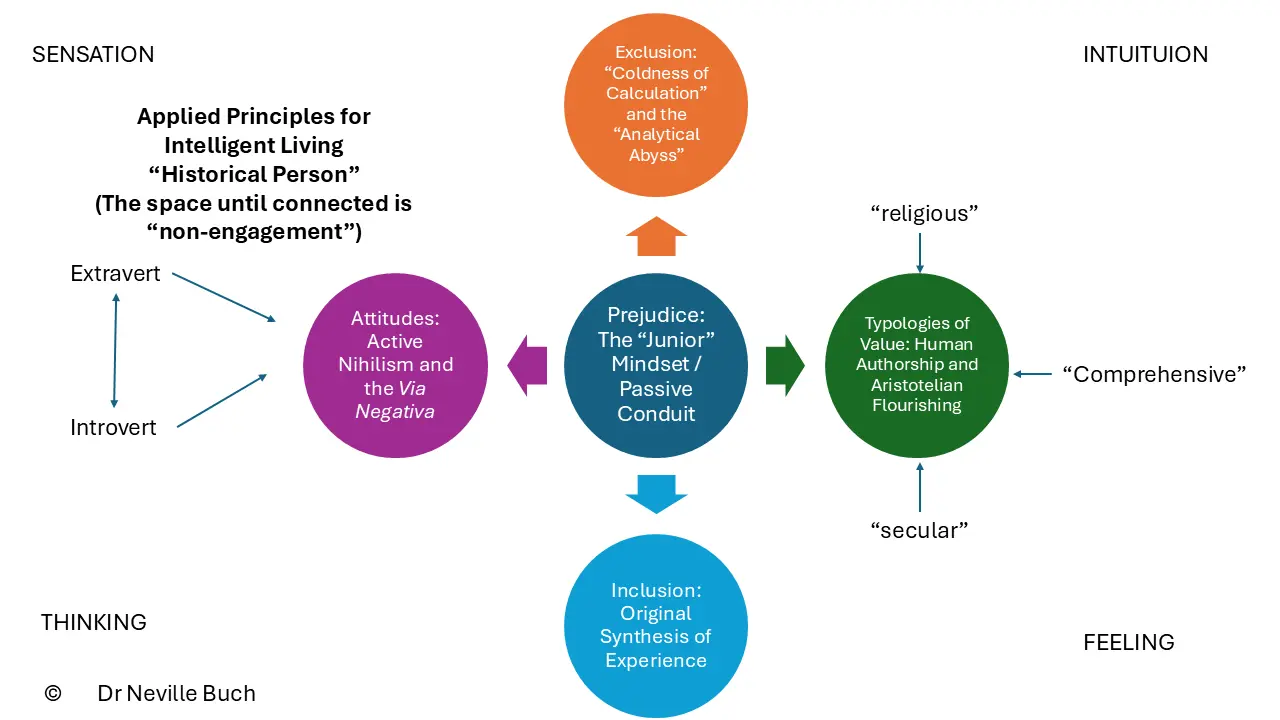
Based on the source “The Architect of Experience: A Manual for Intelligent Living” and the Dynamic of Cognition (DoC) methodology, the following table analyses the components of intelligent living.
DoC Analysis: The Architect of Experience
| DoC Component | Concept from the Manual | Cognitive Mechanism / Rationale |
| Prejudice (Centre) | The “Junior” Mindset / Passive Conduit | The initial, unexamined state of being a passive conduit for societal prejudices, mechanical drives, or predetermined fate. |
| Attitudes (Thinking/Extrovert) | Active Nihilism and the Via Negativa | The active intellectual posture of keeping all beliefs open to systematic skeptical doubt and the persistent purging of “widely-believed falsehoods”. |
| Exclusion (Sensation/Intuition) | “Coldness of Calculation” and the “Analytical Abyss” | The deliberate filtering out of modern technicity and fragmented, specialized data that reduces human experience to mere metrics or instrumental utility. |
| Inclusion (Thinking/Feeling) | Original Synthesis of Experience | The systematic act of weaving disconnected sensory inputs, memories, and historical context into a coherent, holistic, and common world-picture. |
| Typologies of Value (Feeling/Introvert) | Human Authorship and Aristotelian Flourishing | The supreme normative goal of achieving an ethically valuable life where the individual is the active author of their own existence, characterized by Stoic calmness. |
——————————————————————————–
EXAMPLE OF UNINTELLIGENCE
The derogatory status of the term “junior” in American culture is not a linguistic accident, but a profound symptom of an endemic cultural conflict between intellectual life and popular pragmatism. While superficial claims suggest the term is merely context-dependent, a deeper historiographical analysis reveals that “junior” has been weaponized as a marker of diminished competence and intellectual exclusion within a society that often prioritizes immediate utility over comprehensive wisdom.
The Hofstadter Diagnosis: Pragmatism as Prejudice
At the heart of this derogatory construction is what Richard Hofstadter identified as the Anti-Intellectualism Thesis. In American life, there is an entrenched prejudice that values the “utility man”—the individual who produces quantifiable, practical results—over the “bachelor scholar” or the thinker engaged in rigorous, non-technical inquiry. In this framework, the term “junior” ceases to be a developmental stage and becomes a permanent label for those relegated to the “analytical abyss” of modern technicity. It signifies a person who is a “passive conduit” for mechanical drives rather than an active author of their own existence.
The “Junior” Mindset: Limited Thinking and Vocational Enclosure
The sources define the “Junior” mindset as a state of limited thinking and unreflective prejudice. In the American context, this mindset is often enforced by a technocratic instrumentalism that funnels individuals into narrow “vocational fitness” streams. When a person is labelled “junior,” they are being identified as a “resource to be exploited” or a “talent to be mobilized” within a neoliberal discourse that subordinates the human person to market imperatives. The term becomes derogatory because it implies the subject lacks “human authorship” and is merely a “link in a chain” of fate or bureaucratic calculation.
The Binary of Power: Elder-Junior and the Lack of Agency
Drawing from comparisons between Australian and American systems, the “junior” label reflects an elder-junior individual binary relationship that bestows unquestionable authority upon the “elders” (the political or administrative class) while demanding docile loyalty from the juniors. In American culture, this binary is used to justify the exclusion of critical expertise. To be called “junior” is to be stripped of agency and democratic participation, reducing the individual to the “immediacy of their performance”—someone to be measured, administered, and controlled rather than listened to.
The “American Malady”: Behaviourism and the Reduction of the Person
The derogatory nature of “junior” is further intensified by what some critics call the “American malady”: a behaviorist orthodoxy that neglects subjectivity and meaning. In this reductionist environment, the “junior” is seen as a biological machine or a “sublime abortion” of humanity—a docile, mediocre being who has not yet achieved (and may never be permitted to achieve) the “Senior” state of social accountability and philosophical self-understanding. The term is made derogatory to ensure that those who are “junior” remain “at-risk” of staying within unexamined prejudices, preventing the emergence of a critical consciousness that could challenge the status quo.
Conclusion: Authorship versus Execution
Ultimately, in American culture, “junior” is made derogatory because it represents the “partie honteuse” of the inner world—the part characterized by habit, forgetfulness, and mechanical stupidity. It is an act of “strategic corruption” by the political class to keep the discourse flattened, ensuring that the “worried deep thinkers” are opted out while the “simplistic egotists” opt in. To overcome the derogatory weight of “junior,” one must engage in Active Nihilism—the systematic purging of unreflective falsehoods—to reach a “Senior Ascent” where the individual finally finds their own “rudder”.
——————————————————————————–
Analogy for the “Junior” Label in American Culture: Being labelled “junior” in a technocratic society is like being assigned to the boiler room of a great ship while the navigators stay locked on the bridge. The navigators (the political class) treat the ship as a mechanical production, valuing the workers in the boiler room only for their “vocational fitness” to keep the engines turning (the “Job Ready” prejudice). To the navigators, “junior” is a derogatory term because it identifies someone who only understands the “hard” architecture of the coal and the fire, lacking the “Senior” vision to see the horizon or the “soft” architecture of the waves. The workers are told they are “our future,” yet they are “managed and organized” as passive conduits of energy. They are never given a compass (Reason) or a map (History), because if they ever achieved “human authorship” of their own journey, they might realize that the navigators are merely “paper slaves” to profit, and they would demand to take the helm and say, “Thus I willed it.”.
Featured Image: Randall Collins’ The Sociology of Philosophies.



Neville Buch
Latest posts by Neville Buch (see all)
- The Road to Geelong: A Re-Narrativization of The Story of Resilience Part 1 – October 20, 2026
- The Human Being Above the Transaction and Why Markets Cannot Measure Human Worth – October 15, 2026
- Beyond Neoliberal Formalism: Should Taxpayers Fund Independent Philosophy – October 14, 2026