
MICE. Analysis of Big Belief and Big Doubt
https://www.academia.edu/145798686/MICE_Analysis_of_Big_Belief_and_Big_Doubt
Dr Neville Buch ABN: 86703686642
Abstract
The Management Institute for Contributory Economy (MICE) serves as a philosophical and structural intervention designed to correct systemic cognitive failures in modern governance and education. Rooted in the axiom that “understanding history is philosophy in practice,” MICE advocates for a transition from a technocratic “techné” mindset to one of Aristotelian flourishing (eudaimonia). Central to the work of MICE is the dialectical engagement between “big belief”—the affirmative commitment to human authorship and social contribution—and “big doubt”—the rigorous, skeptical critique necessary to dismantle “Widely-Believed Falsehoods”. By synthesizing global theoretical frameworks with local historical mapping, MICE aims to establish an “intellectual immune system” that fosters substantial fairness, rational-critical dialogue, and lifelong learning.
MICE. Analysis of Big Belief and Big Doubt
SOFiA. Analysis of Big Belief and Big Doubt
https://www.academia.edu/145798757/SOFiA_Analysis_of_Big_Belief_and_Big_Doubt
Dr Neville Buch ABN: 86703686642
Abstract
SOFiA (Sea of Faith in Australia), founded in 1995, represents a significant movement within the Australian intellectual landscape that seeks to navigate the transition from traditional religious dogmas to a post-metaphysical, human-centered spirituality. Drawing heavily on the work of Don Cupitt, the organization utilizes the metaphor of the “Sea of Faith” to describe a historical moment where the tide of supernatural belief is receding, leaving behind an “outgoing ocean-tide” of unverifiable doctrines. This transition creates a tension between “Big Belief”—the inherited structures of objective, supernatural religion—and “Big Doubt”—the radical Socratic skepticism and Nietzschean nihilism required to see through human-made fictions. SOFiA advocates for a religion of “solar ethics” and human authorship, where faith is understood not as an intellectual acceptance of the supernatural, but as a commitment to meaningful action (the deed) and the cultivation of a flourishing life within this world. By integrating the insights of thinkers like Wittgenstein, Habermas, and Bernard Williams, SOFiA fosters an open forum for intersubjective mutuality and the critical examination of how we construct our world through language and symbols.
SOFiA. Analysis of Big Belief and Big Doubt
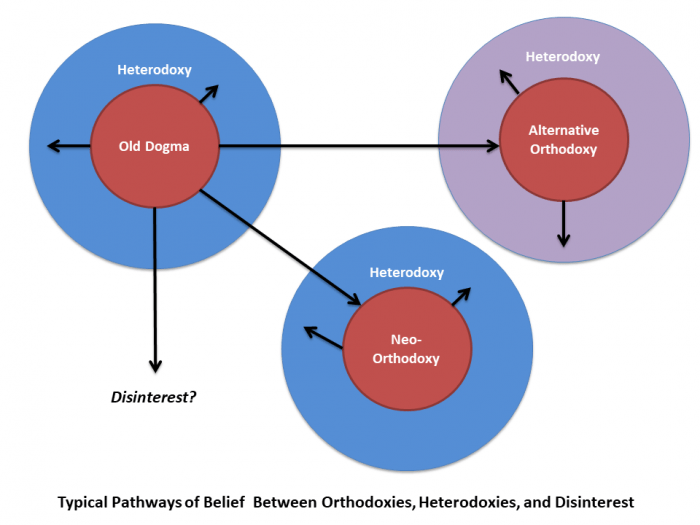
Featured Image: Typical-Pathways-of-Belief-700×525-1.png


Neville Buch
Latest posts by Neville Buch (see all)
- The Unbound Mind: Independent Scholarship, Institutional Isolation, and the Restoration of Human Authorship – October 20, 2026
- The Road to Geelong: A Re-Narrativization of The Story of Resilience Part 1 – October 20, 2026
- The Human Being Above the Transaction and Why Markets Cannot Measure Human Worth – October 15, 2026