
Dr Neville Buch
Abstract
This essay critically examines Frank Furedi’s rejection of the term “carer” in the context of the Management Institute for Contributory Economy (MICE) framework. While Furedi identifies a genuine concern regarding the transformation of intimate bonds into bureaucratic transactions, his focus on semantics is characterized as a “non-issue” compared to the deeper systemic pathologies of denoetization and Historical Forgetfulness. Drawing on the experience of Dr. Neville Buch, who spent a decade in the “crucible of care” for his terminally ill wife, the analysis argues that the term “carer” is not inherently poisonous. Rather, the danger lies in a “techné mindset” that reduces the historical person to a passive bearer of data sets. By utilizing panser (thinking as caring) and the POLICE model, the essay demonstrates that restoring human authorship requires moving beyond a “culture war” over words toward a Contributory Economy that values the intellectual and moral labour of care as a foundational social contribution.
The Semantics of Care: Beyond Furedi’s Non-Issue toward Human Authorship
1. Furedi’s Critique: The Bureaucratic Displacement of Intimacy
Frank Furedi’s visceral reaction against being designated a “carer” for his fatally ill mother stems from a fear of “transactional semantics”. He argues that bureaucratic typologies displace the unique normative status of intimate kinship, such as the bond between a son and a mother, replacing it with a generic, inclusive dogma that “criminalizes” exclusion. Furedi views this as a systematic attempt by cultural institutions to re-engineer language and distance society from its traditional moral content. From his perspective, the term “carer” is an administratively convenient label that fails to capture the filial love and natural concern that drive family caregiving.
2. The MICE Perspective: Care as a Crucible of Scholarship
While language is undoubtedly important, the MICE framework identifies Furedi’s linguistic fixation as a “non-issue” if it fails to address the structural “Academic Immense Regression”. Dr. Neville Buch’s trajectory provides a counter-narrative; having served as a primary caregiver for ten years, Buch does not merely critique the label but uses the “crucible of care” to ground his intellectual inquiry. For Buch, being a “carer” was not a bureaucratic reduction but a state of “voluntary work” enforced by the failure of the Australian economy to recognize his scholarly expertise.
Buch identifies the real threat not in the word “carer,” but in denoetization—the mechanical liquidation of the human capacity to judge that occurs when institutions treat individuals as “puny human nodes” in automated networks. The “humiliation” Furedi felt at the hospital is diagnosed by MICE as the psychological result of being reduced to a bearer (Träger) of a data set rather than a proactive historical person.
3. Panser: Thinking as Caring and the POLICE Model
To remediate the social fragmentation identified by both Furedi and Buch, MICE advocates for the reinvention of thinking (penser) as caring (panser). This is not a retreat into sentimentalism but a procedural “kindness shield” that protects human particularity from the cold calculation of technocratic logic. Utilizing the POLICE model, scholars can “crap detect” manufactured myths and “institutional bullshit” that prioritize status and rank over the archetype of the person.
Unlike Furedi’s “defensive contraction of concern,” which clings to traditional labels to avoid complex moral demands, Buch’s “Methodological Tenderness” uses the pain of the caring experience as an empirical grounding for ethical critique. By “uncoiling” the history of care through Spiral Historiography, MICE reveals that the pursuit of justice requires collective participation and intersubjective mutuality rather than a return to static, isolated myths.
Conclusion: Restoring the Author of Care
The transition from a “Junior” state of unreflective execution to a “Senior” state of social accountability demands that we see care as an act of human authorship. Furedi is correct that language matters, but the Contributory Economy demands more than just better words; it requires a fundamental reorientation that values human dignity, wisdom, and the “long circuits” of individuation over narrow pecuniary profit. Whether one is called a “son” or a “carer,” the goal must be Aristotelian flourishing, ensuring that the “who” (the human being) remains the intentional master of the “what” (the technical and social systems).
Dynamic of Cognition (DoC) Table: Semantic Grievance vs. Contributory Reality
| DoC Component | Furedi’s Regression (Semantic Focus) | Buch’s Corrective (Contributory Reality) | Philosophical Rationale |
| Prejudice (Centre) | Linguistic Anxiety: Fearing that bureaucratic labels destroy natural intimacy. | Structural Architecture: Reclaiming care as a foundational contribution to social memory. | Moves from a “Culture War” over words to proactive, systemic choices. |
| Attitudes (Thinking) | Culture War Messaging: Viewing inclusive language as a “dogma” of elite control. | Panser (Thinking as Caring): Reinventing the rational process to “tend to wounds”. | Replaces defensive rhetoric with the procedural necessity of kindness. |
| Exclusion (Sensation) | Historical Forgetfulness: Ignoring the systemic failure to support caregivers economically. | Denoetization Mapping: Diagnosing the mechanical liquidation of judgment under systems. | Reveals “inclusive language” as a secondary symptom of a deeper cognitive collapse. |
| Inclusion (Intuition) | Kinship Essentialism: Retreating into private bonds to escape bureaucratic “coldness”. | Human Authorship: Restoring the person as the proactive author of their social existence. | Restores the “who” as the master of the “what” (labels and systems). |
APA Bibliography
Buch, N. (2023, July 27). Emotion, caring, and convivial urban sociology between the academy and community. Management Institute for Contributory Economy.
Buch, N. (2025, March 17). MICE principles and philosophy (First development). Management Institute for Contributory Economy.
Buch, N. (2025, November 26). Caring and education, and Australian attention. Management Institute for Contributory Economy.
Buch, N. (2026, May 8). The academic immense regression: Denoetization and the crisis of scholarship. Management Institute for Contributory Economy.
Buch, N., Macklin, M., & Peach, N. (2026, May 28). DRAFT COMBINED BOOK: MICE Intellectual Handbook. Management Institute for Contributory Economy.
Furedi, F. (2026, June 15). Why do I hate the designation of the term ‘carer’ for family caregivers? Roots & Wings. [Gmail correspondence].
Habermas, J. (1979). Communication and the evolution of society (T. McCarthy, Trans.). Beacon Press.
Noddings, N. (1984). Caring: A feminine approach to ethics and moral education. University of California Press.
Stiegler, B. (1998). Technics and time, 1: The fault of Epimetheus (R. Beardsworth & G. Collins, Trans.). Stanford University Press.
Westoby, P., Warner, R., Dowling, G., Buckley, H., Andrews, D., & Donovan, R. (n.d.). The community builder’s journal. [Source documents 66-79].
Endnotes with References
- Denoetization refers to the systemic loss of the collective ability to judge under technical and bureaucratic pressure.
- Panser (Thinking as Caring) is a procedural mechanism and “shield” used to “tend to social wounds”.
- Historical Forgetfulness is a systemic pathology where societies repeat errors because the origins of their core concepts have been banished from memory.
- Human Authorship involves the developmental ascent from being a “puny human node” in a network to becoming the intentional author of one’s own existence.
- The POLICE Model (Philosophically Ontology Logic Intersect Compatibility Education) is used as an “intellectual immune system” to filter out “institutional bullshit”.
- The Contributory Economy is an alternative economic model that values knowledge production, human dignity, and character over narrow pecuniary profit.
- Relational Ethics (Noddings) prioritizes the particularity of the person and the moral relationship over abstract justice or utility.
- The “Crucible of Care” refers to the decade Dr. Buch spent as an unpaid caregiver, which he uses to ground his critiques of the “Academic Immense Regression”.
- Inclusive Language Guides are critiqued by Furedi for replacing terms like “mum” and “dad” with bureaucratic typologies like “birthing parent”.
- Aristotelian Flourishing (Eudaimonia) is the ultimate goal of MICE, defined as a life of virtuous action and meaningful contribution.
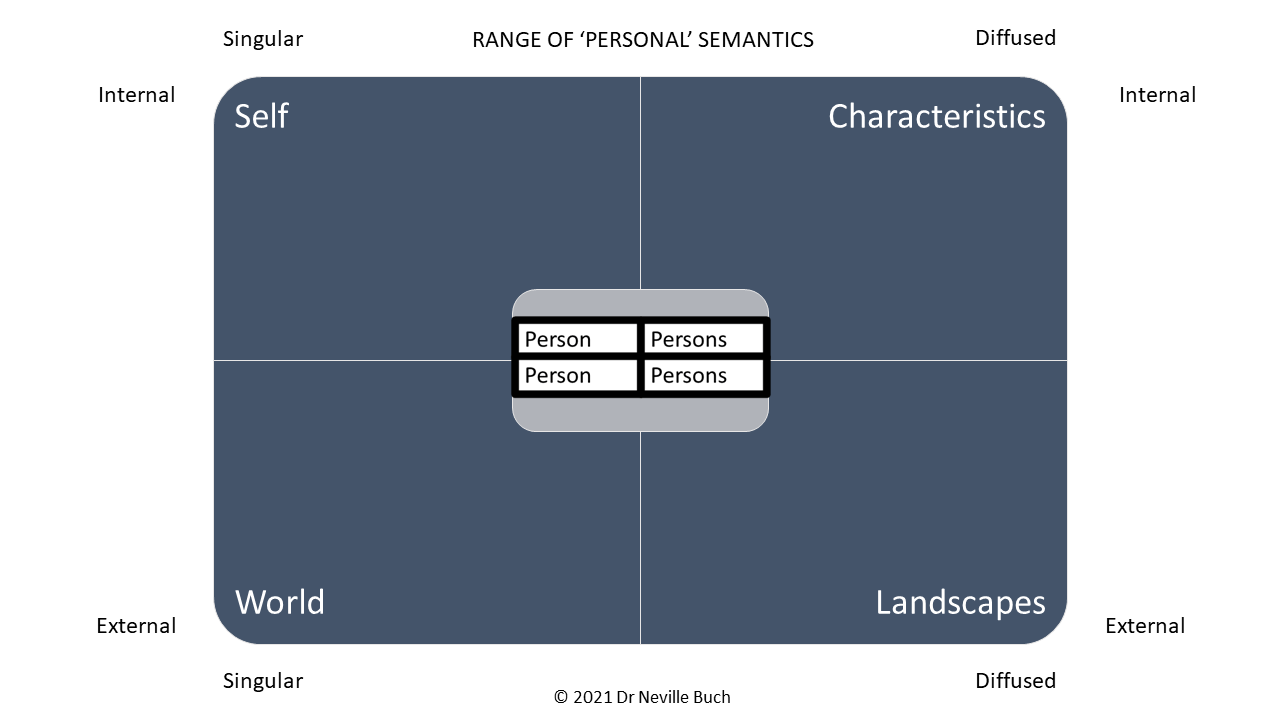
Featured Image: Range of Personal Semantics


Neville Buch
Latest posts by Neville Buch (see all)
- Thank you, Richard: Knowing the message but then acting – October 8, 2026
- The Desiccation of the Common Well: Identity Politics, Algorithmic Assessment, and the Crisis of Adult Responsibility – October 6, 2026
- Academic Rigour, Epistemic Renewal, and the Crisis of Inquiry: A Scholarly Review of the Vanderbilt Commission Report on the State of Scholarship – October 5, 2026