
Abstract
This essay examines the synergistic relationship between the biological and social phenomenon of life, the sociological pathology of herd mentality, the psychological weight of existential angst, and the educational ideal of mastery in learning. Drawing on the “Spiral History” framework developed by Dr. Neville Buch, the analysis argues that these concepts represent different stages of a single cognitive journey toward Human Authorship. Life begins in a “thrown” state of unreflective habit and prejudice, often manifesting as herd mentality—a path of least resistance that prioritizes group conformity over individual judgment. The breakdown of these unthinking habits, often triggered by the “discomforting pain” of reality, produces existential angst—the dizzying awareness of the responsibility for one’s own meaning in an absurd world. To achieve mastery, the individual must transition from a “Junior” state of unreflective execution to a “Senior” state of social accountability. This transition is facilitated by Spiral Historiography, a method of “uncoiling” repetitive patterns of failure by learning from past errors through Regret, ultimately leading to Aristotelian Flourishing (eudaimonia).
The Common Understanding: From Herd Habit to Human Authorship
I. Life and the Tyranny of the Herd
Life is often defined as a continuous process of growth and the overcoming of consolidated values. However, for the “Conventional Person,” existence is frequently anchored in unreflective prejudice and the “tyranny of habit”. This state is sociologically expressed as herd mentality—the tendency to conform to group beliefs to manage inner chaos and uncertainty. In this modality, the individual functions as a “passive conduit” for dominant ideologies, mirroring what Kierkegaard and Nietzsche critiqued as “slave morality” or the mindless behaviour of “sheeple”. This reliance on “potted thinking” and manufactured myths leads to Historical Forgetfulness, a systemic pathology where populations repeat past errors because their origins have been banished from collective memory.
II. Existential Angst: The Sensory Gateway
The move toward mastery begins with what F.C.S. Schiller called the “abnormality of thought”—a disturbance that occurs when unthinking habits prove inadequate for a new situation. This disturbance often manifests as existential angst, a core component of the human condition characterized by the search for meaning in an incomprehensible universe. Within the Buch schema, this angst is the “sensory gateway” of discomforting pain; it is a “social wound” that necessitates a shift from mere technical calculation to “thinking as caring” (panser). Existential anguish is not merely a negative state but the “dizziness of freedom” that signals the possibility of a “personal breakout” from repetitive cognitive patterns.
III. Mastery through Spiral Historiography
True mastery in learning goes beyond the acquisition of “job tickets” or vocational metrics. In a contributory sense, mastery is the achievement of “Conscious Competence,” where the individual reclaims authorship over their life narrative. This is operationalized through Spiral Historiography, a non-linear model that rejects the idea of history as a closed, repetitive loop. Instead, it proposes a spiralling movement where forward progress is achieved by recursively returning to past intellectual struggles. This process identifies Regret as the “father of wisdom”—the psychological corrective that teaches the necessary adjustments to past mistakes.
IV. Conclusion: Reaching Aristotelian Flourishing
The common understanding between these concepts lies in the humanistic ascent from unreflective habit (the Herd) to the mastery of self-determined values. By using reason to negate entrenched myths—a process termed “Active Nihilism”—the individual filters out “institutional bullshit” and restores human dignity. The ultimate goal is Aristotelian Flourishing (eudaimonia), an objective state of being where success is judged by wisdom, character, and contribution to the common good. In this state, the “who” (the human being) remains the intentional master of the “what” (the social and technical systems).
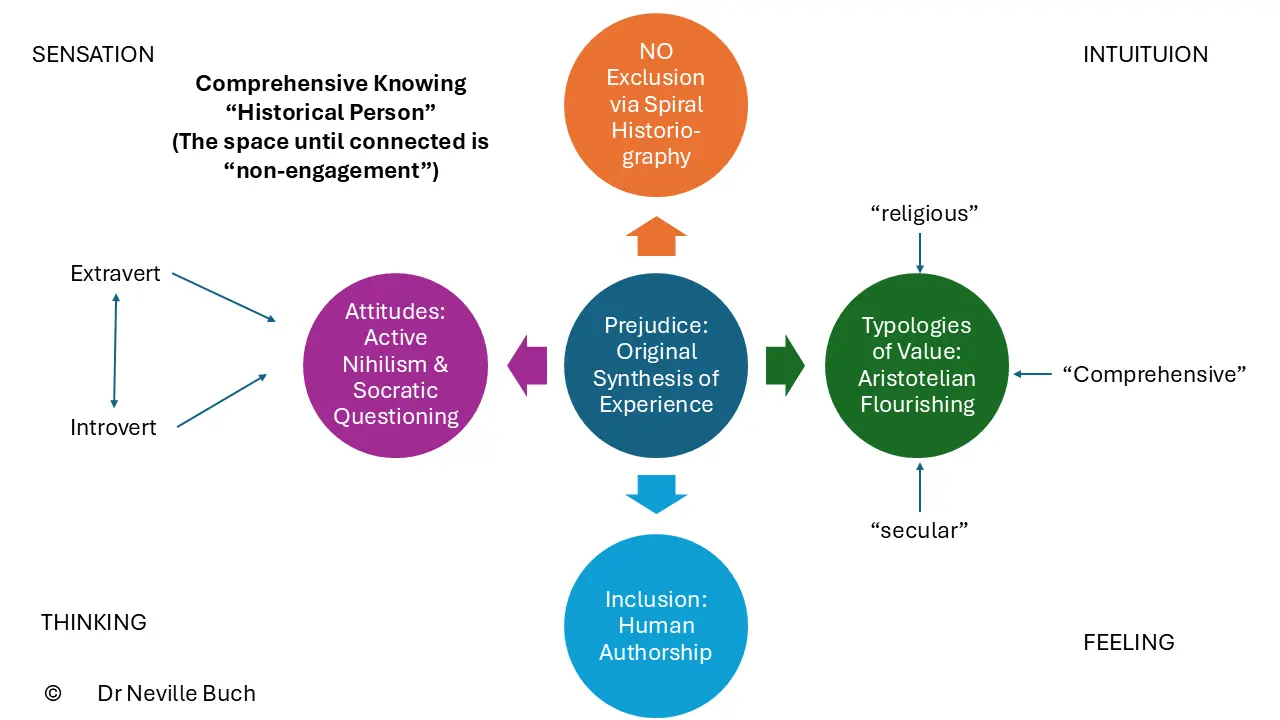
Dynamic of Cognition (DoC) Analytic Table
| DoC Component | Pathological State (The Herd/Stupidity) | Reformatory State (Mastery/Wisdom) | Cognitive Mechanism / Rationale |
| Prejudice (Centre) | Historical Forgetfulness: Records as neutral data; reliance on unreflective habit. | Original Synthesis of Experience: Recognizing knowledge as an interpersonal, social product. | Moves from “thrown” unexamined beliefs to a conscious act of relating the self to a shared world. |
| Attitudes (Thinking) | “Tourist” Attitude: Shielding oneself with private comforts; passive consumption of dogma. | Active Nihilism & Socratic Questioning: Using reason to negate entrenched myths. | Replaces “ignorant habits” with the drive for reflective self-criticism and “crap detecting”. |
| Exclusion (Sensation) | Technocratic Reductionism: Filtering out human agency and the “thick” ethics of pain. | Spiral Historiography: Filtering out “institutional bullshit” and manufactured myths. | Uses the “social wound” (angst/pain) as a diagnostic signal to “uncoil” repetitive historical errors. |
| Inclusion (Intuition) | Relative Inauthenticity: Submerging the “I” in the crowd and unthinking habit. | Human Authorship: Reclaiming the role of the proactive creator of meaning. | Transforms “disconnected impressions” into a shared stream of consciousness and intersubjective mutuality. |
| Value (Feeling) | Simplistic Utility: Measuring success by private accumulation and status. | Aristotelian Flourishing: Measuring success by dignity, wisdom, and character. | Transition to a comprehensive system of social accountability and eudaimonia. |
Bibliography
Arendt, H. (1951). The origins of totalitarianism. Harcourt, Brace and Company.
Arendt, H. (1977). The life of the mind (M. McCarthy, Ed.). Harcourt Brace Jovanovich.
Bengtsson, J. O. (2006). The worldview of personalism: Origins and early development. Oxford University Press.
Buch, N. (2015). No regrets in the evening of life: The history of Junction Park State School (1888–2013). Boolarong Press.
Buch, N. (2024, February 11). The spiral history theory of stupidity: Getting stuck in time-space, and personal breakout of historical cognition patterns. Concepts in Educationalist Thought Series.
Buch, N. (2026, April 10). Understanding history is philosophy in practice: A cognition history of Queensland. Management Institute for Contributory Economy.
Buch, N. (2026, May 15). Journey through intellectual, sociological, and philosophical thinking. Management Institute for Contributory Economy.
Buch, N. (2026, May 17). DRAFT Transference: Character and the contributory economy. Management Institute for Contributory Economy.
Buch, N. (2026, June 15). Spiral historiography and the dynamic of cognition (Revised Final). Management Institute for Contributory Economy.
Buch, N. (2026, June 16). The sensory gateway: From passive comfort to ethical caring. Management Institute for Contributory Economy.
Buch, N. (2026, June 17). Beyond the semantics of care: Restoring human authorship. Management Institute for Contributory Economy.
Buch, N. (2026). Understanding local-global framing for Unitarian-Universalism (UU). UUnderWorld August.
Cervantes Saavedra, M. de. (1615). Segunda parte del ingenioso cavallero. Don Quixote de la Mancha. Juan de la Cuesta.
Dewey, J. (1922). Human nature and conduct: An introduction to social psychology. Henry Holt and Company.
Hofstadter, R. (1965). The paranoid style in American politics, and other essays. Alfred A. Knopf.
Labaree, D. F. (1997). Public goods, private goods: The American struggle over educational goals. American Educational Research Journal, 34(1), 39–81.
McKinney, J. P. (1971). The structure of modern thought. Chatto & Windus.
Peach, T., & Peach, N. (2021). LIFE questions: Answering LIFE questions helps us to find a deeper condition within ourselves. Trevor Peach.
Schiller, F. C. S. (1903). Humanism: Philosophical essays. Macmillan and Co.
Stiegler, B. (1998). Technics and time, 1: The fault of Epimetheus (R. Beardsworth & G. Collins, Trans.). Stanford University Press.
Weber, M. (1930). The Protestant ethic and the spirit of capitalism (Talcott Parsons, Trans.). Allen & Unwin.
Wikipedia. (2026). Existentialism.
Wikipedia. (2026). Herd mentality.
Wikipedia. (2026). Human condition.
Wikipedia. (2026). Mastery learning.
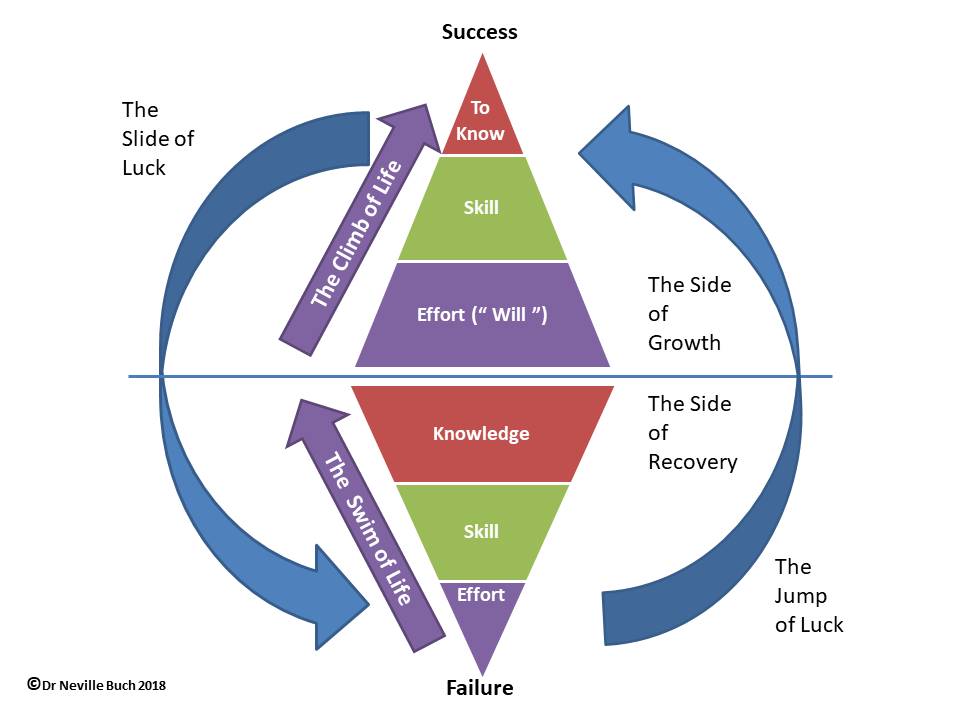
Featured Image: The-Climb-Swim-of-Life


Neville Buch
Latest posts by Neville Buch (see all)
- What Happened to Ross Johnston? – October 9, 2026
- Thank you, Richard: Knowing the message but then acting – October 8, 2026
- The Desiccation of the Common Well: Identity Politics, Algorithmic Assessment, and the Crisis of Adult Responsibility – October 6, 2026