
Dr Neville Buch
This Essay is provided exclusively for CleatCheats’ use. CleatCheats is a watchdog of unethical political behaviour, particularly in Brisbane & Queensland where subliminal behaviour is leading to deepfakes.
Abstract
This essay investigates the phenomenon of institutional cheating within the Brisbane City Council (BCC), defined here as the systematic violation of ethical and democratic standards to gain unfair administrative or political advantage. Drawing on recent forensic reports by Dr. Neil Peach and the historiographical analysis of Dr. Neville Buch, the analysis identifies three primary modes of “cheating”: the reduction of residents to “mechanic citizens” through symbolic inclusion, the exploitation of professional voluntarism to undercut the labour market, and the engineering of an “architecture of scarcity” that favours large-scale corporate interests. To halt this behaviour, the essay proposes a transition from a “Junior” mindset of unreflective execution toward “Senior” social accountability, supported by specific regulatory reforms including a Windfall Gains Tax, mandatory inclusionary zoning, and the establishment of a public housing developer model.
The Architecture of Institutional Cheating in Brisbane
I. The Manipulation of Participation: Mechanic Citizenship
Institutional cheating is most visible in the BCC’s current urban governance through the “plan to have a plan” methodology. While the Council advertises high levels of community engagement, this is often a form of “symbolic inclusion”. Residents are invited to participate in tactical “pin-dropping” exercises on digital maps to suggest minor amenities like park benches or bike racks. However, this traps the community in the tactical realm while shielding foundational strategic decisions—such as tower heights, total precinct density, and yield analyses—from genuine public influence. By the time a draft plan is revealed, the Council has established “procedural momentum” based on thousands of disconnected ideas that have nothing to do with the primary economic drivers of the development.
II. Market Collusion and the Exploitation of Voluntarism
A second form of institutional cheating involves the collusion and exploitation of the professional market through unpaid labour. Dr. Buch identifies a “corrupt practice” where the Council seeks out highly qualified professionals to perform skilled work, such as local history research, under the guise of voluntarism. This practice is characterized as immoral and potentially criminal because it undercuts the market for professional historians and skilled consultants. By exploiting voluntary organizations for professional-grade consultation, the Council avoids its responsibility to budget for community needs while simultaneously maintaining a neoliberal market thinking that has eroded local academic and professional training pathways.
III. Engineering Scarcity and the “Donation Loophole”
The Council facilitates a systemic “architecture of scarcity” that drives up housing costs while appearing to act proactively. Despite a massive backlog of 564 approved but unbuilt large developments in inner areas, entry-level prices in Brisbane have soared. This is achieved by:
- Suburban Protectionism: Concentrating 94% of growth in tiny “infill” nodes to protect established voter bases, which forces high-density vertical growth that only large corporate developers can afford.
- Land Banking: BCC routinely grants unconditional extensions to development approvals, allowing developers to “drip-feed” supply to maximize profits.
- Governance Integrity Risks: 2026 legislative changes have created a “donation loophole” where property developers can contribute to the state accounts of political parties that run the council, aligning planning decisions with large-scale corporate interests rather than public affordability.
IV. Remediation: Reclaiming the Strategic Perspective
To stop this bad behaviour, Brisbane must undergo a “humanistic ascent” from unreflective administrative stasis toward social accountability. The following roadmap for reform is proposed:
- Strategic Resident Advocacy: Communities must move beyond “amenity wishes” to demand ward-level transparency, including access to underlying yield analyses and hard housing targets for their specific wards.
- Whole-of-City Impact Assessments: Residents should demand cumulative impact assessments that account for the simultaneous development of neighbouring precincts to prevent the “divide and conquer” mechanic.
- Systemic Regulatory Shifts:
- Windfall Gains Tax: Implementing a 50% tax on the unearned financial gains generated by “the stroke of a planner’s pen” to fund local suburban infrastructure.
- Mandatory Inclusionary Zoning: Requiring at least 20% of new developments to be social or affordable housing.
- Ending DA Extensions: Placing mandatory time limits on rezoned sites to force developers to build rather than bank land.
- Public Housing Innovation: Establishing a state-owned entity, modelled after the “HouseMate” or Singaporean HDB system, to build “missing middle” housing and sell it to citizens at construction cost, thereby bypassing the private market’s supply bottlenecks.
Conclusion
Institutional cheating in Brisbane is a sophisticated strategy designed to facilitate capital accumulation while fragmenting community resistance. By Organizing at the local ward level and demanding hard data over “pretty architectural renders,” the community can disrupt the “sanitised” narrative of the urban growth machine and ensure the city’s development serves the flourishing of all its inhabitants.
REFERENCES
Based on the source material provided, the following bibliography supports the arguments and citations presented in the essay “The Architecture of Institutional Cheating in Brisbane Governance.”
Primary Reports and Theoretical Frameworks
Buch, N. (2015). No regrets in the evening of life: The history of Junction Park State School (1888–2013). Salisbury, QLD: Boolarong Press.
Buch, N. (2020, July 30). Correspondence on market collusion: The exploitation of professional voluntarism. [Email Correspondence].
Buch, N. (2024). Queensland history, religious education, and belief. In Socio-Anthropological Approach in Queensland (Chapter 7, pp. 161–187). London: Lexington Books.
Buch, N. (2025). The Dynamic of Cognition. [Teaching Document].
Peach, N. (2026, April). The micro-precinct paradigm: Density, fragmentation, and the future of Brisbane’s urban governance. Sustainable Development Research and Advocacy.
Government and Institutional Sources
Brisbane City Council. (2018). Brisbane’s future blueprint: Eight principles and 40 actions to guide our city’s next exciting chapter.
Brisbane City Council. (2024). Annual plan and budget 2024–25.
Department of Housing and Public Works. (2026). Homes for Queenslanders. Queensland Government.
Queensland Government. (2026, March 19). Electoral Laws (Restoring Electoral Fairness) Amendment Act 2026.
Queensland Government. (2023). ShapingSEQ: South East Queensland Regional Plan 2023.
Economic and Planning Theory References
Asian Development Bank (ADB). (2008). City cluster development: Toward an urban-led development strategy for Asia.
Asian Development Bank (ADB). (2011). Competitive cities in the 21st century: Cluster-based local economic development.
Murray, C. (2022). The HouseMate program: A parallel housing system for Australia. Game of Mates.
Porter, M. (n.d.). Foundations of cluster theory and the Diamond Model, as cited in Peach (2026).
State Revenue Office (Victoria). (2026). Windfall gains tax guidelines.
Secondary and Academic Research
Byrne, C. (2014). Religion in secular education: What, in heaven’s name, are we teaching our children? Leiden: Brill.
Campbell, C., & Proctor, H. (2014). A History of Australian schooling. Sydney: Allen & Unwin.
Maddox, M. (2014). Taking God to school: The end of Australia’s egalitarian education. Sydney: Allen & Unwin.
Panke, S., & Stephens, J. (2018). Mechanic citizenship: Boston Mayor’s Office of New Urban Mechanics and the constitution of digital citizens. ResearchGate.
Spearritt, P. (2009). The 200km city, as cited in Peach (2026).
******
TEACHING DOCUMENT
The following table applies the Dynamic of Cognition (DoC) framework to the analysis of institutional cheating within the Brisbane City Council (BCC). This mapping contrasts the systemic cognitive pathologies identified in current urban governance with the proposed roadmap for remediation and state flourishing.
Dynamic of Cognition (DoC) Table: Institutional Cheating in Brisbane Governance
| DoC Component | Phenomenon of Institutional Cheating (Regression) | Corrective Mechanism (Remediation) | Goal of Development |
| Self (Identity) | Mechanic Citizenship: Residents are reduced to “passive sensors,” providing feedback on minor amenities while being shielded from foundational strategic decisions. | Senior Social Accountability: Moving from a “Junior” mindset of unreflective execution to a “Senior” state where residents act as proactive authors of urban reality. | Reclaiming Political Agency. |
| Mind (Judgment) | Symbolic Inclusion: Planners utilize digital placemaking (e.g., pin-dropping) to “sanitise” neighbourhoods and create “procedural momentum” for plans that residents didn’t explicitly approve. | Noetic Action: Interrogating “yield analysis,” tower heights, and hard housing targets; demanding hard data over “pretty architectural renders”. | Restoring Critical Discernment. |
| Reason (Logic) | Splintering Urbanism: Granular planning (micro-precincts) divides the city into isolated “island” hubs, systematically failing to account for cumulative regional impacts on infrastructure and green corridors. | Whole-of-City Impact Assessments: Demanding “synoptic vision” through assessments that account for the simultaneous development of neighbouring precincts to prevents a “divide and conquer” mechanic. | Achieving Sufficient Comprehension. |
| Utility (Action) | Architecture of Scarcity: Deliberate supply restrictions (land banking), suburban protectionism (the “1% squeeze”), and the “donation loophole” align planning with corporate profit. | Systemic Regulatory Shifts: Implementing a Windfall Gains Tax (50%), ending unconditional DA extensions, and mandating 20% inclusionary zoning for affordable housing. | Rejecting the Neoliberal Growth Machine. |
| Love (Bond) | Habitus of Disbelonging: The city is treated as a commodity for “exchange value,” while the council exploits professional voluntarism (e.g., historians) to undercut the skilled labour market. | Public Housing Innovation: Establishing a public developer (e.g., HouseMate or HDB model) to build a “good habitat” and sell homes at construction cost, bypassing private market bottlenecks. | Fostering Aristotelian Flourishing. |
Bibliography
Buch, N. (2015). No regrets in the evening of life: The history of Junction Park State School (1888–2013). Salisbury, QLD: Boolarong Press.
Buch, N. (2020, July 30). Correspondence on market collusion: The exploitation of professional voluntarism. [Email Correspondence].
Buch, N. (2024). Queensland history, religious education, and belief. In Socio-Anthropological Approach in Queensland (Chapter 7, pp. 161–187). London: Lexington Books.
Buch, N. (2025). The Dynamic of Cognition. [Teaching Document].
Peach, N. (2026, April). The micro-precinct paradigm: Density, fragmentation, and the future of Brisbane’s urban governance. Sustainable Development Research and Advocacy.
Peach, N. (2026). Symbolic violence, representation, and collective formation.
Queensland Government. (2026, March 19). Electoral Laws (Restoring Electoral Fairness) Amendment Act 2026.
Panke, S., & Stephens, J. (2018). Mechanic citizenship: Boston Mayor’s Office of New Urban Mechanics and the constitution of digital citizens.
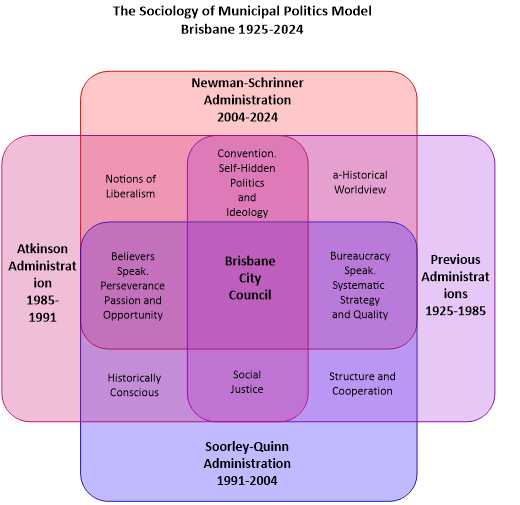
Featured Image: Brisbane-City-Council-Sociology-1925-2024.


Neville Buch
Latest posts by Neville Buch (see all)
- The Road to Geelong: A Re-Narrativization of The Story of Resilience Part 1 – October 20, 2026
- The Human Being Above the Transaction and Why Markets Cannot Measure Human Worth – October 15, 2026
- Beyond Neoliberal Formalism: Should Taxpayers Fund Independent Philosophy – October 14, 2026