

Dr Neville Buch
Abstract
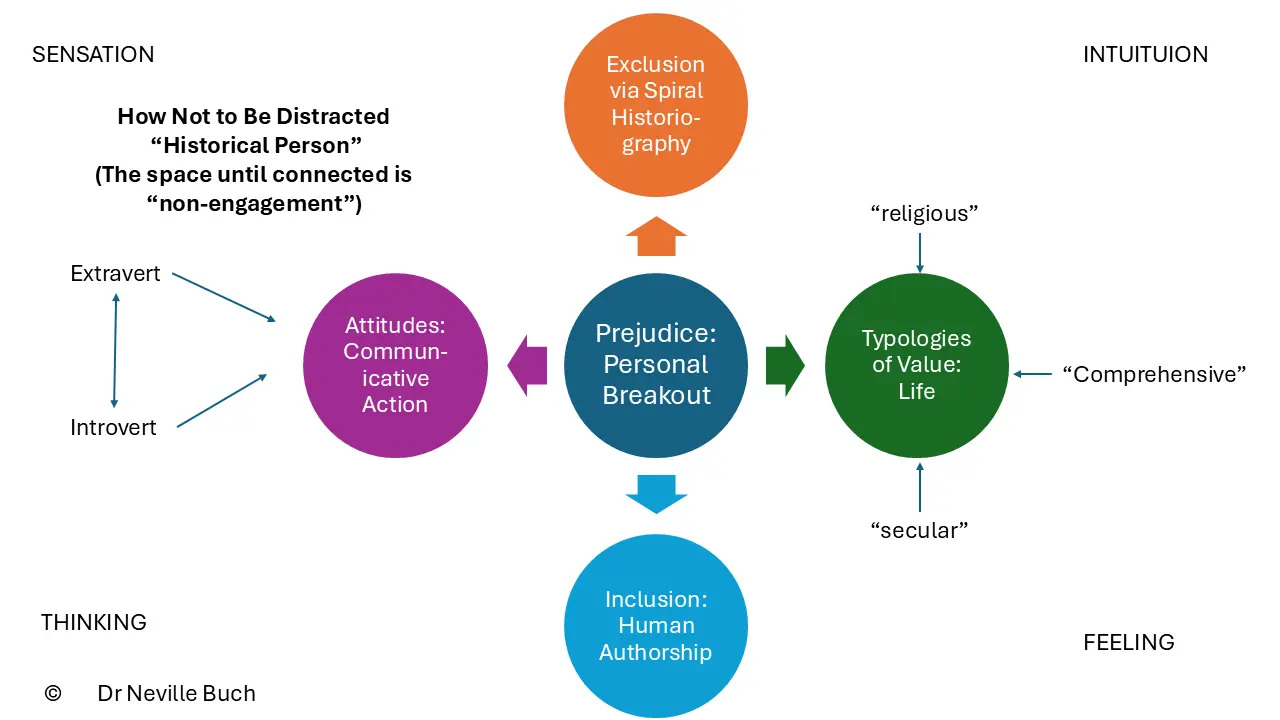
This essay examines the systemic threat of ”crowd-pleasing thinking” within intellectual communities, identifying it as a primary driver of denoetization—the mechanical liquidation of human judgment. By contrasting the rushed, simulated sterility of the Great American State Fair with the parochial nostalgia of the Australian local history industry, the analysis reveals how both phenomena function as “soporific” myths that facilitate Historical Forgetfulness. Drawing on the Management Institute for Contributory Economy (MICE) framework, the essay argues that these distractions reduce the “Historical Person” to a ”puny human node” in a network of decontextualized nuggets. To resist this regression, scholars must utilize Spiral Historiography and the POLICE model for “crap detecting,” moving beyond the ”Junior” mindset of docile compliance toward Human Authorship and Aristotelian flourishing.
The Architecture of Distraction: Resisting Crowd-Pleasing Thought in Intellectual Communities
1. The Simulacrum of Identity: The Great American State Fair
The contemporary intellectual landscape is increasingly haunted by “simulated” experiences that substitute genuine cultural memory for ”singular messaging” and PR-driven narratives. A stark example is the Great American State Fair, a celebration of America’s 250th birthday that critics have described as ”oddly sterile” and lacking genuine nostalgia. Rather than reflecting the “gritty, granular authenticity” of American life, it serves as a ”trade show” for specific political and institutional agendas, mimicking the decontextualized nature of social media scrolling. This ”simulacrum of a simulacrum” rewards insiders with a “magic bubble of power” while offering ordinary citizens a decontextualized “consolation prize” that fails to refresh the democratic spirit. Within the MICE framework, this represents a ”Short Circuit” of desire—soliciting affectual behaviour for immediate gratification rather than the “Long Circuits” of cultural binding.
2. Parochialism as Prison: The Australian Local History Industry
A similar pathology exists within the Australian local history industry, which Dr. Neville Buch identifies as being frequently trapped in ”folk history”. This industry often prioritizes nostalgic storytelling over analytical depth, viewing localities as isolated from global systems. In Queensland, this is operationalized through the ”Queensland Character” myth, which portrays the citizen as a “bumbling, unreflective” agrarian type. Buch argues that this myth is a political device used by elites to justify intellectual neglect and maintain a state of intellectual stasis. By projecting a “folksy, monolithic identity,” the political class can conceal uncomfortable truths—such as Indigenous dispossession—under a veneer of “common sense”. This “soporific” myth forces a ”senseless division of hearts and minds,” suggesting there is one truth for a technical elite and another for the “common people”.
3. The Cognitive Cost: Denoetization and Historical Forgetfulness
The danger of these distractions is not merely aesthetic; they lead to denoetization, a state where the pressure of automated technical and bureaucratic systems causes a loss of the collective ability to think and judge. This results in Historical Forgetfulness, a systemic pathology where a society repeats past intellectual errors because their origins and struggles have been banished from communal memory. When intellectual space is controlled by ”gatekeepers” who prioritize ”Political Profit” and organizational control over innovative thought, the result is ”absolute non-knowledge”. Individuals become ”passive conduits” for biological and social drives, reduced to the level of unreflective execution.
4. The Contributory Corrective: Reclaiming Human Authorship
To remediate this ”immense regression,” MICE proposes the Contributory Corrective, founded on the axiom that ”understanding history is philosophy in practice”. This requires a developmental ascent from a “Junior” state of unreflective habit toward a ”Senior” state of social accountability. Scholars must utilize Spiral Historiography to “uncoil” repetitive patterns of error and “crap detect” manufactured myths. This process involves:
- The POLICE Model: Training individuals to “police their own thoughts” and filter out ”institutional bullshit”.
- Panser (Thinking as Caring): Reintegrating empathy into the rational process to protect human particularity from ”technocratic reductionism”.
- Sufficient Comprehension: Actively seeking the “whole of the matter” rather than being satisfied with “decontextualized nuggets” of information.
Conclusion: Beyond the Bubble of Mind
Resisting crowd-pleasing thinking requires the courage to move beyond one’s own ”cognitive bubble” and engage with the “thick” reality of historical context. By reclaiming Human Authorship, we ensure that the “who” (the human being) remains the intentional master of the “what” (the technical and social systems). Ultimately, the goal is Aristotelian flourishing (eudaimonia), where the success of our intellectual communities is measured by human dignity, wisdom, and our capacity for meaningful contribution to the shared lifeworld.
Dynamic of Cognition (DoC) Table: Resisting Intellectual Distraction
| DoC Component | Pathological Regression (Crowd-Pleasing) | Humanistic Corrective (Contributory Practice) | Philosophical Rationale |
| Prejudice (Centre) | Techné Mindset: Reducing complex identity to “singular messaging” and PR images. | Personal Breakout: Recognizing history as a field of contingency and human choice. | Moves from “calculated design” to active self-perception. |
| Attitudes (Thinking) | “Retail Politics”: Using “simulacrums” and “soporific myths” to avoid conflict. | Communicative Action: Engaging in dialogue aimed at mutual understanding (Verständigung). | Replaces strategic manipulation with intersubjective mutuality. |
| Exclusion (Sensation) | Historical Forgetfulness: Banishing the context of “actual wounds” from communal memory. | Spiral Historiography: ”Uncoiling” repetitive errors and “crap detecting” myths. | Reveals “natural facts” as contingent historical constructions. |
| Inclusion (Intuition) | Symbolic Misery: Reducing the person to a “puny human node” in automated networks. | Human Authorship: Restoring the person as the proactive author of their narrative. | Restores the “who” as the proactive operator of the “what”. |
Bibliography
Arendt, H. (1977). The life of the mind (M. McCarthy, Ed.). Harcourt Brace Jovanovich.
Buch, N. (1995). American influence on Protestantism in Queensland since 1945 (Doctoral dissertation). Department of History, University of Queensland.
Buch, N. (2015). No regrets in the evening of life: The history of Junction Park State School (1888–2013). Boolarong Press.
Buch, N. (2025). Thinking as caring and the quest for wisdom. Management Institute for Contributory Economy.
Buch, N. (2026, March 17). A matrix of sociology. Management Institute for Contributory Economy.
Buch, N. (2026, June 15). Mapping Brisbane history: The Local Study Area framework. Management Institute for Contributory Economy.
Buch, N., Macklin, M., & Peach, N. (2026, May 28). MICE Intellectual Handbook. Management Institute for Contributory Economy.
Habermas, J. (1979). Communication and the evolution of society (T. McCarthy, Trans.). Beacon Press.
Kennicott, P. (2026, June 18). The Great American State Fair feels rushed, simulated and oddly sterile. The Washington Post.
McKinney, J. P. (1971). The structure of modern thought. Catto & Windus.
Stiegler, B. (1998). Technics and time, 1: The fault of Epimetheus (R. Beardsworth & G. Collins, Trans.). Stanford University Press.
Williams, B. (1985). Ethics and the limits of philosophy. Fontana.
Endnotes
- Denoetization is defined by Dr. Buch, following Bernard Stiegler, as the mechanical liquidation of the human capacity to think and judge under the pressure of automated systems.
- Historical Forgetfulness refers to the systemic loss of concept origins, causing societies to repeat past errors.
- The “Queensland Character” is identified as a political device used to simplify complex history and resist intellectual influence.
- A Simulacrum (as in the State Fair) is an imitation of a reality that never truly existed, used to provide a “simplified sense of coherence”.
- Panser (Thinking as Caring) is a procedural necessity used to protect human particularity from the cold calculation of technics.
- Spiral Historiography is a “post-post-postmodernist” lens used to evaluate the cyclical evolution of ideas and uncoil stupidity.
- The POLICE Model (Philosophically Ontology Logic Intersect Compatibility Education) is used as an “intellectual immune system” for “crap detecting”.
- Human Authorship is the developmental ascent of the person from a passive conduit to a proactive creator of their reality.
- Sufficient Comprehension involves seeking the “whole of the matter” while filtering out the “innutritious” falsehoods of the age.
- Aristotelian Flourishing (eudaimonia) is the life of virtuous action and meaningful contribution that serves as the ultimate goal of MICE.


Neville Buch
Latest posts by Neville Buch (see all)
- From Augustine’s Pears to Academic Boycotts: Fundamental Sociological Change in Australian Cultural Relations – October 11, 2026
- Yes, I want Anger Expressed But Then Resolved – October 11, 2026
- Part 3:The Failure of an Educational Institution and How to Spiral Forward – October 10, 2026