
Dr Neville Buch
Abstract
This essay translates the “MICE Research Report on the 2026 AHA Conference” into a comprehensive academic analysis of the role of history within the Management Institute for Contributory Economy (MICE) framework. Centred on the 2026 Australian Historical Association (AHA) conference theme, ”Changing Minds,” the essay posits that historical inquiry is not a static archival endeavor but an active philosophical intervention. By analysing the systemic pathologies of ”Historical Forgetfulness” and ”denoetization,” the analysis demonstrates how the professional historian functions as a ”cognitive sonar” and a panseur (healer). Through the implementation of Spiral Historiography, the POLICE model, and Digital Humanism, the historian remediates the “techné mindset” of modern governance, ultimately facilitating Aristotelian flourishing and the restoration of Human Authorship within a Contributory Economy.
History as Philosophy in Practice: Insights from the 2026 AHA Conference
I. Introduction: The Mandate of “Changing Minds”
The 2026 Australian Historical Association (AHA) Conference, convened at Macquarie University, operated under the urgent theme of ”Changing Minds”. Within the MICE framework, this theme is interpreted through the foundational axiom that ”understanding history is philosophy in practice”. This principle asserts that historical data provides the mandatory empirical grounding for ethical critique and self-understanding, essential for navigating a contemporary landscape characterized by polarized narratives and the mechanical liquidation of judgment. In this context, the professional historian is redefined as a proactive author tasked with narrating conceptual change and unmasking the institutional myths that sustain social stasis.
II. Remediating “Historical Forgetfulness” and the “Techné Mindset”
A primary rationale for historical scholarship is the remediation of ”Historical Forgetfulness”—a systemic pathology where communities repeat past intellectual errors because the origins and struggles of their core concepts have been banished from memory. This forgetfulness is often a byproduct of the ”techné mindset,” an instrumental rationality that reduces human existence to quantifiable data and “job readiness” metrics.
Drawing on the work of Bernard Stiegler, MICE identifies the result of this mindset as ”denoetization”: the loss of the collective ability to judge under the pressure of automated technical and bureaucratic systems. The conference highlights the specific challenge of AI/LLMs, which produce poor facsimiles of humanistic inquiry, mirroring disciplinary commitments without the vital labour of human discernment. The historian’s role, therefore, is to restore Human Authorship, ensuring that the “who” (the human person) remains the proactive master of the “what” (the technical system).
III. Methodological Innovations: Spiral Historiography and the DoC
To move beyond linear myths of progress, MICE utilizes Spiral Historiography, a “post-post-postmodernist” lens that evaluates the cyclical evolution of ideas. This methodology allows the historian to:
- “Uncoil” repetitive patterns of error and “crap detect” manufactured myths, such as the “Queensland character”.
- Facilitate a ”Personal Breakout” from unreflective, “Junior” habits toward a ”Senior” state of social accountability.
- Implement the POLICE model (Philosophically Ontology Logic Intersect Compatibility Education) as an “intellectual immune system” to filter out institutional bullshit.
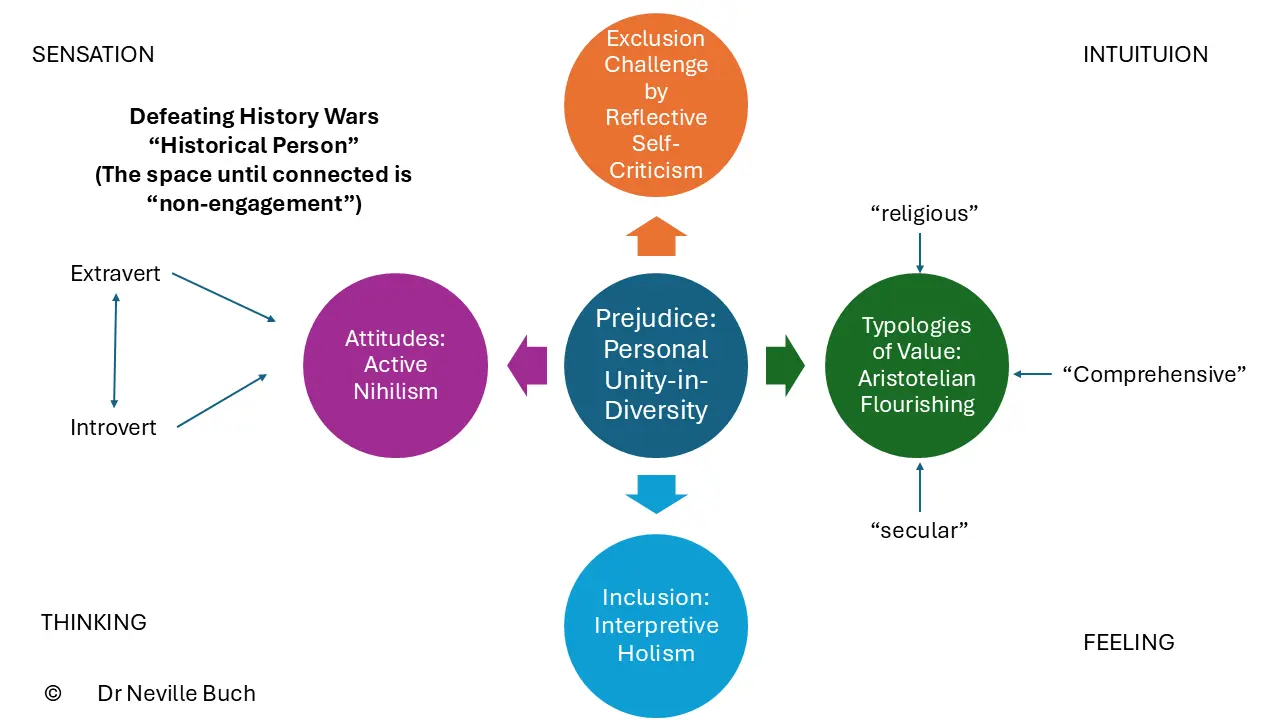
This cognitive movement is tracked through the Dynamic of Cognition (DoC), a diagnostic that maps the mind’s transition from unreflective prejudice toward Sufficient Comprehension—the ability to seek the “whole of the matter” while filtering out the falsehoods of the age.
IV. The Historian as Panseur and the Practice of Methodological Tenderness
Aligning with the AHA’s focus on the legacies of settler colonialism and the Uluru Statement from the Heart, MICE expands the historian’s professional role to that of a panseur (healer). Through Methodological Tenderness, historians use active truth-telling to “tend to social wounds” and unearth hidden intellectual histories that have been suppressed by populist or colonial narratives.
A central application of this is Digital Humanism, exemplified by the Mapping Brisbane History (MBH) Project. By spatially representing foundational sites of belief and scholarship, the MBH project identifies specific human agency behind urban changes, transforming the study of the past into a site for genuine democratic participation.
V. Conclusion: Epistemological Ballast and Aristotelian Flourishing
While engaging in social intervention, the professional historian must maintain rigorous disciplinary standards. MICE utilizes the work of Allan Megill—specifically his four tasks of description, explanation, argument, and interpretation—as ”epistemological ballast”. This ensures that digital humanism remains grounded in ”thick ethical concepts” rather than drifting into technical reductionism.
Ultimately, the professional historian’s work is the cornerstone of a Contributory Economy—a model that values human dignity, wisdom, and character over narrow transactional profit. By bridging the gap between academic inquiry and applied social practice, the historian facilitates Aristotelian flourishing (eudaimonia), where the success of a community is measured by its capacity for virtuous action and its commitment to the principle that “the unexamined life is not worth living”.
Endnotes
- AHA (2026) defines history as a foundational premise where interpretations are adjusted upon encountering disrupting evidence.
- “Understanding history is philosophy in practice” is the core axiom of MICE, mandating historical inquiry be grounded in ethical scrutiny.
- Historical Forgetfulness is identified as a systemic pathology where origins of core concepts are banished from communal memory.
- Denoetization refers to the mechanical liquidation of the human capacity to judge under automated systems.
- Human Authorship is the restoration of the person as the proactive creator of their social reality.
- Spiral Historiography rejects linear progress in favour of a cyclical re-evaluation of human struggle.
- The POLICE Model (Philosophically Ontology Logic Intersect Compatibility Education) functions as an “intellectual immune system” for “crap detecting”.
- Sufficient Comprehension involves seeking the “whole of the matter” while filtering out ephemeral falsehoods.
- Methodological Tenderness is the practice of historical truth-telling to “tend to social wounds”.
- Digital Humanism uses technology to serve humanistic goals of autonomy and democratic participation, as seen in the MBH Project.
- Epistemological Ballast refers to the disciplinary rigor provided by Allan Megill’s matrix of historical tasks.
- Aristotelian Flourishing (eudaimonia) is the ultimate goal of MICE, measured by human dignity and wisdom.
REFERENCES
This bibliography outlines the foundational texts and recent scholarly contributions that define the professional historian’s role within the Management Institute for Contributory Economy (MICE), specifically as informed by the themes of the 2026 AHA Conference, “Changing Minds.” These works support the role of the historian as a proactive author, a panseur (healer), and a cognitive sonar tasked with remediating systemic intellectual pathologies.
I. AHA 2026 Conference Insights and Key Context
- Arrow, M. (2026). Changing Minds in Trying Times. Presidential Address, 2026 Australian Historical Association Conference, Macquarie University, 29 June.
- Australian Historical Association. (2026). Changing Minds: 2026 AHA Annual Conference Program. Macquarie University, Dharug Country, Sydney, 29 June – 3 July.
- Buch, N. (2026). The Landscape Intellectual History of Jack McKinney and Judith Wright. Paper presented at the Australian Historical Association Conference, Macquarie University, 2 July.
II. MICE Core Frameworks and Foundational Manuals
- Buch, N., Macklin, M., & Peach, N. (2026). MICE Intellectual Handbook. Management Institute for Contributory Economy.
- Buch, N. (2026). A Matrix of Sociology. Management Institute for Contributory Economy.
- Buch, N. (2026). Limited Thinking and the Contributory Economy. Management Institute for Contributory Economy.
- Buch, N. (2025). MICE Principles and Philosophy (First Development). Management Institute for Contributory Economy.
- Buch, N., & Peach, N. (2024). Philosophically Ontology Logic Intersect Compatibility Education (POLICE). Management Institute for Contributory Economy.
III. Methodological Foundations: Historiography as Philosophy in Practice
- Buch, N. (2026). Ballast and Sonar: Epistemological Foundations of Historical Practice. Management Institute for Contributory Economy.
- Buch, N. (2026). Understanding History is Philosophy in Practice: A Cognition History of Queensland. Management Institute for Contributory Economy.
- Buch, N. (2026). Spiral Historiography and the Dynamic of Cognition. [Unpublished Draft], University of Queensland.
- Buch, N. (2025). The Dynamic of Cognition. Management Institute for Contributory Economy.
- Megill, A. (2007). Historical Knowledge, Historical Error: A Contemporary Guide to Practice. University of Chicago Press.
IV. Critical Inquiries into Denoetization and Historical Forgetfulness
- Buch, N. (2026). The Academic Immense Regression: Denoetization and the Crisis of Scholarship. Management Institute for Contributory Economy.
- Buch, N. (2025). Public Ignorance, Resistance, or a Hidden Curriculum? Management Institute for Contributory Economy.
- Stiegler, B. (2014). Symbolic Misery, 1: The Hyperindustrial Epoch. (B. Norman, Trans.). Polity Press.
- Stiegler, B. (1998). Technics and Time, 1: The Fault of Epimetheus. (R. Beardsworth & G. Collins, Trans.). Stanford University Press.
V. Primary Philosophical and Sociological Anchors
- Arendt, H. (1977). The Life of the Mind. (M. McCarthy, Ed.). Harcourt Brace Jovanovich.
- Collins, R. (1998). The Sociology of Philosophies: A Global Theory of Intellectual Change. Belknap Press of Harvard University Press.
- Habermas, J. (1979). Communication and the Evolution of Society. (T. McCarthy, Trans.). Beacon Press.
- McKinney, J. P. (1971). The Structure of Modern Thought. Chatto & Windus.
- Williams, B. (1985). Ethics and the Limits of Philosophy. Harvard University Press.
VI. Place-Based Historiography and Digital Humanism
- Buch, N. (2026). Mapping Brisbane History: The Local Study Area Framework. Management Institute for Contributory Economy.
- Buch, N. (2026). Getting Under the Skin: Queensland History and Sociology. Management Institute for Contributory Economy.
- Buch, N. (2025). Mapping Brisbane for the World: A Digital Historiography of Cognition and Place. Management Institute for Contributory Economy.
- Wright, J. (1981). The Cry for the Dead. Oxford University Press.
- Clarke, P., & McKinney, M. (Eds.). (2004). The Equal Heart and Mind: Letters between Judith Wright and Jack McKinney. University of Queensland Press.
Featured Image:


Neville Buch
Latest posts by Neville Buch (see all)
- The Unbound Mind: Independent Scholarship, Institutional Isolation, and the Restoration of Human Authorship – October 20, 2026
- The Road to Geelong: A Re-Narrativization of The Story of Resilience Part 1 – October 20, 2026
- The Human Being Above the Transaction and Why Markets Cannot Measure Human Worth – October 15, 2026