
Abstract
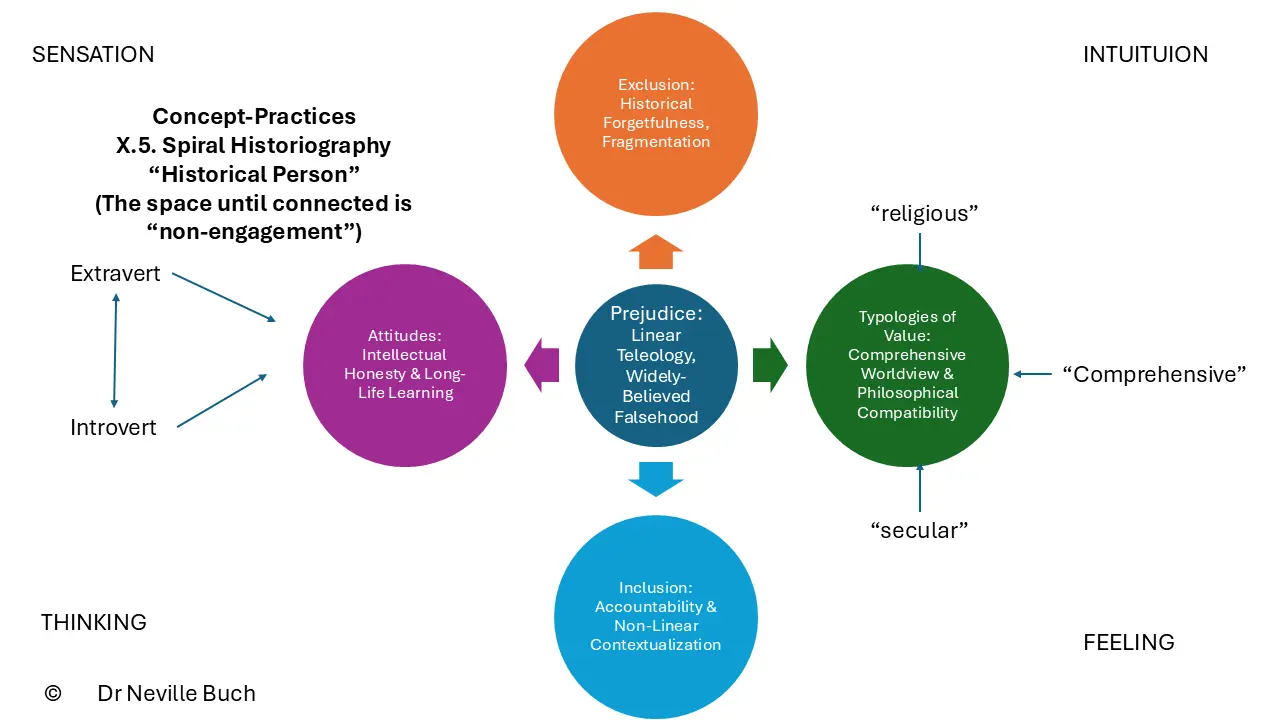
This essay explores the conceptual architecture of Spiral Historiography, framing it as a non-linear methodological intervention designed to resolve the inherent conflict between historical repetition and intellectual progress. Drawing on the works of Dr. Neville Buch and foundational insights from Bernard Williams and Jürgen Habermas, the argument positions the “spiral” as a diagnostic tool for the “Spiral History Theory of Stupidity”—a state where institutions remain “stuck in time-space” through repetitive cognitive errors. By navigating the four-stage cycle of Widely-Believed Falsehood, Accountability, Falsehood Retreats, and Historical Forgetfulness, this historiographical model aims to facilitate a “personal breakout” from the “vicious circles” of unreflective prejudice. Ultimately, the paper contends that acknowledging the recurring “boomerang” of historical error requires an “intellectual immune system” grounded in truthfulness, enabling the human mind to achieve Aristotelian flourishing through a “spiritualized” uncoiling of past failures into future wisdom.
PDF File: Research Note. Conflict in Spiral Historiography
——————————————————————————–
Conflict in Spiral Historiography: The Uncoiling of Progress
The concept of Spiral Historiography serves as a vital “post-post-postmodernist” model for understanding how ideas, beliefs, and societal failures evolve cyclically rather than in a simple linear trajectory. This approach acknowledges the profound truth that “the human mind always makes progress, but it is progress in spirals”; it is a movement that requires us to engage with the history of human thought to learn from past intellectual struggles and avoid the perpetual repetition of errors.
The “Vicious Circle” vs. The Free Spiral
For the historian of cognition, the greatest threat to social evolution is “Historical Forgetfulness”—the state where the lessons of the past are discarded, allowing a “Widely-Believed Falsehood” to re-emerge in a new, often more dangerous form. This repetitive pattern constitutes the “vicious circle” of history, a closed loop of “specialized ignorance” and “techné” reductionism that treats human beings as passive conduits for social drives. However, as Vladimir Nabokov suggested, “the spiral is a spiritualized circle.” In the spiral form, the circle is “uncoiled” and “set free” through the intervention of critical self-reflection and Accountability. By applying the Dynamic of Cognition (DoC), individuals can map their movement from unreflective prejudice toward a “Balanced and Comprehensive” worldview, effectively turning the stagnant circle into an ascending spiral of virtue and truth.
The Boomerang of Historical Stupidity
Despite the potential for progress, one must remain vigilant against the regressive forces inherent in the historical process. Ralph Ellison’s warning—”Beware of those who speak of the spiral of history; they are preparing a boomerang. Keep a steel helmet handy”—resonates with the “Spiral History Theory of Stupidity”. This theory identifies a persistent tendency for societies to “fall back” behind established levels of development, leading to an “immense regression” marked by “symbolic misery” and a post-truth decline in critical thought. The “boomerang” represents the return of “potted thinking” and “institutional bullshit” that occurs when a community fails to maintain its “intellectual immune system”. To survive this boomerang, the citizen scholar must don the “steel helmet” of systematic self-critique and “Honest Communication,” ensuring that assertions submit to universal validity claims of truth and sincerity.
Conflict as a Catalyst for Synthesis
Within the MICE framework, conflict is not viewed as a mere pathology but as a necessary engine for social and cognitive transformation. The “spiral” acknowledges that different systems of thought—Punitive and Reactionary, Kindness and Evolutionary, and Balanced and Comprehensive—are in constant tension. This conflict is resolved not through the totalizing erasure of the past, but through “Reflective Equilibrium,” where theory and practical intuition are adjusted to meet the concrete reality of human needs. This process facilitates a “fusion of horizons,” integrating the “thick” reality of local practices and uncomfortable histories into a shared stream of consciousness.
Conclusion: The Path to Flourishing
Ultimately, Spiral Historiography redefines progress as the capacity for a “personal breakout” from repetitive cognition patterns. It demands that we treat “understanding history as philosophy in practice,” recognizing that the meaningful availability of our world is a historical “happening” that must be constantly worked out through thinking and poetry. By accepting our “social and historical bearings” and embracing the cyclical nature of learning, the human mind moves beyond the “Analytical Abyss” of mortality and fate. We ascend from a “Junior” state of unreflective execution to a “Senior” state of individual self-realization, where we can affirm the grand, beautiful narrative of our history with the triumphant declaration: “Thus I willed it”.
Featured Image: Spiral.


Neville Buch
Latest posts by Neville Buch (see all)
- The Road to Home. A Re-Narrativization of The Story of Resilience Part 7 – October 26, 2026
- The Road to Home. A Re-Narrativization of The Story of Resilience Part 6 – October 26, 2026
- The Road to Home. A Re-Narrativization of The Story of Resilience Part 5 – October 26, 2026