
The Outsider’s Synthesis. Jack McKinney and the Cost of Ignorance
A report on Jack McKinney and the Cost of Ignorance. Jack Philip McKinney’s philosophy was markedly different from that of his contemporaries, and his case offers profound lessons regarding why Australian society continues to ignore its independent thinkers. The following analysis details these differences, the roots of societal neglect, and the social harms resulting from this collective ignorance. Inspired by Jack McKinney, Dr Buch and the Management Institute for Contributory Economy (MICE) take the common thread across comprehensive sources to demonstrate the valorisation of lived experience as a primary tool for overcoming institutional inertia and “Historical Forgetfulness”. By centring the real stories and expertise of those within the system, organizations can move from a state of “Junior” unreflective execution toward a “Senior” state of social accountability.
https://www.academia.edu/164774968/The_Outsiders_Synthesis_Jack_McKinney_and_the_Cost_of_Ignorance
Dr Neville Buch ABN: 86703686642
PDF File: The Outsider’s Synthesis. Jack McKinney and the Cost of Ignorance
List of Tags
- Jack McKinney
- Brisbane
- Queensland
- Hannah Arendt
- Nel Noddings
- Susan Haack
- Bernard Williams
- Bernard Stiegler
- Bernard Lonergan
- Political Theory
- Political Communication
- Thinking
- Cognition
- Foolishness
- Truthfulness
- Value
- Focus
- Exclusion
- Inclusion
- Paid Work
Jack Philip McKinney’s philosophy was markedly different from that of his contemporaries, and his case offers profound lessons regarding why Australian society continues to ignore its independent thinkers. The following analysis details these differences, the roots of societal neglect, and the social harms resulting from this collective ignorance.
How McKinney’s Philosophy Differed from His Own Time
Jack McKinney (1891–1966) was a “self-motivated outsider” who, despite lacking formal academic training, achieved a global synthesis of modern thought that far surpassed the work of the local academic establishment.
- Global vs. Parochial Focus: While formal philosophers at the University of Queensland, such as William Marquis Kyle, remained tethered to outdated British Idealism, McKinney was meticulously reading the leading global innovators in metaphysics, physics, and ethics. He leveraged findings from Relativity Theory and Quantum Mechanics to argue that the physical world is an “experiential construction” rather than an independent “thing-in-itself”.
- The Original Synthesis of Experience: McKinney’s core thesis rejected the prevailing “epistemological individualism”—the belief that the individual is the sole source of knowledge. He proposed instead that knowledge is an “interpersonal thing”. In his view, the “common world-picture” is a determined social product synthesized from discontinuous individual sensory data over generations via the “living bridge” of language.
- Critique of Specialization: McKinney attacked the “non-commitment” and insularity of specialized linguistic philosophy, arguing that the philosopher’s primary duty is to use Reason to promote common understanding and ethical action, rather than “talking about talk”.
Lessons on the Ignorance of Contemporary Philosophers
The case of McKinney illustrates systemic defects in how Australian society—and particularly its institutions—engages with deep thought.
- Academic Gatekeeping and Elitism: McKinney’s work was largely ignored because he did not have a university degree or formal association. Even when distinguished philosophers like Jack Smart recognized his originality, they still labelled him an “amateur,” a term used to diminish his status and shield the professional “guild” from outside critique.
- Anti-Intellectualism: Queensland’s history is marked by an “appallingly anti-intellectual” attitude where decision-makers often “never loved books and reading”. This populist bias favors “common sense know-how” over complex theoretical inquiry, treating independent thinkers as “irrelevant” or “aloof”.
- The “Techné” Mindset: Modern Australian governance and education suffer from a “techné” mindset, which prioritizes narrow “vocational fitness” and “measurable outcomes” over wisdom and critical reflection. This reduces thinkers to “passive conduits” for economic mandates rather than authors of their own social reality.
What Is Being Ignored and the Resulting Social Harm
By marginalizing philosophers like McKinney, individuals and governing bodies ignore foundational truths about our existence, leading to significant societal pathologies.
What Persons are Ignoring:
- Historical Contingency: Many ignore that the content of our ethical and social concepts is a contingent historical phenomenon rather than an eternal truth.
- Human Authorship: Society neglects the fact that humans are the collective “authors of reality,” responsible for reconstructing experience through co-operation.
- Hidden Intellectual History: The rich intellectual heritage of the region remains “ignored, quietly resisted, or hidden” beneath populist myths.
The Social Harm in This Ignorance:
- Historical Forgetfulness: Society systematically loses the “lessons of the past,” leading to a state where errors are repeated and “uncomfortable histories” (such as frontier violence) are concealed by myths like the “Queensland character”.
- Specialized Ignorance: A reliance on fragmented, technical knowledge leaves the population disarmed against propaganda and “widely-believed falsehoods,” preventing informed public assessment.
- The Authoritarianism of the Stupid: When governance is reduced to technical-administrative tasks, it facilitates a “legitimation crisis” where policy is based on immediate utility rather than human flourishing.
- Loss of Agency and Flourishing: The ultimate harm is the erosion of human agency and the failure to achieve Aristotelian Flourishing (eudaimonia), as the synthesis of Self, Mind, Reason, Utility, and Love is discarded for narrow economic efficiency.
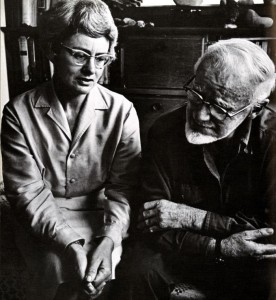
Featured Image: Jack McKinney with partner-wife, Judith Wright – Australia’s most famous poet


Neville Buch
Latest posts by Neville Buch (see all)
- University Academy Aggression: Corporate Managerialism, MICE Philosophy, and the Capacity for Comprehensive Understanding – October 25, 2026
- The Numbers Game Problem: Neoliberal Formalism, MICE Philosophy, and the Capacity for Comprehensive Understanding – October 25, 2026
- Politicians, Other Political Players, why your messaging does not land with the general public – October 25, 2026