
1. ABSTRACT: The Framework of Compassionate Comprehension
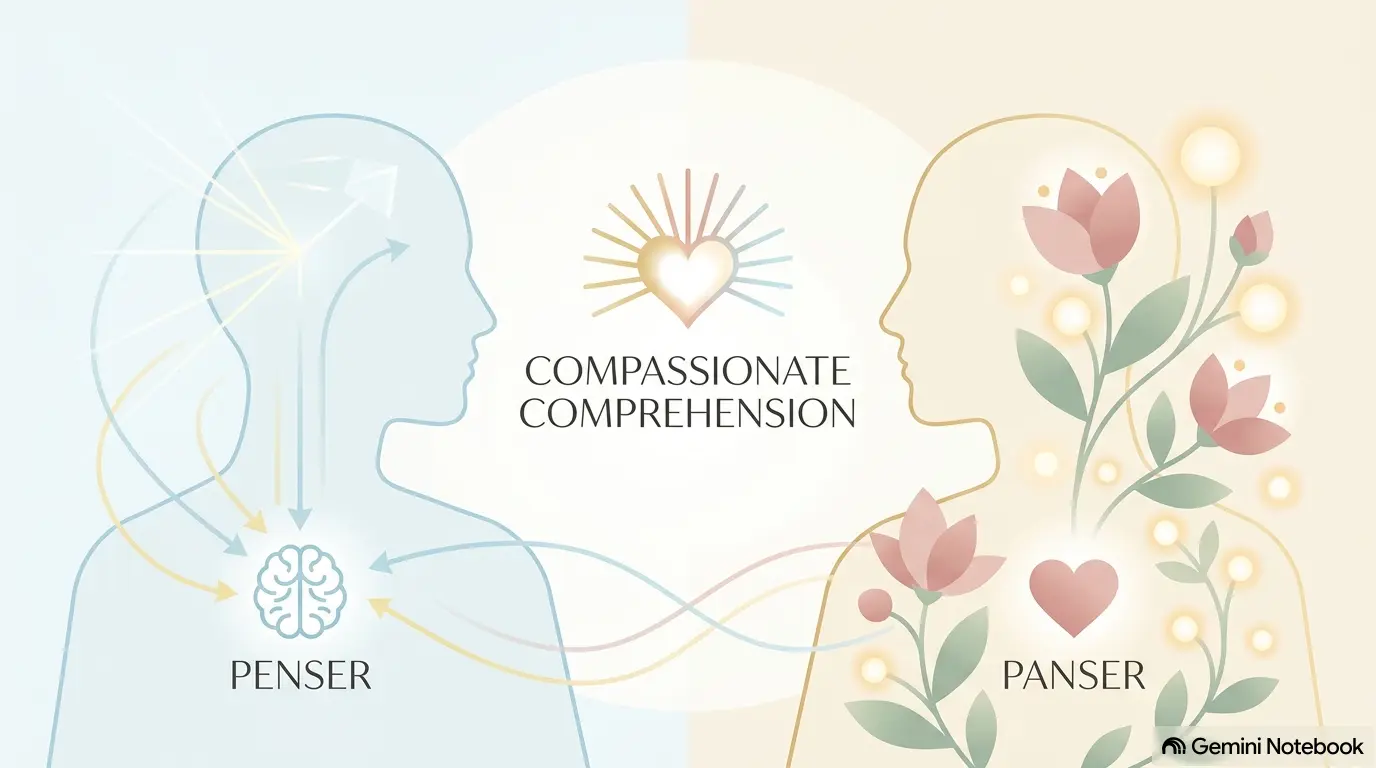
This analysis interrogates the precarious intersection of contemporary “toxic empathy”—characterized by Elizabeth Bruenig as a rhetorical device that reinforces “might makes right”—and Dr. Neville Buch’s counter-framework of “Compassionate Comprehension.” Utilizing the “Dynamic of Cognition” (DoC) as the primary diagnostic tool, this essay deconstructs the cognitive failures inherent in anonymous critiques of Buch’s work. The DoC maps the quaternary interplay between internal states (Thinking/Feeling) and information inputs (Sensation/Intuition), revealing that such criticisms are rarely substantive intellectual disagreements. Instead, they represent an ontological collapse into “Specialized Ignorance.”
The thesis posits that critics remain trapped in a “closed loop” of automaticity, relying on “potted thinking” and unreflective prejudice (Buch 2026, 2). By treating “Attitudes” as mere opinions rather than durable “residues of experience” that condition behaviour (Buch 2025, 2), critics fail to achieve the “Fusion of Horizons” necessary for genuine dialogue. This paper argues for a transition from the “Junior” mindset of unreflective execution toward a “Senior” state of social accountability, mediated by the procedural filter of the POLICE model. Ultimately, Compassionate Comprehension is presented as the only viable scaffolding for “Open Constitutionalism” and a genuine “Level Playing Field.” By restoring “Human Authorship” and utilizing “Thick Ethical Concepts,” society can move beyond inherited political confusion toward a landscape that affirms the “dignity of difference” (Symposium Concept 2023, 1).
2. INTRODUCTION: The Architecture of the Horizon
The cognitive architecture of the human person is fundamentally defined by Heideggerian Geworfenheit—the state of being “thrown into the world” where the cyclical beginning of all inquiry is necessarily rooted in prejudice (Buch 2025, 1). Within the Dynamic of Cognition (DoC) framework, prejudice is not a mere moral failing but the initial state of unexamined belief in “commonality,” the fallacious assumption that one’s personal perception of reality constitutes a universal standard (Buch 2026, 2).
The DoC model explicates the movement from this unreflective starting point toward comprehensive knowledge through four primary states: prejudice (pre-judgement), attitudes (the forcefulness in ideas), typologies of value (collective perceptions of importance), and the agency of exclusion or inclusion. Dr. Buch identifies Jungian classifications—Sensation, Intuition, Thinking, and Feeling—as “better answers” for categorizing these dynamics because they “vaguely float in the dynamic space” of cognition until the meaning of terms becomes concrete through connection with “thick concepts” (Buch 2025, 1).
Critics of this framework frequently fail precisely because they attempt to fix meanings prematurely within simplistic binaries, such as the strict opposition of religion versus secularity. Buch characterizes these binaries as “political devices of confusion” designed to shift the public away from understanding political options intelligently (Buch 2024, 1-2). Genuine comprehension requires resisting these reductive devices and acknowledging that every idea is intimately linked to an affective attitude that configures the person-world relation (Buch 2025, 4).
3. SECTION 1: Contextual Misunderstandings and the “Analytical Abyss”
Contextual failures in contemporary discourse typically stem from a “closed loop” of automaticity (Buch 2026, 2). Critics utilize “potted thinking,” accepting compressed, ready-made statements to bypass the labour of deep reflection. This reliance on the “deceptive simplicity of appearance” leads to the “Analytical Abyss”—an ontological state where the mind operates on “thin” concepts divorced from the multi-textured reality of lived experience (Buch 2026, Endnote 5).
The Failure of Contextual Perception: Potted Thinking vs. Deep Reflection
| Feature | Specialized Ignorance (Potted Thinking) | Fusion of Horizons (Deep Reflection) |
| Conceptual Density | Operates on “thin” concepts and technical formalisms. | Synthesizes diverse perspectives and “thick” concepts. |
| Epistemic Loop | Closed loop; reinforces and moralizes existing prejudices. | Open system; temporal, revisable, and investigative. |
| Interpersonal Engagement | Filters out the “Other” via wilful ignorance/exclusion. | Internalizes the “Other” via empathy and inclusion. |
| Ontological Outcome | An “Analytical Abyss” divorced from lived reality. | Interpersonal knowledge; mutual understanding. |
Critics consistently misunderstand “Attitudes” as superficial opinions. In the DoC framework, attitudes are the “residues of experience that condition and control activity,” functioning as “unconscious habits” that express profound tendencies toward action (Buch 2025, 2). When these attitudes become moralized, they are perceived as objective and universally true standards, triggering resistance to compromise. The “Specialized Ignorance” of the critic assumes their perception is the standard, whereas the “Fusion of Horizons” requires the interpersonal synthesis of individual knowledge with the historical and lived context of others (Buch 2026, Endnotes 5, 7).
4. SECTION 2: Political Misunderstandings and the Failure of Open Constitutionalism
Political discourse is often stymied by a reliance on binaries like “Idealism vs. Realism,” which serve as devices to deliberately obscure intelligent reform (Buch 2024, 1). To remedy this, Buch synthesizes Jürgen Habermas’ “communicative action” with “Open Constitutionalism” (Option iv). Communicative action serves as the procedural remedy to manufactured confusion, providing the dialogical approach necessary for a “Level Playing Field”—a state where the government treats all substantive belief systems fairly by removing the privilege status of any single grouping (Buch 2024, 2).
Critics frequently misuse the concept of the “Level Playing Field” by failing to grasp the “Academic Translation” required for reform. They remain in a “Populistic Translation” that relies on imprecise metaphors of the political landscape (Buch 2024, 1-2). This failure ignores the transition from an inherited Christian heritage to an open society that affirms the “dignity of difference” (Symposium Concept 2023, 1). Open Constitutionalism allows common ground to be negotiated periodically through mutual dialogue, rather than being fixed by “closed constitutionalism” and its rigid adherence to perceived origins (Buch 2024, 2).
5. SECTION 3: The Lessons of Compassionate Comprehension and ‘Panser’
Elizabeth Bruenig (2026) observes the argument that modern empathy often becomes “toxic” when it reinforces the interests of the powerful under the guise of sentimentality. In contrast, Buch offers the concept of panser—thinking as caring—which necessitates a movement from simple “Inclusion” (sympathy) to a comprehensive “Horizon Worldview” (Buch 2026, 1).
This transition is facilitated by Bernard Williams’ “Thick Ethical Concepts” (e.g., courage, kindness, integrity). Unlike “thin” concepts, these terms unite factual description with evaluative meaning, providing the “genuine determinateness” required to move from abstract values toward concrete social practice (Buch 2026, 2-4).
Three Core Lessons of Compassionate Comprehension
- Rejection of the “Illusion of Commonality”: The proactive recognition that the “Other” does not necessarily share one’s starting points or perceptions.
- Transformation of Habits: The conversion of unconscious, automatic “Attitudes” into intentional, reflective, and critical activities.
- Social Accountability through Eudaimonia: A shift from narrow material utility toward Aristotelian flourishing, measuring value by its contribution to the social whole (Buch 2026, 2-3).
6. SECTION 4: The Imperative of Human Authorship and the POLICE Model
The restoration of “Human Authorship” is the core humanist imperative of the DoC. It seeks to reinstate the “Who” of the person as a proactive master rather than a “passive conduit” for technical or bureaucratic systems (Buch 2026, 3-5). This restoration requires a developmental ascent from a “Junior” mindset—characterized by unreflective execution—to a “Senior” state of social accountability and intentionality (Buch 2026, 3).
The mechanism for this ascent is the POLICE model (Philosophically Ontology Logic Intersect Compatibility Education). This procedural filter is designed to identify and eliminate “institutional bullshit,” manufactured myths, and “widely-believed falsehoods” (Buch 2024; Buch 2026, 4).
The “Save Victoria Park” context provides a definitive proof of the “Analytical Abyss” in action. Proponents of the stadium development operate within a “Junior” mindset, utilizing the technical formalisms of the “Deed of Grant in Trust (DOGIT)” to bypass environmental and heritage protections (SVP 2025, Legal 12, 15). Through “Specialized Ignorance,” they reduce the park to the “thin” concept of “vacant land” (SVP 2025, Myth 22). Conversely, a “Senior” mindset applies Compassionate Comprehension to recognize “thick” concepts like “Barrambin” or “York’s Hollow”—irreplaceable cultural landscapes and First Nations meeting places (SVP 2025, Heritage 9, 11). The failure to apply the POLICE filter leads to the proposed destruction of 66% of the park, including 200-year-old Eucalyptus Tereticornis trees, under the guise of a sustainable Olympic legacy (SVP 2025, Environmental 1, 3).
7. CONCLUSION: Toward a Level Playing Field
The “Analytical Abyss” generated by critics’ “Specialized Ignorance” creates a state of non-engagement that prevents the genuine dialogue required for a healthy democracy (Buch 2026, 3). By remaining anchored in unreflective prejudice, they fail to connect their working concepts to the lived reality of the world.
A “Level Playing Field” is achievable only when the State removes the privilege status of specific groupings and treats all substantive belief systems fairly (Buch 2024, 2). Compassionate Comprehension enables the “Fusion of Horizons,” an interpersonal process where individual knowledge is synthesized with the experiences of others. This allows society to move beyond inherited prejudice and “potted thinking” toward a future governed by intentional human authorship and the “dignity of difference” (Buch 2026, 4; Symposium Concept 2023, 1).
8. BIBLIOGRAPHY
Full Notebook Bibliography (92 Sources)
- Anonymous / Academic Synthesis (2024). 2024-03-14 Symposium Concept of Level Playing Field and Interorganisational Dialogue. Brisbane: Management Institute for Contributory Economy.
- Anonymous / Compiled Reference (2024). Annotated List of Works on Hierarchy.
- Anonymous / Compiled Reference (2024). Annotated List of Works on Level Playing Field.
- Anonymous / Synthesis Note (2025). Architects of the Modern Political Mind.
- Anonymous / Synthesis Note (2025). Ideological Centralism: Correcting Errors Through Spiral Historiography.
- Anonymous / Synthesis Note (2025). Ideologies in Flux: Conservatism, Liberalism, and Radicalism.
- Anonymous / Synthesis Note (2025). Nineteenth Century Ideologies: Conservatism, Liberalism, and Radicalism.
- Anonymous / Research Synthesis (2025). Research Report: Save Victoria Park Campaign and Olympic Legislation.
- Anonymous / Synthesis Note (2025). The Triadic Evolution of Modern Political Identity.
- Anonymous / Synthesis Note (2025). The Triadic Evolution: Ideology, Nuance, and Spiral Historiography.
- Aristotle / Classical Literature (2026). Politics. [Wikipedia / Classical Reference Document].
- Aristotle / Cicero / Classical Literature (2026). Rhetoric. [Wikipedia / Classical Reference Document].
- Bruenig, E. (27 Sep 2026). Why Empathy Is Now ‘Toxic,’ ‘Suicidal,’ and a ‘Sin’. The Atlantic.
- Buch, N. (1995). American Influence on Protestantism in Queensland since 1945. Ph.D. Thesis, Department of History, University of Queensland.
- Buch, N. (2023f). Stupidity of the Market Economy in Higher Education. Dr Neville Buch Website (ABN 86703686642).
- Buch, N. (2024). Rethinking School: Historical Forgetfulness and Educationalist Theory 1971–1989. Brisbane: Management Institute for Contributory Economy.
- Buch, N. (22 Oct 2024). Semantics and Strategies for the Level Playing Field. Brisbane: Management Institute for Contributory Economy.
- Buch, N. (2025). Applications in Liberalism. Brisbane: Management Institute for Contributory Economy.
- Buch, N. (2025). Buckley’s Up With Liberalism Mind-Twister. Brisbane: Management Institute for Contributory Economy.
- Buch, N. (2025). Concept-Practice X.6. Dynamic of Cognition. Brisbane: Management Institute for Contributory Economy.
- Buch, N. (2025). Substantial Fairness in Semantics and Strategies for the Level Playing Field. Brisbane: Management Institute for Contributory Economy.
- Buch, N. (2025). The Jamesian Appeal of Scheler’s Felt Metaphysics. Brisbane: Management Institute for Contributory Economy.
- Buch, N. (2025). The Process of Learning and The Dynamic of Cognition. Brisbane: Management Institute for Contributory Economy.
- Buch, N. (2026). Basic Social Psychology: Architecture of the Horizon – Navigating the Dynamic of Cognition. Brisbane: Management Institute for Contributory Economy.
- Buch, N. (2026). Covenantal Hermeneutics and the Dynamic of Cognition. Brisbane: Management Institute for Contributory Economy.
- Buch, N. (2026). Interbelief and the Level Playing Field. Brisbane: Management Institute for Contributory Economy.
- Buch, N. (2026). Model of Intellect. Brisbane: Management Institute for Contributory Economy.
- Buch, N. (2026). Non-Religion and Dynamic of Cognition. Academic Synthesis.
- Buch, N. (2026). Post-Christianity Level Playing Field. Brisbane: Management Institute for Contributory Economy.
- Buch, N. (17 Sep 2026). Spelling it Out. Brisbane: Management Institute for Contributory Economy.
- Buch, N. (2026). The Architecture of Meaning: Context, General Rules, Modern Chatter. Brisbane: Management Institute for Contributory Economy.
- Buch, N. (2026). (Neville Buch) The Dynamic of Cognition. Brisbane: Management Institute for Contributory Economy.
- Buchan, B. (2017). Anarchism and Liberalism. Brill, pp. 58–80.
- Cicero, M. T. (1928). De Re Publica. De Legibus. Translated by C. W. Keyes. Loeb Classical Library. Cambridge, MA: Harvard University Press.
- Cicero, M. T. (1902). De Oratore / Cicero PDF Collection. The Latin Library.
- Corwin, S. L. (2026). An Epistemological and Historiographical Audit.
- Corwin, S. L. (2026). Delusions of Ascent: Neville Buch.
- Corwin, S. L. (2026). Refuting Cognitive Degradation in Modern Education.
- Corwin, S. L. (2026). The Problem Is Always with the Left.
- Corwin, S. L. (2026). The Quixotic War for Sociology.
- Corwin, S. L. (2026). The Rhetorical Architecture of Conceptual Inflation.
- Corwin, S. L. (2026). The Sovereign Idiot: Performative Absurdity.
- de Spinoza, B. (1670/2007). Tractatus Theologico-Politicus (Theologico-Political Treatise). Edited by J. I. Israel. Cambridge: Cambridge University Press.
- Eccleshall, R. (2000). The Doing of Conservatism. Journal of Political Ideologies, 5(3): 275–287.
- Games Watchdog 2032 (2025). Games Watchdog’s Time for Plan B Report — Save Victoria Park.
- Gaston, W. A. (1996). Value Pluralism and Political Liberalism.
- Jarvis, D. (1996). British Conservatism and Class Politics in the 1920s. The English Historical Review, 111(440): 59–84.
- Kennedy, S. (2022). True Conservatism and the Future of the Right.
- Kroes, R. (1983). Neo-Conservatism: Its Emergence in USA and Europe.
- Laituri, M. (2026). Dilemmas of Humanitarian Geospatial Artificial Intelligence. Geopolitics and AI, 12(1): 45–68.
- Level Playing Field Symposium (2025). Level Playing Field Interbelief Symposium: Scoping the Concept (Queensland Version).
- Luchel, B. (2026). A Brief Response to Buch’s Latest Evasion: The Fuglseth Diversion.
- Luchel, B. (2026). A Review of Dr Neville Buch’s The Architecture of Meaning.
- Luchel, B. (2026). An Army of Strawmen: A Comprehensive Audit.
- Luchel, B. (2026). Media Style Responses to Buch.
- Luchel, B. (2026). Potted Warnings from the MICE Bunker.
- Luchel, B. (2026). Review of The Case for Intellectual History.
- Luchel, B. (2026). The Pathology of Cognitive Inflation.
- Maddox, M. (2021). Middle Class Radicalism. Australian Journal of Politics & History, 67(2): 180–198.
- McManus, M. (2020). The Rise of Post-Modern Conservatism: Neoliberalism, Post-Modern Culture, and Reactionary Politics. Cham: Palgrave Macmillan.
- Moreton, B. (2009). Why Is There So Much Sex in Christian Conservatism and Why Do So Few Historians Care Anything About It? Journal of Southern History, 75(3): 717–738.
- Nicholls, D. (1985). The English Middle Class and Radicalism.
- Pilbeam, B. (2010). The Tragedy of Compassionate Conservatism. Journal of American Studies, 44(2): 251–268.
- Rootes, C. (1978). The Rationality of Student Radicalism. Australian and New Zealand Journal of Sociology, 14(3): 251–258.
- Rovero, J. K. T. (2024). Essays on Civilization: The Treatise Manifesto of Civilization in Our Time.
- Saleam, J. (2020). The Other Radicalism (p. 265 excerpt).
- Save Victoria Park (2025). 30 Reasons Why Victoria Park is Not Suitable for Permanent Olympics Venue.
- Save Victoria Park (2025). Resources — Save Victoria Park Archive.
- Save Victoria Park (2025). Submission to Parliament – Say NO to Scrapping 15 State Laws.
- Save Victoria Park (2025). Time for Plan B Report: Cost Risk Analysis of Stadiums in Victoria Park.
- Simah, J. L. and Tilman, R. (1978). Radicalism vs. Liberalism: C. Wright Mills’ Critique of John Dewey’s Ideas. American Journal of Economics and Sociology, 37(4): 413–430.
- The Washington Post (2022). 4 Takeaways from the GOP Midterm Convention.
- Waters, M. (2004). Modernist Radicalism: Postmodernization and Orderings in the Work of Stephen Crook. Journal of Sociology, 40(3): 211–228.
- Wikipedia (2006). Man of the Year (2006 Film).
- Wikipedia (2026). 1950s.
- Wikipedia (2026). 2020s.
- Wikipedia (2026). Classical Radicalism.
- Wikipedia (2026). Conservatism.
- Wikipedia (2026). Etiquette.
- Wikipedia (2026). Hierarchy.
- Wikipedia (2026). Level Playing Field.
- Wikipedia (2026). Liberalism.
- Wikipedia (2026). Oliver Cromwell’s Letters and Speeches.
- Wikipedia (2026). One-Nation Conservatism.
- Wikipedia (2026). Politics.
- Wikipedia (2026). Practice (Learning Method).
- Wikipedia (2026). Reform.
- Wikipedia (2026). Salus Populi Suprema Lex Esto.
- Wikipedia (2026). Thomas Carlyle.
- Wikipedia (2026). Understanding.
- Wikipedia (2026). Upper Class.
- Wilson, R. (1976). Social Conservatism in Australia.
Take the MICE Quiz


Neville Buch
Latest posts by Neville Buch (see all)
- The Unbound Mind: Independent Scholarship, Institutional Isolation, and the Restoration of Human Authorship – October 20, 2026
- The Road to Geelong: A Re-Narrativization of The Story of Resilience Part 1 – October 20, 2026
- The Human Being Above the Transaction and Why Markets Cannot Measure Human Worth – October 15, 2026